
Lock Installation
Deadbolt Installation That Holds: Hardware, Strikes and Safe Exits
Short answer: Deadbolt installation means boring or adapting the door, setting the bolt so it extends fully into the jamb, and anchoring a reinforced strike with 3-inch screws in the wall framing. Julian's Locksmith installs single-cylinder, one-sided and high-security deadbolts across the Inland Empire, the San Gabriel and Pomona valleys, north Orange County and southeast Los Angeles County, explaining grade and fire-egress trade-offs and quoting before any drilling.
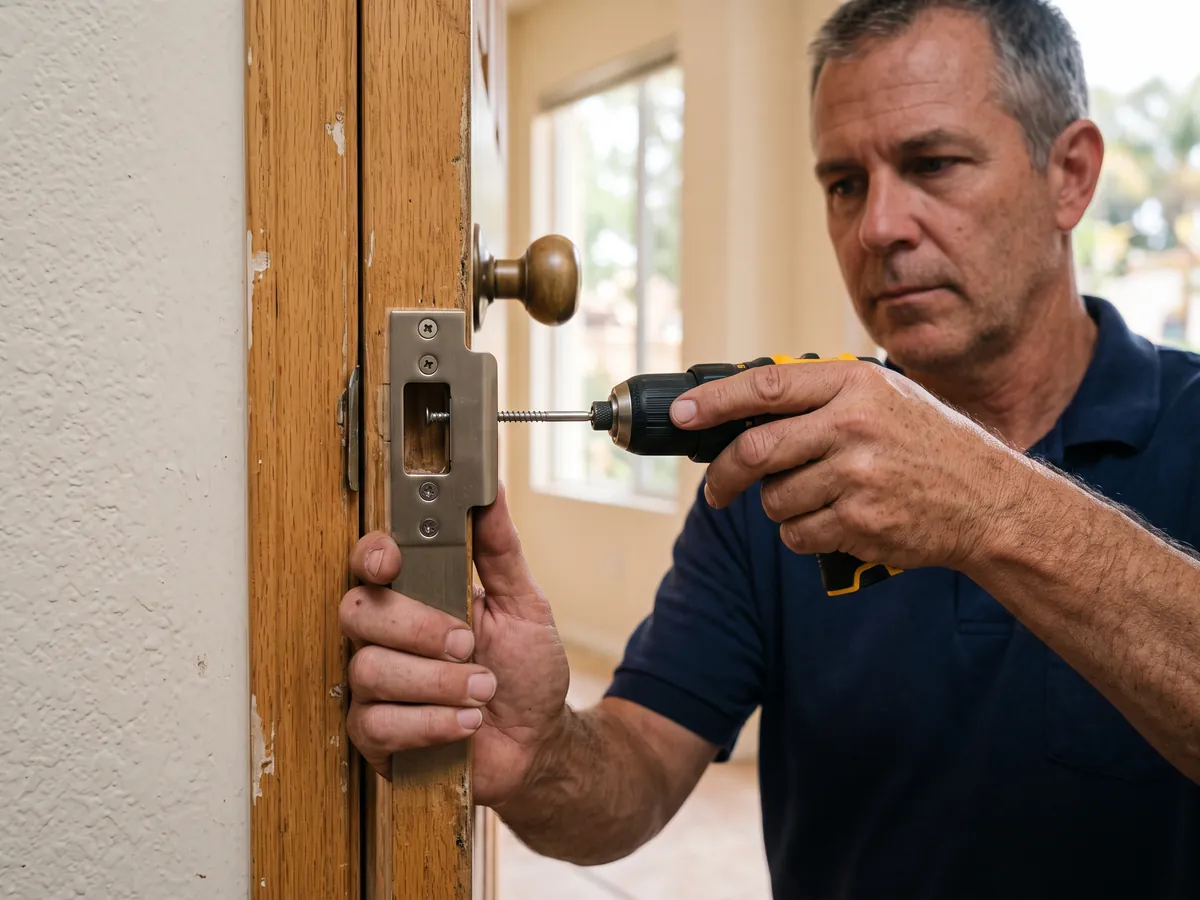
What a Deadbolt Does That a Knob Lock Can't
Most exterior doors close on a spring latch: the angled tongue in a knob or lever that snaps into its strike when you shut the door. It's convenient, and that convenience is its weakness. The bevel that lets it close by itself also lets it be pushed back. On cheaper knobs without a working deadlatch plunger, a thin strip of plastic slid between door and frame can retract it, and some keyed knobs can be twisted off with a pipe wrench to expose the mechanism.
A deadbolt works on a different principle. Its bolt is square-ended, moves only when someone turns the key or the inside thumbturn, and once fully extended it locks in position, so pressure on the end of the bolt won't drive it back into the door. That property is called deadlocking, and it's the reason the bolt has to travel its full distance. A bolt that stops a quarter inch short because it's hitting the bottom of a shallow strike pocket may never reach the point where it deadlocks.
Well-made deadbolts add several more defenses:
- A throw of about one inch, enough to reach well past the gap between door and jamb
- A hardened steel pin or roller inside the bolt that spins when a hacksaw blade hits it
- A cylinder housing or free-spinning collar that resists twisting with pliers or a wrench
- Hardened inserts that protect the cylinder's shear line from drilling
None of that matters if the bolt lands in half an inch of soft pine held by short screws. That's why most of this page is about what surrounds the lock rather than the lock itself.
Single Cylinder, Double Cylinder or One-Sided
Deadbolts come in three basic configurations, and the choice between them depends mostly on how the door is used and who might need to get out through it.
A single-cylinder deadbolt has a keyed cylinder outside and a thumbturn inside. It's the default for house entry doors for good reason: anyone indoors, including children, guests and a half-awake adult with a smoke alarm sounding, can open it without searching for a key.
A double-cylinder deadbolt has a key cylinder on both faces. The appeal is easy to understand. If a glass panel, sidelight or pet door sits within reach of the lock, a burglar who breaks the glass can't simply reach in and turn a knob. The cost is just as easy to understand: during an emergency, the door stays shut until somebody finds the key. Some households hang a key on a hook beside the door, which undercuts the whole idea if that hook can be reached through the same glass.
A one-sided deadbolt has a thumbturn inside and a blank plate outside, with no keyway at all. It suits a door you only ever lock from indoors, such as a side door used just for going out to the trash cans, a door from an attached garage, or a back door you never enter from outside. With nothing exposed on the exterior, there's nothing to pick, bump or drill.
For doors with glass near the lock, better answers than a keyed inside cylinder usually exist:
- Laminated glass or security film that holds together when struck
- A solid or reinforced sidelight in place of clear glass
- A replacement door with its glass set higher, out of reach of the thumbturn
Fire Egress: What California Codes Expect
Building and fire codes care less about how a door locks from outside than about how fast it opens from inside. For houses, California's residential code expects the required egress door to open from the inside without a key, tool, or special knowledge or effort. For apartments, condos and other residential units, the building code permits a deadbolt, night latch or security chain in addition to the regular latch only if it can be released from inside without a key or tool. A single-cylinder deadbolt satisfies both. A double-cylinder deadbolt on the door you'd use to escape does not, and it can be called out during rental inspections, permitted remodels or pre-sale inspections.
Commercial openings are stricter. An exit door generally has to open from the egress side with one motion and no key. A limited exception lets certain business, mercantile and similar occupancies use a key-operated lock on the main entrance, but only with a durable sign on or beside the door stating that it must remain unlocked while the building is occupied, and the building official can revoke that allowance. Back doors and other required exits don't qualify for it.
Two more rules shape commercial deadbolt choices:
- Accessibility. Hardware on many commercial doors must work with one hand and without tight grasping, pinching or twisting of the wrist, which affects the style of inside turn piece
- Fire-rated doors. Drilling a labeled door beyond its factory preparation can compromise the rating, so holes and hardware must match what the label permits
Enforcement details vary between cities and fire districts. When a particular door's status isn't clear, the local building or fire department has the final word, and we'd rather you ask them before installing than after.
Grades 1, 2 and 3: What the Ratings Mean
The Builders Hardware Manufacturers Association (BHMA) publishes ANSI standards for door hardware and certifies products tested against them. For deadbolts, the result is a grade:
- Grade 1. The heaviest tier, intended for commercial buildings and high-abuse doors, with the most demanding cycle, strength and impact tests
- Grade 2. Solid residential and light commercial hardware, a sensible floor for most house entry doors
- Grade 3. Basic residential hardware, common in builder packages and appropriate for interior doors and low-risk openings
The tests simulate years of daily use and several kinds of attack: repeated lock-and-unlock cycles, force against the end of the bolt, blows to the door near the lock, and torque applied to the cylinder. Higher grades have to survive more of each.
You may also see a three-letter rating instead of, or alongside, a grade. BHMA's residential standard scores security, durability and finish separately, each from A at the top to C. A lock rated AAA earned the best mark in all three categories; one labeled BBA, for instance, sits in the middle for security and durability but has an excellent finish.
High-security cylinders have an additional benchmark. A UL 437 listing covers resistance to picking, drilling and other forms of attack, and brands such as Medeco, Mul-T-Lock and Schlage Primus pair that resistance with patented or restricted keys that can only be duplicated through authorized channels.
Read the back of the package, not the front. Phrases like heavy duty and maximum security are marketing copy. The grade or rating describes what was actually tested, and it's the first thing we look at before recommending a deadbolt for a particular door.
The Strike and Frame: Where Doors Actually Fail
Think through what happens when someone kicks a locked door. The force lands near the lock, the door swings inward against its stop, and the bolt presses hard on the inner edge of the strike pocket. The steel bolt seldom bends. The jamb around it is usually pine or finger-jointed softwood about three quarters of an inch thick, and the strike plate is often held by screws barely longer than that. Behind the jamb sits a shim gap, then the doubled 2x4 framing of the wall opening. If nothing ties the strike to that framing, the jamb splits along its grain and the door swings open with the bolt still extended.
That's why reinforcement is the heart of a deadbolt installation rather than an optional extra. The options, from basic to thorough:
- Long screws. Replacing the strike's short screws with 3-inch screws that pass through the jamb and shim space into the stud
- Heavier strike. A thicker plate with four screw holes, set flush in a mortise, often with a deep metal box behind the bolt hole
- Jamb reinforcement. A steel strip several feet long that spreads impact across a long section of jamb
- Door-edge wrap. A U-shaped plate around the door's edge at the bore that stops the door itself from splitting through the lock holes
- Hinge-side screws. At least one long screw per hinge so the door can't be forced from its opposite edge
One caution about long screws. Driving them hard draws the jamb toward the stud, which narrows the gap at the latch side and can make the door rub or the bolt miss. Done properly, they're snugged rather than cranked, with a shim added behind the strike where the space is wide.
Door Prep: Bores, Backset, Thickness and Spacing
Most residential deadbolts sold in the US share a common door preparation, which is what makes it possible to swap one brand for another:
- Face bore, also called the cross bore. A 2-1/8-inch hole through the door
- Edge bore. A 1-inch hole from the door's edge into the face bore
- Backset. The distance from the door edge to the center of the face bore, usually 2-3/8 inch on many doors and 2-3/4 inch on many entry doors
- Door thickness. Standard deadbolts fit doors roughly 1-3/8 to 1-3/4 inch thick, while thicker custom doors need extended tailpieces or thick-door kits
Most current deadbolts include an adjustable bolt that sets to either backset, but some decorative and high-security models are fixed, so measuring before buying saves a return trip.
On a new door, we clamp a boring jig at the marked height so both holes come out square and centered. The face hole is cut halfway from each side, which keeps veneer and paint from tearing out around the rim. The edge hole is drilled level until it meets the face bore. Then the faceplate recess is cut flush with a chisel or router template, although some deadbolts use a round drive-in bolt that skips the mortise entirely.
Spacing above an existing knob or lever is typically about 5-1/2 inches center to center. Handlesets set their own spacing, though, and that dimension rules if you plan to add one later. We also check the inside of the door: the deadbolt's interior assembly needs clearance from the knob's rose, and glass lites, raised panels or narrow stiles can limit where the holes are able to go.
Wood, Steel, Fiberglass and Hollow Doors
What a door is made of determines how we drill it and how much the finished deadbolt can resist.
Solid wood doors, including the fir and oak doors found on many older homes, bore cleanly and hold screws well. Watch for decorative panels near the lock rail and for doors patched after earlier hardware was removed, since wood filler doesn't carry load the way wood does.
Steel doors have a thin steel skin over a foam core, with a wooden or steel lock block running inside the lock edge. Drilling outside that block leaves the deadbolt anchored in foam. Many prehung steel doors arrive pre-bored for a deadbolt, which is the best case. On undrilled steel doors, we locate the block before cutting and use bits made for sheet metal.
Fiberglass doors behave much like steel ones, with a composite skin over foam and wood or composite edges. They stay stable in heat and resist dents, but the skin chips if it's bored with a dull hole saw.
Hollow-core doors deserve an honest answer. They have a thin perimeter frame with cardboard honeycomb inside. A deadbolt can be mounted with a reinforcing plate, but a determined kick goes straight through the face. On a door that leads outdoors or into a garage, swapping in a solid door is the real fix, and we'll say so rather than sell you hardware the door can't support.
Metal frames change the strike side of the job. Hollow-metal frames on commercial buildings and some condo complexes need strikes made for steel, and a frame filled with grout or concrete calls for different drilling than an empty one. We check the frame type before cutting anything.
Alignment, Heat and Doors That Move
A deadbolt that's hard to turn is rarely a defective lock. Usually the bolt and the strike pocket simply don't line up anymore. Common causes:
- Loose hinge screws letting the door sag toward the floor on the latch side
- Wood framing shifting as a house settles, especially on expansive clay soils
- New weatherstripping pushing the door away from its stop
- Heat expanding dark steel doors or swelling wood ones
- Strong Santa Ana winds pressing on and racking doors on exposed sides of a house
To diagnose, we test the bolt with the door open and then closed. If it turns freely open but drags closed, the problem is at the strike. A little marker or lipstick on the end of the bolt, thrown against the closed jamb, shows exactly where it hits. The fix depends on the cause: tightening or replacing hinge screws with longer ones to lift the door, shimming a hinge, relocating or enlarging the strike pocket, or adjusting the door stop.
Filing the strike opening wider is a popular shortcut, but overdone it leaves the bolt with very little to bear against. Moving the strike is often the better repair.
In Inland Empire heat, a west-facing door can behave differently at 4 p.m. than at 7 a.m. We test alignment with that in mind, sometimes checking again after the sun has been on the door, and leave enough clearance for the bolt to work through the seasons without being so loose that the door rattles in its frame.
Double Doors, Garage Entries, Screen Doors and Storefronts
Some openings need more than a standard single-door install.
French doors and double entries. The deadbolt mounts on the active leaf and throws into the edge of the inactive leaf. That inactive leaf has to be held firmly by flush bolts at the top and bottom, ideally long enough to engage the head jamb and the threshold or floor. Short or worn flush bolts let both doors push open together, regardless of the deadbolt on the active side.
Garage-to-house doors. These are often solid or fire-rated doors fitted with self-closing hinges or a closer. Adding a deadbolt is reasonable, but the door must still close and latch on its own afterward, and drilling should follow the door maker's guidance, especially if a fire label is fixed to the hinge edge.
Security screen doors. Common throughout Southern California, they hang just a few inches outside the main door. A new deadbolt or handleset with bulky exterior trim can strike the screen door's lock box or frame. We check the gap before choosing hardware and can rekey the screen door's lock to match the new deadbolt.
Aluminum storefronts. Narrow-stile glass doors use their own narrow-backset deadlocks, often with a hookbolt that swings up into the frame. A residential deadbolt won't fit or perform there, so we use hardware designed for that door.
Casitas and accessory dwelling units. ADUs add another exterior door to secure. Keying its deadbolt to match the main house simplifies life for a family, while a separate key makes more sense when the unit is rented to someone outside the household.
Deadbolts in Rental Property
California Civil Code section 1941.3 requires landlords to install and maintain an operable deadbolt on each main swinging entry door of a dwelling unit. When locked, the bolt must extend at least 13/16 of an inch beyond the strike edge of the door and into the jamb, and the lock must comply with state and local codes, including fire safety and accessibility. The same section also covers security or locking devices on windows designed to be opened, and locking mechanisms on exterior doors that lead into common areas of multifamily buildings.
In practice, owners should check entry deadbolts at every turnover:
- The bolt throws fully and doesn't drag on the strike
- The strike is intact and anchored, especially after lost keys or a forced door
- The inside operates with a thumbturn, never a double cylinder on the main entry
- Keys from the previous tenant no longer work
Tenants have a role too. The statute makes the tenant responsible for notifying the owner when a required lock doesn't work, and putting that notice in writing creates a record. Tenants who want to add or change a deadbolt themselves should get the landlord's written permission first and follow the lease on providing keys.
For multi-unit buildings, we install deadbolts keyed individually, keyed alike within a unit, or fitted into a master key system so management can enter when the law and lease allow. Separate state rules give tenants protected by certain court orders or police reports the right to have locks changed within 24 hours of a request, and we handle those calls with the same care.
Cost Factors, Scheduling and Where We Work
Every deadbolt job is priced on what the door actually needs, and you get the price before we drill. The main factors:
- Door prep. Fitting into existing holes versus boring a blank door
- Hardware. Grade 3, 2 or 1, smart or keypad, or high-security with restricted keys, whether we supply it or you do
- Reinforcement. A long-screw strike alone, or a full jamb, door-edge and hinge package
- Material and condition. Steel, fiberglass, thick custom doors, metal frames, or repairs to old damage
- Keying. Matching existing keys, rekeying other doors, or fitting a master key system
- Scale. One door, every exterior door, or a group of rental units in one visit
Julian's Locksmith is a mobile service based in San Bernardino, licensed by the California Bureau of Security and Investigative Services under license LCO7891, which you can look up at search.dca.ca.gov. We work across the Inland Empire, the San Gabriel Valley, the Pomona Valley, north Orange County and southeast Los Angeles County, bringing drilling jigs, reinforcement hardware and a range of deadbolts to the door.
Our hours are every day, Sunday through Saturday, 6:30 a.m. to 11:30 p.m. Weekends are included. Most deadbolt work is scheduled ahead, but if a break-in has left a door unsecured, mention it when you call and we'll give you an honest ETA. For rentals and businesses, we ask that the person approving the work owns or manages the property. Call (951) 903-3193 to describe your door and get a quote.
Frequently asked questions
Is it worth adding a deadbolt if my door already has a keyed knob?
Yes. A keyed knob relies on a spring latch, which can be pushed back with a thin tool or forced with modest pressure, and the knob itself can sometimes be wrenched off. A deadbolt's square bolt locks in place once extended and can't be pushed back from its end. Add a reinforced strike with long screws, and the door becomes far harder to force. On an exterior door, a knob shouldn't be the only lock.
How far should a deadbolt's bolt extend?
Most quality deadbolts throw about one inch. California law requires rental entry deadbolts to extend at least 13/16 of an inch beyond the strike edge of the door into the jamb. Beyond the number, the bolt has to reach its full extension with the door closed. If a shallow strike pocket or misalignment blocks it, the bolt may not deadlock, and that's a weakness even with excellent hardware.
Can I use a double-cylinder deadbolt on a door with glass?
You can install one, but think hard about which door it goes on. California codes expect a home's main exit door to open from inside without a key, and residential units may only add locks that release from inside without one. For a door with glass near the lock, security film, laminated glass or a reinforced sidelight paired with a single-cylinder deadbolt is usually the safer approach. Check local requirements before you decide.
Do I need a permit to install a deadbolt?
Adding or replacing a deadbolt on a house door generally doesn't involve a permit. Changes to commercial exit doors, fire-rated door assemblies or access control systems can bring in the building or fire department, depending on the city and the scope of the work. If you're unsure, call your local building department. We'll also point out when a door's role or label might trigger extra requirements before we start.
What's the difference between a deadbolt and a deadlatch?
A deadlatch is a spring latch with a small extra plunger beside it. With the door closed, the strike holds that plunger in, which blocks the latch from being pushed back with a card. It still locks automatically when the door shuts. A deadbolt has to be thrown deliberately with a key or thumbturn, but it's longer, stronger and much more resistant to force. Many exterior doors benefit from having both.
Can a deadbolt be installed in a metal door frame?
Yes. Hollow-metal frames need strikes made for steel, and the strike pocket is cut with metal-cutting tools rather than a spade bit. If the frame has been filled with grout or concrete, drilling takes longer and may call for masonry bits. We check the frame before quoting, since steel frames are stronger than wood but less forgiving if the strike ends up in the wrong place.
How can I tell what grade my current deadbolt is?
Look for the original packaging or the model number, which is sometimes stamped on the bolt faceplate or printed inside the interior trim. Searching that model on the manufacturer's website usually shows the BHMA grade or residential rating. Hardware installed by a builder is often Grade 3. If you can't find any markings, we can look at the lock's construction and tell you whether it's worth upgrading.
Should all my exterior deadbolts use the same key?
For most homes, yes. Keying every exterior deadbolt alike means one key on your ring and fewer copies to keep track of. Exceptions include a rented ADU, a room you want kept separate, or a business where some staff shouldn't open every door. For those, we can key doors separately or set up a master key system, where one key opens everything and each individual key opens only its own doors.
Deadbolt Installation by city
Local details, routes and answers for deadbolt installation in each city we cover across four counties.
San Bernardino County
Riverside County
Los Angeles County
- Rosemead
- San Gabriel
- Temple City
- Arcadia
- Sierra Madre
- Monrovia
- Duarte
- Bradbury
- El Monte
- South El Monte
- Baldwin Park
- West Covina
- Covina
- Azusa
- Irwindale
- Glendora
- San Dimas
- La Verne
- Pomona
- Claremont
- Diamond Bar
- Walnut
- La Puente
- City of Industry
- Hacienda Heights
- Rowland Heights
- Avocado Heights
- Charter Oak
- Valinda
- West Puente Valley
- South San Gabriel
- East San Gabriel
- North El Monte
- Citrus
- La Habra Heights
- La Mirada
- Cerritos
- Artesia
- Hawaiian Gardens
- Lakewood
- Bellflower
- Norwalk
- Downey
- Pico Rivera
- Whittier
- Santa Fe Springs