
Cypress, Orange County
Deadbolt Installation in Cypress
Short answer: A proper deadbolt installation in Cypress is more than mounting a lock. Julian's Locksmith bores or adapts the door, sets the bolt so it throws its full inch into the jamb, and swaps the short strike screws for 3-inch screws that reach the wall stud. We come to you and quote before drilling. Call (951) 903-3193 to schedule a visit.
Walk down a lock aisle and every deadbolt looks about the same through the plastic. The differences are inside: bolt material, length of throw, the cylinder's pin count and drill protection, and the BHMA grade printed in small type on the back of the box. For homes in Cypress, we usually steer front doors toward Grade 1 or a strong Grade 2 and save lighter hardware for sheds and interior rooms. Julian's Locksmith installs Schlage, Kwikset, Yale and Baldwin deadbolts for everyday jobs and can source Medeco or Mul-T-Lock when you want restricted keys. We'll match the finish of your existing knob and key the new deadbolt to your current key if you like. Call (951) 903-3193 for a recommendation.
A deadbolt is the lock that keeps a door shut, and plenty of Cypress doors have a weaker setup than owners think. Garage entry doors and kitchen doors facing the side yard often have only a spring-latch knob, so a credit card or a screwdriver is enough. A deadbolt adds a hardened steel bolt that extends at least an inch into the frame. First decide between single and double cylinder. A single-cylinder deadbolt turns by hand inside, which is safest for fire egress. A double-cylinder deadbolt needs a key on both sides and is worth considering only where glass sits next to the lock, and then only if you keep a key near the door and your fire marshal or building department allows it. We usually recommend single-cylinder for homes. Also decide grade. Grade 1 is the toughest, Grade 2 is a solid residential choice and Grade 3 is entry level. Whichever you pick, a reinforced strike plate with screws that reach the framing makes the difference. We check door thickness, since some older doors are thinner than the standard 1-3/4 inches, and finish by testing that the bolt throws fully.
How this works in Cypress
BHMA, the Builders Hardware Manufacturers Association, tests deadbolts under ANSI standards and sorts them into three grades. Grade 1 is the toughest, built for heavy commercial use and high-abuse entry doors. Grade 2 covers solid residential and light commercial hardware. Grade 3 is the basic tier often found in builder packages. The tests look at how many lock and unlock cycles a deadbolt survives and how it holds up to pressure on the bolt end, impact near the lock and twisting at the cylinder. Some packaging now shows a three-letter residential rating instead, scoring security, durability and finish separately from A to C. Grade matters, but it isn't the whole story. A Grade 1 deadbolt screwed to a jamb with short screws still fails at the frame. Meanwhile, a well-installed Grade 2 lock with a reinforced strike makes a strong front door for most homes in Cypress. We use Grade 3 mostly on interior doors, closets and storage rooms. When you want key control on top of strength, we move up to restricted keyways from Medeco, Mul-T-Lock or Schlage Primus, where copies come only through an authorized source.
How we can help in Cypress
- Adding a deadbolt above an existing knob or lever. Before we bore above a lever or knob, we check three things: whether the stile is wide enough for a second set of holes, whether a glass panel or decorative molding is in the way, and whether a security screen door outside will clear the new cylinder. Then layout, boring and mounting all happen in the same visit.
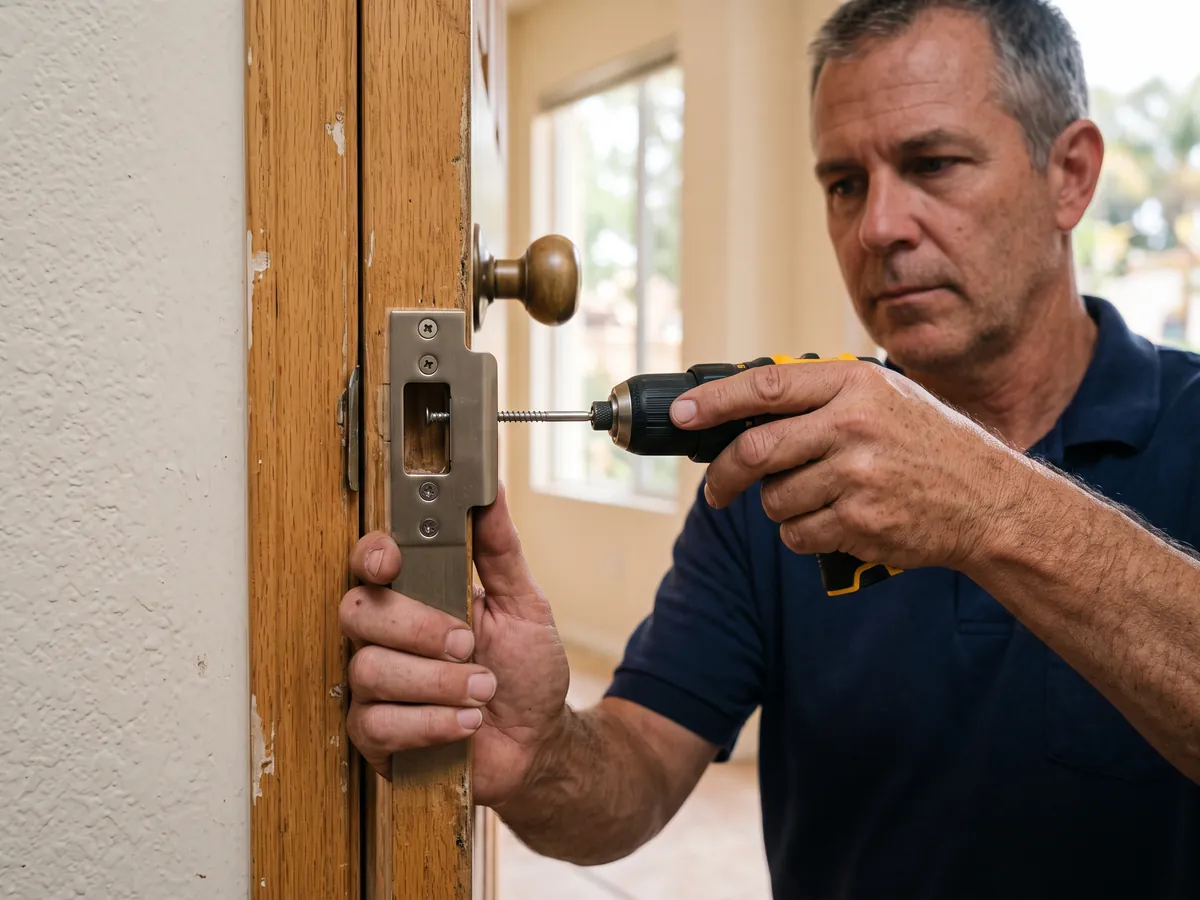
- Reinforced strike plates with 3-inch screws. Short screws are the weak point on almost every residential door. Our standard install pairs a reinforced strike plate with screws long enough to reach framing behind the jamb. We pilot each hole so the softwood doesn't split, and tighten only to snug so the frame isn't pulled out of plane and the door still closes freely.
- Double-cylinder and one-sided deadbolts, with an egress check. We install double-cylinder deadbolts where they make sense, such as a secondary door with glass beside it that isn't the home's required exit. Before we do, we explain the fire-safety trade-off and California's egress expectations, and talk through where a key should live so it's always reachable from inside but never through the glass.
- Keyed alike to your existing keys. A new deadbolt shouldn't mean another key on the ring. We rekey its cylinder to match your current house key, or rekey everything to a fresh key if the old ones have been floating around for years. Schlage, Kwikset, Yale and Baldwin use different keyways, so we choose hardware that can actually share your key.
- Fixing deadbolts that drag or won't fully throw. Afternoon sun on a dark steel door or seasonal swelling in a wood one can push the bolt out of line for part of the day. We test the lock at several points in the door's swing and set clearances so it works on a cool morning and in late-afternoon heat, rather than tuning it for one moment.
Local factors in Cypress
Apartment owners in Cypress must provide a working deadbolt on each unit's main entry door, with a bolt that extends at least 13/16 inch beyond the door edge under California law. We install compliant deadbolts, key them per unit or under a master system, and reinforce strikes on doors that have taken years of abuse. Inside operation stays keyless, which keeps residents in line with egress rules and keeps maintenance staff out of fire-safety trouble.
Student rentals near Cypress High School see frequent turnover and plenty of key copies drifting around. Landlords benefit from deadbolts that rekey quickly between leases, whether SmartKey models or standard pin-tumbler locks, plus reinforced strikes that survive rough use. Students in shared houses sometimes want deadbolts on their own bedroom doors; that needs the owner's approval, and we install those as single-cylinder locks so nobody can be keyed inside a room.
In family neighborhoods around Cypress, single-cylinder deadbolts are almost always the right call, because everyone, including kids, guests and grandparents, needs a fast way out in an emergency. We install Grade 1 or 2 deadbolts with reinforced strikes, key them to match your other doors, and set the bolt to turn easily so older children can operate it without a struggle during a fire drill or a real alarm.
Common situations
A homeowner in College Park realizes his kitchen door, which opens to the driveway, has only a knob lock. The door is metal-clad and 1-3/4 inches thick. We bore it for a single-cylinder Schlage deadbolt, install a strike plate with 3-inch screws into the stud, and key it to match the front door. The same key now works on both doors, and the kitchen door finally has real security.
- A typical example: a dark-painted steel front door facing west locks easily at breakfast, but by late afternoon the bolt drags and the key won't turn unless you lean on the door. The sun has bowed the panel slightly toward the stop. We'd enlarge the strike pocket just enough, lift the door with a long screw in the top hinge, and test the lock again with the door both warm and cool.
- For example, the door from an attached garage into a kitchen is a solid steel unit with spring hinges that pull it shut, and it has only a knob. The owner wants a deadbolt. We'd check the hinge edge for a fire-rating label, follow the door maker's prep guidance, install a one-sided or single-cylinder deadbolt, and confirm the door still swings closed and latches on its own afterward.
- A typical request from an older homeowner in Old Cypress: arthritis makes pinching the small, flat thumbturn on the deadbolt painful. We'd replace it with a deadbolt that has a broader, easier interior turn piece, or a keypad deadbolt that locks with a single button press. We'd also make sure the bolt slides freely, since a binding bolt is harder on stiff hands than any knob could be.
How the visit works
- Tell us about the door. Call (951) 903-3193 and describe the door: wood, steel or fiberglass, whether it already has a deadbolt hole, and what hardware is on it now. A photo of the door edge and the inside face helps us bring the right jig, bits and deadbolt the first time.
- Assess the door, frame and options. On arrival we check for solid material around the lock area, look at the jamb for splits or old repairs, and watch how the door sits in its frame. Then we lay out the choices: single or double cylinder, Grade 1 or 2, and how much strike reinforcement the frame needs. You get a firm price before drilling.
- Prepare the door. Steel and fiberglass doors get extra care. We locate the internal lock block, use bits suited to metal or composite skins, and keep the foam core sealed. On wood, we score the veneer and bore from both faces so the hole stays crisp on the inside and outside of the door.
- Reinforce the strike and jamb. We mark the strike by throwing the bolt against the closed jamb, drill the bolt pocket deep enough for full extension, and mortise a reinforced strike flush. Then 3-inch screws go through the jamb and shim gap into the stud, tightened just enough to hold without pulling the frame.
- Mount, key and align. Before the trim screws are tightened, we center the cylinder so the tailpiece isn't pinched, the most common cause of a stiff key on a new install. We rekey or reset the cylinder to match your other locks, then check that both the key and thumbturn throw the bolt all the way.
- Test and hand over. The visit ends with a clean work area, keys counted into your hand, and the old hardware left with you if you want it. If you bought a high-security deadbolt, we also go over the key card or authorization that controls who can order future copies.
Pricing factors
- How much strike and frame reinforcement. Reinforcement scales with the door's risk. A back door hidden from the street, or a side door facing an alley, may justify a full jamb kit, while a front door on a busy cul-de-sac may need only the upgraded strike. We put those options and their costs side by side so you can choose.
- Keying and number of keys. If the deadbolt you choose uses a different keyway from your other locks, matching them may mean rekeying or replacing additional cylinders. We point out that trade-off before you buy hardware, so the convenience of a single key doesn't turn into an unexpected expense on the day.
- Number of doors and scheduling. Doing several doors in one visit is more efficient than separate trips, so a whole-house deadbolt upgrade often works out to less per door than one-off installs. Travel distance from our San Bernardino base also factors in, and you see the total before work begins.
Every job gets a clear quote before any work starts. Call (951) 903-3193 with the details and we'll tell you what to expect for your situation in Cypress.
Mistakes to avoid
- Forcing a binding deadbolt by pushing or lifting the door every time you lock it. That strains the tailpiece and cam until something snaps. A bolt that binds is telling you the door and strike are misaligned, and the alignment is what needs fixing.
- Choosing a deadbolt by finish and style alone. A handsome deadbolt can hide a light Grade 3 mechanism. For an exterior door, check the grade or residential rating first, then pick a finish from the hardware that meets the standard your door needs.
- Installing a deadbolt in a hollow-core door and assuming the job is done. These doors have only a thin wood frame around the edge, and a kick can split the skin around the lock. On an exterior or garage-entry opening, a solid door is the better investment.
Practical tips before you call
- Check how far your deadbolt actually throws. Open the door, turn the thumbturn, and look at the bolt sticking out of the door edge. A good deadbolt extends about an inch. If yours shows much less, or stops short when the door is closed, it isn't giving you the protection you're counting on.
- Don't ignore the hinge side of the door. A door that's strong at the deadbolt can still be forced at the hinges if they're held by short screws. Replace one screw in each hinge, ideally the one nearest the door stop, with a 3-inch screw that reaches the framing behind the jamb.
- Lubricate with dry graphite or a lock-specific lubricant, not a general-purpose oil spray. In the dusty, windy conditions common around Cypress, oily lubricants collect grit that turns into paste inside the cylinder and bolt, which slowly makes the key harder to turn.
- If you have a security screen door, check how much space sits between it and the main door before buying a new deadbolt or handleset. Bulky exterior trim can hit the screen door's frame or lock box, which is far easier to plan around than to correct after the holes are drilled.
Getting to Cypress
Cypress is about 63 miles from our San Bernardino base, roughly 68 minutes in light traffic via I-215 South through Colton and Grand Terrace to SR-91 West through Riverside, Corona and the Santa Ana Canyon. When you call, you get an arrival estimate based on where the technician is and the traffic at that moment.
Commercial jobs on busy stretches like SR-91 sometimes need a parking plan, especially for storefront doors or roll-up gates. Let us know about loading zones, red curbs or parking structures before we arrive.
About Cypress: Landowner S.O. Walker laid out a Cypress townsite in 1905 beside the Pacific Electric trolley line, whose station stood on Walker Street at Lincoln Avenue.
| Neighborhoods | Veterans Park area, Heroes Park area off San Rolando Circle, Oak Knoll Park neighborhood, Larwin Park area off Ball Road, Katella Avenue corridor and Race Course district, Old Cypress |
|---|---|
| ZIP codes | 90630, 90720 |
| Main routes | I-605, SR-91, SR-22, Katella Avenue |
| From our San Bernardino base | about 63 miles via I-215 South through Colton and Grand Terrace to SR-91 West through Riverside, Corona and the Santa Ana Canyon, then the Valley View Street exit and south into Cypress; alternate via SR-57 South to SR-22 West and the Valley View Street exit when the 91 is jammed |
New or replacement locks in Cypress?
Call (951) 903-3193 and tell us which doors and what kind of hardware you have in mind. If you already bought the lock, keep the box handy so we can check it fits the door, and we'll quote the install before any work starts.
Frequently asked questions
Can the new deadbolt use my existing house key?
Usually, yes. If the deadbolt shares the brand and keyway of your other locks, we rekey it to match. Kwikset SmartKey deadbolts can be reset to another Kwikset key in moments. If the brands differ, we may need to rekey or replace another cylinder to get everything on one key, and we'll explain those options before you buy.
Is a smart deadbolt as strong as a regular deadbolt?
It depends on the model. Many smart deadbolts, including the Schlage Encode and Yale Assure lines, publish a BHMA grade or residential rating, so compare those the same way you would for a mechanical deadbolt. The installation matters as much as the lock: a smart deadbolt still needs a reinforced strike, long screws and a bolt that throws fully.
Do you install deadbolts on steel and fiberglass doors?
Yes. Steel doors have a thin skin over foam with an internal lock block, and fiberglass doors need sharp bits to avoid chipping the skin. We locate the block, drill carefully and keep the core sealed. Many prehung steel and fiberglass doors come pre-bored for a deadbolt, which makes the install simpler and cleaner.
What's the difference between single- and double-cylinder deadbolts?
A single-cylinder deadbolt has a key outside and a thumbturn inside. A double-cylinder deadbolt needs a key on both sides. Single cylinders let anyone inside exit quickly. Double cylinders stop someone from reaching through nearby glass to turn the thumbturn, but they can trap people inside during an emergency if the key isn't right there.
Can I add a deadbolt to the door between my garage and house?
Usually, yes. That door is often solid or fire-rated and set up to close on its own. We check the hinge edge for a fire label, follow the manufacturer's prep guidance, and install a single-cylinder or one-sided deadbolt. Afterward, the door should still swing shut and latch by itself, and we test that before leaving.
How long does a deadbolt installation take?
Installing into a door that already has standard holes is a fairly short job once we're on site. Boring a new door, reinforcing the jamb, or working on steel or double doors takes longer, and a damaged frame adds more. We'll give you a realistic time estimate for your specific door in Cypress when you call (951) 903-3193 and describe what you have.
How far is Cypress from your base?
Cypress is about 63 miles from our San Bernardino base, roughly 68 minutes in light traffic. Arrival time depends on traffic and on the job the technician is finishing, so we give you an estimate on the phone before you commit.
Related services in Cypress
- Deadbolt Replacement in Cypress
- Double Cylinder Deadbolt Installation in Cypress
- Deadbolt Repair in Cypress
- Smart Deadbolt Installation in Cypress
- Lock Installation in Cypress
- Front Door Lock Installation in Cypress
- Security Lock Upgrade in Cypress
- High Security Locks in Cypress
- Lock Rekey in Cypress
- Locksmith for Rental Property in Cypress
Deadbolt Installation in nearby cities
- Deadbolt Installation in Los AlamitosOrange County
- Deadbolt Installation in Hawaiian GardensLos Angeles County
- Deadbolt Installation in La PalmaOrange County
- Deadbolt Installation in StantonOrange County
- Deadbolt Installation in Buena ParkOrange County
- Deadbolt Installation in CerritosLos Angeles County
- Deadbolt Installation in ArtesiaLos Angeles County
- Deadbolt Installation in Seal BeachOrange County