
Orange, Orange County
Deadbolt Installation in Orange
Short answer: A proper deadbolt installation in Orange is more than mounting a lock. Julian's Locksmith bores or adapts the door, sets the bolt so it throws its full inch into the jamb, and swaps the short strike screws for 3-inch screws that reach the wall stud. We come to you and quote before drilling. Call (951) 903-3193 to schedule a visit.
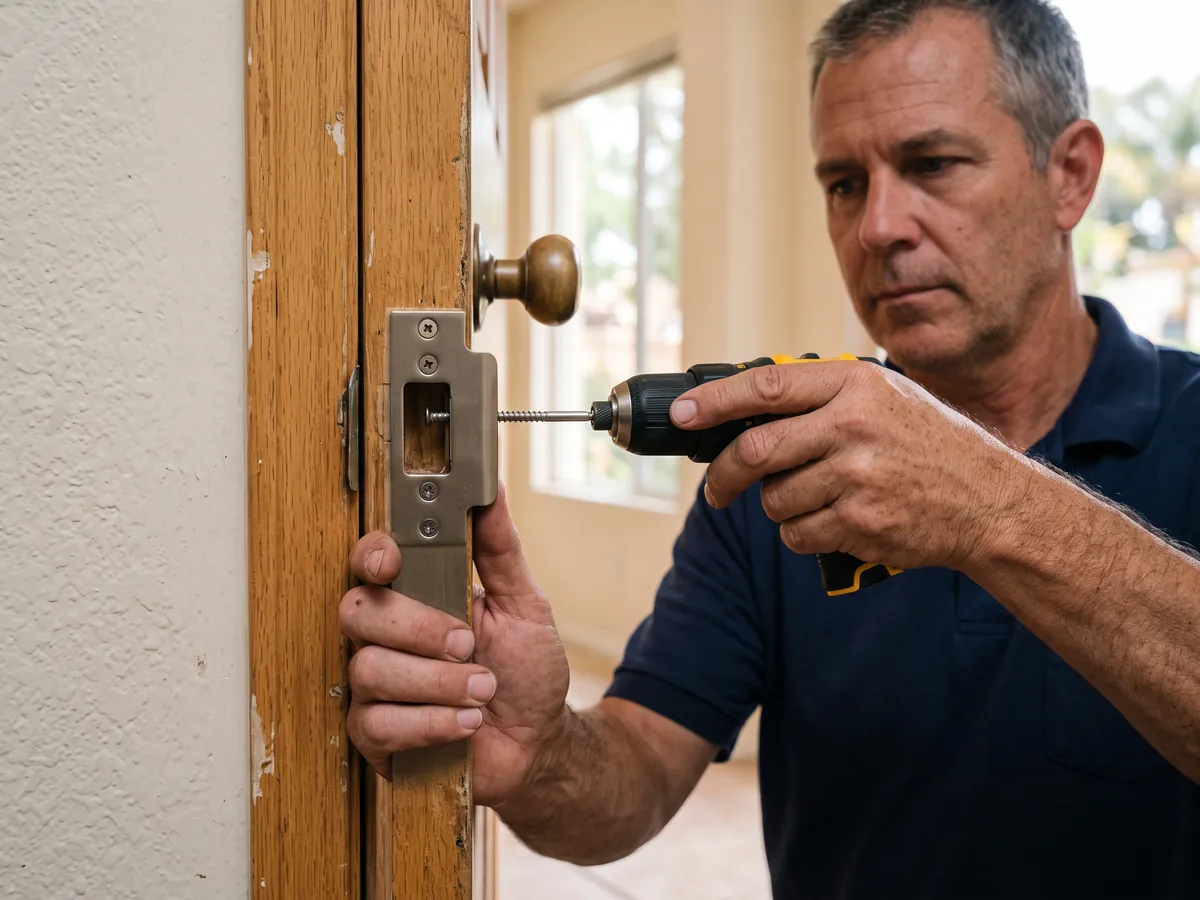
Deadbolt installation is usually something you plan, so we schedule it around your day. Julian's Locksmith works every day from 6:30 a.m. to 11:30 p.m., and we come to your Orange address with boring jigs, hole saws, chisels, long screws and a selection of hardware. A deadbolt going into existing holes takes a modest part of the visit. An undrilled door, a steel skin or a frame that needs repair adds time, and we'll tell you that up front. You get a written price before the first hole is drilled. If a recent break-in left you without a working lock, say so when you call so we can move you up the list. (951) 903-3193.
Deadbolt installation is about more than drilling a hole. A deadbolt is only as strong as the frame that holds it, and in Orange the frames vary. Old Towne's early-1900s doors often have jambs that have dried and checked for a century, so a deadbolt added in the 1980s may sit on a strike held by half-inch screws. Tracts from the 1950s have softer pine jambs that split under a kick. In Eichler homes, entry and atrium doors may be glass or have narrow stiles that limit the hardware. We choose between single-cylinder deadbolts, which use a thumbturn inside, and double-cylinder ones, which need a key on both sides. Double-cylinder locks make sense near glass, but they can trap you inside during a fire if the key is not at hand, so we explain the tradeoff before you choose. Grade 1 or Grade 2 bolts with a one-inch throw hold up best. A reinforced strike plate fastened with three-inch screws that bite into the framing does more for security than any brand name.
What to know first in Orange
BHMA, the Builders Hardware Manufacturers Association, tests deadbolts under ANSI standards and sorts them into three grades. Grade 1 is the toughest, built for heavy commercial use and high-abuse entry doors. Grade 2 covers solid residential and light commercial hardware. Grade 3 is the basic tier often found in builder packages. The tests look at how many lock and unlock cycles a deadbolt survives and how it holds up to pressure on the bolt end, impact near the lock and twisting at the cylinder. Some packaging now shows a three-letter residential rating instead, scoring security, durability and finish separately from A to C. Grade matters, but it isn't the whole story. A Grade 1 deadbolt screwed to a jamb with short screws still fails at the frame. Meanwhile, a well-installed Grade 2 lock with a reinforced strike makes a strong front door for most homes in Orange. We use Grade 3 mostly on interior doors, closets and storage rooms. When you want key control on top of strength, we move up to restricted keyways from Medeco, Mul-T-Lock or Schlage Primus, where copies come only through an authorized source.
Work included on a typical visit
- Deadbolt installation on an undrilled door. A blank door gets a full prep: a 2-1/8-inch face bore through the door, a 1-inch edge bore into the lock stile, and a shallow mortise so the bolt's faceplate sits flush. We clamp a boring jig to the door so both holes meet square, which keeps the tailpiece straight and the key turning smoothly for years.
- Adding a deadbolt above an existing knob or lever. Before we bore above a lever or knob, we check three things: whether the stile is wide enough for a second set of holes, whether a glass panel or decorative molding is in the way, and whether a security screen door outside will clear the new cylinder. Then layout, boring and mounting all happen in the same visit.
- Jamb, door-edge and hinge-side reinforcement. When a door has already been forced, or you simply want it built heavier, we add a steel jamb strip that spreads impact along several feet of frame, plus a wrap-around plate that encloses the door edge at the bore. On the hinge side, one long screw per hinge ties the leaf into framing so the door can't be pried from that edge.
- Grade 1 and high-security deadbolts. For front doors that need the strongest hardware, we install Grade 1 deadbolts with hardened bolts, heavier housings and drill-resistant cylinders. Commercial-weight models from Schlage, Sargent and Corbin Russwin suit offices and rentals, while residential Grade 1 options fit most homes in Orange without changing the look of your entry.
- Rental, multi-unit and small-business deadbolts. Property managers in Orange often need several units handled in one trip. We bring matching hardware, key each unit to its own key under a master if you use one, reinforce strikes on doors that have taken abuse, and leave the keys tagged. Incoming tenants get a deadbolt that works smoothly from day one.
What's different about Orange
Older homes in Orange often have solid wood doors that take a deadbolt well, but the hardware on them may date back decades: short-throw bolts, worn cylinders and strikes held by tiny screws. Some still rely on a lone knob or an original mortise lockset. We work with the door's existing holes where possible, avoid cutting into decorative panels, and fit a modern deadbolt with a full throw and a long-screw strike, matching period finishes where we can.
Shops along Santiago Canyon Road need deadbolts that handle constant daily use and comply with egress rules for customer and employee exits. We install Grade 1 deadbolts on back and side doors, narrow-backset deadlocks on aluminum storefront doors, and explain where a key-operated main entrance is allowed with the required posted sign. We can also key several doors alike for managers while keeping an owner's key separate.
Horse properties have tack rooms, feed rooms and barn offices holding saddles and equipment worth protecting. If those rooms have a standard swinging door, a deadbolt with a reinforced strike is a big improvement over a hasp and padlock that can be pried off. We install deadbolts suited to outbuilding doors, key them to your main property key if you like, and pick hardware with finishes that hold up to dust, hay and weather.
Common situations
A homeowner in a 1950s tract near Tustin Street has a side door with a small glass pane right beside the lock, and a thumbturn within arm's reach of that glass invites a break-in. We would talk through the options: a single-cylinder deadbolt placed away from the pane, a double-cylinder with the key kept nearby, or a security film on the glass. Whichever you pick, we install it with a one-inch throw and a reinforced strike.
- For example, picture a 1960s single-story home near Santiago Canyon College with a solid fir back door that has never had a deadbolt, just an old brass knob. We'd measure a 2-3/8-inch backset, bore above the knob with a jig, set a Grade 2 deadbolt keyed to the front door, and replace the strike's short screws with 3-inch ones that reach the stud. The homeowner ends up with one key for both doors and a back entry that finally locks properly.
- A typical request from an older homeowner in Olive Heights: arthritis makes pinching the small, flat thumbturn on the deadbolt painful. We'd replace it with a deadbolt that has a broader, easier interior turn piece, or a keypad deadbolt that locks with a single button press. We'd also make sure the bolt slides freely, since a binding bolt is harder on stiff hands than any knob could be.
- Picture a front entry with a steel security screen door outside the main door, a setup found all over Orange County. The owner wants a new deadbolt on the main door and the screen door keyed the same. We'd check the gap between the two doors so the new exterior cylinder and handle won't hit the screen door's lock box, rekey the screen door's lock to match, and test both closed together.
From your call to the finished job
- Tell us about the door. On the first call we ask what you want the deadbolt to do: replace a failed one, add one to a door with only a knob, or step up to Grade 1 after a scare. That answer, plus the door type, tells us which hardware to load and how much time to plan.
- Assess the door, frame and options. Before any tool touches the door, we look at the hinges, the gap on the latch side, the weatherstrip and whether the bolt will land in sound wood. If something needs fixing first, like a sagging hinge, we say so and price it separately, so the decision stays yours.
- Prepare the door. Steel and fiberglass doors get extra care. We locate the internal lock block, use bits suited to metal or composite skins, and keep the foam core sealed. On wood, we score the veneer and bore from both faces so the hole stays crisp on the inside and outside of the door.
- Reinforce the strike and jamb. The strike pocket needs to be deeper than the bolt's throw so the bolt never bottoms out. We cut it, set a box strike or heavy plate, and pilot-drill for the long screws. Where the shim gap is wide, a shim goes behind the strike so tightening doesn't bow the jamb.
- Mount, key and align. The bolt goes into the edge with the correct side facing up, the exterior cylinder and tailpiece pass through, and the interior turn piece is screwed on. We key the cylinder to your existing key or a new one, then test operation with the door open and again with it closed.
- Test and hand over. Before we leave, you try it yourself: key outside, thumbturn inside, door closed. We show you how to tell when the bolt is fully thrown and mention any related issues we noticed, like a worn knob latch or loose hinge, with no pressure to fix them today.
What affects the cost
- The deadbolt you choose. Grade, brand and features all move the price. A Grade 2 residential deadbolt costs less than a Grade 1 commercial unit, and Medeco or Mul-T-Lock cylinders with key control cost more again. Finish can matter too, since some specialty finishes cost more than the common satin nickel or bronze options.
- Door material, size and condition. Double doors, doors with glass near the lock, and fire-rated garage-entry doors each bring extra steps, from flush bolts to checking a fire label before drilling. These aren't surprises sprung on you at the door; we ask about them up front so the quote reflects the real job in Orange.
- Number of doors and scheduling. Apartment complexes and multi-unit buildings benefit from batching. We can install deadbolts in several units in one trip, with hardware bought together and keys cut on site. Tell us the number of doors when you call, and we'll quote the whole project instead of one lock at a time.
Every job gets a clear quote before any work starts. Call (951) 903-3193 with the details and we'll tell you what to expect for your situation in Orange.
Common errors that cost time and money
- Putting a double-cylinder deadbolt on the main exit door and keeping the key in a drawer across the room. In a fire, smoke and panic make finding a key hard, and California's egress rules expect a home's exit door to open from inside without one.
- Drilling freehand without a jig. A face bore that's slightly off-angle or an edge bore that drifts makes the bolt rub and the tailpiece twist. The lock works at first but wears quickly, and fixing a misdrilled hole often means a reinforcement plate or filler block.
- Ignoring the inactive leaf on double doors. The deadbolt on the active door throws into the stationary door's edge, so if that leaf is held by weak flush bolts, both doors can be pushed open together despite a strong deadbolt on the active side.
Practical tips before you call
- If there's glass within arm's reach of your thumbturn, deal with the glass before reaching for a double-cylinder deadbolt. Security film, laminated glass or a solid sidelight addresses the reach-through risk without putting a keyed lock between your family and the way out.
- Tenants: get written permission before adding or changing a deadbolt, and check whether your lease requires you to give the owner a key. California puts the duty to provide a working entry deadbolt on the landlord, so reporting a faulty one in writing is often the right first step.
- Don't ignore the hinge side of the door. A door that's strong at the deadbolt can still be forced at the hinges if they're held by short screws. Replace one screw in each hinge, ideally the one nearest the door stop, with a 3-inch screw that reaches the framing behind the jamb.
- If you have a security screen door, check how much space sits between it and the main door before buying a new deadbolt or handleset. Bulky exterior trim can hit the screen door's frame or lock box, which is far easier to plan around than to correct after the holes are drilled.
Reaching Orange
Orange is about 52 miles from our San Bernardino base, roughly 60 minutes in light traffic via I-215 South through Colton and Grand Terrace to SR-91 West. When you call, you get an arrival estimate based on where the technician is and the traffic at that moment.
Stuck on the shoulder or in a parking lot along I-5? Get somewhere safe, turn on your hazards, and give us the nearest exit or business so we can find the car without guessing.
About Orange: Orange was incorporated on April 6, 1888, and is the only city in Orange County planned around a central plaza, which earned it the nickname Plaza City.
| Neighborhoods | Orange Park Acres, North El Modena, Olive Heights, El Modena, Fairhills Eichler tract, Chapman University area |
|---|---|
| ZIP codes | 92865, 92866, 92867, 92868, 92869 |
| Main routes | I-5, SR-22, SR-55, SR-57 |
| From our San Bernardino base | about 52 miles via I-215 South through Colton and Grand Terrace to SR-91 West (Riverside Freeway) through Riverside, Corona and the Santa Ana Canyon, then SR-55 South (Costa Mesa Freeway) to the Chapman Avenue exit; west on Chapman Avenue for Old Towne and the Plaza, east on Chapman Avenue for El Modena, Santiago Canyon College and Orange Park Acres; alternate via I-10 West to SR-57 South and the Chapman Avenue exit for The City district, The Outlets at Orange and UCI Medical Center when the 91 is jammed |
New or replacement locks in Orange?
Call (951) 903-3193 and tell us which doors and what kind of hardware you have in mind. If you already bought the lock, keep the box handy so we can check it fits the door, and we'll quote the install before any work starts.
Frequently asked questions
Can I add a deadbolt to the door between my garage and house?
Usually, yes. That door is often solid or fire-rated and set up to close on its own. We check the hinge edge for a fire label, follow the manufacturer's prep guidance, and install a single-cylinder or one-sided deadbolt. Afterward, the door should still swing shut and latch by itself, and we test that before leaving.
Can I buy my own deadbolt and have you install it?
Yes. Pick up the hardware you like and we'll install it. We'll look at the box first and tell you if it's a weak choice for that door, such as a Grade 3 deadbolt on a front entry, or if it won't fit your door's thickness or backset. That check happens before any drilling.
Can you put a deadbolt on a door that has never had one?
Yes. We drill a 2-1/8-inch face hole and a 1-inch edge hole using a clamped jig, chisel a recess so the bolt's faceplate sits flush, and cut a strike pocket into the jamb. Before drilling, we confirm the door is solid enough to hold a deadbolt and that the location clears glass, panels and the existing knob.
Can you install deadbolts on French doors or double doors?
Yes. The deadbolt goes on the active door and throws into the edge of the stationary door. That stationary door must be secured with solid flush bolts at the top and bottom, or the pair can be pushed open together. We install or upgrade those flush bolts and fit the deadbolt with a strike designed for a door edge.
How much does deadbolt installation cost?
It depends on whether the door is already drilled, the deadbolt grade, how much strike reinforcement you want, the door material and your keying needs. We give you a quote before any drilling begins, and nothing is added without your approval. Call (951) 903-3193 with details about your door in Orange for a realistic range.
Why do I have to push or lift my door to lock the deadbolt?
The bolt and strike are out of alignment, often because of sagging hinges, a shifted frame, new weatherstripping or heat swelling the door. Forcing it wears out the tailpiece and cam. We diagnose the cause, adjust hinges or the strike, and set it so the key turns smoothly without any pressure on the door.
How far is Orange from your base?
Orange is about 52 miles from our San Bernardino base, roughly 60 minutes in light traffic. Arrival time depends on traffic and on the job the technician is finishing, so we give you an estimate on the phone before you commit.
Related services in Orange
Deadbolt Installation in nearby cities
- Deadbolt Installation in Villa ParkOrange County
- Deadbolt Installation in TustinOrange County
- Deadbolt Installation in Santa AnaOrange County
- Deadbolt Installation in AnaheimOrange County
- Deadbolt Installation in PlacentiaOrange County
- Deadbolt Installation in Yorba LindaOrange County
- Deadbolt Installation in FullertonOrange County
- Deadbolt Installation in Garden GroveOrange County