
Lock Rekeying
Lock Rekey: Re-Pinning Your Existing Locks to a New Key
Short answer: A lock rekey changes the key pins inside an existing cylinder so it works with a new key and rejects every old one. Julian's Locksmith performs rekeys on-site across the Inland Empire, the San Gabriel and Pomona valleys, north Orange County and southeast Los Angeles County, re-pinning residential and commercial cylinders, resetting SmartKey locks and rebuilding master key systems. We verify ownership and quote before any work begins.
What a Rekey Changes Inside the Lock
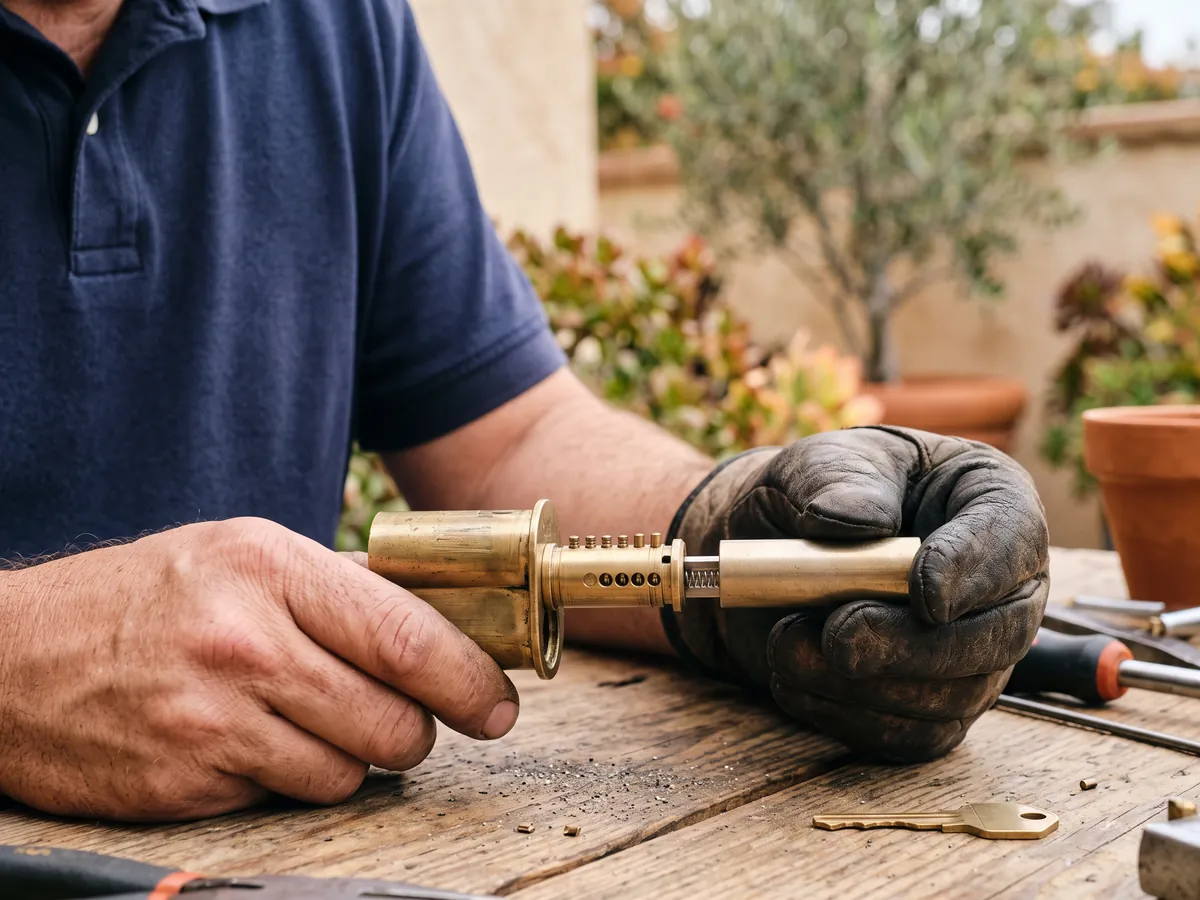
Take an ordinary deadbolt off a door and the part that matters for keys is a brass cylinder about the size of your thumb. Inside it, a rotating plug sits in a fixed shell. A row of vertical holes, usually five on residential hardware and six or seven on commercial, passes through the plug and up into the shell. Each hole holds a small stack of parts:
- A key pin, also called a bottom pin, which rides directly on the key's cuts
- A driver pin, or top pin, sitting above it
- A spring that presses the whole stack down toward the keyway
Without a key, the driver pins sit partly in the plug and partly in the shell, bridging the gap between them so the plug can't rotate. Slide in the correct key and each cut raises its stack to exactly the height where the top of the key pin meets the bottom of the driver right at that gap. Locksmiths call the gap the shear line. With every stack split at the shear line, the plug turns and its cam or tailpiece moves the bolt.
Rekeying swaps the key pins. Because each key pin is matched to one cut depth, replacing them with different lengths means a different key is now required to line everything up. The old key lifts the new pins to the wrong heights, at least one pin crosses the shear line, and the plug stays locked.
Nothing else about the lock changes. The bolt, latch, strike, handles, finish and door preparation are identical before and after. That's why a lock rekey is the first tool for regaining key control, and why it only makes sense when the rest of the hardware is in good working order.
Step by Step: How a Cylinder Gets Re-Pinned
Every rekey follows the same basic sequence, though the details shift with the hardware.
Removal comes first. On most deadbolts, two screws hold the interior thumbturn assembly; once it's off, the exterior cylinder and its tailpiece slide out. Many knobs and levers hide the cylinder behind the handle, which is released by depressing a small catch through a hole in the neck. Mortise locks use a threaded cylinder held in place by a set screw behind the faceplate. Rim cylinders, found on exit devices and night latches, are secured by two long screws from the inside.
On the bench, the retaining clip or cam comes off the back of the cylinder. With the existing key inserted to lift the stacks, the plug is pushed out by a plug follower, a short rod with the same diameter as the plug. The follower slides in behind the plug and keeps the drivers and springs captured in the shell. Without it, those parts spring loose and the job becomes a hunt across the floor.
Next, the old key pins are tipped into a tray and discarded. The new key goes into the plug, and pins are selected from a pinning kit whose lengths match each new cut. A correctly pinned plug shows every key pin flush with its top surface, with none standing proud and none sitting low.
Reassembly runs backward: the plug pushes the follower out, the clip or cam goes back on, and the cylinder is tried with the new key and the old one. Finally, it goes back into the door and gets tested again with the door closed, because a bolt dragging on the strike can masquerade as a pinning problem.
Reading Keys: Bitting, Depths and Gauges
A key's cuts are described by a bitting code, one number per pin position, read from the bow toward the tip on most brands. Each number stands for a specific depth. Kwikset's common five-pin keyway uses seven depths, while Schlage's uses ten, with smaller steps between them. Pins in a kit are numbered to match, so a cut at depth 4 gets a key pin labeled for depth 4.
To learn what a key is, we read it with a key gauge, a slotted plate showing which depth each cut reaches, or measure it with a caliper against the manufacturer's specifications. That matters in three situations:
- Keying a lock to a key you already carry, where we need the intended depths rather than the worn ones
- Cutting additional keys by code so every copy matches factory dimensions
- Rebuilding a master system when no chart survived, which starts with decoding whatever keys still exist
Keys wear in predictable ways. Peaks round off, cuts nearest the bow get shallower from repeated insertion, and a key that has hung on a heavy ring for years can be a full depth off in places. Pinning a lock to that worn key produces a cylinder that feels perfect with one key and fights every new copy.
Choosing a new bitting has rules too. Manufacturers publish a maximum adjacent cut specification, the largest difference allowed between neighboring cuts. Exceed it and the key gets a steep valley that binds on pins or cracks over time. We also avoid combinations that are nearly flat, that mirror the previous bitting, or that sit one depth away from another key in the same system, which could let one key open a door it shouldn't.
Keyways, Pin Counts and Why Brands Don't Mix
Before promising one key for every door, a locksmith looks at the keyway, the shaped slot in the face of the plug. The profile of the key blank has to match it, and different manufacturers use different profiles, pin spacing and depth tables. That's why a Kwikset key can't be pinned into a Schlage cylinder, no matter how the pins are arranged.
What a mixed house usually means in practice:
- Kwikset hardware, along with a number of store brands built around a Kwikset-compatible keyway, can share one key
- Schlage residential hardware can share a key with other Schlage cylinders
- Baldwin, Weiser, Yale and others follow their own standards, with occasional product lines that use a compatible cylinder
When brands are mixed, the options are simple and honest: carry two keys, swap the odd cylinder where the lock accepts one in a different keyway, or replace the odd lock so everything matches. Some product lines offer cylinders in alternate keyways and many don't, and we tell you which situation you're in before anything is ordered.
Pin count matters as well. Commercial hardware commonly uses six or seven pins to allow a larger number of distinct combinations, which becomes important in buildings with hundreds of keys. A system that mixes five-pin and six-pin cylinders has to be planned carefully so each key fits and operates only the cylinders it's meant to. We design around the cylinders actually installed instead of forcing a single key where it doesn't belong, and if a few locks need new cylinders to make the plan work, that shows up in the quote rather than as a surprise halfway through the job.
Master Pins: Two Keys, One Cylinder
A master keyed cylinder is pinned so that more than one key will turn it. The trick is a master pin, sometimes called a master wafer or spacer, placed between the key pin and the driver. It creates a second break in the stack. The change key, the one issued to a single tenant or office, lifts the stack so one break reaches the shear line. The master key lifts it to a different height where the other break lines up.
The sizing is arithmetic. On a hypothetical Schlage-style system, if a door's change key has a 3 cut in the first position and the master key has a 7, the key pin is sized for 3 and a master pin four increments thick sits on top of it. On brands with small depth steps, designers usually work in two-step increments so a key that's one step off can't slip through.
Master keying has a security cost. Every master pin adds a shear point, which gives a picker or a bump key more ways to succeed. In a simple system, someone holding a change key can also learn a surprising amount about the master. That's why we recommend removing master pins from cylinders that no longer need them.
During a rekey we can:
- Re-pin a cylinder to a new change key while keeping your existing master
- Remove all master pins so the door responds only to its own key
- Build a new hierarchy with a grand master, masters and change keys, documented on a keying chart
If the last manager walked off with the master key or the chart has vanished, re-pinning the whole system is the only way to be sure the old master no longer works anywhere.
Kwikset SmartKey and Other Tool-Reset Cylinders
Many tract homes built in the region over the past two decades came with Kwikset SmartKey hardware, so SmartKey resets are a routine part of rekeying here. SmartKey cylinders don't use the loose pin stacks described above. Instead, a row of small sliders reads the key and engages racks, and a sidebar holds the plug until the key presents the right combination. Because the parts are captive, the cylinder can be reset without disassembly:
- Insert the current working key and turn it a quarter turn clockwise
- Push the SmartKey tool firmly into the small hole beside the keyway, then remove it
- Pull the old key, insert the new key fully and turn it back
That convenience comes with failure modes. If the key isn't fully inserted, the tool isn't seated or the cylinder is turned the wrong way, the reset can stop partway, leaving a cylinder that no key turns. Keys cut with sloppy depths can teach the lock an inaccurate combination that later copies won't match. And without any working key, the tool method isn't available, so the cylinder has to be decoded, carefully disassembled or replaced.
Earlier SmartKey generations drew criticism for how they held up to forced turning, and later versions were redesigned. If a SmartKey shows signs of being forced, such as a loose face or a plug that spins freely, we recommend replacing the cylinder rather than resetting it.
Standard SmartKey hardware uses the ordinary Kwikset keyway, so a SmartKey deadbolt and a conventional Kwikset knob can be keyed alike. Kwikset's Halo smart locks use a SmartKey cylinder, and the Schlage Encode takes a conventional Schlage cylinder, so the backup keys on those smart locks can be matched to the rest of the house.
Commercial Cylinders: Mortise, Rim, Storefront and Interchangeable Core
Business doors carry hardware that rekeys well but punishes shortcuts.
Mortise cylinders thread into the lock body and are held by a set screw under the faceplate. The cam on the back is matched to the lock: an office mortise lock, an Adams Rite-style storefront deadlock and an exit device trim each need a particular cam, and it has to go back in the correct orientation. Reinstall a storefront cylinder a quarter turn off and the hookbolt may only partly throw, leaving a door that looks locked and isn't.
Rim cylinders mount on the outside of exit devices from makers like Von Duprin, and on night latches. A tailpiece reaches through the door into the device, and it has to be cut or set to the right length whenever a cylinder is swapped. Once removed, these re-pin like any other cylinder.
Interchangeable cores, common in schools, hospitals and multi-tenant buildings, put the entire pin chamber in a removable figure-eight core. A control key, cut to a separate shear line, releases the core from its housing. Rekeying means pinning a new core and swapping it in, which takes moments at the door. Small format cores fit a standard housing across many brands, while large format systems from Schlage, Sargent, Corbin Russwin and others are brand-specific. Losing the control key turns a quick swap into a picking or drilling job, so we always ask where it is.
Commercial work also comes with paperwork. We record which cylinders were re-pinned, which keys operate them and how many keys were issued, and keys can be stamped with identifiers. Where an electronic access system is involved, the keyed override cylinder is ours to rekey, while wiring and controller changes may need a low-voltage contractor.
When a Lock Can't or Shouldn't Be Rekeyed
Most cylinders can be re-pinned, but an honest locksmith turns down some rekeys and recommends something else instead.
- Worn or damaged cylinders. When pin chambers have gone oval, the plug has play in the shell or the cam is cracked, new pins won't sit consistently. A new cylinder or lock is the better fix.
- Break-in damage. A lock that was pried, drilled, hammered or twisted may still turn, but its internal parts are suspect. Rekeying it is false economy.
- Proprietary cylinders. Some inexpensive imported keypad and smart locks use cylinders with no published depths and no pins available to locksmiths. When the manufacturer sells a replacement cylinder, we can order it; when they don't, the lock gets replaced.
- Wafer locks. Many cabinet cam locks and low-cost mailbox and furniture locks use flat wafers rather than pins. Some can be rekeyed by rearranging wafers, but a new lock with a fresh key often costs less than the labor.
- Restricted high-security systems. Medeco, Mul-T-Lock, ASSA and similar systems use patented key blanks and features like sidebars or telescoping pins. They can be rekeyed, but blanks, cores and key orders are controlled through authorized dealers and registration records. We work within those controls rather than around them.
- Mechanical failures. A latch that sticks, a deadbolt that won't extend fully or a knob spindle that has sheared has nothing to do with pinning, and rekeying won't fix it.
In each case we explain what we found and what it means for cost before any parts are opened or ordered. Often the right answer is a mix: rekey the good cylinders, replace the one bad lock, and key the new one to match the rest.
Dust, Heat and What We Check While the Lock Is Open
A rekey is the one time a cylinder's insides are fully exposed, so it's the right moment for maintenance. Conditions across inland Southern California are hard on locks. Summer temperatures in the inland valleys regularly climb past 100 degrees, sun-facing doors get far hotter than the air around them, and Santa Ana winds push fine dust into every keyway. Closer to the coast, damp air slowly corrodes springs.
While the plug is out, we look for:
- Packed grit in the pin chambers and keyway, which we flush out
- Gummy residue from wet oils that trapped dust, which we clean away
- Springs that are rusted, shortened or weak, which we replace
- Chipped or mushroomed driver pins, which we swap
- Wear on the plug and shell, which tells us whether the cylinder has years of service left
After cleaning, we lubricate with graphite or a dry PTFE product. Wet sprays feel smooth at first but attract dust, and in hot weather they migrate and thicken.
Heat also changes how doors behave. Wood doors swell, metal doors and frames expand, and a deadbolt that throws easily in the morning can drag against the strike by afternoon. When a customer says the key sticks only on hot days, the cause is often alignment rather than the cylinder, so we check the strike before blaming the pins. Adjusting a strike plate or deepening the bolt hole is frequently all it takes.
Gate locks, padlocks and garage side doors face the worst conditions. We re-pin those with the same care as the front door, because a key that works everywhere except the side gate isn't much of a key system.
Verification, Records and California Rules
Rekeying decides who can enter a property, so authorization is part of the job. Before re-pinning anything, we check photo ID and proof that you live at or own the property: a deed, lease, property tax bill or utility bill showing the address. For businesses, the owner or a manager with authority approves the work. Tenants who want locks rekeyed need the landlord's written permission or a legal basis to act on their own.
Our work is governed by California's Locksmith Act (Business and Professions Code §6980 and following), which is administered by the Bureau of Security and Investigative Services. Julian's Locksmith holds locksmith company license LCO7891, and you can confirm it at search.dca.ca.gov before booking.
A few California rules come up often around rekeying:
- Civil Code §1941.3 requires landlords to provide working deadbolts on the main swinging entry doors of rental units, along with window security. A rekey at turnover keeps that hardware in place and gives the incoming tenant keys nobody else holds.
- Civil Code §1941.5 and §1941.6 require a landlord to change the locks within 24 hours of a tenant's written request in certain situations involving a protective order or similar documentation. Re-pinning the existing cylinders is frequently the fastest way to meet that deadline.
- If the landlord misses that window, the protected tenant may change the locks, must notify the landlord and generally must provide a key. The statutes spell out the details, and a tenant should read them before acting.
We keep records of the work: which doors, which cylinders and how many keys. For commercial clients, that record becomes the starting point for real key control rather than a guess about who still has access.
What Drives the Cost, and How Scheduling Works
We don't publish flat prices for rekeying because jobs differ more than a price list can capture. Here is what shapes the quote:
- The number of keyed cylinders, counted individually rather than by door
- Brand and type. Standard residential cylinders, SmartKey resets, mortise and rim cylinders, interchangeable cores and high-security systems
- Master keying, including chart design or matching an existing chart
- Cylinder condition and any parts that need replacing
- How many keys, which blanks, and whether they're stamped
- Missing working keys, which may require picking, decoding or drilling
Call (951) 903-3193 with a count of locks, the brands if you can read them, and what prompted the rekey. You get a quote before work starts, and we confirm it at the door once we've seen the hardware.
Julian's Locksmith is a mobile service based in San Bernardino. Our van carries pinning kits for common residential and commercial keyways, key blanks, a code machine and the tools to handle cylinders on site. We work across the Inland Empire, the San Gabriel Valley, the Pomona Valley, north Orange County and southeast Los Angeles County, and we give an honest ETA based on where you are when you call.
Hours are 6:30 a.m. to 11:30 p.m., seven days a week. Early slots suit businesses that want cylinders re-pinned before opening, and evening appointments work well for households after the workday ends.
Frequently asked questions
Can a lock be rekeyed if I don't have any key for it?
Yes, in most cases, but it takes more work. For a standard pin-tumbler cylinder, we can pick the lock to remove the cylinder, or decode it to determine the pin heights, then re-pin it normally. Some designs, especially high-security cylinders or SmartKey locks without a working key, may need to be disassembled differently or drilled and replaced. We explain which applies before starting, and we verify ownership before touching any lock that has no key.
Does rekeying make a lock harder to pick or bump?
Not by itself. A rekey changes which key works, not the cylinder's design. However, it's an easy moment to add security driver pins, such as spools or serrated drivers, where the manufacturer's parts allow, and to remove unnecessary master pins, both of which make picking harder. For real resistance to picking, bumping and drilling, a high-security cylinder rated to UL 437 or a comparable standard is the upgrade worth considering.
Is there a limit to how many times a lock can be rekeyed?
There's no fixed number. Each rekey replaces the key pins, so the cylinder doesn't wear out from rekeying itself. What limits its life is ordinary wear: chambers widening, the plug loosening in its shell, springs fatiguing and the cam or tailpiece wearing down. Careless rekeys that scratch the plug or lose springs shorten that life. When a cylinder is nearing the end of its useful service, we'll recommend replacing it instead of re-pinning it again.
My key is hard to turn. Will a rekey fix it?
Sometimes. If the stiffness comes from worn key pins, a worn key, or dirt and old oil in the cylinder, rekeying with fresh pins, a code-cut key and a thorough cleaning usually makes it smooth. If the bolt is dragging on the strike, the latch is worn or the door has shifted, the cylinder isn't the problem. We test with the door open and closed to find out which, and adjust the strike when that's the real cause.
Can the backup key cylinder on my smart lock be rekeyed?
Often, yes. Schlage Encode and Kwikset Halo models use standard Schlage and SmartKey cylinders respectively, and retrofit products such as August or Level Bolt leave your original deadbolt cylinder in place, so those re-pin or reset like any other lock. Some imported keypad locks use proprietary cylinders with no pin kits, and those may need a manufacturer replacement cylinder or a different lock. Change keypad codes and app users at the same time.
What happens to the old keys after a rekey?
They stop working in the rekeyed cylinders, but they still physically fit the keyway, so we suggest collecting and discarding them to avoid confusion. Keep in mind that old keys may still open anything that wasn't rekeyed, such as a padlock, a cabinet or a side gate. If you're not sure which locks a key ring opens, we can test each key against each cylinder before we leave so nothing gets missed.
Do I need to be present during the rekey?
Someone authorized needs to be there at the start so we can verify ID and ownership or authorization, and to confirm which locks are included. For businesses, a manager often meets us, approves the quote and returns at the end to receive keys. For homes, we prefer that the owner or resident stays through the testing step, so you see every lock work with the new key and refuse the old one.
Can you key my locks to a key from another property I own?
If the keyway and pin count match, yes. We decode the key you want to use, correct worn cuts to factory depth, and pin your cylinders to it. That works well for owners who want one key for a home and a rental, or a small business with two suites. If the key belongs to a master system or a restricted keyway controlled by someone else, we need authorization from whoever controls that system.
Lock Rekey by city
Local details, routes and answers for lock rekey in each city we cover across four counties.
San Bernardino County
Riverside County
Los Angeles County
- Rosemead
- San Gabriel
- Temple City
- Arcadia
- Sierra Madre
- Monrovia
- Duarte
- Bradbury
- El Monte
- South El Monte
- Baldwin Park
- West Covina
- Covina
- Azusa
- Irwindale
- Glendora
- San Dimas
- La Verne
- Pomona
- Claremont
- Diamond Bar
- Walnut
- La Puente
- City of Industry
- Hacienda Heights
- Rowland Heights
- Avocado Heights
- Charter Oak
- Valinda
- West Puente Valley
- South San Gabriel
- East San Gabriel
- North El Monte
- Citrus
- La Habra Heights
- La Mirada
- Cerritos
- Artesia
- Hawaiian Gardens
- Lakewood
- Bellflower
- Norwalk
- Downey
- Pico Rivera
- Whittier
- Santa Fe Springs
