
Stanton, Orange County
Deadbolt Installation in Stanton, Built to Hold a Kick
Short answer: California requires landlords to keep a working deadbolt on each main swinging entry door of a rental unit, with a bolt reaching at least 13/16 inch past the door edge. Julian's Locksmith fits compliant deadbolts in Stanton rentals and homes, keyed to your system, every day from 6:30 a.m. to 11:30 p.m. Call (951) 903-3193.
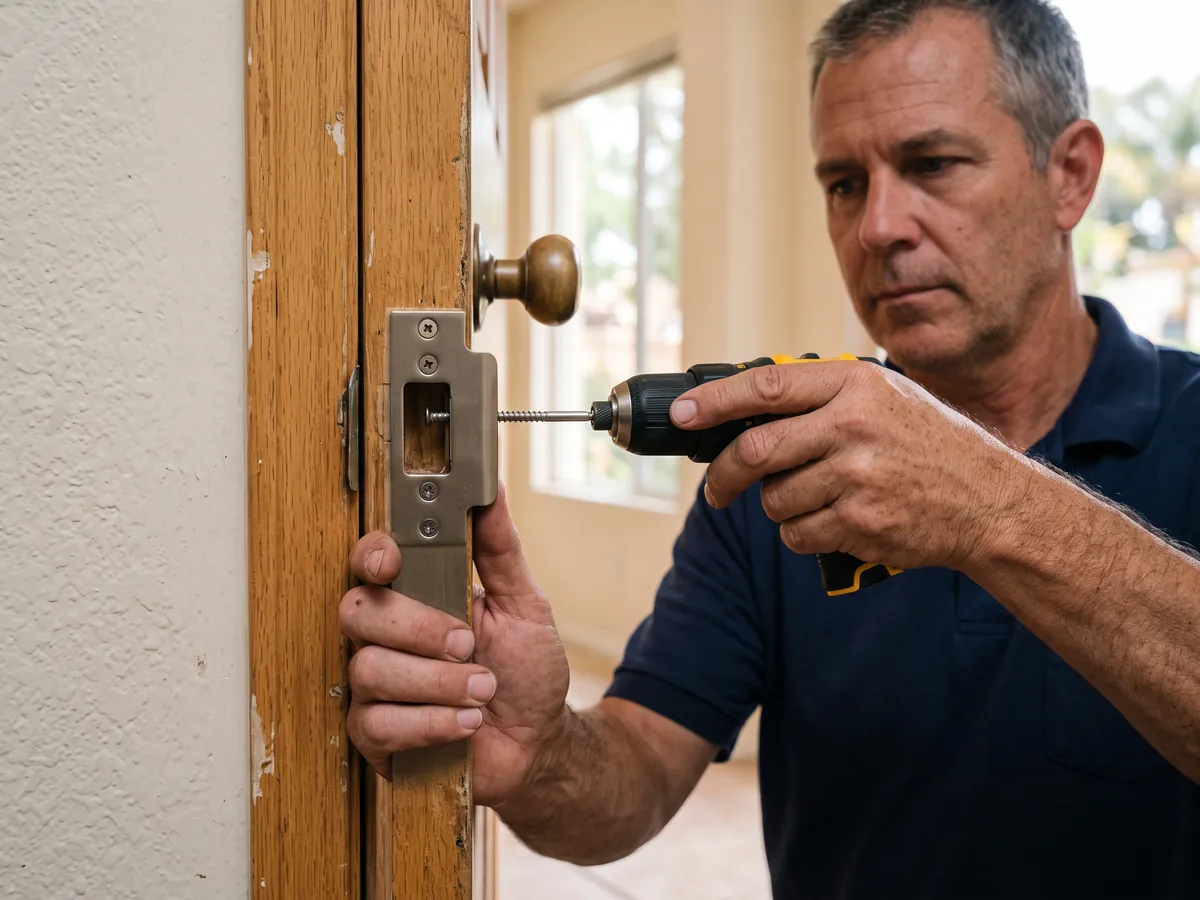
Plenty of doors around Stanton still close on nothing more than the spring latch in a knob, especially back doors, side doors off the garage and the entry to a converted garage or casita. A spring latch can be slipped with a thin tool and gives way to a solid shoulder. Adding a deadbolt above it changes that. We measure the door's thickness and backset, mark a center usually about five and a half inches above the knob or follow your handleset's template, then bore the face and edge holes with a guided jig so the bolt runs straight. Julian's Locksmith brings the drilling kit, chisels and hardware to your door. Call (951) 903-3193 to set up a visit.
Deadbolts make a door harder to kick in, but only when the whole assembly is sound. In Stanton, many front doors still rely on the knob latch that came with the house, with no deadbolt at all, or with an older bolt that barely reaches the jamb. California Civil Code §1941.3 expects landlords to provide working deadbolts on the main swinging entry doors of rentals, which makes this a common repair for property managers. A single-cylinder deadbolt, keyed outside with a thumb turn inside, is the right choice for most doors. Double-cylinder models need a key on both sides, which can trap you in a fire, and doors with glass beside them tempt owners toward that setup. We discuss the tradeoff, including the egress risk, before installing one. Quality details matter. A Grade 1 or Grade 2 bolt with a one-inch throw, a reinforced strike plate and three-inch screws that reach the stud do more than a fancy finish. We drill the door cleanly, set the bolt so it throws without binding, and test it with the door closed. Sliding glass doors, garage side doors and back doors usually need a deadbolt too, and we can key all of them to match.
Deadbolt Installation in Stanton: what to expect
BHMA, the Builders Hardware Manufacturers Association, tests deadbolts under ANSI standards and sorts them into three grades. Grade 1 is the toughest, built for heavy commercial use and high-abuse entry doors. Grade 2 covers solid residential and light commercial hardware. Grade 3 is the basic tier often found in builder packages. The tests look at how many lock and unlock cycles a deadbolt survives and how it holds up to pressure on the bolt end, impact near the lock and twisting at the cylinder. Some packaging now shows a three-letter residential rating instead, scoring security, durability and finish separately from A to C. Grade matters, but it isn't the whole story. A Grade 1 deadbolt screwed to a jamb with short screws still fails at the frame. Meanwhile, a well-installed Grade 2 lock with a reinforced strike makes a strong front door for most homes in Stanton. We use Grade 3 mostly on interior doors, closets and storage rooms. When you want key control on top of strength, we move up to restricted keyways from Medeco, Mul-T-Lock or Schlage Primus, where copies come only through an authorized source.
Work included on a typical visit
- Deadbolt installation on an undrilled door. New doors from the home center often arrive with a knob bore but no deadbolt prep, and custom wood or fiberglass doors may come completely blank. In Stanton, we lay out the backset to match your knob, bore from both faces to avoid tearing the veneer, and chisel or rout the faceplate recess to a clean, flush fit.
- Reinforced strike plates with 3-inch screws. The strike in the jamb takes the force of a kick, so we upgrade it on every install. Out go the 3/4-inch screws that reach only the jamb; in go hardened 3-inch screws that pass through the shim gap and anchor in the trimmer stud. Where the jamb allows, we mortise in a heavier four-screw strike with a deep box behind the bolt hole.
- Jamb, door-edge and hinge-side reinforcement. When a door has already been forced, or you simply want it built heavier, we add a steel jamb strip that spreads impact along several feet of frame, plus a wrap-around plate that encloses the door edge at the bore. On the hinge side, one long screw per hinge ties the leaf into framing so the door can't be pried from that edge.
- Double-cylinder and one-sided deadbolts, with an egress check. We install double-cylinder deadbolts where they make sense, such as a secondary door with glass beside it that isn't the home's required exit. Before we do, we explain the fire-safety trade-off and California's egress expectations, and talk through where a key should live so it's always reachable from inside but never through the glass.
- Fixing deadbolts that drag or won't fully throw. A deadbolt that stops short of full throw is a weak deadbolt. We check the bolt's travel with the door open and closed, deepen or re-cut the strike pocket, shim hinges, and set a hinge screw long enough to pull a sagging door back up. The key should turn with two fingers and no help from your shoulder.
Local factors in Stanton
Shops along Dale Avenue need deadbolts that handle constant daily use and comply with egress rules for customer and employee exits. We install Grade 1 deadbolts on back and side doors, narrow-backset deadlocks on aluminum storefront doors, and explain where a key-operated main entrance is allowed with the required posted sign. We can also key several doors alike for managers while keeping an owner's key separate.
In family neighborhoods around Stanton, single-cylinder deadbolts are almost always the right call, because everyone, including kids, guests and grandparents, needs a fast way out in an emergency. We install Grade 1 or 2 deadbolts with reinforced strikes, key them to match your other doors, and set the bolt to turn easily so older children can operate it without a struggle during a fire drill or a real alarm.
Apartment owners in Stanton must provide a working deadbolt on each unit's main entry door, with a bolt that extends at least 13/16 inch beyond the door edge under California law. We install compliant deadbolts, key them per unit or under a master system, and reinforce strikes on doors that have taken years of abuse. Inside operation stays keyless, which keeps residents in line with egress rules and keeps maintenance staff out of fire-safety trouble.
Situations this covers
A tenant off Orangewood Avenue tells us her back door has only a flimsy knob lock. With her landlord's written permission, we cut the bore, install a single-cylinder Grade 2 deadbolt, fit a heavy strike plate secured to the framing with three-inch screws, and rekey the new bolt to match her front door. She has a small child, so we set the thumb turn where it is easy for her to reach and test it with her in the room.
- For example, picture a 1960s single-story home near Stanton Park with a solid fir back door that has never had a deadbolt, just an old brass knob. We'd measure a 2-3/8-inch backset, bore above the knob with a jig, set a Grade 2 deadbolt keyed to the front door, and replace the strike's short screws with 3-inch ones that reach the stud. The homeowner ends up with one key for both doors and a back entry that finally locks properly.
- Picture a small shop near Beach Boulevard with a steel back door opening onto an alley. The owner wants it keyed on both sides so employees can't prop it open for smoke breaks. Because it's a required exit, we'd explain why a keyed inside cylinder is a problem, then suggest a single-cylinder Grade 1 deadbolt or an alarmed exit device, which keeps the door secure and monitored without trapping anyone.
- Picture a front entry with a steel security screen door outside the main door, a setup found all over Orange County. The owner wants a new deadbolt on the main door and the screen door keyed the same. We'd check the gap between the two doors so the new exterior cylinder and handle won't hit the screen door's lock box, rekey the screen door's lock to match, and test both closed together.
How the visit works
- Tell us about the door. Call (951) 903-3193 and describe the door: wood, steel or fiberglass, whether it already has a deadbolt hole, and what hardware is on it now. A photo of the door edge and the inside face helps us bring the right jig, bits and deadbolt the first time.
- Assess the door, frame and options. This is where the egress question gets answered. We ask which door is your main exit, whether there's glass near the lock, and who lives in the home, including kids and older relatives. From there we recommend a configuration and grade that fit both the door and the people using it.
- Prepare the door. Steel and fiberglass doors get extra care. We locate the internal lock block, use bits suited to metal or composite skins, and keep the foam core sealed. On wood, we score the veneer and bore from both faces so the hole stays crisp on the inside and outside of the door.
- Reinforce the strike and jamb. If you've chosen extra reinforcement, this is when the steel jamb strip, door-edge wrap and long hinge screws go in. Each piece is fitted around the existing trim and weatherstrip, so the door still closes softly and seals against dust and drafts in Stanton.
- Mount, key and align. Before the trim screws are tightened, we center the cylinder so the tailpiece isn't pinched, the most common cause of a stiff key on a new install. We rekey or reset the cylinder to match your other locks, then check that both the key and thumbturn throw the bolt all the way.
- Test and hand over. The visit ends with a clean work area, keys counted into your hand, and the old hardware left with you if you want it. If you bought a high-security deadbolt, we also go over the key card or authorization that controls who can order future copies.
What affects the cost
- How much strike and frame reinforcement. If the jamb has already been kicked or pried, repairing it before reinforcing adds time. Small splits can be glued and strapped with hardware; heavy damage may call for a carpenter. The cost depends on how much of the frame we're rebuilding versus simply strengthening sound wood.
- Door material, size and condition. Older doors that have been painted many times, warped by heat, or patched after earlier lock changes take more fitting. If the door must be planed, hinges shimmed, or old holes filled before the new deadbolt goes in, that's included in the quote with an explanation of why it's needed.
- Number of doors and scheduling. Planned installs are booked at a time that suits you within our hours. An urgent install after a break-in, when we rearrange the schedule to get there sooner, may be priced differently from a routine appointment. Either way, you get the price first and nothing is added without your approval.
Every job gets a clear quote before any work starts. Call (951) 903-3193 with the details and we'll tell you what to expect for your situation in Stanton.
Advice before you book
- When painting a door or frame, remove the deadbolt and strike or mask them carefully. Paint on the bolt or inside the strike pocket builds up over several coats and is a common reason a deadbolt that worked for years suddenly starts sticking.
- Fresh weatherstripping can push the door away from the stop and pull the bolt out of line with the strike. If your deadbolt starts dragging right after weatherstrip work, that's probably the reason, and moving the strike slightly is usually a small fix.
- Keep the key card or code number that comes with a high-security deadbolt somewhere safe and separate from your keys. For restricted systems, it's what authorizes new copies, and losing it can make ordering extra keys slower and more involved.
- If there's glass within arm's reach of your thumbturn, deal with the glass before reaching for a double-cylinder deadbolt. Security film, laminated glass or a solid sidelight addresses the reach-through risk without putting a keyed lock between your family and the way out.
What not to do
- Forcing a binding deadbolt by pushing or lifting the door every time you lock it. That strains the tailpiece and cam until something snaps. A bolt that binds is telling you the door and strike are misaligned, and the alignment is what needs fixing.
- Ignoring the inactive leaf on double doors. The deadbolt on the active door throws into the stationary door's edge, so if that leaf is held by weak flush bolts, both doors can be pushed open together despite a strong deadbolt on the active side.
- Installing a deadbolt in a hollow-core door and assuming the job is done. These doors have only a thin wood frame around the edge, and a kick can split the skin around the lock. On an exterior or garage-entry opening, a solid door is the better investment.
Service in Stanton
Stanton is about 55 miles from our San Bernardino base, roughly 60 minutes in light traffic via I-215 South through Colton and Grand Terrace to SR-91 West in Riverside, SR-91 West through Corona and Santa Ana Canyon to SR-57 South. When you call, you get an arrival estimate based on where the technician is and the traffic at that moment.
Rush hour on Western Avenue can stretch a drive considerably. We'd rather give you a realistic arrival window than an optimistic one, and we'll call you if a closure or a crash changes the plan.
About Stanton: Beach Boulevard, State Route 39, is the city's main north-south artery, and no freeway runs through Stanton; Beach Boulevard connects south to the Garden Grove Freeway.
| Neighborhoods | Briarwood Street and Premier Park, Date Street, Civic Center area along Katella Avenue, Stanton Central Park area off Western Avenue, Cedar Street, Santa Paula Street and the Family Resource Center |
|---|---|
| ZIP codes | 90680 |
| Main routes | Beach Boulevard, Katella Avenue, Western Avenue, Knott Avenue |
| From our San Bernardino base | about 55 miles via I-215 South through Colton and Grand Terrace to SR-91 West in Riverside, SR-91 West through Corona and Santa Ana Canyon to SR-57 South, then SR-22 West (Garden Grove Freeway) to Beach Boulevard (SR-39) north into Stanton; alternate is SR-91 West to the Beach Boulevard exit in Buena Park and south on Beach, or I-10 West to SR-57 South when the 91 is jammed |
New or replacement locks in Stanton?
Call (951) 903-3193 and tell us which doors and what kind of hardware you have in mind. If you already bought the lock, keep the box handy so we can check it fits the door, and we'll quote the install before any work starts.
Frequently asked questions
Is a smart deadbolt as strong as a regular deadbolt?
It depends on the model. Many smart deadbolts, including the Schlage Encode and Yale Assure lines, publish a BHMA grade or residential rating, so compare those the same way you would for a mechanical deadbolt. The installation matters as much as the lock: a smart deadbolt still needs a reinforced strike, long screws and a bolt that throws fully.
Do you install deadbolts on steel and fiberglass doors?
Yes. Steel doors have a thin skin over foam with an internal lock block, and fiberglass doors need sharp bits to avoid chipping the skin. We locate the block, drill carefully and keep the core sealed. Many prehung steel and fiberglass doors come pre-bored for a deadbolt, which makes the install simpler and cleaner.
Can I add a deadbolt to the door between my garage and house?
Usually, yes. That door is often solid or fire-rated and set up to close on its own. We check the hinge edge for a fire label, follow the manufacturer's prep guidance, and install a single-cylinder or one-sided deadbolt. Afterward, the door should still swing shut and latch by itself, and we test that before leaving.
How long does a deadbolt installation take?
Installing into a door that already has standard holes is a fairly short job once we're on site. Boring a new door, reinforcing the jamb, or working on steel or double doors takes longer, and a damaged frame adds more. We'll give you a realistic time estimate for your specific door in Stanton when you call (951) 903-3193 and describe what you have.
Are double-cylinder deadbolts allowed in California homes?
California's residential code expects a home's main egress door to open from inside without a key or special knowledge, and the rules for residential units allow extra locks only when they release from inside without a key. That makes a double-cylinder deadbolt on the main exit a problem. Enforcement varies by city, so check with your local building or fire department about a specific door.
When can you come out to install a deadbolt?
We schedule installs every day from 6:30 a.m. to 11:30 p.m. That includes weekends. If a break-in has left your door without a working lock, tell us when you call so we can try to prioritize your visit and give you an honest ETA to Stanton.
How far is Stanton from your base?
Stanton is about 55 miles from our San Bernardino base, roughly 60 minutes in light traffic. Arrival time depends on traffic and on the job the technician is finishing, so we give you an estimate on the phone before you commit.
Related services in Stanton
Deadbolt Installation in nearby cities
- Deadbolt Installation in Garden GroveOrange County
- Deadbolt Installation in CypressOrange County
- Deadbolt Installation in WestminsterOrange County
- Deadbolt Installation in Buena ParkOrange County
- Deadbolt Installation in Los AlamitosOrange County
- Deadbolt Installation in La PalmaOrange County
- Deadbolt Installation in Hawaiian GardensLos Angeles County
- Deadbolt Installation in AnaheimOrange County