
Service category
Business Lockout Help for Storefronts, Offices and Warehouses
Short answer: A business lockout goes fastest when three things are ready: a description of the door and lock, a person with authority over the premises, and a clear sense of when staff need to be inside. Julian's Locksmith is a mobile, BSIS-licensed company (LCO7891) that opens commercial doors with picks, extractors and, when unavoidable, a replacement cylinder. Broken glass and pry bars are off the table, and you get a quote before we drive out.
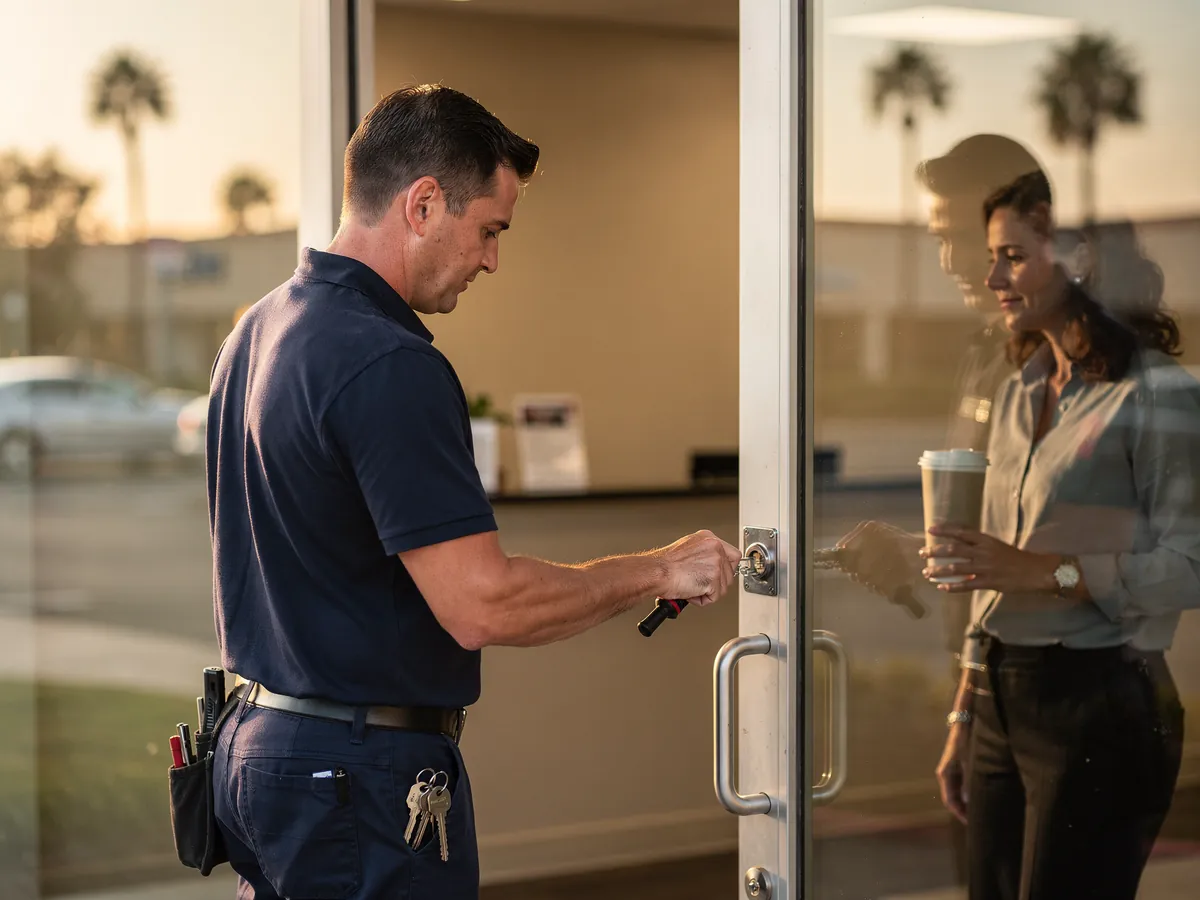
Why a business lockout is its own kind of job
A locked house usually affects one household. A business lockout can stall a whole payroll. Employees arrive and wait on the sidewalk, a delivery driver on a tight route won't idle for long, customers try the handle and leave, and the person who could solve it may be the one who left the keys at home.
The lock itself is often the smaller part of the problem. Commercial hardware is tougher than residential hardware, but a trained locksmith can get through nearly all of it. What takes judgment is everything around the lock: deciding who actually has the right to approve entry, choosing the least damaging way in, and making sure the reason for the lockout (a missing key ring, an employee who quit, a dead keypad) doesn't become a security hole once the doors are open.
On every business lockout, we work toward three outcomes, in this order:
- Confirm that the person approving the work controls the premises
- Get the right door open with the least damage the hardware allows
- Leave the business able to lock up tonight with keys that are accounted for
The sections below walk through how that plays out on the most common business doors across Southern California: aluminum glass storefronts, office suites, warehouse man doors and roll-up doors, and electronic entries. They also cover the timing question most owners ask first, which is whether a locksmith can get the crew inside before the shift starts.
Authorization: who can approve opening a business
A locksmith who opens a business for anyone with a confident story is a liability to every business owner. That's why authority, not the lock, is the first thing we settle.
The simplest case is an owner or corporate officer standing at the door with photo ID. Next most common is a manager or opener whose authority the owner confirms. Larger operations often skip the phone tag entirely: a facilities department issues a work order or purchase order, and that reference ties the job to the company.
Documents that connect a person to a California business and its address include:
- A signed commercial lease or lease amendment naming the tenant
- The city business license or business tax certificate
- A fictitious business name statement filed with the county clerk, for a company operating under a DBA
- The seller's permit from the California Department of Tax and Fee Administration, which retailers are expected to display at the location
- The Statement of Information on file with the Secretary of State, which lists a corporation's officers or an LLC's managers and can be looked up through bizfile Online
When confirmation comes by phone, we prefer to dial a number we find ourselves, such as the company's listed main line, over a number handed to us by the person at the door. If the paperwork is locked inside, we can open first and then hold the space until someone produces it. Our company is licensed under California's Locksmith Act by the Bureau of Security and Investigative Services as LCO7891, and every opening goes on a work order showing who approved it.
Lockouts we decline, and what to do instead
Some calls sound like lockouts but are really disputes. Opening the door in those cases picks a side in an argument a locksmith has no standing to settle, so we politely decline and explain why.
- A landlord changed the locks. Commercial tenancies run on the lease and on rules that differ from residential rentals, and some leases give a landlord lock-change rights after a default. Talk to the landlord and an attorney.
- Co-owners or partners disagree about who controls the space. When the paperwork shows both names, neither one can use us to get in over the other's objection.
- A former employee or contractor wants to collect belongings. That gets arranged with the current owner, who can let them in.
- A business is being sold and the buyer wants in before escrow closes. Until the deal transfers possession, the seller generally still controls the premises, so the seller has to approve.
- The space is under a court order, a receiver or a bankruptcy trustee. Entry is up to whoever the court has put in charge.
Declining is not a judgment about the caller. It protects the same owners who might one day be on the other side of that story, finding that someone talked their way into the shop. Once control is settled, we're glad to come back for rekeying, new keys or a fresh master key system.
Anatomy of an aluminum storefront door
The glass-and-aluminum door on a typical strip-center shop, restaurant or office lobby looks simple, but its lock is engineered around a tight constraint: the vertical frame member, or stile, is only a few inches wide. Residential locks sit with their keyholes 2-3/8 or 2-3/4 inches from the door edge. On a narrow-stile door that distance, called backset, is often 1-1/8 or 1-1/2 inches and sometimes less than an inch.
To fit that space, storefront deadlocks in the Adams Rite MS1850 style use a pivoting hookbolt. Instead of sliding straight out, the bolt swings in an arc and hooks behind the strike, so prying or spreading the frame tends to pull it tighter rather than free it. The parts that matter on a lockout:
- A mortise cylinder that threads directly into the lockbody, held by a set screw reachable only from the door's edge with the door open
- A cam on the back of the cylinder, shaped to match the lockbody; cams made for other mortise locks look similar but may not throw this bolt
- On many doors, a deadlatch with a paddle or push handle, so the door can latch during business hours without the deadbolt
- Safety glazing in the door panel, either tempered glass, which collapses into small pebbles when broken, or laminated glass, which cracks but stays in the frame
Some storefronts use a double-cylinder deadlock, keyed on both sides. Building codes allow that on the main entrance of many business and retail spaces only under conditions, typically including a posted sign stating the door must remain unlocked while the space is occupied, and the local fire authority has the final say on what's acceptable.
How we open a storefront without glass damage or pry marks
Every storefront job starts with a look at the whole door before any tool goes into the lock. Our order of operations:
- Look for a legitimate easier route. A rear service door with ordinary hardware, a building engineer with a key, or a manager who lives nearby can beat any technique.
- Check for binding. If the door has dropped on worn pivots or the frame has shifted, the hookbolt may be loaded against the strike. Taking that pressure off sometimes lets the existing key work again.
- Pick the cylinder. Storefront cylinders range from inexpensive units on residential keyways to Schlage, Sargent and Corbin Russwin commercial cylinders to Best small-format interchangeable cores. Security pins slow picking down but rarely stop it on standard cylinders.
- Remove a broken key first, if a fragment is jammed in the keyway, so the plug can rotate.
- Drill and replace only when necessary. Patented high-security cylinders from Medeco, Mul-T-Lock or ASSA resist picking by design, and a cylinder that has been hammered or pried may be too damaged to manipulate. Controlled drilling destroys the cylinder's pin stacks and nothing else; the lockbody, hookbolt and stile survive, and a new cylinder threads in.
We tell you which step we expect before starting and requote if the plan changes. Prying is never on the list. A bent stile can leave a door that never meets its strike squarely again, and a replacement door costs far more than the original lockout.
After opening, we confirm the set screw is snug, the cam engages, and the hookbolt throws fully with the key you'll actually be using tonight.
Storefront failures that masquerade as lockouts
A good share of storefront calls involve a key that is fine and a door that isn't. Knowing the signs helps you describe the problem on the phone, and occasionally it saves the call entirely.
- The whole cylinder turns with the key, or sticks out farther than it used to. The retaining set screw has loosened and the cylinder is unscrewing from the lockbody. Stop turning, because each turn backs it out further.
- The key spins all the way around with no resistance. The cam has broken or slipped, or the wrong cam went in during an earlier repair.
- The key turns partway, then stops hard. The hookbolt is binding against the strike, usually from a sagging door, a strike that has crept out of line, or late-day heat expanding the frame on a sun-facing entrance.
- The bolt throws but the door won't stay shut. The hookbolt may be bent from the door being slammed while the bolt was extended, so it no longer catches the strike lip.
- The paddle won't release. The deadlatch may be packed with grit or worn at its linkage.
Each of these has a repair that costs less on a calm afternoon than at opening or closing time. If your staff have started relying on tricks to make the door cooperate, such as lifting it, kicking the bottom rail or holding the paddle at an angle, treat that as the signal to schedule a service visit before the trick stops working.
Office suites, interior doors and multi-tenant buildings
Office lockouts hinge on the lock's function, which is set inside the lever lock and isn't obvious from the outside. The common commercial functions:
- Storeroom. The outside lever is always locked and only a key retracts the latch. Walk out without keys and the door locks behind you every time.
- Office or entry. A push button or turn button inside locks the outside lever until it's released from inside or with a key.
- Classroom. A key on the outside locks or releases the outside lever, and the inside lever always lets you out.
These functions show up on cylindrical levers like the Schlage ND, Sargent 10 Line and Corbin Russwin CL3300, and on mortise locks such as the Schlage L9000 and Sargent 8200, some of which add a deadbolt. Commercial latches usually include a deadlatching plunger that defeats the credit-card trick, and outswinging doors often wear a latch protector plate, so improvised entry mostly damages the door and frame. We open these by picking or with tools built to reach the inside lever, chosen by the door's gap, threshold and closer.
In multi-tenant buildings, the lobby may run on the landlord's card system while your suite has its own keyed lock. Call building management first, because they may hold a master key. When they can't help, we open the suite once they've confirmed your tenancy. Inside a suite, focus on the door that leads to spare keys: opening one interior office often makes every other opening unnecessary.
Warehouses, roll-up doors and fenced yards
Industrial lockouts rarely come down to one lock. A distribution building, contractor shop or storage yard may have a man door, several rolling steel doors, dock doors and a perimeter gate, each secured differently.
Man doors are usually hollow metal in steel frames, fitted with Grade 1 levers or rim exit devices from makers such as Von Duprin, Sargent or Precision. Exterior access through an exit device comes from outside trim, which may be a lever or just a cylinder in a night-latch arrangement. Many rear doors have no outside trim at all. Those exit-only doors can't be opened from outside without cutting into the door, so we pick a different entry and work from the inside.
Rolling steel doors normally lock from inside with slide bolts on the bottom bar or a padlocked chain keeper on the hoist. Some carry an exterior cylinder in the bottom bar or a keyswitch for a motor operator. Once someone is inside through a man door, releasing them is quick.
Padlocks are where industrial work slows down. Boron-alloy shackles shrug off bolt cutters, shrouded hasps hide the shackle, and container puck locks leave almost nothing to grip. We pick or shim first. Cutting with an abrasive wheel is a last resort, and on dry, windy days we're careful about sparks near brush, pallets and cardboard. In shared yards, a gate padlock may belong to the landlord or a neighboring tenant, so ownership gets confirmed before anything is cut.
Gated logistics parks with guard shacks add one more step. Give the guard our company name ahead of time so the van isn't held at the gate while your trailer waits at the dock.
Keypads, card readers and electrified locks
Electronic hardware fails in its own ways, and the fix depends on whether the trouble is the lock, its power or the system behind it.
Standalone keypad levers, such as the Alarm Lock Trilogy and the Schlage CO-Series, run on AA batteries and usually hide a mechanical override cylinder. When the batteries die and the override key has wandered off, we pick the override, then replace the batteries and test the user codes. Mechanical pushbutton locks like the Kaba Simplex need no power at all, but a botched combination change can shut everyone out; many have a key override we can work.
Networked access control is different. A card reader tells a controller to release an electric strike or a magnetic lock:
- A fail-secure electric strike stays locked when power drops, so the door still needs a mechanical key from outside.
- A fail-safe magnetic lock releases when power drops, and egress doors fitted with maglocks have to release for people leaving the building.
- Electrified exit devices may retract their latch electrically and still carry a key cylinder for outside access.
Where a mechanical cylinder exists, we can usually open the door by key or by picking. Repairs to controllers, power supplies, wiring and software belong to your access control provider or a licensed C-7 low-voltage contractor, and alarm panels belong to your alarm company. If the building owner runs the card system, we won't alter any part of it without the owner's approval.
Beating the shift: timing, hours and what to do while you wait
Julian's Locksmith starts every day at 6:30 a.m. We keep going until 11:30 p.m. every day of the week, weekends included. We aren't a 24/7 company, and saying so plainly helps you plan around it.
What that schedule means for a business lockout:
- If a closing manager realizes at night that tomorrow's opener has no key, reach us before 11:30 that evening and ask for the earliest spot on the next morning's schedule.
- Shifts that begin before 6:30 a.m., like bakeries, gyms and early warehouse crews, need a second key holder. No locksmith's calendar substitutes for one.
- Late-evening problems should be reported as soon as they're found, because a job that starts at 10:45 p.m. may not finish before our 11:30 p.m. close.
- Early-opening businesses should confirm keys and alarm codes with their openers the night before, since we don't start until 6:30 a.m.
While you wait for the van:
- Call the alarm monitoring company and tell them a locksmith is on the way
- Reach whoever will authorize entry and keep them on standby
- Text a clear photo of the lock and the edge of the door
- Keep staff from trying screwdrivers, cards or pliers on the lock
- Reschedule or redirect deliveries if the dock door is the one that's stuck
When you call, we give you a real arrival estimate based on where our van is at that moment, and we say so if it won't beat your opening time.
After the door opens: keys, cores and what to change
Once staff are inside, the useful question is where the missing keys are now. The answer decides how much more work makes sense:
- Keys are at someone's home or locked inside. Nothing needs changing, though a spare for a second key holder is wise.
- Keys were lost with nothing identifying the business. Risk is lower, but exterior rekeying is still worth considering if the ring held many keys.
- Keys were lost with a company tag, badge, vehicle or paperwork showing the address. Rekey the exterior doors the same day.
- Keys left with a terminated employee who won't return them. Rekey the exterior doors and any cash or records rooms that ring could open.
- An interchangeable-core control key is missing. Anyone holding a control key can pull a core and operate the lock behind it, so the cores, and possibly the control key system itself, need replacing.
- A key on a restricted high-security system is gone. New keys and cylinders come through the dealer holding your authorization records; temporary cylinders can secure the doors until they arrive.
Two habits keep this list short. Stamp keys with codes instead of door names, and track who holds each one. It also helps to know that a Do Not Duplicate stamp is a request, not a lock feature, and a key counter with the right blank can ignore it. Real copy control comes from restricted or patented keyways, where blanks are sold only to authorized dealers who check signed records before cutting.
What a business lockout costs and how we quote it
We don't publish flat prices for commercial openings, because two calls that sound alike on the phone can look very different at the door. Instead, we ask enough questions to quote before the van leaves, and we requote on site before doing anything beyond that scope.
The things that move the number:
- The hardware. A standard office lever versus a high-security storefront cylinder, a mortise lock with a deadbolt, an exit device or a boron-shackle padlock
- The method. Picking and bypass leave nothing to replace, while drilling adds a new cylinder
- The path. How many doors, grilles and gates stand between the parking lot and the first working key
- The drive from our San Bernardino base, plus site access steps such as guard check-in or escort requirements
- The time of the call within our working hours
- Anything you add after entry, such as rekeying, extra keys, a replacement cylinder or a door adjustment
Two ways to keep the bill smaller: point us to the simplest door that leads to a spare key, and have authorization lined up before we pull in, so time on site goes into the lock rather than into phone calls. If a planned visit next week would serve you better than an urgent one today, we'll tell you that too.
Where we work
Julian's Locksmith is a mobile company based at 2544 Rosemary Ln in the University Heights area of San Bernardino, near Cal State San Bernardino. We don't keep a walk-in shop. The van comes to your business carrying picks, extractors, drills, replacement cylinders, padlocks and a key machine.
We handle business lockouts across the Inland Empire, the San Gabriel Valley, the Pomona Valley, north Orange County and southeast Los Angeles County. That ground includes warehouse corridors along I-10, I-15 and SR-60, older downtown office blocks, newer business parks, medical office buildings and a great many strip-center storefronts.
Before we arrive, you can confirm our California locksmith company license, LCO7891, through the Department of Consumer Affairs license search at search.dca.ca.gov. Then call (951) 903-3193, tell us the door, the lock and who's authorizing, and we'll give you a quote and an honest arrival estimate before anyone gets in the van.
Frequently asked questions
Can the buyer of a business get in before escrow closes?
Usually not on their own. Until the sale transfers possession, the seller generally still controls the premises, so we need the seller, or one of the seller's officers or managers, to approve the opening. If the purchase agreement already gives the buyer early access, bring a copy along with photo ID and have the seller confirm by phone. After closing, the new owner can authorize entry directly, and that's a smart moment to rekey every exterior lock, since nobody knows how many keys the previous owner handed out.
Does a Do Not Duplicate stamp stop people from copying our keys?
Not reliably. The stamp tells honest key cutters what the owner wants, but it doesn't change the key itself, and plenty of counters will copy it anyway. If copy control matters, use a restricted or patented keyway, where blanks are sold only through authorized dealers who check a signature card or authorization list before cutting. After a lockout caused by an unreturned key, that's often the upgrade worth discussing, especially for exterior doors, cash rooms and records storage.
Our back door has no handle or keyhole on the outside. Can you open it?
Generally not from outside without damaging it. Exit-only doors are designed so nothing on the exterior can operate the latch, which is exactly what you want on a rear door at night. We'll open a door that does have exterior hardware, then release the exit-only door from inside. If your crew regularly needs to come in that way, we can talk about adding night-latch or lever trim with a cylinder while keeping the exit device compliant for egress.
The person who can authorize entry is traveling. What works?
An email from the owner's known business address, a call we place to a number we look up independently, or a signed authorization letter your managers keep on file all help. Time zones are the usual snag, so start reaching the owner before you call us. If the owner can't be reached at all and no other officer or property manager can confirm, we'll wait rather than open. A standing letter naming approved managers prevents that dead end the next time.
Do we need our landlord's permission to rekey after a lockout?
Check your lease. Many commercial leases require the tenant to get consent before changing or rekeying locks, or to give the landlord a key afterward for emergency access. Opening a door after a lost key rarely raises an issue, but rekeying can. If your lease calls for a landlord key, we can cut one while we rekey so you stay compliant. When you're unsure, a short email to the property manager before the work avoids an awkward conversation later.
If you drill our storefront cylinder, will the door lock tonight?
Yes, because we don't leave a drilled door unsecured. Standard mortise cylinders for storefront deadlocks ride on the van, so the usual outcome is a new cylinder installed during the same visit, keyed to new keys or, in many cases, to your existing key. If your building uses a restricted high-security keyway we can't match on site, we'll fit a temporary cylinder so the door locks, and you can order the permanent one through the dealer holding your key records.
Can you open our roll-down security grille?
Often, yes. Manual grilles usually lock with padlocks or a cylinder in the bottom bar, which we can pick, shim or replace. Motorized grilles typically use a keyswitch to run the operator, and a lost key means picking or replacing that switch. If the motor, chain hoist or springs have failed, that's work for a rolling door company rather than a locksmith. Tell us whether the grille is manual or motorized and how it's locked, so we bring the right parts.
Can you let our cleaning crew or a contractor into the building?
Only with the owner's or manager's approval for that specific visit, ideally with someone from your business present or on the phone. We won't hand a business over to a vendor on the vendor's word. If outside crews need regular access, a better long-term setup is a separately keyed door, a keypad code you can change, or an access credential you can switch off when the contract ends. That keeps your main keys in fewer hands.
Business Lockout by city
Local details, routes and answers for business lockout in each city we cover across four counties.
San Bernardino County
Riverside County
Los Angeles County
- Rosemead
- San Gabriel
- Temple City
- Arcadia
- Sierra Madre
- Monrovia
- Duarte
- Bradbury
- El Monte
- South El Monte
- Baldwin Park
- West Covina
- Covina
- Azusa
- Irwindale
- Glendora
- San Dimas
- La Verne
- Pomona
- Claremont
- Diamond Bar
- Walnut
- La Puente
- City of Industry
- Hacienda Heights
- Rowland Heights
- Avocado Heights
- Charter Oak
- Valinda
- West Puente Valley
- South San Gabriel
- East San Gabriel
- North El Monte
- Citrus
- La Habra Heights
- La Mirada
- Cerritos
- Artesia
- Hawaiian Gardens
- Lakewood
- Bellflower
- Norwalk
- Downey
- Pico Rivera
- Whittier
- Santa Fe Springs