
Service category
Door Hardware Repair: Getting Doors to Swing, Close and Latch Again
Short answer: Door hardware repair restores the parts that let a door swing, close, latch and lock: hinges and pivots, strikes, latches, deadbolts, closers, exit devices and storefront hardware. Julian's Locksmith diagnoses the whole opening on site across the Inland Empire, the San Gabriel and Pomona valleys, north Orange County and southeast Los Angeles County, fixes the part that actually failed, and quotes before any work begins.
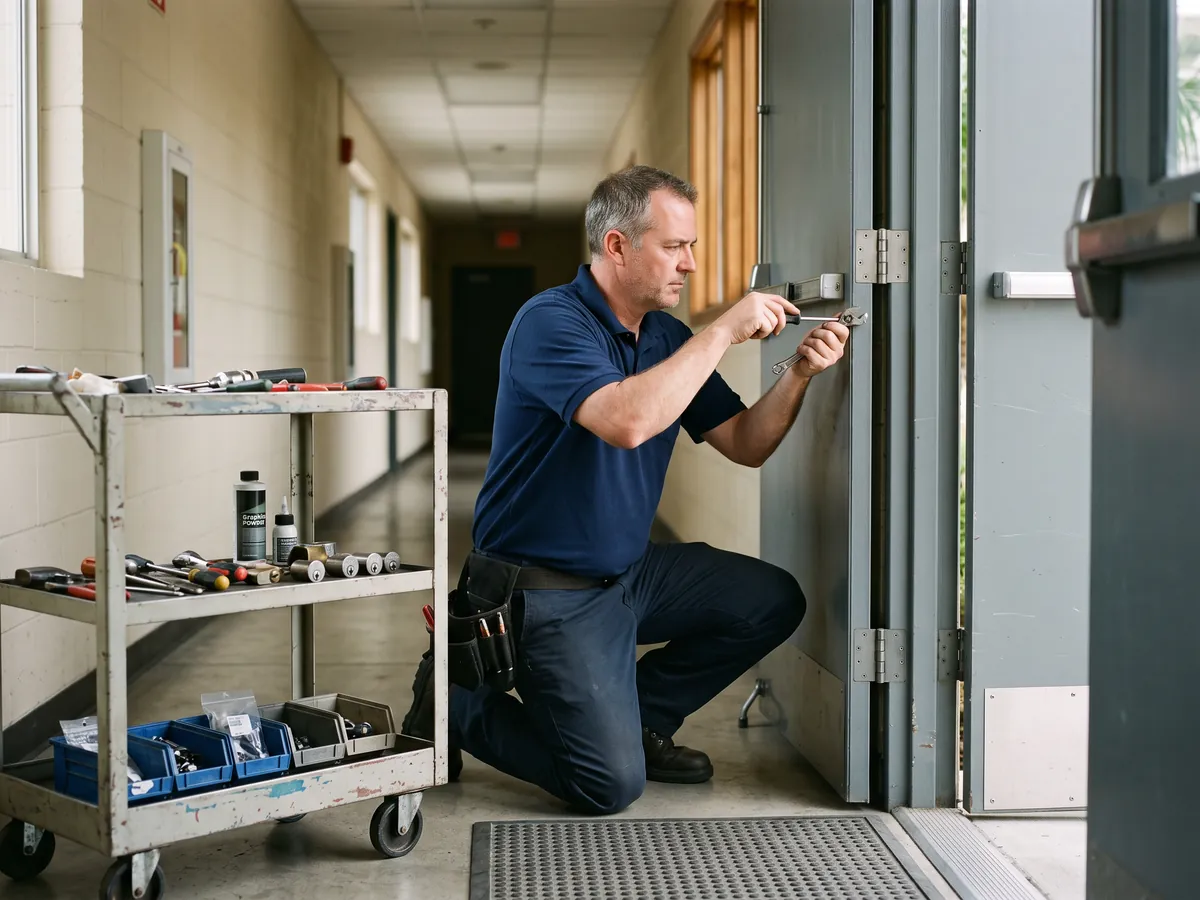
Why a Door Fails as a System
Think of a hung door as a long lever. Its weight sits roughly halfway across its width, but it hangs entirely from one edge. That arrangement pulls the top hinge away from the jamb and presses the bottom hinge into it, every hour of every day. So the top hinge is almost always the first thing to give, and because the latch corner sits three feet from the hinges, a tiny shift at the hinge becomes a noticeable drop where the latch meets the frame.
Once the door drops, a chain reaction starts. The latch drags on the strike lip instead of sliding past it. People begin pushing or slamming to get it to catch. Slamming loosens the strike screws and dents the jamb. On a commercial door, someone turns up the closer's spring power to make it latch, the heavier swing pounds the latch and hinges harder, and now a closer, a latch and a strike all look worn out. One loose screw produced five symptoms.
That's the reason a good repair visit begins with the whole opening rather than the part the caller mentioned. The useful questions are simple:
- Is the gap around the door even at the head and along the latch edge?
- Does the lock work normally with the door standing open?
- Does the door rub, bind or bounce anywhere through its swing?
- Has anything changed recently, such as paint, weatherstripping, a new lock or a storm?
Answer those and the fix usually becomes obvious. Skip them and you can spend money on a new lockset that fails exactly like the old one.
Hinges, Pivots and the Sagging Door
Most houses use 3.5-inch butt hinges with rounded corners, usually a quarter-inch or five-eighths-inch radius depending on the builder and era. Commercial doors use 4.5-inch hinges with square corners, in standard or heavy weight, and any door with a closer should hang on ball-bearing hinges, because plain-bearing knuckles wear quickly under the constant push of a closer. A common rule from the hardware industry is one hinge for every 30 inches of door height, so a standard 80-inch door carries three and an 8-foot door gets four.
The most common hinge repair is also the simplest. Jamb screws are often three-quarters of an inch to an inch and a quarter long and only grab the thin jamb board. Swapping at least one screw in the top hinge for a 3-inch screw that reaches the stud behind the jamb pulls the door back up and keeps it there. When knuckles have worn oval, the hinge itself gets replaced in the same size, radius and finish. Thin shims behind a hinge leaf, or a slightly deeper mortise, fine-tune the gaps once the door is tight.
Out-swinging doors expose their hinge pins to the outside, so they should use non-removable pin hinges or security studs. The door between an attached garage and the house often hangs on spring hinges so it closes by itself, and those springs lose tension and need re-tensioning or replacement.
Aluminum storefronts usually hang on offset pivots at the top and bottom, sometimes with an intermediate pivot. The bottom pivot carries most of the load, and when its bearing wears, the door settles and drags. Replacing pivots fixes it, while a continuous geared hinge spreads the load along the whole height for entries that see very heavy traffic.
Strikes and Latches: Small Gaps, Big Consequences
A spring latch typically projects about half an inch, and the clearance between a door and its frame is usually around an eighth of an inch. That leaves little room for error. If the door drops or swells, the latch hits the strike lip. If the door shrinks or a new seal pushes it away from the stop, the latch may barely engage the strike at all.
Most exterior locks use a deadlatch: next to the latch bolt sits a small plunger, sometimes called a guardbolt or trigger. When the door closes properly, the strike face holds the plunger in, which locks the latch so it can't be pushed back with a card or thin tool. If the gap is too wide or the strike opening has been filed oversized, the plunger drops into the opening along with the latch, and the anti-shim feature quietly stops working. That's why we fix alignment before reaching for a file.
Strikes come in several patterns. Homes usually have a small T-strike or full-lip strike for the latch, plus a separate deadbolt strike. Commercial hollow metal frames are prepared for the ANSI strike, which measures 4-7/8 inches tall, with a lip length chosen to clear the frame's trim. A strike box behind the opening keeps the bolt hole clean and gives the latch a solid pocket.
Repair options run from small to large:
- Tightening or lengthening strike screws
- Moving the strike slightly and filling the old screw holes
- Swapping to a strike with a longer or curved lip
- Fitting an adjustable strike on doors that move with the seasons
- Installing a reinforced strike with long screws after a kick-in
Locksets That Stick, Droop or Spin
Bored, or cylindrical, locksets are the round-hole locks on most homes and many offices. Inside the chassis, a retractor converts the turn of a knob or lever into the backward pull of the latch, and return springs bring the handle back to level. Levers put far more twisting force on those springs than knobs, which is why a cheap lever starts to droop after a year or two. On commercial and better residential lines, the spring cage or chassis parts are replaceable. On many builder-grade sets they aren't sold at all, and replacement is the honest answer.
Mortise locks are a different animal: a rectangular case set into a pocket cut in the door edge, with the latch, deadbolt and sometimes an auxiliary latch all inside. They're built for decades of service and they're meant to be opened and repaired. Typical problems include broken hub springs that leave the lever limp, worn latch tails, and a loose cylinder. Mortise cylinders thread into the case and are held by a set screw behind the faceplate; if that screw backs out, the cylinder can turn in the case, and someone with a wrench could unscrew it from outside.
When a lockset does need replacing, the details matter. Residential latches come in 2-3/8-inch and 2-3/4-inch backsets, commercial mortise locks come in specific functions such as office, classroom and storeroom, and levers can be handed. Matching all of that keeps the door's existing holes usable and the lock behaving the way the people using it expect.
Door Closers: Speed, Force and Leaks
A hydraulic door closer is a spring and a pump in one body. Opening the door compresses the spring, and as the spring pushes the door closed, fluid has to pass through small adjustable valves. Those valves set the speed of each part of the swing:
- Sweep controls most of the closing arc
- Latch controls the last few inches, giving the door enough push to engage the latch
- Backcheck cushions the door as it opens past roughly 70 degrees, so wind or a hard shove doesn't fling it into the wall
- Delayed action, on some models, holds the door briefly before closing for carts and wheelchairs
The mounting style changes the closer's behavior. A regular arm sits on the pull side of the door; a parallel arm sits on the push side with the arm folded along the door, which is common on exterior doors because the closer body stays inside. Parallel arm mounting gives the closer less mechanical advantage, so it needs more spring power to do the same job.
Adjustment fixes slamming and slow closing. Oil on the door face or floor means the seals have failed, and the closer needs replacing; topping it up doesn't last. Broken arms, stripped shoes and torn mounting screws can be repaired separately.
Public doors also carry accessibility limits. Federal accessibility standards ask that a closer take at least five seconds to move the door from 90 degrees open to 12 degrees from the latch. California's accessibility code caps opening force at 5 pounds on most non-fire doors, and it applies that limit to exterior hinged doors as well. Meeting both while still latching against a breeze is a balancing act, and it starts with a well-hung door.
Exit Devices and Panic Hardware
Exit devices let people leave with a single push, and they come in four main styles:
- Rim devices latch at the door edge into a strike mounted on the frame, the simplest and most common type on single doors
- Surface vertical rod devices latch at the top and bottom of the door through exposed rods, often on pairs
- Concealed vertical rod devices run the rods inside the door, cleaner looking but more labor to service
- Mortise devices operate a mortise lock body set into the door edge
Most failures are mechanical wear and impact damage. Latch bolts wear their edges round. Internal springs fatigue and the bar stops returning. End caps crack when doors are hit. Vertical rods get bent by carts and dollies, which knocks the top and bottom latches out of time with each other. Outside trim, the lever or cylinder that lets authorized people in, can stop retracting the latch. Each of these is repairable on major brands such as Von Duprin, Sargent and Corbin Russwin.
There's an important distinction between panic hardware and fire exit hardware. Panic hardware on a non-rated door can usually be dogged, which means the latch is held back with a key or hex wrench during business hours. Fire exit hardware, used on fire-rated doors, can't have mechanical dogging, because the door must latch to resist fire and smoke.
No latching problem justifies chaining an exit or padlocking a panic bar. Building and fire codes require exit doors to open from the egress side in one motion without a key or special knowledge, and when a device fails, the answer is repair or a code-compliant temporary measure.
Aluminum Storefront Doors
Narrow-stile aluminum doors are everywhere in retail centers, restaurants and office lobbies, and they use hardware designed to fit inside a stile not much wider than a few inches. The standard lock is a narrow deadlock operated by a mortise cylinder, often with a hookbolt: a curved bolt that swings out and hooks behind the strike so the door can't easily be pried away from the frame. Adams Rite deadlocks such as the MS1850 series are the familiar example.
Typical storefront repairs include:
- Replacing worn or broken deadlocks and hookbolts
- Tightening a mortise cylinder that has started to spin, and fitting the correct cam
- Repairing paddle handles and push-pull hardware that operates the latch
- Replacing worn offset pivots so the door stops dragging and the bolt finds its strike
- Servicing surface closers, concealed overhead closers in the header, or floor closers under center-hung doors
The cylinder cam deserves a special mention. Each deadlock or exit device needs a specific cam on the back of the mortise cylinder, set to the right position. Reinstall it wrong and the bolt may only partly throw, which leaves a door that appears locked but isn't.
There are limits to what hardware can fix on a storefront. Cracked glass needs a glazier, and broken rail welds or a torn frame need a storefront or metal contractor. We'll tell you if your door has crossed that line.
Many storefronts lock with a key on both sides. Building codes allow that on the main entrance of certain business types only when a readily visible sign states the door must stay unlocked whenever the space is occupied, so staff never get trapped behind a keyed door.
Double Doors, Fire Labels and California Rules
Pairs of doors bring their own hardware. The inactive leaf is held in place by flush bolts at the top and bottom, manual or automatic, and an astragal covers the gap between the leaves. On rated pairs, a coordinator mounted at the head makes sure the inactive leaf closes before the active one so both latch. If the flush bolts slip, the coordinator jams or the astragal is bent, the pair either won't latch or can be pushed open while locked.
Fire-rated doors carry a label, usually on the hinge edge of the door and on the frame. NFPA 80, the standard fire officials use for these openings, expects them to be self-closing and positively latching, and it calls for regular inspection and testing. Hardware on a rated door has to be listed for that use, hold-open devices need an approved release tied to the fire alarm, and field modifications are restricted. When we repair a rated door, we use listed parts and avoid changes that could compromise the label. If a door needs relabeling or a formal inspection report, that's a separate specialty, and we'll say so.
Homes have their own version of this. California expects the door between an attached garage and the living space to be self-closing, which is why so many have spring hinges or a small closer. When those stop working, the door is no longer doing its fire-separation job.
Accessibility rules shape commercial repairs too. Hardware on accessible doors should work with one hand, without tight grasping, pinching or twisting of the wrist, and operable parts belong between 34 and 48 inches above the floor. Replacing a knob with a lever on a public door is often part of a proper repair.
Electrified Hardware at the Door
More doors now combine mechanical hardware with electric control: electric strikes, electrified locks and exit devices, magnetic locks, request-to-exit sensors and door position switches. When one of these doors misbehaves, the problem is often mechanical even though the system is electric.
The classic example is preload. An electric strike releases by letting its keeper swing free, but if the latch is pressed hard against the keeper, from a warped door, a tight weatherseal, wind or someone leaning on the door, many strikes can't release. Adjusting the strike position, correcting the door's hang or switching to a strike rated for preload fixes it.
Other points we check at the door:
- Fail-secure versus fail-safe. A fail-secure strike stays locked without power, while a fail-safe strike unlocks; electric strikes on fire-rated doors must be fail-secure so the door still latches
- Power transfer hinges and door loops, which carry wires into the door and can break from flexing
- Mechanical overrides and key cylinders that must still work during a power outage
- Strike alignment and voltage at the strike itself
We repair the hardware side of these openings. When the fault lives in the controller, reader, power supply or wiring inside the walls, a low-voltage contractor or your access control provider may need to handle it. We'll tell you where our part ends and help that conversation go faster.
Repair or Replace: How the Decision Gets Made
Most door hardware calls end in one of three ways: an adjustment, a repair with replacement parts, or a full replacement of the unit. Choosing between them is mostly a matter of answering a short list of questions honestly.
- Can the failed part be bought separately? Commercial closers, exit devices and mortise locks usually have parts; many builder-grade locks don't.
- Will a replacement fit the existing preparation? Matching backset, bore size, mounting pattern and rail length avoids new holes, which matters most on fire-rated doors.
- Is the hardware the right grade for how the door is used? A Grade 3 lever on a busy office door will keep failing no matter how often it's repaired.
- Has it failed before? A closer that has leaked once is likely to leak again, and a lock body with a cracked case isn't worth new springs.
- Is a security upgrade worth doing now? Replacing a worn strike is the moment to add a reinforced one; replacing a failed lock is the moment to consider a better cylinder.
- Does appearance matter? On a front entry, mixing finishes or styles may cost more in the long run than replacing a matched set.
We give both prices whenever both paths are reasonable, say which we'd choose, and leave the decision with you. A repair that buys several more years of service is often the right call, and so is a replacement that ends a cycle of repeat visits.
Heat, Wind, Dust and a Simple Maintenance Routine
Southern California's climate is mild for people and hard on doors. Inland summers push surface temperatures on sun-facing doors far above the air temperature, aluminum frames expand, wood dries and shrinks, and closer fluid thins so doors swing faster. Santa Ana winds catch open doors and wrench closer arms and hinges. Winter storms swell wood doors that fit perfectly in September. Fine dust from dry hillsides and construction sites works its way into latches and cylinders.
None of that requires special hardware for most doors, but it does reward a little routine attention:
- Monthly, for businesses. Pull every exterior door closed and tug on it to confirm it latched, and check that exit devices aren't left dogged
- Every few months. Watch each closer through a full swing and listen for hissing or slamming
- Twice a year. Tighten hinge, strike and closer screws by hand
- Once a year. Lubricate cylinders with a dry lubricant and latch bolts with a light grease
- Before summer and after big wind events. Check reveals, latching and closer arms
When a door changes behavior with the seasons, note when it happens and what it does. That simple record tells a technician whether the cause is temperature, moisture or movement, and it often turns a guess into a quick, accurate repair.
How a Repair Visit Works Across Our Service Area
Julian's Locksmith is a mobile locksmith based in San Bernardino, and every repair happens at your door. We serve homes and businesses across the Inland Empire, the San Gabriel Valley, the Pomona Valley, north Orange County and southeast Los Angeles County. Our hours are every day from 6:30 a.m. to 11:30 p.m. Weekends are included.
A visit follows a predictable pattern. You call (951) 903-3193, describe the problem and, if you can, send photos of the door and any labels. We give you an honest ETA based on the schedule and distance. On site, we confirm that you're authorized to approve work on that door, and if it's locked and needs opening first, we verify ID and proof of ownership, residence or authorization before touching it. Then we diagnose the opening, quote the options and do the work you approve.
We're licensed by California's Bureau of Security and Investigative Services under locksmith company license LCO7891, which you can verify at search.dca.ca.gov. The Locksmith Act in the Business and Professions Code governs locksmiths in this state.
Some door work belongs to other trades, and we'll say so plainly: automatic door operators and sliding automatic entrances, overhead garage doors and their springs, glass replacement, frame welding and major carpentry. When your door needs one of those, we'll explain why and handle the hardware part ourselves.
Frequently asked questions
How can I tell whether the problem is the door or the lock?
Open the door and operate the lock while it's standing open. Turn the knob or lever, work the deadbolt with the key and the thumbturn. If everything moves smoothly, the lock is probably fine and the problem lies in how the door meets the frame: sag, swelling, a shifted strike or a shallow bolt hole. If the lock is stiff, gritty or won't retract even with the door open, the lockset itself needs attention. That simple test saves a lot of people from buying a lock they don't need.
How long will a repaired door stay adjusted?
It depends on what caused the problem. When we fix the root cause, such as replacing stripped hinge screws with long screws into the framing, the repair usually holds for years. Doors exposed to strong sun, heavy traffic or wind may need small closer or strike adjustments as seasons change. Buildings that are still settling, or doors that get hit by carts and equipment, will need attention again sooner. We tell you what to watch so you can call before a small drift turns into a bigger repair.
What's the difference between door hardware repair and lock replacement?
Lock replacement swaps out a lockset for a new one. Door hardware repair looks at everything that makes the door work, including hinges, strikes, closers, exit devices and the latch, and fixes whatever actually failed. Sometimes that does mean a new lock, but often the lock is fine and the door has moved. Repairing the opening first means any new lock you buy will work properly instead of struggling against the same misalignment that ruined the old one.
Do you work on automatic doors or overhead garage doors?
No. Automatic sliding entrances and power-assisted swing door operators are serviced by automatic door specialists, and overhead garage doors, their springs and openers belong to garage door companies. We do repair the hardware on manual doors nearby, such as the man door into a garage, the lock on a manual storefront door next to an automatic entrance, or the closer and latch on a door that has a separate push-button operator added.
Can you fix hardware on a door that's part of an access control system?
Yes, the mechanical side. We adjust and replace electric strikes, fix binding latches that keep a strike from releasing, repair locks, closers and exit devices on controlled doors, and service the key override cylinders. If the problem is in the reader, controller, power supply or wiring, a low-voltage contractor or your system provider may need to be involved. We'll identify which side the fault is on so you don't pay the wrong trade to look at it.
Do you work with landlords, HOAs and property managers?
Yes. We regularly coordinate door repairs with owners and managers of rentals, condo associations and commercial buildings. We confirm who can authorize work and who receives the invoice, handle multiple doors in one visit when possible, and leave a short record of what was repaired at each opening. For rental units, that includes making sure main entry doors have working deadbolts, which California law requires landlords to provide.
Can my shop's front door lock with a key from the inside?
Sometimes. Codes generally require exit doors to open from inside without a key. There is a limited exception for the main entrance of certain business occupancies, which may use a key-operated lock if a readily visible sign near the door states that it must remain unlocked while the building is occupied. Whether it applies depends on your occupancy and your local fire official, so check before relying on it. We can install the right hardware either way.
Which areas do you cover for door hardware repair?
We're a mobile service based in San Bernardino and cover the Inland Empire, the San Gabriel Valley, the Pomona Valley, north Orange County and southeast Los Angeles County. When you call (951) 903-3193, we'll confirm whether your address is in range and give you an honest ETA. We work every day from 6:30 a.m. to 11:30 p.m.
Door Hardware Repair by city
Local details, routes and answers for door hardware repair in each city we cover across four counties.
San Bernardino County
Riverside County
Los Angeles County
- Rosemead
- San Gabriel
- Temple City
- Arcadia
- Sierra Madre
- Monrovia
- Duarte
- Bradbury
- El Monte
- South El Monte
- Baldwin Park
- West Covina
- Covina
- Azusa
- Irwindale
- Glendora
- San Dimas
- La Verne
- Pomona
- Claremont
- Diamond Bar
- Walnut
- La Puente
- City of Industry
- Hacienda Heights
- Rowland Heights
- Avocado Heights
- Charter Oak
- Valinda
- West Puente Valley
- South San Gabriel
- East San Gabriel
- North El Monte
- Citrus
- La Habra Heights
- La Mirada
- Cerritos
- Artesia
- Hawaiian Gardens
- Lakewood
- Bellflower
- Norwalk
- Downey
- Pico Rivera
- Whittier
- Santa Fe Springs
Specific door hardware repair needs
Choose your city on the next page for local details.
- Lock RepairSan Bernardino and nearby
- Door Lock RepairSan Bernardino and nearby
- Broken Lock RepairSan Bernardino and nearby
- Damaged Lock RepairSan Bernardino and nearby
- Lock Not TurningSan Bernardino and nearby
- Key Stuck in LockSan Bernardino and nearby
- Jammed Door LockSan Bernardino and nearby
- Loose Door LockSan Bernardino and nearby
- Deadbolt RepairSan Bernardino and nearby
- Latch RepairSan Bernardino and nearby
- Mortise Lock RepairSan Bernardino and nearby
- Commercial Lock RepairSan Bernardino and nearby
- Key Broken Inside LockSan Bernardino and nearby
- Commercial Door RepairSan Bernardino and nearby
- Storefront Door RepairSan Bernardino and nearby
- Storefront Door Lock ReplacementSan Bernardino and nearby
- Aluminum Storefront Door RepairSan Bernardino and nearby
- Narrow Stile Lock RepairSan Bernardino and nearby
- Commercial Latch RepairSan Bernardino and nearby
- Commercial Door Won't LatchSan Bernardino and nearby
- Commercial Door Won't LockSan Bernardino and nearby
- Glass Door Lock RepairSan Bernardino and nearby
- Office Door Lock RepairSan Bernardino and nearby
- Warehouse Door Lock RepairSan Bernardino and nearby
