
Lock Installation
Change Locks the Right Way: Rekey, Replace and California Rules
Short answer: Changing locks means making every existing key useless. A locksmith can do that by rekeying the cylinders you already have, swapping only the cylinder, or installing new hardware. Rekeying suits sound locks; replacement suits worn, damaged or mismatched ones. Renters generally need landlord consent, though Civil Code 1941.5 and 1941.6 set separate rules in certain protective order situations. Julian's Locksmith does this work on-site across the Inland Empire and neighboring valleys.
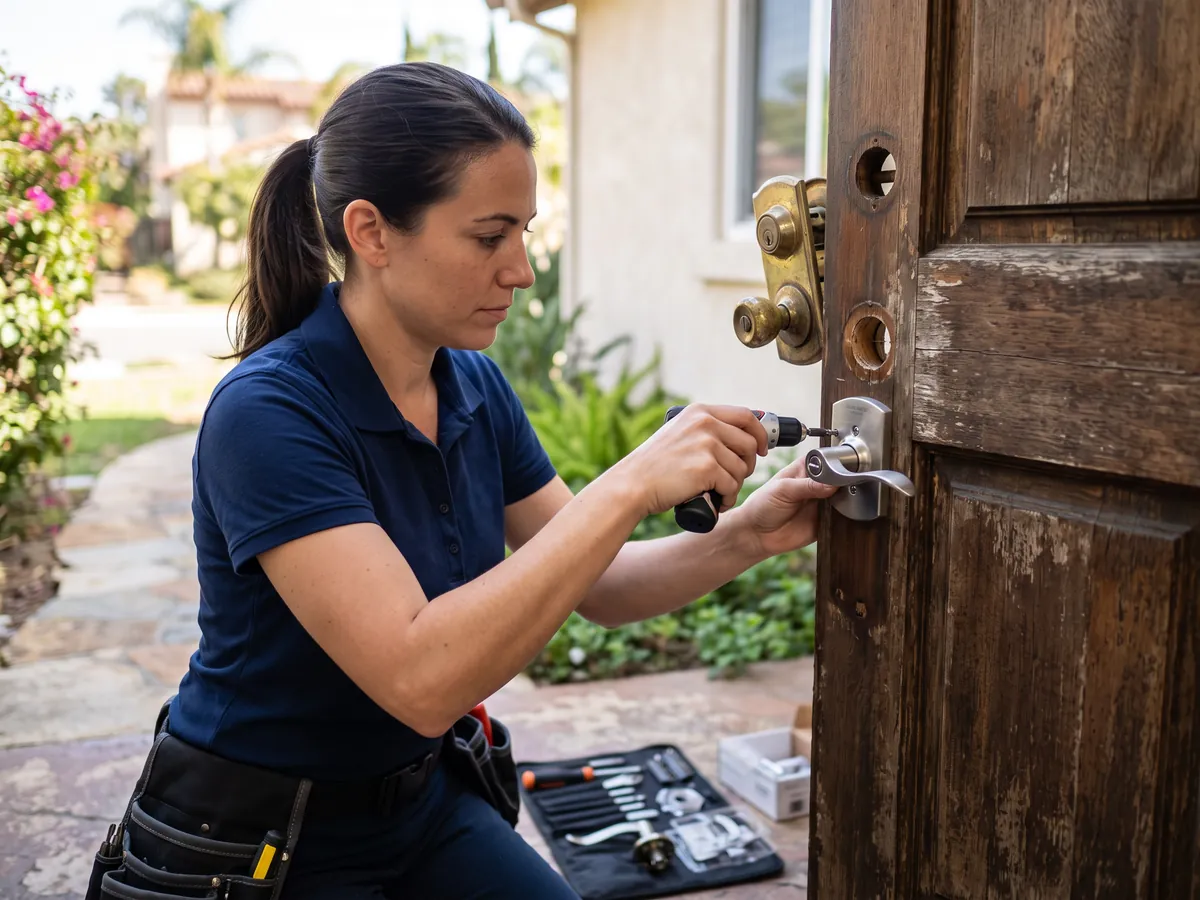
Three Ways to Change a Lock, and What Each One Changes
Most people say they want to change the locks when what they really want is simpler: certainty that no old key will ever open their door again. There are three ways to get there, and they differ in what stays on the door.
- Rekeying. The lock body, trim and finish stay. Inside the cylinder, the key pins are swapped for new lengths that match a new key. Old keys still slide into the keyway but no longer lift the pins to the shear line, so the plug won't turn.
- Cylinder replacement. On locks where the cylinder is a separate part, such as mortise locks, rim locks, Euro-profile cylinders on multipoint doors and interchangeable cores, the cylinder alone is removed and a new one goes in. The latch mechanism stays.
- Hardware replacement. The deadbolt, knob, lever or handleset comes off entirely and new hardware goes into the door. This is the only route that also fixes mechanical wear, changes the look, or adds features.
A fourth, newer option is worth mentioning. On an electronic lock, deleting user codes and resetting the app account changes who can get in without touching a single pin. It only counts as a complete lock change if the mechanical backup cylinder is rekeyed as well.
Done properly, all four end the same way: a fresh, known set of keys or codes, and a list of who holds them. The right choice for any given door depends on the condition of the lock, the brands involved, and what you want that door to do next.
The Moments That Call for New Keys
Hardware rarely prompts the call. A change in who might hold a key usually does. Common triggers include:
- Moving into a home you bought or rented, where past owners, tenants, agents, cleaners and contractors may have had copies.
- A roommate, partner or family member moving out, whether amicably or not.
- Lost or stolen keys, especially when an ID, mail or a key tag ties them to your address.
- A break-in, where spare keys inside the house may have been taken and the door may be damaged.
- The end of a remodel, a caregiving arrangement or a house-sitting stint.
- Turnover in a rental unit you own or manage.
- A safety concern, such as someone you've sought a protective order against still holding a key.
- Plain wear. A lock that sticks, a key that has to be jiggled, a finish that has peeled after years of afternoon sun.
The first seven are about key control. You don't know how many working keys exist, so you reset the count. The last one is about hardware. Plenty of jobs involve both: a family moves into a 1980s house, rekeys four sound locks and replaces a back door knob that has been failing for years.
Knowing which category your reason falls into speeds up the decision. Key control problems are solved by any method that makes old keys useless, and rekeying is usually the most economical of them. Hardware problems need hardware.
Rekey or Replace: Deciding Door by Door
A good lock change treats each door separately. These are the criteria a locksmith actually works through.
Rekey when: - The lock operates smoothly with a good key and the latch retracts fully. - The deadbolt throws its full length into the strike without being forced. - The housing is tight on the door and the finish is acceptable to you. - The cylinder shares a keyway with your other locks, so it can be keyed to match.
Replace when: - The knob or lever is loose, droops, or spins without retracting the latch. - The latch still sticks, especially on hot afternoons, after lubrication and strike adjustment have been tried. - The lock is an ungraded or Grade 3 model on a primary exterior door and you want more resistance to force. - The brand doesn't match the rest of the house and you want one key. - The lock was damaged in a break-in, or the cylinder has been drilled, pried or wrenched. - You want a feature the old lock can't provide, such as a keypad, a restricted keyway, or a lever that's easier on arthritic hands.
The middle ground is common. A homeowner might rekey a high-quality deadbolt while replacing the cheap entry knob beneath it, or keep a handleset and swap only its tired thumb latch mechanism if parts exist. Price per door matters, but so does the next five years. Paying to re-pin a lock that's already on its way out only postpones the cost of replacing it.
Measuring the Door Before Buying Hardware
Most failed do-it-yourself lock changes start in the hardware store aisle. A lock is designed for a specific door preparation, and residential doors in Southern California vary more than people expect. Before buying anything, check:
- Backset. The distance from the door edge to the center of the large face hole. Most modern doors use 2-3/8 or 2-3/4 inches, and most current locks have adjustable latches for both. Older doors occasionally use 5 inches or other sizes.
- Cross bore. The large face hole, usually 2-1/8 inches. Some older homes have 1-1/2 inch bores that modern locks won't cover properly without enlarging the hole or using an adapter.
- Edge bore and faceplate. The latch hole in the door edge is usually 1 inch. Faceplates come in round-corner, square-corner and drive-in styles, and the new latch must match the recess already cut or the edge needs chisel work.
- Door thickness. Standard exterior doors are 1-3/4 inches. Thicker custom doors need a thick-door kit with longer spindles and screws.
- Handleset spacing. The lower grip on a handleset bolts through its own hole, and spacing differs between brands, which can leave an old hole exposed.
- Strike side. The jamb should be solid rather than split or patched with filler, and the strike pocket deep enough for the bolt's full throw.
A photo of the door edge with a tape measure across it, plus another of the door face, answers most compatibility questions before anyone spends money. A locksmith takes the same measurements on arrival; doing them yourself first simply saves a trip.
One Key for Every Door: Keyways, Brands and Key Control
Keying a house alike is one of the most requested parts of a lock change, and it depends on the keyway, meaning the shape of the slot the key slides into. Residential locks in this region mostly fall into two families: Schlage, commonly the SC1 keyway with five pins, and Kwikset, commonly KW1 with five pins. A Schlage key won't enter a Kwikset cylinder and vice versa, so a house with both needs some hardware or cylinders swapped before a single key can open everything. Weiser, Defiant, Baldwin, Yale and other brands add more variety, though many of their models use Kwikset- or Schlage-compatible keyways.
Kwikset SmartKey cylinders deserve a note. They can be reset to a new key with a small tool, provided you have a working key, which makes them handy for owners who rekey often. Without a working key, the cylinder may need decoding or replacement.
Key control is the other half of the picture. Ordinary keys can be copied almost anywhere, including at self-serve kiosks, and a 'Do Not Duplicate' stamp is a request rather than a technical barrier. If keys keep spreading beyond the people you chose, consider a patented or restricted keyway such as Medeco, Mul-T-Lock or ASSA Abloy. Their blanks are controlled, so copies require the owner's authorization, and the cylinders add resistance to picking, bumping and drilling.
For households with helpers or tenants, a keypad deadbolt on the main entry plus a restricted key for its backup cylinder often works best: codes for everyday access, and a small number of physical keys you can account for.
Smart Locks and the Digital Side of a Lock Change
Smart locks change what 'changing the locks' means. With a keypad or app-controlled deadbolt such as a Schlage Encode, Kwikset Halo, Yale Assure, Lockly or Ultraloq, revoking someone's access is a code deletion. That's a real advantage for rentals, caregivers and busy families. A few details still catch people out.
First, retrofit smart locks such as August replace only the interior thumbturn assembly. The exterior cylinder, and every key that fits it, stays exactly as it was. Installing one without rekeying leaves old keys working.
Second, almost every full smart deadbolt has a keyed backup cylinder. Treat it like any other lock: key it to a key you control and keep those keys few.
Third, a smart lock inherited with a house carries its history. The previous owner may still be the administrator in the app, and old codes may sit in the keypad's memory. A factory reset followed by enrolling the new owner clears both. If the lock connects through a hub or Wi-Fi bridge, reset or remove that too, and change the home network password if the sellers set it up.
Fourth, heat and battery life matter in inland valleys. Keypads on sun-facing doors work harder, and a motorized bolt dragging against a misaligned strike drains batteries quickly. Alignment is part of a proper installation, not an afterthought.
Finally, have a plan for dead batteries. Many keypads include terminals for emergency power from a 9-volt battery or a USB source, and the backup key should live somewhere other than inside the locked house.
After a Break-In: The Lock Is Rarely What Failed
When a door is forced, attention goes straight to the lock, but the weak point is usually elsewhere. A typical kick drives the deadbolt through the strike side of the jamb, splitting the soft wood along the bolt pocket or tearing out short strike screws. The deadbolt itself often comes through intact.
That's why an effective lock change after a burglary covers more than the cylinder:
- Rekey or replace every lock, on the assumption that keys inside the house, like spares in drawers and keys hanging by the garage door, were taken or copied.
- Assess the jamb and door edge. A cleanly split jamb can sometimes be repaired with a reinforcement kit; a shattered frame or a door with a crushed edge may need carpentry or a new door, and a locksmith should say when the damage is beyond lock work.
- Upgrade the strike. A heavy-gauge strike or a full-length reinforcement plate anchored with 3-inch screws into the framing behind the jamb.
- Check the hinge side. Short hinge screws let a determined kick pull the door away from the hinge jamb, and replacing at least one screw per hinge with a long one helps.
- Look at the other doors. Garage entry and side doors are often weaker, and many are hollow-core or carry builder-grade hardware.
Document everything before repairs begin: photos, the police report number, and a dated invoice describing the work. Insurers commonly ask for all three. Because sliding glass doors are a frequent entry point, check their latch and add a secondary bar or pin lock at the same time.
Renters and California Lock Law
Renters have more lock protections in California than many people realize, along with some obligations.
Civil Code 1941.3 puts basic security on the landlord. Each main swinging entry door of a dwelling unit must have an operable deadbolt, and a newly installed bolt must extend at least 13/16 inch beyond the strike edge of the door into the jamb. Windows designed to be opened need working locks or security devices, with exceptions for certain window types and placements. In multifamily buildings, exterior doors leading into common areas with access to the units need locking mechanisms that meet fire and safety codes. The tenant's part is to notify the landlord when one of these locks stops working; the landlord then has a reasonable time to correct it.
Beyond that baseline, leases usually require the landlord's consent before a tenant changes or adds locks. That's not arbitrary. California's entry statute, Civil Code 1954, lets landlords enter with proper written notice for repairs and inspections, and without notice in an emergency, so they need a working key. A tenant who changes locks without permission risks a lease violation and the cost of restoring the original setup.
The practical route is simple: ask in writing, explain why, offer to pay, and hand the landlord a copy of the new key. Many landlords agree readily, especially after a break-in or a roommate's departure, because a rekey protects their property too. Keep the email or text exchange as your record that the change was approved.
Safety Lock Changes Under Civil Code 1941.5 and 1941.6
California gives tenants who are protected from abuse a direct way to control who holds a key. Civil Code 1941.5 applies when the restrained person is not on the lease, and 1941.6 covers situations where the restrained person is on the lease. In both, once the protected tenant gives the landlord a written request along with the qualifying documentation, such as a protective order or, in some situations, a police report the statute describes, the landlord must change the locks within 24 hours.
If the landlord doesn't act in time, the protected tenant may change the locks without the landlord's permission, regardless of what the lease says. The tenant then needs to use locks of similar or better quality, let the landlord know, and provide a key by a reasonable method.
A few practical notes from the locksmith's side:
- Rekeying serves the purpose when the hardware is sound, and it's usually the fastest way to make an existing key useless.
- Don't stop at the front door. Rekey the garage entry, back door and any gate the restrained person had a key for, and change keypad and garage opener codes.
- Keep the invoice. It records the date and scope of the change.
- This area of law is amended from time to time, and the details of qualifying paperwork matter. Local legal aid organizations and domestic violence advocates can confirm what applies to your situation.
We treat these calls as a priority within our hours, keep the visit discreet, and will work with the tenant, the landlord or both.
Landlords, Owners and Turnover Lock Changes
For owners and property managers, changing locks is routine maintenance, and doing it well protects both the property and the next tenant.
- Rekey at every turnover, even when the departing tenant returns their keys. Copies are cheap and easy to make, and there's no way to know how many exist.
- Use the turnover to check compliance. An operable deadbolt with adequate throw on each main swinging entry door, working window locks where the law requires them, and common-area door locks that meet code.
- Keep a key log listing the unit, the date of each rekey, the number of keys issued and who received them. It makes disputes over lost keys and deposits easier to settle.
- Consider rekeyable or interchangeable-core cylinders if you manage many doors. A core swap with a control key, or a quick re-pin, beats replacing hardware every time someone moves out.
There's one thing an owner must never do: change locks to remove a tenant. California law, including Civil Code 789.3, forbids a landlord from locking a tenant out, removing doors or otherwise cutting off access to force them to leave. Evictions go through an unlawful detainer case in court, and any lockout after judgment is carried out by the sheriff. A responsible locksmith verifies who is requesting a rental lock change and whether the unit is actually vacant, and declines jobs that would shut out a lawful occupant.
Once a sheriff's lockout has been completed, or a tenant has moved out and returned possession, securing the unit right away with written authorization from the owner or manager is exactly the right move.
What Happens During the Visit and What Shapes the Quote
Lock changes follow a predictable sequence, and knowing it helps you prepare.
On the call, we ask why you're changing locks, how many keyed doors and gates you have, which brands are on them, and whether anything is damaged. Photos help. We give an honest arrival estimate based on where our technician is at that moment.
On arrival, we verify identity and your right to authorize the work: photo ID plus a deed, closing statement, utility bill or lease, or written authorization for managers and executors. Then we check each lock, recommend rekeying or replacement door by door, and quote before any work starts.
The quote depends on a handful of factors:
- How many cylinders are involved.
- Whether locks are rekeyed or replaced, and the grade and finish of any new hardware.
- Prep work such as strike relocation, bore enlargement or jamb repair.
- Key type. Standard keys versus patented or restricted keys.
- Smart lock setup, if any.
- Travel distance and timing within our hours.
Our hours are 6:30 a.m. to 11:30 p.m., seven days a week. We're closed overnight. Rekeys use pins and key blanks we carry, so most are finished in one visit. Special-order hardware may need a second trip, and we secure the doors in between.
You'll leave with new keys cut from code, an itemized invoice, and a short list of who holds keys. That list is the real product of a lock change.
Where We Change Locks
Julian's Locksmith is a mobile service based in San Bernardino. We change locks at homes, rentals and small businesses across the Inland Empire, the San Gabriel Valley, the Pomona Valley, north Orange County and southeast Los Angeles County, bringing the pins, key machine and hardware stock with us.
Housing across that area spans a wide range, and lock changes vary with it. Older bungalows and Spanish revival homes near historic downtowns often have mortise locks worth preserving. Postwar tracts carry decades of replacement knobs in mixed brands. Newer master-planned neighborhoods have builder-grade hardware, HOA rules on exterior finishes, and gated entries with their own keys and fobs. Apartment complexes may run master key systems that only management should change. Foothill homes deal with wind-driven dust, while valley homes deal with heat that pushes doors out of alignment.
Every visit starts the same way: verification, inspection, a quote you approve, then the work and a full test. California requires locksmith companies to be licensed by the Bureau of Security and Investigative Services under the Locksmith Act; our license is LCO7891, and you can check it at search.dca.ca.gov.
To schedule a lock change, call (951) 903-3193 with the number of doors, the brands on your locks and the reason for the change. If you're not sure whether to rekey or replace, describe the locks and we'll talk it through before you commit to anything.
Frequently asked questions
Can I change my own locks, or should I hire a locksmith?
Replacing a standard knob or deadbolt with one that fits the existing holes is a reasonable do-it-yourself job if you're handy and measure first. Rekeying is harder without pinning kits and practice, except for Kwikset SmartKey cylinders, which reset with a tool when you have a working key. Call a locksmith when doors need prep work, mixed brands must be keyed alike, the strike needs reinforcing, or old keys have to be disabled quickly and correctly.
Will new locks fit the existing holes in my door?
Usually. Most residential doors made in recent decades use a 2-1/8 inch face bore, a 1-inch edge bore and a 2-3/8 or 2-3/4 inch backset, and most new locks fit that preparation. Trouble comes with older doors, thick custom doors, mortise locks and handlesets from different brands. Measuring before buying avoids most problems, and a locksmith can fill old holes or adjust the prep when needed.
How many keys should I have cut after changing locks?
Fewer than you might think. A common approach is one key per adult living in the home, one spare kept with someone you trust outside the house, and, for renters, one for the landlord. Every extra key is another one to track. If you need to give access to cleaners, dog walkers or contractors, codes on a keypad lock are far easier to revoke than physical keys.
Are double-cylinder deadbolts allowed in California homes?
Building and fire codes generally require that the exit doors of a home open from the inside without a key or special knowledge, which is why double-cylinder deadbolts are discouraged and can be a code problem on a required exit. People sometimes choose them for doors beside glass, but during a fire the key may be impossible to find. Check with your local building department first; we usually suggest safer alternatives.
Can you change locks on an inherited or probate property?
Yes, with the right authority. An executor or administrator can show letters testamentary or letters of administration from the probate court, and a successor trustee can show the trust document along with photo ID. Changing locks early in an estate is often wise because neighbors, caregivers and relatives may hold keys. We key the house to new keys, and you decide which heirs or agents receive copies.
Does my HOA control what locks I can install?
Some associations do. CC&Rs and architectural guidelines may regulate visible exterior hardware, including handleset style and finish, so check before choosing something dramatically different from your neighbors. Associations generally don't care about the cylinder inside, so a rekey never raises an issue. Common-area locks on pool gates, pedestrian gates and mailbox clusters belong to the association, and only the HOA or its management company should change them.
If I lost one key, do I need to change every lock?
It depends on what was lost with it. A single key dropped at a park, with nothing identifying your address, carries limited risk, though many people still rekey for certainty. A keyring lost with an ID, mail, a vehicle registration or a labeled tag is different, because someone may know both the key and the door it fits. In that case, rekey every lock that key opened, starting with the entry doors.
Should I change the locks after a tenant or roommate leaves even if the keys came back?
Yes. Returned keys tell you nothing about copies. Ordinary keys can be duplicated quickly at a kiosk or hardware store, and nobody has to sign anything. A rekey after each departure costs far less than dealing with an unauthorized entry later. For rentals with frequent turnover, consider a keypad deadbolt or rekeyable cylinders so that each change is quick and inexpensive.
Change Locks by city
Local details, routes and answers for change locks in each city we cover across four counties.
San Bernardino County
Riverside County
Los Angeles County
- Rosemead
- San Gabriel
- Temple City
- Arcadia
- Sierra Madre
- Monrovia
- Duarte
- Bradbury
- El Monte
- South El Monte
- Baldwin Park
- West Covina
- Covina
- Azusa
- Irwindale
- Glendora
- San Dimas
- La Verne
- Pomona
- Claremont
- Diamond Bar
- Walnut
- La Puente
- City of Industry
- Hacienda Heights
- Rowland Heights
- Avocado Heights
- Charter Oak
- Valinda
- West Puente Valley
- South San Gabriel
- East San Gabriel
- North El Monte
- Citrus
- La Habra Heights
- La Mirada
- Cerritos
- Artesia
- Hawaiian Gardens
- Lakewood
- Bellflower
- Norwalk
- Downey
- Pico Rivera
- Whittier
- Santa Fe Springs