
Walnut, Los Angeles County
Deadbolt Installation in Walnut
Short answer: California requires landlords to keep a working deadbolt on each main swinging entry door of a rental unit, with a bolt reaching at least 13/16 inch past the door edge. Julian's Locksmith fits compliant deadbolts in Walnut rentals and homes, keyed to your system, every day from 6:30 a.m. to 11:30 p.m. Call (951) 903-3193.
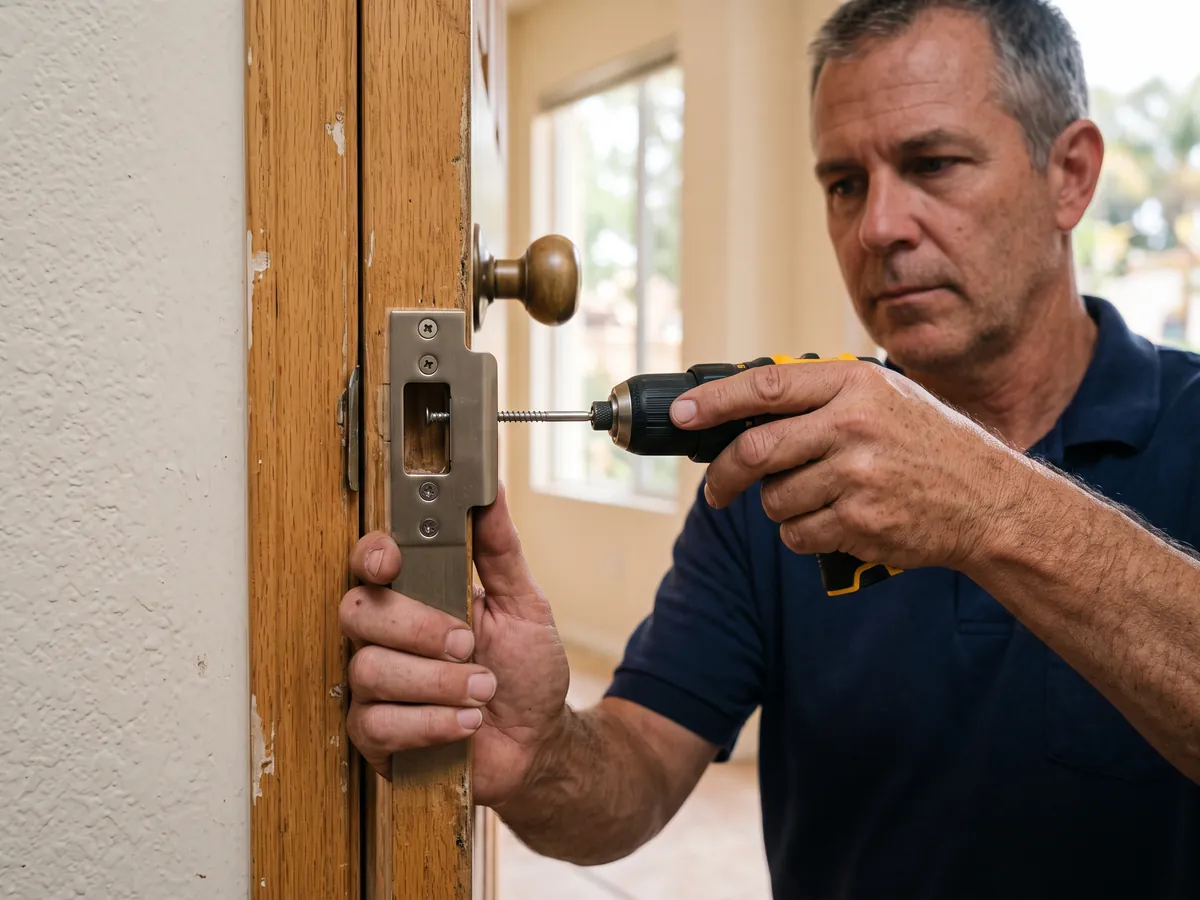
Walk down a lock aisle and every deadbolt looks about the same through the plastic. The differences are inside: bolt material, length of throw, the cylinder's pin count and drill protection, and the BHMA grade printed in small type on the back of the box. For homes in Walnut, we usually steer front doors toward Grade 1 or a strong Grade 2 and save lighter hardware for sheds and interior rooms. Julian's Locksmith installs Schlage, Kwikset, Yale and Baldwin deadbolts for everyday jobs and can source Medeco or Mul-T-Lock when you want restricted keys. We'll match the finish of your existing knob and key the new deadbolt to your current key if you like. Call (951) 903-3193 for a recommendation.
A deadbolt is the single most useful lock to add in most Walnut houses, and the usual place to start is the door that connects the garage to the house. In a lot of 1980s tract homes that door carries only a push-button or keyed knob, yet it is the door the family uses all day, which makes it the one nobody checks. Choose between single and double cylinder with fire safety in mind. A single-cylinder deadbolt has a thumbturn inside and a key outside. A double-cylinder needs a key on both sides, which sounds more secure around glass but can trap people during a fire, and building codes restrict it on required exit doors. For nearly every Walnut front, garage-entry and side door, single cylinder is the answer. Quality lives in the details. Grade 1 or Grade 2 deadbolts from Schlage, Kwikset or Yale have hardened bolts with at least a one-inch throw. The strike matters as much: a reinforced plate with 3-inch screws that reach the framing makes a door far harder to kick open than the lock alone. Check the door's age and material too. A hollow-core door with a deadbolt is only as strong as the door.
What to know first in Walnut
Most houses around Walnut are wood-framed with stucco outside, and the door frame is a softwood or finger-jointed jamb set into a rough opening with shims filling the gap. That gap is why short strike screws do so little. A 3/4-inch screw holds only in the jamb itself, while a 3-inch screw crosses the shim space and anchors in the 2x4 trimmer stud. Driving that long screw too hard, though, draws the jamb toward the stud and can make the door rub, so we snug it rather than crank it and add a shim where the gap is wide. Door construction changes the job too. Solid wood and wood-edged fiberglass doors bore cleanly. Steel doors have a thin skin over foam and a lock block that must be located before drilling. Hollow-core doors, which turn up on some older garage-entry and side openings, have almost nothing to hold a deadbolt, and we'll tell you if a door isn't worth reinforcing. Afternoon sun on west-facing doors swells and bows panels, so we leave the bolt enough clearance to work through that daily movement.
How we can help in Walnut
- Deadbolt installation on an undrilled door. Drilling a fresh hole is where most of the long-term quality is decided. We mark the centerline from the knob or handleset template, confirm the hole won't hit a glass lite or panel joint, and bore halfway from each side. The edge hole is drilled level and deep enough that the bolt can reach full extension.
- Adding a deadbolt above an existing knob or lever. If your door has only a knob or lever, we add the deadbolt above it, usually around five and a half inches center to center. That spacing keeps your hand from hitting the thumbturn and lines up with most matching handlesets, should you upgrade later. We confirm the inside trim won't collide with the knob's rose before drilling.
- Grade 1 and high-security deadbolts. For front doors that need the strongest hardware, we install Grade 1 deadbolts with hardened bolts, heavier housings and drill-resistant cylinders. Commercial-weight models from Schlage, Sargent and Corbin Russwin suit offices and rentals, while residential Grade 1 options fit most homes in Walnut without changing the look of your entry.
- Fixing deadbolts that drag or won't fully throw. A deadbolt that stops short of full throw is a weak deadbolt. We check the bolt's travel with the door open and closed, deepen or re-cut the strike pocket, shim hinges, and set a hinge screw long enough to pull a sagging door back up. The key should turn with two fingers and no help from your shoulder.
- Rental, multi-unit and small-business deadbolts. Property managers in Walnut often need several units handled in one trip. We bring matching hardware, key each unit to its own key under a master if you use one, reinforce strikes on doors that have taken abuse, and leave the keys tagged. Incoming tenants get a deadbolt that works smoothly from day one.
How Walnut shapes the job
Horse properties have tack rooms, feed rooms and barn offices holding saddles and equipment worth protecting. If those rooms have a standard swinging door, a deadbolt with a reinforced strike is a big improvement over a hasp and padlock that can be pried off. We install deadbolts suited to outbuilding doors, key them to your main property key if you like, and pick hardware with finishes that hold up to dust, hay and weather.
In family neighborhoods around Walnut, single-cylinder deadbolts are almost always the right call, because everyone, including kids, guests and grandparents, needs a fast way out in an emergency. We install Grade 1 or 2 deadbolts with reinforced strikes, key them to match your other doors, and set the bolt to turn easily so older children can operate it without a struggle during a fire drill or a real alarm.
Larger homes around Walnut often have heavy custom doors, oversized double entries and many exterior openings. Deadbolts for these need the right thickness range, extended tailpieces and finishes matched to high-end handlesets from brands like Baldwin. We also install high-security deadbolts with restricted keys from Medeco or Mul-T-Lock for owners who want tight control over copies, which matters when housekeepers, landscapers and contractors come and go through the year.
Situations this covers
Imagine a rear door in Hunter Hills Estates with a window panel beside the lock. The owner asks about a double-cylinder deadbolt because a thief could break the glass and reach the thumbturn. We would explain the fire-exit problem, then offer a better plan: a single-cylinder Grade 1 deadbolt, a reinforced strike, and security film or a decorative grille over the glass. The thumbturn stays, so everyone can get out quickly.
- For example, a landlord with a small fourplex gets a repair list after a tenant complaint, including worn deadbolts with stubby bolts that barely catch. We'd replace each unit's deadbolt with a full one-inch-throw model, key every unit differently, reinforce two strikes showing old pry marks, and hand over tagged keys with a simple key record. A job like that can usually be finished in one scheduled visit rather than four separate trips.
- Say you have patio French doors where the stationary door is held only by short flush bolts at the top and bottom. Push on the center and both doors flex inward together. We'd install longer flush bolts that seat deeper into the head jamb and threshold, then fit a deadbolt on the active door with a strike made for a door edge, so the pair resists force as one unit.
- For example, a family converts the space behind the main house into a detached casita for a grandparent. Its entry door came with only a basic knob. We'd install a single-cylinder deadbolt with a larger, easy-grip thumbturn, key it to the main house key so relatives carry one key, and reinforce the strike. Nobody inside the casita ever needs to hunt for a key to get out quickly.
From your call to the finished job
- Tell us about the door. Measure the door's thickness and, if there's an existing hole, the distance from the door edge to its center. Those two numbers, usually 1-3/4 inch thick and a 2-3/8 or 2-3/4 inch backset, let us quote accurately and bring matching hardware to your Walnut address.
- Assess the door, frame and options. Before any tool touches the door, we look at the hinges, the gap on the latch side, the weatherstrip and whether the bolt will land in sound wood. If something needs fixing first, like a sagging hinge, we say so and price it separately, so the decision stays yours.
- Prepare the door. For a blank door, we clamp a boring jig at the marked height, cut the 2-1/8-inch face hole halfway from each side, and drill the 1-inch edge hole square to the face. The faceplate recess is chiseled or routed so the bolt plate sits flush with the door's edge.
- Reinforce the strike and jamb. If you've chosen extra reinforcement, this is when the steel jamb strip, door-edge wrap and long hinge screws go in. Each piece is fitted around the existing trim and weatherstrip, so the door still closes softly and seals against dust and drafts in Walnut.
- Mount, key and align. The bolt goes into the edge with the correct side facing up, the exterior cylinder and tailpiece pass through, and the interior turn piece is screwed on. We key the cylinder to your existing key or a new one, then test operation with the door open and again with it closed.
- Test and hand over. Before we leave, you try it yourself: key outside, thumbturn inside, door closed. We show you how to tell when the bolt is fully thrown and mention any related issues we noticed, like a worn knob latch or loose hinge, with no pressure to fix them today.
How we quote the job
- Whether the door is already drilled. Installing into existing holes is quicker than boring a new door. A blank door needs layout, face and edge bores and a faceplate mortise, which adds time and care, and steel or fiberglass skins add a bit more. We list door prep as its own line in the quote so you can see where the time goes.
- How much strike and frame reinforcement. If the jamb has already been kicked or pried, repairing it before reinforcing adds time. Small splits can be glued and strapped with hardware; heavy damage may call for a carpenter. The cost depends on how much of the frame we're rebuilding versus simply strengthening sound wood.
- Keying and number of keys. Keying options range from using the key that came in the box to setting up a master key system for a rental property. Each cylinder that's rekeyed adds a little time, and restricted keys cost more to cut than standard ones. We list keying separately so you can see exactly what you're paying for.
Every job gets a clear quote before any work starts. Call (951) 903-3193 with the details and we'll tell you what to expect for your situation in Walnut.
What not to do
- Reusing the short screws packed with the strike. Many deadbolt kits include screws that reach only the jamb. Without longer screws anchored in the stud, a well-placed kick can tear the strike out of the frame no matter how strong the deadbolt itself is.
- Cranking 3-inch strike screws until the jamb bows inward. Overtightening pulls the frame toward the stud, changes the gap around the door, and can make the bolt miss its pocket. Snug is enough, and a shim behind the strike handles a wide gap.
- Ignoring the inactive leaf on double doors. The deadbolt on the active door throws into the stationary door's edge, so if that leaf is held by weak flush bolts, both doors can be pushed open together despite a strong deadbolt on the active side.
Advice before you book
- Fresh weatherstripping can push the door away from the stop and pull the bolt out of line with the strike. If your deadbolt starts dragging right after weatherstrip work, that's probably the reason, and moving the strike slightly is usually a small fix.
- When painting a door or frame, remove the deadbolt and strike or mask them carefully. Paint on the bolt or inside the strike pocket builds up over several coats and is a common reason a deadbolt that worked for years suddenly starts sticking.
- Tenants: get written permission before adding or changing a deadbolt, and check whether your lease requires you to give the owner a key. California puts the duty to provide a working entry deadbolt on the landlord, so reporting a faulty one in writing is often the right first step.
- If there's glass within arm's reach of your thumbturn, deal with the glass before reaching for a double-cylinder deadbolt. Security film, laminated glass or a solid sidelight addresses the reach-through risk without putting a keyed lock between your family and the way out.
Getting to Walnut
Walnut is about 40 miles from our San Bernardino base, roughly 46 minutes in light traffic via I-215 South briefly to SR-210 West. When you call, you get an arrival estimate based on where the technician is and the traffic at that moment.
If you're close to Pierre Road, tell us which exit or cross street you're nearest. It trims the last mile and keeps the van from circling a block that looks right on the map but isn't.
About Walnut: Buzzard Peak in the San Jose Hills rises to 1,375 feet, the highest point in Walnut, while the southern edge of the city near Valley Boulevard sits around 500 feet.
| Neighborhoods | Country Hollow, Walnut Grove senior condominiums, Hunter Hills Estates, West Valley, Lemon Creek, Timberline |
|---|---|
| ZIP codes | 91789 |
| Main routes | SR-60, SR-57, I-10, Valley Boulevard |
| From our San Bernardino base | about 40 miles via I-215 South briefly to SR-210 West (Foothill Freeway) through Rialto, Fontana, Rancho Cucamonga and La Verne, then SR-57 South to the Temple Avenue exit and west past Mt. SAC to Grand Avenue, Amar Road and La Puente Road; I-10 West to SR-57 South as the alternate, and SR-60 West through the 57/60 confluence to Lemon Avenue, Fairway Drive or Nogales Street for Valley Boulevard and West Valley |
New or replacement locks in Walnut?
Call (951) 903-3193 and tell us which doors and what kind of hardware you have in mind. If you already bought the lock, keep the box handy so we can check it fits the door, and we'll quote the install before any work starts.
Frequently asked questions
Is a smart deadbolt as strong as a regular deadbolt?
It depends on the model. Many smart deadbolts, including the Schlage Encode and Yale Assure lines, publish a BHMA grade or residential rating, so compare those the same way you would for a mechanical deadbolt. The installation matters as much as the lock: a smart deadbolt still needs a reinforced strike, long screws and a bolt that throws fully.
Are landlords in California required to provide deadbolts?
Yes. California Civil Code section 1941.3 requires landlords to install and maintain an operable deadbolt on each main swinging entry door of a dwelling unit, with the bolt extending at least 13/16 inch beyond the strike edge into the jamb. We install compliant deadbolts for rental owners throughout Los Angeles County and can key them per unit or under a master.
What's the difference between single- and double-cylinder deadbolts?
A single-cylinder deadbolt has a key outside and a thumbturn inside. A double-cylinder deadbolt needs a key on both sides. Single cylinders let anyone inside exit quickly. Double cylinders stop someone from reaching through nearby glass to turn the thumbturn, but they can trap people inside during an emergency if the key isn't right there.
Do you install deadbolts on business doors?
Yes. We install Grade 1 deadbolts and mortise deadlocks on office, retail and warehouse doors in Walnut. Exit doors generally must open from inside without a key, and some business entrances may use a key-operated lock only with a specific posted sign. We'll review those requirements with you before anything is installed.
Why do I have to push or lift my door to lock the deadbolt?
The bolt and strike are out of alignment, often because of sagging hinges, a shifted frame, new weatherstripping or heat swelling the door. Forcing it wears out the tailpiece and cam. We diagnose the cause, adjust hinges or the strike, and set it so the key turns smoothly without any pressure on the door.
How long does a deadbolt installation take?
Installing into a door that already has standard holes is a fairly short job once we're on site. Boring a new door, reinforcing the jamb, or working on steel or double doors takes longer, and a damaged frame adds more. We'll give you a realistic time estimate for your specific door in Walnut when you call (951) 903-3193 and describe what you have.
How far is Walnut from your base?
Walnut is about 40 miles from our San Bernardino base, roughly 46 minutes in light traffic. Arrival time depends on traffic and on the job the technician is finishing, so we give you an estimate on the phone before you commit.
Related services in Walnut
- Deadbolt Replacement in Walnut
- Double Cylinder Deadbolt Installation in Walnut
- Deadbolt Repair in Walnut
- Smart Deadbolt Installation in Walnut
- Lock Installation in Walnut
- Front Door Lock Installation in Walnut
- Security Lock Upgrade in Walnut
- High Security Locks in Walnut
- Lock Rekey in Walnut
- Locksmith for Rental Property in Walnut
Deadbolt Installation in nearby cities
- Deadbolt Installation in West CovinaLos Angeles County
- Deadbolt Installation in Diamond BarLos Angeles County
- Deadbolt Installation in ValindaLos Angeles County
- Deadbolt Installation in Rowland HeightsLos Angeles County
- Deadbolt Installation in CovinaLos Angeles County
- Deadbolt Installation in City of IndustryLos Angeles County
- Deadbolt Installation in Charter OakLos Angeles County
- Deadbolt Installation in La PuenteLos Angeles County