
Downey, Los Angeles County
Deadbolt Installation in Downey
Short answer: BHMA grades deadbolts 1 through 3. Grade 1 is the toughest tier, Grade 2 is a solid residential choice, and Grade 3 is light builder hardware. For an entry door in Downey, we usually recommend Grade 1 or 2 paired with a reinforced strike, because the jamb tends to give out before the bolt does. Julian's Locksmith installs all three: (951) 903-3193.
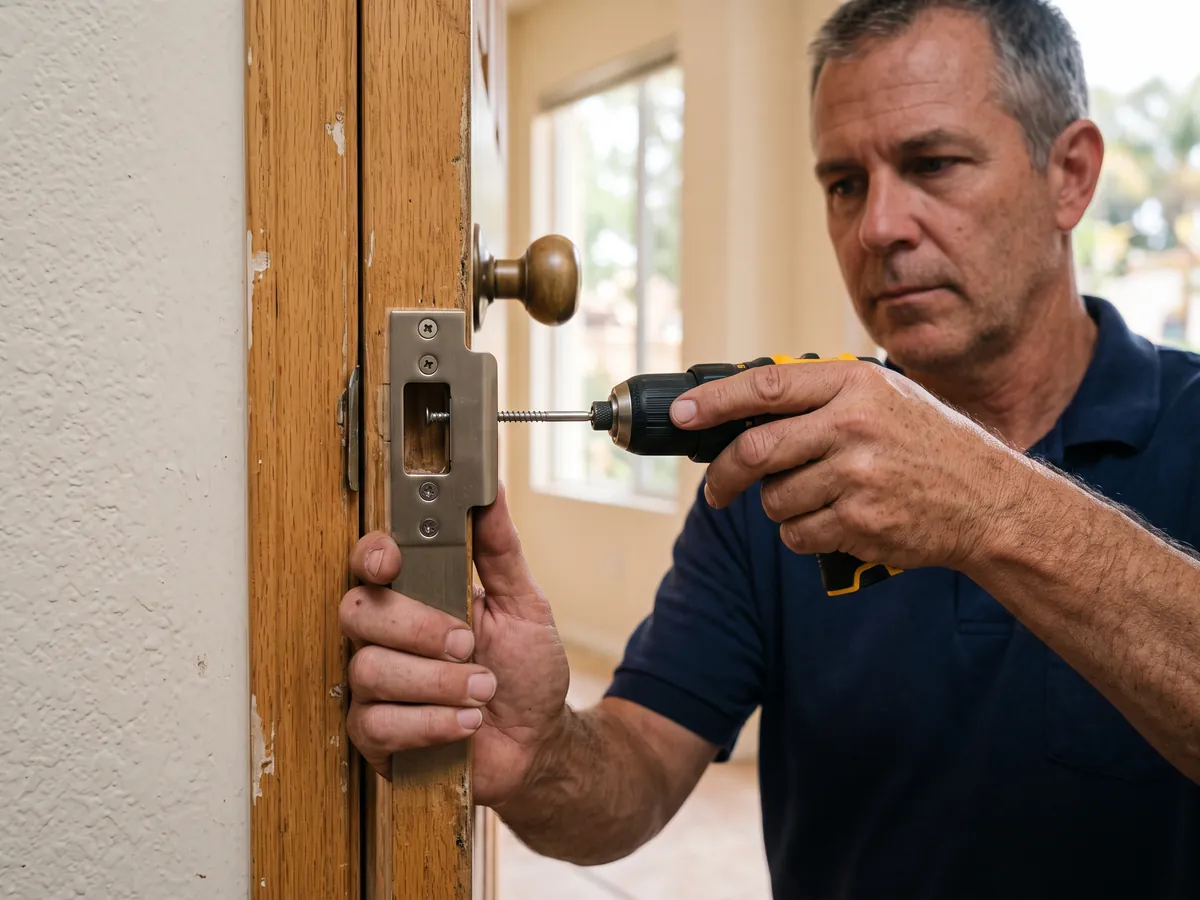
Deadbolt installation is usually something you plan, so we schedule it around your day. Julian's Locksmith works every day from 6:30 a.m. to 11:30 p.m., and we come to your Downey address with boring jigs, hole saws, chisels, long screws and a selection of hardware. A deadbolt going into existing holes takes a modest part of the visit. An undrilled door, a steel skin or a frame that needs repair adds time, and we'll tell you that up front. You get a written price before the first hole is drilled. If a recent break-in left you without a working lock, say so when you call so we can move you up the list. (951) 903-3193.
A good deadbolt is one of the most effective upgrades you can make to a Downey front door, and the details decide whether it helps. Single-cylinder deadbolts take a key outside and a thumb turn inside. Double-cylinder models need a key on both sides. A double-cylinder lock can make sense on a door with a glass panel, where a burglar could break the glass and reach the thumb turn, but it raises a fire-safety problem. Building codes generally expect main exit doors to open from inside without a key, so a lost key in a smoky room is a real risk. Most homes are better served by a single-cylinder lock and a break-resistant panel. Grade matters. ANSI/BHMA Grade 3 meets a basic standard, Grade 2 is a solid choice for most houses and Grade 1 is built for heavy use. The deadbolt body is only part of the story. A reinforced strike plate and three-inch screws that reach the framing do more than anything else to keep a door from being kicked in. We install deadbolts on front doors, side doors and garage entry doors, and on rental doors when the landlord approves. On the postwar houses around Furman Park, the original door often has only a knob lock, which leaves a lot to improve.
Deadbolt Installation in Downey: what to expect
Fire safety shapes deadbolt choices more than most people realize. California's residential code expects a home's egress door to open from inside without a key, tool or special knowledge, and the rules for apartments and other residential units allow a deadbolt alongside the latch only when it releases from inside without a key. A single-cylinder deadbolt meets that easily. A double-cylinder model, keyed on both faces, can conflict with it on the door you'd actually use to escape, and local fire officials may flag it. Commercial doors carry their own rules. Exit doors generally have to open from the egress side in one motion without a key. A narrow exception lets certain businesses put a key-operated lock on the main entrance if a posted sign says the door stays unlocked while the space is occupied, and the building official can withdraw that allowance. Fire-rated doors, such as the door between an attached garage and the house, shouldn't be drilled carelessly, since unapproved holes can compromise the rating. Julian's Locksmith points out these issues in Downey before installing, so your new deadbolt adds security without creating a trap.
What we can do on-site
- Reinforced strike plates with 3-inch screws. The strike in the jamb takes the force of a kick, so we upgrade it on every install. Out go the 3/4-inch screws that reach only the jamb; in go hardened 3-inch screws that pass through the shim gap and anchor in the trimmer stud. Where the jamb allows, we mortise in a heavier four-screw strike with a deep box behind the bolt hole.
- Jamb, door-edge and hinge-side reinforcement. Split jambs, chewed-up strike holes and doors cracked through the bore are common after an attempted entry. We can rebuild modest damage with glue, clamps and reinforcement hardware. If the jamb is broken into pieces or the door is split end to end, we'll tell you honestly that a carpenter or a new prehung door should come first.
- Fixing deadbolts that drag or won't fully throw. Afternoon sun on a dark steel door or seasonal swelling in a wood one can push the bolt out of line for part of the day. We test the lock at several points in the door's swing and set clearances so it works on a cool morning and in late-afternoon heat, rather than tuning it for one moment.
- French doors and double-door entries. On a pair of doors, the deadbolt on the active leaf throws into the edge of the inactive one, so that inactive leaf has to be locked solidly top and bottom. We install or upgrade flush bolts that reach into the head jamb and a floor or threshold strike, then fit the deadbolt with a strike sized for a door edge.
- Rental, multi-unit and small-business deadbolts. Small offices and shops get Grade 1 deadbolts suited to heavy daily use, with attention to egress and accessibility. If the door is a required exit, the inside must open without a key. On aluminum storefronts with narrow stiles, we fit the narrow-backset deadlocks those doors were built for rather than a residential deadbolt.
Local factors in Downey
Warehouses and distribution buildings around Downey have hollow-metal man doors in steel frames that take a beating from forklifts, dust and constant use. We install Grade 1 deadbolts or mortise deadlocks fitted to steel frames, use strikes designed for hollow-metal jambs, and make sure any door serving as an exit still opens from inside without a key, which keeps the building in line with fire inspections.
Shops along I-710 need deadbolts that handle constant daily use and comply with egress rules for customer and employee exits. We install Grade 1 deadbolts on back and side doors, narrow-backset deadlocks on aluminum storefront doors, and explain where a key-operated main entrance is allowed with the required posted sign. We can also key several doors alike for managers while keeping an owner's key separate.
Apartment owners in Downey must provide a working deadbolt on each unit's main entry door, with a bolt that extends at least 13/16 inch beyond the door edge under California law. We install compliant deadbolts, key them per unit or under a master system, and reinforce strikes on doors that have taken years of abuse. Inside operation stays keyless, which keeps residents in line with egress rules and keeps maintenance staff out of fire-safety trouble.
Common situations
A typical call comes from a landlord with a duplex near Dennis the Menace Park whose back door has nothing but a push-button knob. His tenants ask for something stronger. We would drill a clean bore, install a Grade 2 single-cylinder deadbolt, keyed to the unit's front door so each tenant carries one key, and set a reinforced strike with three-inch screws into the stud behind the jamb.
- For example, a family converts the space behind the main house into a detached casita for a grandparent. Its entry door came with only a basic knob. We'd install a single-cylinder deadbolt with a larger, easy-grip thumbturn, key it to the main house key so relatives carry one key, and reinforce the strike. Nobody inside the casita ever needs to hunt for a key to get out quickly.
- Picture a front entry with a steel security screen door outside the main door, a setup found all over Los Angeles County. The owner wants a new deadbolt on the main door and the screen door keyed the same. We'd check the gap between the two doors so the new exterior cylinder and handle won't hit the screen door's lock box, rekey the screen door's lock to match, and test both closed together.
- A typical call after an attempted break-in: the front door held, but the jamb around the strike split along the grain and the bolt now has little solid wood to land in. We'd glue and clamp the split, add a steel jamb reinforcement strip, set a box strike with long screws, and move up to a Grade 1 deadbolt. If the jamb had shattered into loose pieces, we'd recommend a carpenter before any new lock goes on.
How the visit works
- Tell us about the door. On the first call we ask what you want the deadbolt to do: replace a failed one, add one to a door with only a knob, or step up to Grade 1 after a scare. That answer, plus the door type, tells us which hardware to load and how much time to plan.
- Assess the door, frame and options. Before any tool touches the door, we look at the hinges, the gap on the latch side, the weatherstrip and whether the bolt will land in sound wood. If something needs fixing first, like a sagging hinge, we say so and price it separately, so the decision stays yours.
- Prepare the door. For a blank door, we clamp a boring jig at the marked height, cut the 2-1/8-inch face hole halfway from each side, and drill the 1-inch edge hole square to the face. The faceplate recess is chiseled or routed so the bolt plate sits flush with the door's edge.
- Reinforce the strike and jamb. We mark the strike by throwing the bolt against the closed jamb, drill the bolt pocket deep enough for full extension, and mortise a reinforced strike flush. Then 3-inch screws go through the jamb and shim gap into the stud, tightened just enough to hold without pulling the frame.
- Mount, key and align. Final alignment happens with the door closed and the weatherstrip compressed. If the bolt drags anywhere, we adjust the strike or hinges until it slides freely. A properly aligned deadbolt turns with fingertip pressure, with no lifting, pulling or pushing on the door.
- Test and hand over. We cycle the lock several times from both sides, try every key, and confirm the bolt reaches full throw into the strike. You get your keys, a quick walkthrough of the hardware, and tips for keeping the deadbolt working through Downey's heat and dust.
What affects the cost
- Whether the door is already drilled. Installing into existing holes is quicker than boring a new door. A blank door needs layout, face and edge bores and a faceplate mortise, which adds time and care, and steel or fiberglass skins add a bit more. We list door prep as its own line in the quote so you can see where the time goes.
- How much strike and frame reinforcement. A reinforced strike with 3-inch screws is part of every install we do and adds little to the total. Going further with a full-length steel jamb strip, a door-edge wrap and long hinge screws adds parts and labor. We'll recommend the level that matches the door's exposure and history.
- Keying and number of keys. If the deadbolt you choose uses a different keyway from your other locks, matching them may mean rekeying or replacing additional cylinders. We point out that trade-off before you buy hardware, so the convenience of a single key doesn't turn into an unexpected expense on the day.
Every job gets a clear quote before any work starts. Call (951) 903-3193 with the details and we'll tell you what to expect for your situation in Downey.
Mistakes to avoid
- Putting a double-cylinder deadbolt on the main exit door and keeping the key in a drawer across the room. In a fire, smoke and panic make finding a key hard, and California's egress rules expect a home's exit door to open from inside without one.
- Forcing a binding deadbolt by pushing or lifting the door every time you lock it. That strains the tailpiece and cam until something snaps. A bolt that binds is telling you the door and strike are misaligned, and the alignment is what needs fixing.
- Choosing a deadbolt by finish and style alone. A handsome deadbolt can hide a light Grade 3 mechanism. For an exterior door, check the grade or residential rating first, then pick a finish from the hardware that meets the standard your door needs.
What to do before we arrive
- A deadbolt only protects you when it's thrown. Make a habit of turning it every time you close the door, even for a quick trip to the mailbox or the side yard, because the spring latch in your knob can be slipped with a thin tool in seconds.
- If you have a security screen door, check how much space sits between it and the main door before buying a new deadbolt or handleset. Bulky exterior trim can hit the screen door's frame or lock box, which is far easier to plan around than to correct after the holes are drilled.
- Turn the deadbolt package over before you buy. The BHMA grade or three-letter residential rating is usually printed in small type on the back. Ignore phrases like heavy duty or maximum security on the front; the grade or rating is what tells you how the lock actually performed in testing.
- Fresh weatherstripping can push the door away from the stop and pull the bolt out of line with the strike. If your deadbolt starts dragging right after weatherstrip work, that's probably the reason, and moving the strike slightly is usually a small fix.
Getting to Downey
Downey is about 59 miles from our San Bernardino base, roughly 66 minutes in light traffic via I-215 South to I-10 West through Rialto, Fontana, Ontario, Pomona and West Covina. When you call, you get an arrival estimate based on where the technician is and the traffic at that moment.
Most trips into Downey use Old River School Road for at least part of the drive, and the technician keeps an eye on live traffic along the way so the arrival estimate you heard on the phone stays honest.
About Downey: Every Apollo Command and Service Module was built at the Downey plant run by North American Aviation and later Rockwell, and the Space Shuttle was conceived there before the plant closed in 1999.
| Neighborhoods | North Downey, Stonewood Center area, Downtown Downey, Furman Park and Rives Avenue, Columbia Way and the former Rockwell plant site, Civic Center on Brookshire Avenue |
|---|---|
| ZIP codes | 90240, 90241, 90242 |
| Main routes | I-5, I-105, I-605, I-710 |
| From our San Bernardino base | about 59 miles via I-215 South to I-10 West through Rialto, Fontana, Ontario, Pomona and West Covina (or SR-210 West) to I-605 South, then the Florence Avenue, Firestone Boulevard or Imperial Highway exit depending on the address; Firestone Boulevard reaches Stonewood Center and Downtown Downey, Imperial Highway reaches Kaiser Permanente, Rancho Los Amigos and the south end, and Florence Avenue reaches the Lakewood Boulevard corner |
New or replacement locks in Downey?
Call (951) 903-3193 and tell us which doors and what kind of hardware you have in mind. If you already bought the lock, keep the box handy so we can check it fits the door, and we'll quote the install before any work starts.
Frequently asked questions
Can you install deadbolts on French doors or double doors?
Yes. The deadbolt goes on the active door and throws into the edge of the stationary door. That stationary door must be secured with solid flush bolts at the top and bottom, or the pair can be pushed open together. We install or upgrade those flush bolts and fit the deadbolt with a strike designed for a door edge.
Do you install deadbolts on steel and fiberglass doors?
Yes. Steel doors have a thin skin over foam with an internal lock block, and fiberglass doors need sharp bits to avoid chipping the skin. We locate the block, drill carefully and keep the core sealed. Many prehung steel and fiberglass doors come pre-bored for a deadbolt, which makes the install simpler and cleaner.
How much does deadbolt installation cost?
It depends on whether the door is already drilled, the deadbolt grade, how much strike reinforcement you want, the door material and your keying needs. We give you a quote before any drilling begins, and nothing is added without your approval. Call (951) 903-3193 with details about your door in Downey for a realistic range.
Can I install a deadbolt in my rental as a tenant?
Check your lease first. Most leases require the landlord's permission to add or change locks, and many require you to give the owner a key. Get approval in writing. If your entry door doesn't have a working deadbolt at all, notify the landlord in writing, since providing one is the owner's responsibility under California law.
Which grade of deadbolt should I buy for my front door?
For exterior doors on most Downey homes, Grade 1 or a strong Grade 2 deadbolt is the right range. Grade 3 is fine for interior doors and storage rooms. Just as important as the grade is how it's installed: a reinforced strike anchored with long screws makes any good deadbolt far harder to defeat.
Why do I have to push or lift my door to lock the deadbolt?
The bolt and strike are out of alignment, often because of sagging hinges, a shifted frame, new weatherstripping or heat swelling the door. Forcing it wears out the tailpiece and cam. We diagnose the cause, adjust hinges or the strike, and set it so the key turns smoothly without any pressure on the door.
How far is Downey from your base?
Downey is about 59 miles from our San Bernardino base, roughly 66 minutes in light traffic. Arrival time depends on traffic and on the job the technician is finishing, so we give you an estimate on the phone before you commit.
Related services in Downey
- Deadbolt Replacement in Downey
- Double Cylinder Deadbolt Installation in Downey
- Deadbolt Repair in Downey
- Smart Deadbolt Installation in Downey
- Lock Installation in Downey
- Front Door Lock Installation in Downey
- Security Lock Upgrade in Downey
- High Security Locks in Downey
- Lock Rekey in Downey
- Locksmith for Rental Property in Downey
Deadbolt Installation in nearby cities
- Deadbolt Installation in BellflowerLos Angeles County
- Deadbolt Installation in NorwalkLos Angeles County
- Deadbolt Installation in Santa Fe SpringsLos Angeles County
- Deadbolt Installation in Pico RiveraLos Angeles County
- Deadbolt Installation in ArtesiaLos Angeles County
- Deadbolt Installation in CerritosLos Angeles County
- Deadbolt Installation in LakewoodLos Angeles County
- Deadbolt Installation in WhittierLos Angeles County