
Bloomington, San Bernardino County
Deadbolt Installation in Bloomington, Built to Hold a Kick
Short answer: Most homes in Bloomington should get a single-cylinder deadbolt: key outside, thumbturn inside, so anyone can get out fast during a fire. Double-cylinder models, keyed on both faces, can conflict with California egress rules on a home's main exit and belong only in narrow cases. Julian's Locksmith explains the trade-offs before installing anything. Call (951) 903-3193.
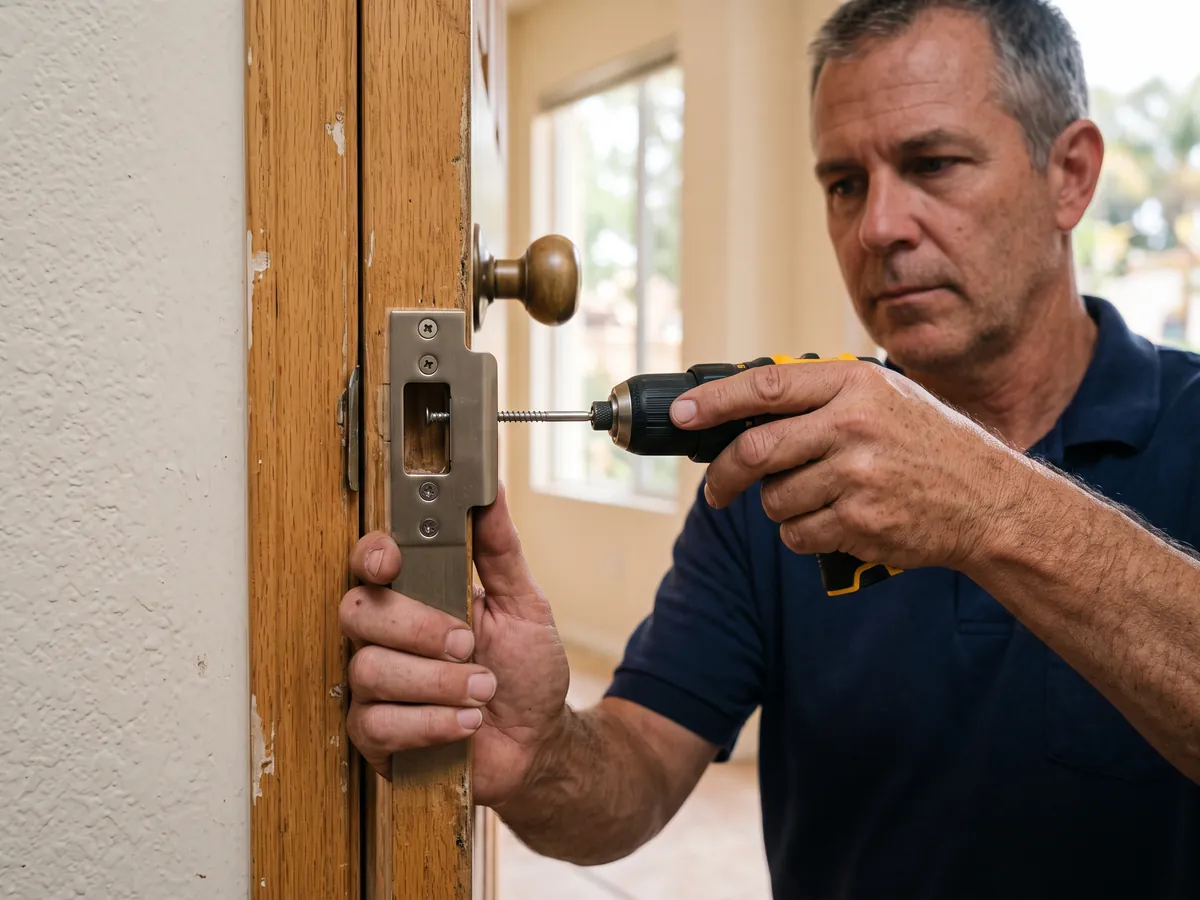
Walk down a lock aisle and every deadbolt looks about the same through the plastic. The differences are inside: bolt material, length of throw, the cylinder's pin count and drill protection, and the BHMA grade printed in small type on the back of the box. For homes in Bloomington, we usually steer front doors toward Grade 1 or a strong Grade 2 and save lighter hardware for sheds and interior rooms. Julian's Locksmith installs Schlage, Kwikset, Yale and Baldwin deadbolts for everyday jobs and can source Medeco or Mul-T-Lock when you want restricted keys. We'll match the finish of your existing knob and key the new deadbolt to your current key if you like. Call (951) 903-3193 for a recommendation.
A deadbolt is only as good as the door and frame it's anchored in. On a Bloomington property that often means a garage side door, a workshop door, a back-unit entry or a kitchen door with glass beside the lock, all of which commonly rely on a knob lock. A knob's spring latch can be slipped with a card or pried; a deadbolt's one-inch throw cannot. Choosing the right one: single-cylinder deadbolts have a key outside and a thumb-turn inside, which suits nearly every door. Double-cylinder deadbolts need a key on both sides and are meant for doors with glass within arm's reach, but they conflict with fire safety, because in an emergency you may not have the key. We install them only where it makes sense, and we usually advise a single cylinder with window film or laminated glass instead. For strength, use ANSI Grade 1 or 2, a reinforced strike plate and 3-inch screws that reach the stud. We also check the door edge and jamb, and fixing a split jamb before the lock goes in is part of the job.
How this works in Bloomington
Most houses around Bloomington are wood-framed with stucco outside, and the door frame is a softwood or finger-jointed jamb set into a rough opening with shims filling the gap. That gap is why short strike screws do so little. A 3/4-inch screw holds only in the jamb itself, while a 3-inch screw crosses the shim space and anchors in the 2x4 trimmer stud. Driving that long screw too hard, though, draws the jamb toward the stud and can make the door rub, so we snug it rather than crank it and add a shim where the gap is wide. Door construction changes the job too. Solid wood and wood-edged fiberglass doors bore cleanly. Steel doors have a thin skin over foam and a lock block that must be located before drilling. Hollow-core doors, which turn up on some older garage-entry and side openings, have almost nothing to hold a deadbolt, and we'll tell you if a door isn't worth reinforcing. Afternoon sun on west-facing doors swells and bows panels, so we leave the bolt enough clearance to work through that daily movement.
What we can do on-site
- Reinforced strike plates with 3-inch screws. A deep metal box strike does two jobs: it keeps crumbling softwood out of the bolt hole and gives the bolt a clean pocket to seat in. Paired with longer screws set into the stud, it turns the thinnest part of the frame into something that resists a shoulder. In Bloomington, we fit both during the same visit as the lock.
- Jamb, door-edge and hinge-side reinforcement. Thorough reinforcement covers three areas: the latch-side jamb, the door around the lock holes, and the hinges. A wrap plate keeps the door from splitting through the bores we cut, a jamb strip keeps the strike area from blowing out, and swapping a center hinge screw for a 3-inch one braces the opposite edge of the door.
- Double-cylinder and one-sided deadbolts, with an egress check. A one-sided deadbolt has a thumbturn inside and a smooth blank plate outside, with no keyhole at all. It suits doors you only lock from indoors, like a garage-to-house door or a back door to the patio. There's nothing to pick or bump from the exterior, and nobody gets trapped, because the inside turn is always there.
- Keyed alike to your existing keys. A new deadbolt shouldn't mean another key on the ring. We rekey its cylinder to match your current house key, or rekey everything to a fresh key if the old ones have been floating around for years. Schlage, Kwikset, Yale and Baldwin use different keyways, so we choose hardware that can actually share your key.
- Fixing deadbolts that drag or won't fully throw. A deadbolt that stops short of full throw is a weak deadbolt. We check the bolt's travel with the door open and closed, deepen or re-cut the strike pocket, shim hinges, and set a hinge screw long enough to pull a sagging door back up. The key should turn with two fingers and no help from your shoulder.
How Bloomington shapes the job
Properties on larger lots near Bloomington often have more doors than people expect: a detached garage, workshop, casita or pump house. Each one needs a deadbolt fitted to its door type, and owners usually want one key for all of them. We install deadbolts on outbuildings, key them alike to the house, and choose finishes that tolerate dust and sun, with strikes anchored into framing that's sometimes rougher than the main house.
Older homes in Bloomington often have solid wood doors that take a deadbolt well, but the hardware on them may date back decades: short-throw bolts, worn cylinders and strikes held by tiny screws. Some still rely on a lone knob or an original mortise lockset. We work with the door's existing holes where possible, avoid cutting into decorative panels, and fit a modern deadbolt with a full throw and a long-screw strike, matching period finishes where we can.
In family neighborhoods around Bloomington, single-cylinder deadbolts are almost always the right call, because everyone, including kids, guests and grandparents, needs a fast way out in an emergency. We install Grade 1 or 2 deadbolts with reinforced strikes, key them to match your other doors, and set the bolt to turn easily so older children can operate it without a struggle during a fire drill or a real alarm.
Common situations
The back door of a house a few blocks north of Valley Boulevard has a large glass pane next to a knob lock. The owner worries someone could break the glass and reach in. We would explain the options: a single-cylinder deadbolt set away from the pane, security film on the glass and a thumb-turn inside so everyone can get out. We install a Grade 2 deadbolt with a reinforced strike and three-inch screws, and the door finally closes with a solid thunk.
- Picture a front entry with a steel security screen door outside the main door, a setup found all over San Bernardino County. The owner wants a new deadbolt on the main door and the screen door keyed the same. We'd check the gap between the two doors so the new exterior cylinder and handle won't hit the screen door's lock box, rekey the screen door's lock to match, and test both closed together.
- A typical example: a dark-painted steel front door facing west locks easily at breakfast, but by late afternoon the bolt drags and the key won't turn unless you lean on the door. The sun has bowed the panel slightly toward the stop. We'd enlarge the strike pocket just enough, lift the door with a long screw in the top hinge, and test the lock again with the door both warm and cool.
- Imagine a family in a two-story house off Cedar Avenue with a decorative glass sidelight beside the front door. They ask for a double-cylinder deadbolt so nobody can reach through the glass and turn the thumbturn. We'd talk through the fire risk with kids sleeping upstairs, then suggest a single-cylinder Grade 1 deadbolt plus security film or laminated glass on the sidelight, which deals with the reach-through problem without locking anyone in.
How the visit works
- Tell us about the door. Call (951) 903-3193 and describe the door: wood, steel or fiberglass, whether it already has a deadbolt hole, and what hardware is on it now. A photo of the door edge and the inside face helps us bring the right jig, bits and deadbolt the first time.
- Assess the door, frame and options. This is where the egress question gets answered. We ask which door is your main exit, whether there's glass near the lock, and who lives in the home, including kids and older relatives. From there we recommend a configuration and grade that fit both the door and the people using it.
- Prepare the door. For a blank door, we clamp a boring jig at the marked height, cut the 2-1/8-inch face hole halfway from each side, and drill the 1-inch edge hole square to the face. The faceplate recess is chiseled or routed so the bolt plate sits flush with the door's edge.
- Reinforce the strike and jamb. The strike pocket needs to be deeper than the bolt's throw so the bolt never bottoms out. We cut it, set a box strike or heavy plate, and pilot-drill for the long screws. Where the shim gap is wide, a shim goes behind the strike so tightening doesn't bow the jamb.
- Mount, key and align. Before the trim screws are tightened, we center the cylinder so the tailpiece isn't pinched, the most common cause of a stiff key on a new install. We rekey or reset the cylinder to match your other locks, then check that both the key and thumbturn throw the bolt all the way.
- Test and hand over. Before we leave, you try it yourself: key outside, thumbturn inside, door closed. We show you how to tell when the bolt is fully thrown and mention any related issues we noticed, like a worn knob latch or loose hinge, with no pressure to fix them today.
Pricing factors
- The deadbolt you choose. Grade, brand and features all move the price. A Grade 2 residential deadbolt costs less than a Grade 1 commercial unit, and Medeco or Mul-T-Lock cylinders with key control cost more again. Finish can matter too, since some specialty finishes cost more than the common satin nickel or bronze options.
- Keying and number of keys. Keying options range from using the key that came in the box to setting up a master key system for a rental property. Each cylinder that's rekeyed adds a little time, and restricted keys cost more to cut than standard ones. We list keying separately so you can see exactly what you're paying for.
- Number of doors and scheduling. Doing several doors in one visit is more efficient than separate trips, so a whole-house deadbolt upgrade often works out to less per door than one-off installs. Travel distance from our San Bernardino base also factors in, and you see the total before work begins.
Every job gets a clear quote before any work starts. Call (951) 903-3193 with the details and we'll tell you what to expect for your situation in Bloomington.
Practical tips before you call
- If you have a security screen door, check how much space sits between it and the main door before buying a new deadbolt or handleset. Bulky exterior trim can hit the screen door's frame or lock box, which is far easier to plan around than to correct after the holes are drilled.
- Measure your backset before shopping. It's the distance from the door edge to the center of the round hole, usually 2-3/8 or 2-3/4 inch. Most current deadbolts adjust to either, but some decorative and high-security models don't, and a wrong backset can't be fixed with force.
- Turn the deadbolt package over before you buy. The BHMA grade or three-letter residential rating is usually printed in small type on the back. Ignore phrases like heavy duty or maximum security on the front; the grade or rating is what tells you how the lock actually performed in testing.
- Buy a deadbolt in the same brand and keyway as your other locks if you want one key for everything. A Kwikset knob and a Schlage deadbolt take different keys, and making them match later means rekeying or replacing one of them, which adds to the job.
Common errors that cost time and money
- Reusing the short screws packed with the strike. Many deadbolt kits include screws that reach only the jamb. Without longer screws anchored in the stud, a well-placed kick can tear the strike out of the frame no matter how strong the deadbolt itself is.
- Cranking 3-inch strike screws until the jamb bows inward. Overtightening pulls the frame toward the stud, changes the gap around the door, and can make the bolt miss its pocket. Snug is enough, and a shim behind the strike handles a wide gap.
- Drilling freehand without a jig. A face bore that's slightly off-angle or an edge bore that drifts makes the bolt rub and the tailpiece twist. The lock works at first but wears quickly, and fixing a misdrilled hole often means a reinforcement plate or filler block.
Service in Bloomington
Bloomington is about 14 miles from our San Bernardino base, roughly 22 minutes in light traffic via Belmont Avenue and Palm Avenue to I-215 South, SR-210 West to the Riverside Avenue exit. When you call, you get an arrival estimate based on where the technician is and the traffic at that moment.
Stuck on the shoulder or in a parking lot along Linden Avenue? Get somewhere safe, turn on your hazards, and give us the nearest exit or business so we can find the car without guessing.
About Bloomington: The Semi-Tropic Land and Water Company, formed in 1887, surveyed the Bloomington town site in April 1888 and also laid out Rialto and Fontana; it survives today as the West Valley Water District.
| Neighborhoods | South Bloomington, Original 1888 town site, Cedar Avenue corridor, Kessler Park area, Crestmore, Valley Boulevard corridor |
|---|---|
| ZIP codes | 92316, 92335 |
| Main routes | I-10, Cedar Avenue, Valley Boulevard, Slover Avenue |
| From our San Bernardino base | about 14 miles via Belmont Avenue and Palm Avenue to I-215 South, SR-210 West to the Riverside Avenue exit, then south on Riverside Avenue and west on Bloomington Avenue; the alternate is I-215 South to I-10 West and the Cedar Avenue exit, about 17 miles |
New or replacement locks in Bloomington?
Call (951) 903-3193 and tell us which doors and what kind of hardware you have in mind. If you already bought the lock, keep the box handy so we can check it fits the door, and we'll quote the install before any work starts.
Frequently asked questions
Can I buy my own deadbolt and have you install it?
Yes. Pick up the hardware you like and we'll install it. We'll look at the box first and tell you if it's a weak choice for that door, such as a Grade 3 deadbolt on a front entry, or if it won't fit your door's thickness or backset. That check happens before any drilling.
How long does a deadbolt installation take?
Installing into a door that already has standard holes is a fairly short job once we're on site. Boring a new door, reinforcing the jamb, or working on steel or double doors takes longer, and a damaged frame adds more. We'll give you a realistic time estimate for your specific door in Bloomington when you call (951) 903-3193 and describe what you have.
Can I add a deadbolt to the door between my garage and house?
Usually, yes. That door is often solid or fire-rated and set up to close on its own. We check the hinge edge for a fire label, follow the manufacturer's prep guidance, and install a single-cylinder or one-sided deadbolt. Afterward, the door should still swing shut and latch by itself, and we test that before leaving.
Can you put a deadbolt on a door that has never had one?
Yes. We drill a 2-1/8-inch face hole and a 1-inch edge hole using a clamped jig, chisel a recess so the bolt's faceplate sits flush, and cut a strike pocket into the jamb. Before drilling, we confirm the door is solid enough to hold a deadbolt and that the location clears glass, panels and the existing knob.
Is a smart deadbolt as strong as a regular deadbolt?
It depends on the model. Many smart deadbolts, including the Schlage Encode and Yale Assure lines, publish a BHMA grade or residential rating, so compare those the same way you would for a mechanical deadbolt. The installation matters as much as the lock: a smart deadbolt still needs a reinforced strike, long screws and a bolt that throws fully.
Do you install deadbolts on steel and fiberglass doors?
Yes. Steel doors have a thin skin over foam with an internal lock block, and fiberglass doors need sharp bits to avoid chipping the skin. We locate the block, drill carefully and keep the core sealed. Many prehung steel and fiberglass doors come pre-bored for a deadbolt, which makes the install simpler and cleaner.
How far is Bloomington from your base?
Bloomington is about 14 miles from our San Bernardino base, roughly 22 minutes in light traffic. Arrival time depends on traffic and on the job the technician is finishing, so we give you an estimate on the phone before you commit.
Related services in Bloomington
- Deadbolt Replacement in Bloomington
- Double Cylinder Deadbolt Installation in Bloomington
- Deadbolt Repair in Bloomington
- Smart Deadbolt Installation in Bloomington
- Lock Installation in Bloomington
- Front Door Lock Installation in Bloomington
- Security Lock Upgrade in Bloomington
- High Security Locks in Bloomington
- Lock Rekey in Bloomington
- Locksmith for Rental Property in Bloomington
Deadbolt Installation in nearby cities
- Deadbolt Installation in RialtoSan Bernardino County
- Deadbolt Installation in FontanaSan Bernardino County
- Deadbolt Installation in ColtonSan Bernardino County
- Deadbolt Installation in RubidouxRiverside County
- Deadbolt Installation in Grand TerraceSan Bernardino County
- Deadbolt Installation in North FontanaSan Bernardino County
- Deadbolt Installation in Jurupa ValleyRiverside County
- Deadbolt Installation in San BernardinoSan Bernardino County