
Lock Installation
Lock Replacement for Failed, Damaged and Outdated Hardware
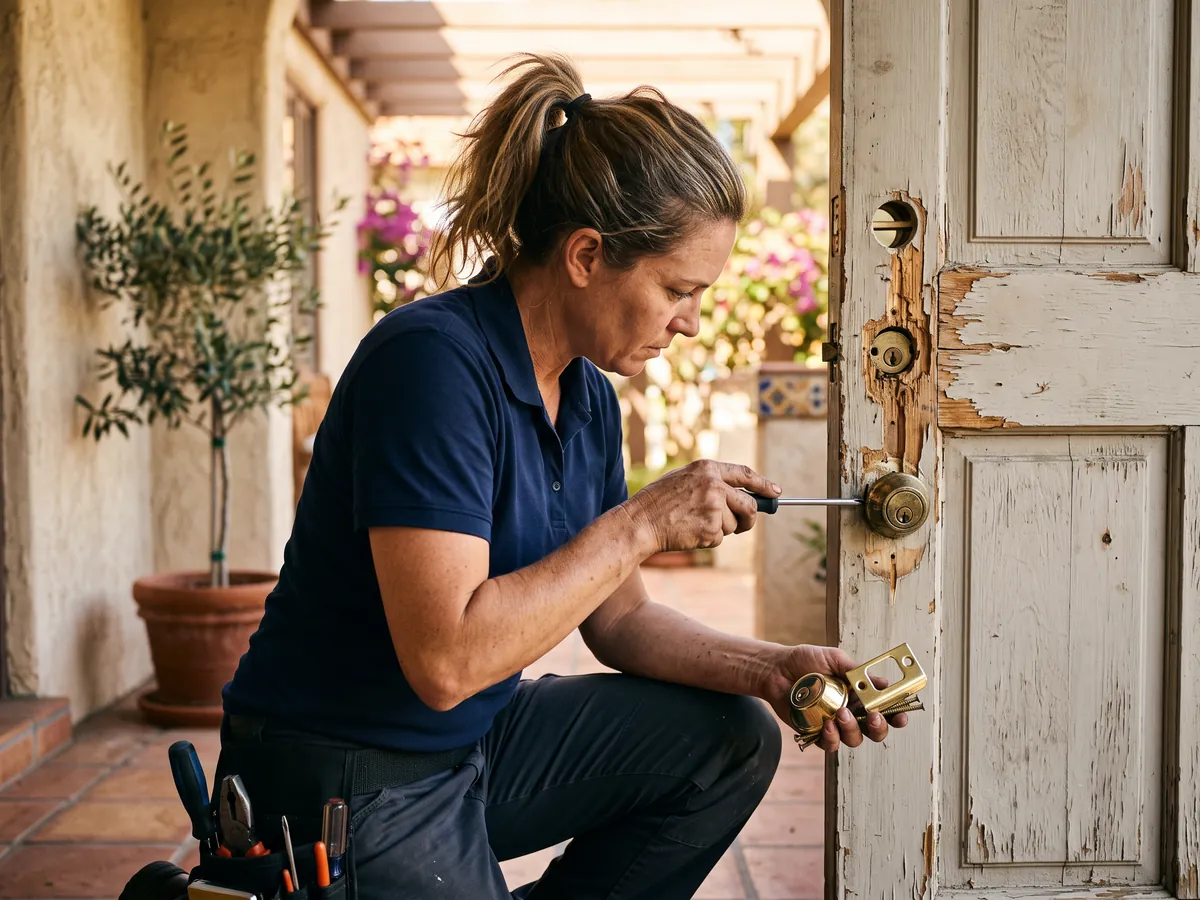
Short answer: Lock replacement removes a lock that has broken, been damaged or become obsolete and installs new hardware sized to the door's existing holes. Julian's Locksmith does this on-site across the Inland Empire, San Gabriel Valley, Pomona Valley, north Orange County and southeast Los Angeles County. We diagnose the failure, measure the door prep, quote before work starts, and can key the new lock to your existing key.
Signs a Lock Has Reached the End
Locks give warnings before they quit, and most people ignore them until the morning the door won't open. A few symptoms point clearly toward replacement rather than adjustment:
- The key rotates freely but the bolt never moves. The tailpiece or cam linking the cylinder to the bolt has sheared or stripped.
- A lever sags below horizontal and stays there. The return spring inside the chassis has broken or slipped off its seat.
- The latch doesn't spring back out after you release the handle. The latch spring or retractor is worn, and the door may drift open on its own.
- The knob turns but the latch stays extended. A spindle or retractor tab has failed inside the lockset.
- Only one specific old key works, and only with jiggling. The cylinder pins and plug are worn enough that freshly cut copies no longer line up.
- The bolt is visibly bent, the cylinder spins in its housing, or the trim wobbles no matter how much you tighten the screws.
Some symptoms look like lock failure but aren't. A deadbolt that throws easily with the door open but fights you once it's closed has an alignment problem at the strike. A latch that misses its plate usually means the door has sagged on its hinges. Before we recommend new hardware, we test the lock both ways. If adjusting the strike or tightening hinge screws solves it, that's what we do, and your existing lock stays on the door.
Replace, Rekey or Repair: Making the Call
Three different fixes cover almost every lock problem, and choosing the wrong one wastes money.
Rekeying changes the pins inside a working cylinder so old keys stop operating it. It's the right move when the lock functions well and the issue is key control, such as after moving in or after a roommate leaves. It does nothing for a broken mechanism.
Repair replaces one specific failed part. It makes sense on quality hardware where the manufacturer still sells components, such as a commercial mortise lock with a broken spring or a deadbolt with a replaceable cylinder. On budget residential locks, individual parts often aren't sold at all, or cost nearly as much as a new lock.
Replacement installs new hardware. We recommend it when:
- The mechanism is worn throughout rather than failing at one point
- Damage has bent the bolt, cracked the housing or destroyed the cylinder
- Parts are discontinued or the brand has left the market
- The lock is too weak for the door's exposure or traffic
- The hardware falls short of a legal requirement, such as a rental entry deadbolt with a short bolt
- You want a different function, like keyless entry or levers instead of knobs
Cost matters too. A lock that needs a new cylinder, a new latch and a new strike may cost almost as much to repair as to replace, and the replacement arrives with all-new wear parts. When the choice is close, we show you both numbers and let you decide.
Reading the Door: Bore, Backset, Thickness and Faceplate
A replacement only fits cleanly if it matches the way the door was originally prepared. Before choosing hardware, we take these measurements:
- Backset. The distance from the edge of the door to the center of the large hole on its face. Residential doors are almost always 2-3/8 or 2-3/4 inches. Commercial cylindrical locks usually sit at 2-3/4 inches, while narrow aluminum storefront stiles use much shorter backsets.
- Cross bore. The large hole through the face of the door. The modern standard is 2-1/8 inches, though older doors may have smaller bores left from earlier tubular locks.
- Edge bore. The hole drilled into the door edge for the latch or bolt, typically 1 inch on current hardware and smaller on some older doors.
- Door thickness. Exterior doors usually measure 1-3/4 inches and interior doors 1-3/8 inches. Custom entry doors may be 2-1/4 inches or thicker and need extended parts.
- Faceplate style. Drive-in latches with a round collar, square-corner faceplates and radius-corner faceplates each need a matching recess in the door edge.
- Strike. The plate on the jamb, including its size, corner shape and how deep the bolt pocket behind it runs.
- Handleset spacing. On entry doors with a grip handle, the distance between the deadbolt and the lower mounting point varies by brand.
We also note the handing for mortise locks and levers, the door material (wood, fiberglass, steel or aluminum), and whether a fire label is present. Together, those details decide whether a replacement goes in with a screwdriver or needs extra work.
When the Old Prep Doesn't Match
Plenty of doors were prepared for hardware that's no longer made, and some were modified badly over the years. Matching them is where experience shows. Common situations and the fixes we use:
- Handleset spacing mismatch. A different brand's lower mounting hole may not line up with the old one. Choosing a brand with the same spacing is cleanest; otherwise we cover the old hole with a matching plate or fill and refinish it.
- Undersized bore. A 2-1/8 inch lock won't fit a smaller vintage bore. We enlarge it with a hole saw and a guide, which works well on solid doors. On hollow-core or veneered doors, we check that there's enough solid lock block first.
- Oversized or damaged bore. A retrofit plate or larger rose covers the excess and gives the new lock solid support.
- Faceplate shape. New latches often have radius corners while old recesses are square. We either square the new faceplate's recess, use a square-corner faceplate, or switch to a drive-in latch where it suits the door.
- Thick doors. Extended tailpieces, longer screws and thick-door kits let standard locks work on heavier entries.
- Removing or adding a lock. Taking a deadbolt off a door leaves a hole that a filler plate covers neatly, while adding one to a lever-only door needs fresh boring.
- Mortise pockets. A conversion kit covers the pocket and creates proper cylindrical prep when the original mortise body can't be replaced.
The aim is always the same: a lock that sits flat, operates without friction, and leaves the door edge as strong as possible.
After a Break-In: Rebuilding the Whole Opening
Burglars defeat doors in a few predictable ways, and each leaves its own pattern of damage:
- Kick-ins put sudden force on the strike side. The bolt usually survives while the jamb splits around the strike screws, which often reach only the thin jamb trim.
- Pry attacks drive a bar between the door and frame. The latch bends, the door edge splinters and the weatherstripping tears.
- Cylinder attacks include drilling through the shear line or ripping the cylinder out with a puller. The door may look untouched, but the lock is finished.
- Broken sidelights or door glass let someone reach in and turn a thumbturn.
A sound repair rebuilds the opening rather than just swapping the lock. Our order of work:
- Document. Photos of both sides of the door, the frame and any parts on the ground, for police and insurance.
- Preserve. Remove the damaged hardware and keep it for the claim.
- Restore the strike side. A heavy-gauge or box strike, screws long enough to reach the stud behind the jamb, and a jamb reinforcement plate where the wood split.
- Restore the door edge. A wraparound plate over a cracked lock area holds the wood together and protects it from the next attempt.
- Install the new lock, often a step up in grade, with a bolt that has a hardened insert.
- Test with the door fully latched and the weatherstripping compressed.
If the door slab is cracked through or the frame has pulled away from the wall, hardware alone won't make it secure. In that case we make the opening lockable and refer you to a door installer or carpenter for the structural repair.
Worn Mechanisms and What Actually Breaks Inside
Opening a failed lock usually reveals one of a handful of culprits, and understanding them explains why replacement is often smarter than repair.
Deadbolts typically fail at the tailpiece, the flat bar that carries rotation from the cylinder to the bolt mechanism. Forcing a key or thumbturn against a misaligned strike twists it until it snaps or strips. The bolt's internal cam can also wear, so the bolt throws only partway.
Knob and lever sets fail at their springs and retractors. Levers put more torque on the mechanism than knobs because of their length, so cheaper lever sets sag as the return springs fatigue. Spindles wear where they engage the retractor, leaving a handle that spins without pulling the latch.
Cylinders wear gradually. Brass pins and plugs lose material with every key insertion, and worn keys speed the process up. Eventually only the original, equally worn key operates the lock, and newly cut copies bind.
Corrosion attacks plated steel parts, screws and springs. Sprinkler overspray, pool chemicals and coastal air accelerate it, and once springs rust, they lose tension and break.
Materials make the difference. Budget locks often use zinc die-cast parts and plastic components that crack with age and heat, while higher-grade locks use steel and brass internals that tolerate abuse. When a lock fails from internal wear, we usually suggest a replacement at least one grade stronger for exterior doors, because that door has already proven it gets heavy use.
Obsolete and Discontinued Hardware
Some locks work fine right up until a part breaks and you discover nothing compatible exists. Common examples across Southern California:
- Vintage mortise locks in pre-war homes, often with skeleton keys or early cylinders. Some can be restored by cleaning and replacing springs. When a cast part has broken, a modern mortise lock with a similar case size can often fit the pocket, or a conversion kit adapts the door to standard cylindrical hardware.
- Discontinued residential brands and product lines. Their latches, strikes and handleset spacing may not match anything currently sold, so replacement can involve covering or adjusting old holes.
- Mobile and manufactured home entry locks. These doors often use combination latch-and-deadbolt units sized for thinner doors and specific cutouts. Replacements need to match that prep, and standard house locks frequently won't fit without modification.
- Early smart locks. Older models may lose app support, depend on discontinued hubs, or have keypads and battery compartments that degrade. Current models that fit the standard deadbolt prep restore reliability.
- Unusual keyways. A lock with an uncommon keyway may be impossible to key alike with the rest of the house, so replacing it puts everything back on one key.
With obsolete hardware, the first question is whether the door needs a direct replacement or an adaptation. We explain what the new hardware will look like, what changes the door needs, and whether restoring the original is realistic, all before you commit to anything.
Commercial Lock Replacement: Functions, Grades and Codes
Business doors carry requirements that residential work doesn't. When we replace commercial hardware, we match or improve each of these:
- Function. Commercial locks are specified by function: storeroom (always locked outside), office (locked with a push button or turn), classroom (a key locks the outside lever), passage, privacy and others. A replacement must do what the door is meant to do, or it creates security gaps or exit problems.
- Grade. ANSI/BHMA Grade 1 cylindrical and mortise locks are built for heavy commercial traffic. Replacing a failed Grade 2 lock on a busy door with another Grade 2 usually means another replacement soon.
- Accessibility. California's accessibility rules require operable door hardware on many commercial doors to work with one hand, without tight grasping, pinching or twisting of the wrist. In practice, knobs on those doors should become levers.
- Egress. Doors along an exit path must open from the inside without a key, special knowledge or effort, so double-cylinder deadbolts and key-only inside functions don't belong on most of them.
- Fire-rated doors. Labeled openings require listed hardware that latches positively, and adding holes or installing unlisted parts can compromise the label.
- Keying. Replacement cylinders must fit the building's master key system, interchangeable cores or restricted keyway. We reuse existing cores wherever possible.
- Storefront hardware. Narrow-stile aluminum doors use specific deadlocks and cylinders with short backsets and particular cams, and replacements must match the existing cutout.
Exit devices, door closers and access control hardware often share the same opening. We check how each piece interacts with the new lock so the door latches and releases correctly after the work is done.
Smart Lock and Electronic Lock Replacement
Electronic locks fail differently from mechanical ones, and diagnosis comes first because many problems aren't fatal.
- Weak batteries cause the most trouble. Motor stalls, partial bolt throws and erratic beeping often disappear with a fresh set of the battery type the manufacturer specifies.
- Strike friction overloads motors. If the bolt rubs the strike, the motor works harder, drains batteries and may stop short. Adjusting the strike fixes this and protects the motor.
- Connectivity problems often trace back to a router change, a failed hub or an app update rather than the lock itself.
True hardware failures include stripped motor gears, corroded battery contacts, cracked or unreadable keypads, and circuit boards damaged by heat or water. Older models may lose app support entirely.
When replacement is the answer, we check:
- Whether the manufacturer will replace the unit under its own warranty first
- Whether a new model fits the existing deadbolt prep, since most current smart deadbolts use the standard bore and backset but differ in interior footprint
- Whether the door edge and strike can handle the new bolt's throw
- Whether a key override or mechanical backup is included
We install the replacement, pair it with your phone or hub, set user codes, and test it with the door closed. Models such as the Schlage Encode, Yale Assure, Kwikset Halo and Lockly each have different strengths, and we'll help you choose one suited to your door, your network and the way your household actually uses it.
Southern California Conditions That Shorten Lock Life
Climate decides how long replacement hardware lasts, and our service area serves up several hard conditions.
Heat is the biggest factor inland. South- and west-facing doors bake through long summers, which fades and peels finishes, dries out lubricants, softens plastic parts and degrades electronics. Doors and frames also expand, changing how the bolt meets the strike from one season to the next.
Wind-driven dust works its way into keyways and mechanisms, especially during Santa Ana events. Oily lubricants turn that dust into a paste that clogs pins.
Irrigation is a quiet lock killer. Sprinklers that hit doors, gates and keypads leave mineral deposits and speed corrosion of steel parts and screws.
Closer to the coast, humid salt air corrodes plated finishes and steel components faster than dry inland air.
For replacements in these conditions, we suggest:
- Finishes with physical vapor deposition (PVD) coatings, or solid materials that resist fading and peeling
- Locks with metal internals rather than plastic
- Stainless steel screws for strikes and hinges in corrosive spots
- Dry lubricants or lock-specific products instead of household oils
- Electronic locks rated for outdoor temperature ranges, with keypads shaded where possible
- Adjusting or redirecting sprinkler heads that spray door hardware
None of this adds much at installation, and it can add years to a replacement lock's working life.
Choosing Replacement Hardware That Lasts
A replacement lock should be chosen for the door it's going on, not just the price on the shelf. These factors guide our recommendations:
- Grade. ANSI/BHMA grades reflect cycle life, strength and security testing. Grade 1 suits commercial doors and high-risk residential entries, Grade 2 is solid for most homes, and Grade 3 fits light-duty interior use.
- Bolt and strike. A deadbolt with a full 1-inch throw and a hardened insert, paired with a reinforced strike, does more to stop a kick-in than any keyway feature.
- Cylinder. Standard cylinders are fine for most homes. Pick- and bump-resistant or high-security cylinders from brands like Medeco, Mul-T-Lock or Schlage's high-security lines add protection and key control where the situation calls for it.
- Keying. Hardware with the same keyway as the rest of the house keeps one key for every door.
- Finish. Match the existing hardware's finish code, and choose durable coatings for doors that take direct sun.
- Ease of use. Levers help people with limited grip strength, and keypad deadbolts reduce key handling for families and rentals.
- Egress. A single-cylinder deadbolt with a thumbturn lets occupants leave without a key, and residential building codes expect the main exit door to open from inside without special knowledge.
We carry reliable residential and light commercial hardware and can order specific brands, finishes or functions. If you've already chosen a lock, we'll install it and give you straight feedback on how well it suits the door.
California Rules, Verification and What a Visit Looks Like
Lock work in California is regulated. Locksmith companies must be licensed by the Bureau of Security and Investigative Services under the Locksmith Act, Business and Professions Code section 6980 and following. Julian's Locksmith holds license LCO7891, which you can verify at search.dca.ca.gov.
Rental properties carry their own rules. Civil Code 1941.3 requires landlords to provide operable deadbolts on the main swinging entry doors of dwelling units, with bolts extending at least 13/16 of an inch beyond the door edge, along with working window security devices. Older grandfathered locks are expected to be brought up to that standard when they need repair or replacement. Civil Code 1941.5 and 1941.6 also require landlords to change locks within 24 hours of a tenant's written request in certain protective-order situations.
Before replacing any lock, we verify identity and authority: photo ID plus a deed, lease, utility bill, management agreement or written owner authorization. That step protects you from anyone trying to change locks on a property they don't control.
A typical visit runs like this:
- You call (951) 903-3193 and describe the problem, and we give you an honest ETA.
- We verify authorization, diagnose the failure and measure the door prep.
- You receive a quote for hardware and labor before any work starts.
- We install, align, reinforce, key and test the new lock.
- You get an itemized invoice and any damaged parts you need to keep.
We serve the Inland Empire, the San Gabriel Valley, the Pomona Valley, north Orange County and southeast Los Angeles County from our base in San Bernardino. Hours are 6:30 a.m. to 11:30 p.m., seven days a week. We are closed overnight.
Frequently asked questions
Is replacing a lock more secure than rekeying it?
Only if the new lock is stronger than the old one. Rekeying and replacement both make old keys useless, but rekeying leaves the same mechanism, bolt and strike in place. Replacement lets you step up in grade, add a hardened bolt, switch to a pick- or bump-resistant cylinder, and install a reinforced strike. If your current lock is sound and reasonably strong, rekeying delivers the same key-control result for less money. If the lock is light-duty or damaged, replacement improves security in ways rekeying never can.
What do Grade 1, 2 and 3 mean on lock packaging?
The grades come from ANSI/BHMA standards, which test locks for cycle life, resistance to force and other performance measures. Grade 1 is the most demanding and is aimed at commercial and high-security use. Grade 2 suits most residential entries and light commercial doors. Grade 3 is the entry level and fits low-use or interior doors. The grade isn't everything, since a Grade 1 deadbolt mounted with short strike screws can still be kicked through, but it's a useful starting point when comparing replacements.
Can a kicked-in door be fixed with just a new lock?
Sometimes, but usually not. Kick-ins typically split the jamb around the strike or crack the door around the lock bore, and a new lock in a damaged opening has nothing solid to hold onto. A proper repair includes a reinforced strike anchored into the framing, a jamb repair plate where the wood split, and a wrap plate around the door edge if it cracked. When the slab or frame is badly broken, a carpenter or door installer should handle the structural work, and we'll make the opening secure in the meantime.
Why won't a new lock from the hardware store fit my older door?
Older doors were often prepared for hardware with different dimensions: smaller cross bores, smaller edge bores, square latch recesses, nonstandard backsets or unusual thicknesses. Handlesets from different brands also use different mounting spacing. Modern locks are designed around today's standard prep. The fix might be enlarging the bore, chiseling the latch recess, adding a retrofit plate, or choosing a brand that shares the old dimensions. Measuring before buying avoids most of these surprises.
Are there special rules for replacing locks on fire-rated doors?
Yes. Fire-rated doors carry labels and must use hardware listed for fire-rated openings, and the door has to latch positively every time it closes. Replacement locks, latches and exit devices should be listed for that use, and adding holes or modifications beyond what the label allows can compromise the rating. Before replacing hardware on a commercial stairwell, corridor or other labeled door, we check the label and choose suitable listed hardware. Some work may need coordination with the building owner or the local fire authority.
Should I replace all my locks at the same time?
Not necessarily. If only one lock has failed and the others work well, replace the failed one and key it to match. There are good reasons to do more at once, though: locks of the same age and model often fail one after another, a single finish and keyway looks cleaner, and one visit is more efficient than several. We'll look at your other locks while we're there and tell you honestly which ones still have plenty of life left.
Where does Julian's Locksmith provide lock replacement?
We're a mobile locksmith based in San Bernardino, serving the Inland Empire, the San Gabriel Valley, the Pomona Valley, north Orange County and southeast Los Angeles County. We bring common residential and light commercial hardware with us, so many replacements are finished in a single visit. Specialty items such as particular mortise bodies, storefront locks or uncommon finishes may need to be ordered. Call (951) 903-3193 for an estimate and an honest arrival time.
Can you replace the lock on a mobile or manufactured home?
Usually, yes. Manufactured home doors often use combination latch and deadbolt units designed for thinner doors and specific cutouts, and standard residential locks frequently won't fit without changes. We identify the existing hardware and match a replacement that fits the cutout, or adapt the door when a direct match isn't available. Many owners also add a separate deadbolt or a reinforced strike for better security, and we can key everything on the home to one key.
Lock Replacement by city
Local details, routes and answers for lock replacement in each city we cover across four counties.
San Bernardino County
Riverside County
Los Angeles County
- Rosemead
- San Gabriel
- Temple City
- Arcadia
- Sierra Madre
- Monrovia
- Duarte
- Bradbury
- El Monte
- South El Monte
- Baldwin Park
- West Covina
- Covina
- Azusa
- Irwindale
- Glendora
- San Dimas
- La Verne
- Pomona
- Claremont
- Diamond Bar
- Walnut
- La Puente
- City of Industry
- Hacienda Heights
- Rowland Heights
- Avocado Heights
- Charter Oak
- Valinda
- West Puente Valley
- South San Gabriel
- East San Gabriel
- North El Monte
- Citrus
- La Habra Heights
- La Mirada
- Cerritos
- Artesia
- Hawaiian Gardens
- Lakewood
- Bellflower
- Norwalk
- Downey
- Pico Rivera
- Whittier
- Santa Fe Springs