
Service category
Car Lockout Service: Back Into Your Vehicle Without a Scratch
Short answer: A car lockout is solved by opening the vehicle the way it was built to be opened: a padded air wedge and a coated reach rod that work the unlock control from inside, or a keyway-specific Lishi pick that turns the door cylinder like a key. Julian's Locksmith does this at your car across the Inland Empire, San Gabriel Valley, Pomona Valley, north Orange County and southeast Los Angeles County, and verifies ownership before handing over the keys.
What happens on a car lockout call
Every car lockout comes down to two questions: where is the key, and how was this particular door designed to be opened from outside? Answer both correctly and the job is calm, quick and invisible afterward. Guess wrong and you get a scuffed sill, a sprung frame or a latch rod knocked off its clip.
Our side of the work starts on the phone. We ask for the year, make and model, whether the car starts with a key or a button, where the keys were last seen, and whether anyone is inside. That short conversation tells us which reach tools, which Lishi pick and which key blanks to have ready, and it lets us give you a firm quote and an honest arrival estimate before we leave.
At the car, the sequence rarely changes:
- Walk around and try every door, the liftgate and any sliding rear glass
- Choose an entry point and a method suited to that door's construction
- Open the vehicle and recover the keys
- Check your ID against the registration or other proof that the car is yours
- Test the locks, the fob and the door seal before packing up
The rest of this page explains each method in detail, the situations that make a car lockout harder than it looks, and the limits we're upfront about. If you're standing beside a locked car right now with a child or pet inside, read the section on calling 911 first. Otherwise, call us at (951) 903-3193 and keep reading while we're on the way.
Why the old slim-jim tricks stopped working
For decades, many car doors used solid metal rods running from the lock cylinder and the inside lock post down to the latch. A thin strip of spring steel slid between the glass and the weatherstrip could hook one of those rods and pull it. That's the slim jim most people picture, and on older cars it often worked.
Manufacturers spent the following years closing that gap. A modern door packs the space below the window with things nobody should be fishing around in blind:
- Side-impact beams and reinforcement plates
- Crash sensors and, on some models, door-mounted side airbags
- Wiring harnesses for windows, mirrors, speakers and handle sensors
- Bowden cables, the thin sheathed wires that replaced many solid latch rods
- Plastic or metal shrouds placed specifically to keep tools away from the latch
A slim jim pushed into that cavity has a far better chance of popping a cable end, cutting into a wire or snapping a plastic clip than of unlocking anything. Some lock cylinders also use a clutch that lets the plug spin freely when it's forced, so screwdriver attacks go nowhere.
The modern answer is to stay out of the door shell entirely. Professional vehicle entry works either from above, through a small gap at the top of the frame, or through the cylinder itself, by picking it. Both approaches leave the hidden parts of the door alone, which is exactly why they leave no damage behind.
Wedge and reach: the everyday entry method
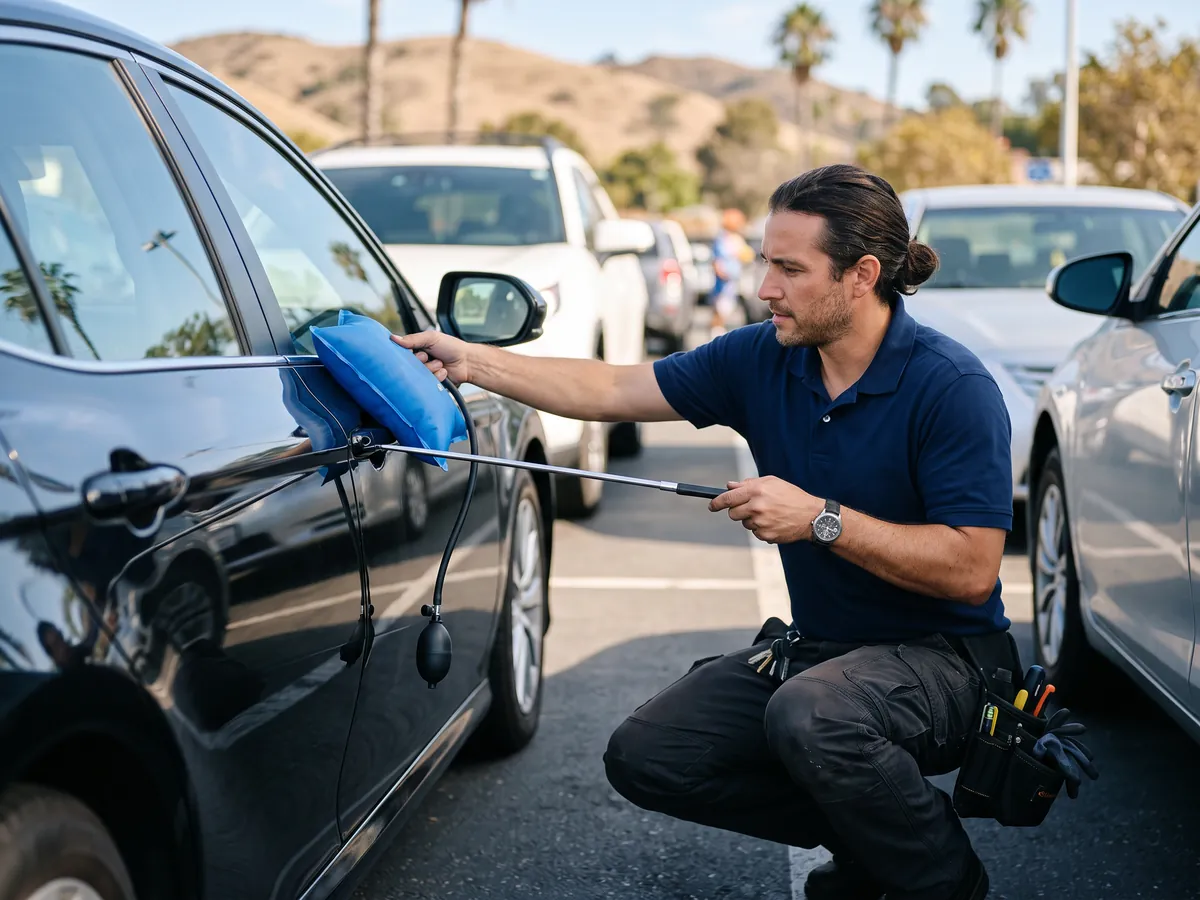
For most sedans, crossovers, SUVs and pickups, the quickest damage-free route runs through the top rear corner of a front door. That corner has a small amount of designed flex, and the cabin controls sit within reach of it. A careful technician uses it like this:
- Inspect the door for existing chips, dents, tint film and frameless glass, and point out any prior damage before starting
- Slip a thin protective sleeve or a non-marring plastic wedge into the seam to shield paint and rubber
- Insert a flat, reinforced air bag and pump it with a hand bulb in small increments, watching the glass and weatherstrip
- Stop once the gap is just wide enough for a tool, and hold it with a second soft wedge if needed
- Feed a coated long-reach rod into the cabin and work the target by sight with a flashlight
- Release the air, remove the wedges, and confirm the door closes flush and seals
The target depends on the vehicle. Most late-model cars unlock from the power lock rocker on the driver's armrest. Many also unlock and open from one firm pull of the interior handle, which a hooked tip can catch. Older cars with lock posts on the windowsill get a loop tool lowered over the knob. On some vehicles the most accessible switch sits on the center stack or the passenger door instead.
Tool length matters more than people expect. A compact hatchback may need only a short rod, while a crew-cab pickup with a wide door and a deep armrest needs a long, stiff one that won't droop under its own weight. Carrying the full range is what keeps this method fast across very different vehicles.
Picking and decoding with Lishi tools
Car door locks are wafer locks. Instead of the pin stacks found in a house lock, the plug holds flat spring-loaded wafers that must all sit flush with its edge before it can rotate. Your key does that in a single motion. A Lishi 2-in-1 tool does it one wafer at a time.
Each Lishi is built for one keyway family. A few that turn up constantly on Southern California roads:
- HON66 for many Honda and Acura models with laser-cut keys
- TOY43 for a long run of Toyota vehicles with standard edge-cut keys
- HU100 for many General Motors vehicles from roughly 2010 onward
- HU101 for a range of newer Ford, Volvo and Land Rover models
- HU66 for many Volkswagen and Audi vehicles
- NSN14 for a wide range of Nissan and Infiniti models
The tool holds light turning pressure on the plug while a thin lifter probes each wafer position. When a wafer reaches the shear line, the plug gives a hair and the tool records that position on an engraved grid. With every wafer set, the plug turns and the door unlocks. Nothing is drilled, removed or reset, so your key works afterward exactly as it did before.
The grid readings are the bonus. They translate directly into cut depths, so if the key is missing rather than locked inside, we can cut a matching blade on the spot. Door cylinders don't always contain every wafer the ignition uses, so a complete key sometimes requires a second decode or a code lookup, but the door read usually gets most of the way there.
Picking is slower than wedging and depends on the cylinder's condition. A lock that has sat unused through years of sun and dust may need cleaning and patient work before it cooperates.
Keys in the trunk: from the cabin outward
A trunk lockout is really two lockouts in a row: first the cabin, then the trunk. Cars are designed to keep the trunk secure even from someone sitting inside, so reaching the second one takes some knowledge of the specific model.
Once a door is open, we work through the options in roughly this order:
- The trunk release button on the dash, the driver's door panel or the fob, which works only if the car has power and the release isn't disabled
- The mechanical release lever on the floor beside the driver's seat, common on older models
- The valet or trunk-cancel switch in the glove box, which some owners turn off without realizing it kills the cabin release
- The rear seatbacks, which fold on many cars, though some sedans put the fold-down pulls inside the trunk itself
- The ski pass-through behind the center armrest, which on some cars offers a narrow path toward the trunk's interior emergency handle
That last item exists because federal safety rules, effective with the 2002 model year, require passenger cars with trunks to carry a glow-in-the-dark release inside the trunk compartment so a trapped person can escape. It's meant for occupants, not locksmiths, but on the right car a long tool can reach it.
Plenty of newer cars have no exterior trunk cylinder at all, which rules out simply picking the lid. On models that still have one, picking it is the fallback when the cabin route fails.
Hatchbacks, wagons and SUVs are easier because the cargo area is part of the cabin, with one exception: a power liftgate on a car with a flat battery. Many have a small manual release behind a trim cover on the inside of the gate, reachable once the rear seats fold down.
Push-start cars that lock with the fob inside
Smart-key vehicles are supposed to make this lockout impossible. Low-frequency antennas in the door handles, cabin and cargo area ping the fob, the fob replies by radio, and the body control module decides whether the key is inside or out. Press the lock button on the door handle with the fob detected in the cabin, and most cars refuse, chirp a warning or unlock again.
In practice, several things slip past that safeguard:
- A weak coin cell, usually a CR2032 or CR2025, that answers too faintly from inside a bag or console bin
- Shielding from a metal tin, a signal-blocking pouch or an RFID wallet
- Interference from a phone, laptop or wireless charging pad stacked on or beside the fob
- Locking the car with the second fob from outside, which many models treat as a deliberate command and obey
- Walk-away auto-lock features that lock once one fob leaves range, without registering the other one left behind
- Cargo areas and deep rear footwells that fall into antenna dead spots on some models
Getting in is the same work as any other cabin lockout: wedge and reach, or picking the hidden cylinder in the driver's handle. What separates a good call is what happens next. We test the recovered fob's battery and signal, check whether the car can see it in the spot where it was left, and show you the settings that control walk-away and auto-lock on your model. If two fobs share one household, we'll explain how to keep the spare from setting up the same mistake again.
Dead batteries, capped keyholes and cars without one
A flat 12-volt battery turns a smart-key car into a sealed box. The fob's buttons do nothing, the handle sensors are asleep and the power locks can't move. What's left is mechanical: the emergency blade inside the fob and the cylinder in the driver's door.
That cylinder is often hidden. Many Honda, Toyota, Hyundai, Kia, Ford and Mazda models tuck it behind a small cap at the end of the handle, which has to be pried off from a slot underneath. Owners who never knew it was there reasonably assume the car has no keyhole. Once the cap is off, the blade may turn easily, or it may not move at all, because a lock unused for years in heat and dust tends to bind.
Forcing it is how emergency blades snap. When a cylinder won't turn with gentle pressure, we pick it instead, then pull the hood release so a jump start or a battery replacement can follow. Before leaving, we clean and lubricate the cylinder so your blade works the next time.
A growing number of vehicles, including several electric models, have no exterior keyhole whatsoever. Some provide hidden terminals for feeding outside 12-volt power to open the hood or front trunk, and the procedure differs by manufacturer. We'll tell you honestly on the phone if your model falls outside what we can open, and we'll point you to the manufacturer's roadside line when that's the better route.
Trucks, vans, fleets and high-end cars
Vehicle type changes the plan, so it helps to know what we're walking up to.
Full-size and heavy-duty pickups have thick doors, tall windows and switches far from the gap, which calls for longer, stiffer rods and sometimes a step stool on lifted rigs. Locking toolboxes, camper shells and tonneau covers usually carry their own cam locks, so it matters whether the keys are in the cab or in the bed.
Cargo vans such as the Ford Transit, Ram ProMaster, Chevrolet Express and Mercedes-Benz Sprinter often lock the cab and cargo areas independently. Opening the cab may give access to the rear through a dash button or a bulkhead door, or it may not, depending on the upfit. Shelving, ladder racks and aftermarket lock boxes are worth describing when you call.
Fleet and company vehicles add an authorization step. We confirm with an owner, manager or fleet coordinator that the driver is entitled to the vehicle before handing over keys, and businesses can share a list of approved drivers in advance to speed things up.
Luxury and performance cars ask for a lighter touch. Frameless door glass drops slightly when the door opens and has no frame to brace a wedge against. Soft-close latches, laminated side glass and leather armrests show every slip. Many European models also double-lock, disabling the interior handles. Our default on these cars is to pick the door cylinder and leave the glass alone, and if the design makes a damage-free result uncertain, we say so before starting.
Proving the car is yours
Opening a car for the wrong person is the one mistake a locksmith can't take back, so ownership verification is part of every car lockout we handle. Locksmiths in California are licensed by the Bureau of Security and Investigative Services under the Locksmith Act, Business and Professions Code section 6980 and following. Our company license, LCO7891, can be checked by anyone at search.dca.ca.gov.
What we ask for is straightforward:
- A government-issued photo ID, such as a driver's license, state ID or passport
- A document tying that name to the vehicle, typically the registration or an insurance card
- For rentals, the rental agreement with your name on it
- For company vehicles, confirmation from an authorized manager or fleet contact
- For a car owned by a spouse, parent or friend, the owner reachable by phone or a written authorization
Paperwork is often locked inside with the keys, which is fine. We open the vehicle, then look at the registration and your ID together before you take the car. If the documents don't line up and the owner can't be reached, we stop there. That can feel inconvenient in the moment, but it's the same rule that keeps a stranger from getting into your car while you're at work.
Expect us to note your name, the vehicle and the location on our work order. It's routine record keeping, and it doubles as a receipt if your roadside plan or employer reimburses the service.
What shapes the price of a car lockout
We don't publish a flat number for car lockouts, because two calls can sound identical on the phone and play out very differently at the car. Instead, we price each job from a handful of factors and give you the figure before anyone drives anywhere.
- The vehicle. A common sedan with an easy armrest switch is faster than a frameless coupe, a double-locking European car or a heavy-duty truck
- The keys' location. On a seat is one step, in the trunk is two, in a locked glove box or toolbox is three, and missing entirely becomes a key-making job
- The time. Late-evening calls are typically priced above midday ones
- The drive. We're mobile, so distance and traffic from our current location matter
- Access. Gated communities, secured lots and low-clearance garages can add time
- Surprises. A dead battery, a seized cylinder, or damage left by earlier attempts
If something on site changes the work, we stop, explain it and agree on a revised price with you before continuing. Optional extras, such as a new fob battery, a spare blade or a full spare key, are quoted separately so the lockout price stays clear.
One comparison worth making: a tow to a dealership adds its own charge, takes the car out of your hands and still leaves someone to open the door. For a car lockout with the keys inside, entry where the vehicle sits is nearly always the more sensible route.
When to call 911 instead, and when we're closed
Some lockouts aren't locksmith calls at all. If a child, a vulnerable adult or a pet is inside a closed car on a warm day, call 911 before anyone else. Cabin temperatures in Southern California sunshine climb far above the outside air, and fire and police crews can break a window immediately if conditions demand it. No mobile service should promise to beat them there. California law also makes it an offense to leave a young child alone in a vehicle when conditions are dangerous, and separate rules cover animals left in hot cars.
A running engine with the doors locked is a priority call rather than an emergency. Fuel burns and an unattended running car tempts thieves, so stay near it while you wait.
Our hours are every day, 6:30 a.m. to 11:30 p.m. That includes weekends. We aren't a 24/7 service and won't pretend to be. If you're locked out while we're closed, realistic options include:
- A spare key held by someone at home, at work or nearby
- Roadside assistance through your insurer, auto club, credit card or the vehicle manufacturer
- The automaker's connected app, which can unlock many recent vehicles remotely if the service is active
- Leaving a safely parked car until we open, then calling us first thing
If you can't stay with the car, move somewhere lit and populated, and tell us exactly where you'll be when you call.
Preventing the next lockout, and where we work
Most car lockouts trace back to a handful of habits, and small changes undo them:
- Treat the trunk lid like a door that locks behind you, and keep keys on your body while loading
- Practice releasing your fob's emergency blade and uncapping the door keyhole once, in daylight
- Give the mechanical lock a turn now and then so the wafers don't freeze in place
- Swap the fob's coin cell when range shrinks, rather than waiting for it to die
- Use signal-blocking pouches for overnight storage only, never while driving
- Keep a second key, or at least a cut blade, somewhere other than the car itself
Julian's Locksmith is a mobile service based in the University Heights area of San Bernardino, near Cal State San Bernardino. We handle car lockouts throughout the Inland Empire, the San Gabriel Valley, the Pomona Valley, north Orange County and southeast Los Angeles County. That territory covers commuter park-and-rides along the I-10 and I-215 corridors, foothill trailheads, hospital garages, college lots and warehouse yards, and each setting brings its own wrinkles: gate codes, clearance bars, weak cell signal and summer heat.
Tell us where the car is as precisely as you can, along with the year, make and model, and we'll plan for it before we pull out. Call (951) 903-3193 for a quote and an honest ETA.
Frequently asked questions
Can I open my own car with an inflatable wedge kit bought online?
Sometimes, but the risk sits with you. Bargain kits often skip the protective sleeve, the bladder inflates unevenly, and the rod has a bare metal tip that scuffs plastic and leather. The common results are a door frame sprung out of shape, which shows up later as wind noise or a leak, and chipped paint along the top edge. Frameless glass and double-locking doors are especially poor candidates for a first attempt. If you try anyway, inflate slowly, stop at the smallest gap that works, and quit the moment the glass starts to flex.
Will my car need any repair after a professional lockout?
It shouldn't. A properly handled wedge entry flexes the door frame within its normal range and leaves it exactly where it was, and picking only moves the wafers inside the cylinder. Before we leave, we close the door, check that the gap and weatherstrip line up, and confirm the locks respond to your key and fob. If we notice an existing problem, such as a failing lock actuator or a door that already sat out of alignment, we'll point it out so you're not left wondering whether it was there before.
Can you open a car parked tight against a wall or another vehicle?
Usually. The driver's door is the most common entry point, but it isn't the only one. We can work from the front passenger door, a rear door or, on some pickups, the sliding rear window, as long as the reach rod can get to a control from that side. Home garages with tight walls and carports with narrow stalls are routine. If every side is blocked by something, picking whichever cylinder we can physically reach is usually the answer.
Do you handle lockouts on classic and older vehicles?
Yes, and they're often simpler to open, though they deserve extra care. Many older cars have vertical lock posts on the windowsill that a loop tool can lift, and their door locks usually pick readily. The catch is age: original weatherstrip turns brittle, chrome trim and vent windows bend easily, and decades-old paint chips at a touch. We use smaller gaps, more padding and a slower pace on these cars. If the trim or glass looks too fragile for a wedge, we'll pick the lock instead.
What if someone already tried to get in and damaged the door or lock?
Tell us exactly what was tried, because it changes the plan. A door frame bent by a pry bar may not seal properly no matter who opens it next, and we'll point that out before working on it. A lock cylinder chewed by a screwdriver may not pick normally, so we may choose another door or the wedge method. A coat hanger can knock a latch cable loose inside the door, which sometimes means the door won't open even after it unlocks. We can usually still get you in, but the quote may change.
Can you open my car if the key broke off inside the door lock?
Yes, and the two problems are handled in order. First we extract the broken piece with thin hooked extractors, working it out along the keyway without pushing it deeper. With the cylinder clear, we either pick the lock or switch to a wedge entry through another door. Then we look at why the key broke. A worn or cracked blade, a seized cylinder or a key used as a pry tool are the usual suspects, and the two halves together can often serve as a pattern for a fresh blade.
Are hybrid and electric vehicle lockouts any different?
The entry methods are the same, since doors, glass and latches work like any other car's. The differences are electrical. Hybrids and EVs rely on a small 12-volt battery to run the locks and computers, and when it dies the car can seem completely dead even though the high-voltage pack is fine. Some models use phone keys or key cards and have no exterior keyhole, which limits the options without power. We never touch the high-voltage system. Tell us your model when you call, and we'll explain what's realistic before driving out.
Do I need to stay with the car until you arrive?
It helps, but your safety comes first. Staying nearby keeps an eye on the car, especially if it's running, and lets you show us exactly where the keys are. If the spot feels unsafe or you're stuck in the heat with no shade, move somewhere comfortable within sight of the car, or to the nearest open business, and tell us where to find you. We'll call when we're close. We do need you present for the ID check before we release the vehicle, so plan to be back at the car by then.
Car Lockout by city
Local details, routes and answers for car lockout in each city we cover across four counties.
San Bernardino County
Riverside County
Los Angeles County
- Rosemead
- San Gabriel
- Temple City
- Arcadia
- Sierra Madre
- Monrovia
- Duarte
- Bradbury
- El Monte
- South El Monte
- Baldwin Park
- West Covina
- Covina
- Azusa
- Irwindale
- Glendora
- San Dimas
- La Verne
- Pomona
- Claremont
- Diamond Bar
- Walnut
- La Puente
- City of Industry
- Hacienda Heights
- Rowland Heights
- Avocado Heights
- Charter Oak
- Valinda
- West Puente Valley
- South San Gabriel
- East San Gabriel
- North El Monte
- Citrus
- La Habra Heights
- La Mirada
- Cerritos
- Artesia
- Hawaiian Gardens
- Lakewood
- Bellflower
- Norwalk
- Downey
- Pico Rivera
- Whittier
- Santa Fe Springs
Specific car lockout needs
Choose your city on the next page for local details.
- Locked Out of CarSan Bernardino and nearby
- Keys Locked in CarSan Bernardino and nearby
- Unlock Car DoorSan Bernardino and nearby
- Vehicle LockoutSan Bernardino and nearby
- Trunk LockoutSan Bernardino and nearby
- Keys Locked in TrunkSan Bernardino and nearby
- Mobile Car Lockout ServiceSan Bernardino and nearby
- Emergency Car LockoutSan Bernardino and nearby
- Car Unlocking ServiceSan Bernardino and nearby