
Service category
Residential Locksmith Services for Every Lock on Your Home
Short answer: A residential locksmith looks after all the locks on a house: re-pinning cylinders to cancel lost or unaccounted-for keys, fixing deadbolts and latches, fitting stronger or keypad hardware, reinforcing strikes and frames, securing sliders and opening doors after a lockout. Julian's Locksmith, California license LCO7891, does this at your home across the Inland Empire and nearby regions, confirms residence first and quotes before starting.
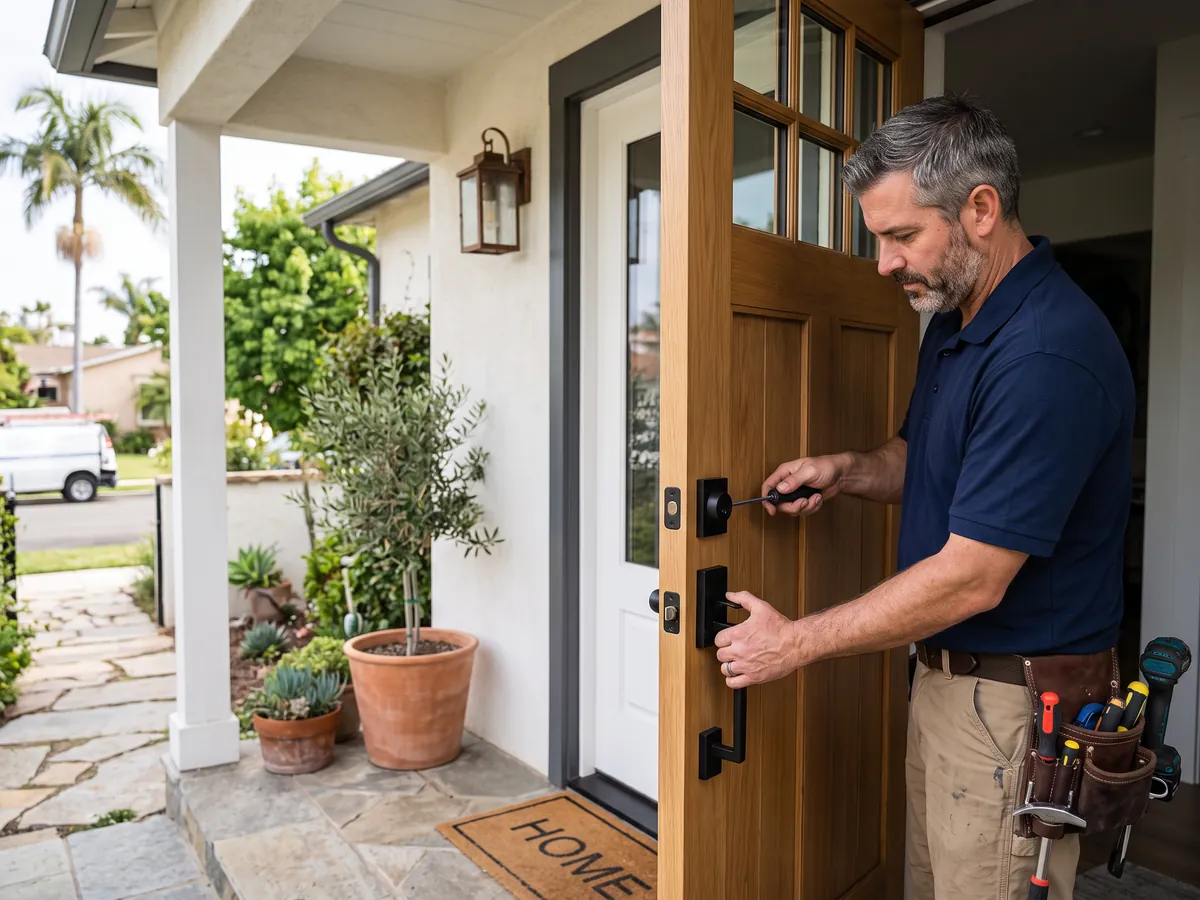
The whole house is the job, not just the front door
A residential locksmith is the trade responsible for every keyed or latching opening on a home, from the entry handleset to the gate latch beside the trash cans. That scope is wider than most people assume, and narrower in a few places that matter.
Inside the line sit rekeying, lock repair, new and upgraded hardware, deadbolts on doors that never had one, keypad and app-connected locks, strike and hinge reinforcement, sliding door latches and secondary locks, window locks, broken key extraction, home lockouts, key cutting by code, restricted key systems, private mailbox locks, gate hardware and residential safes.
Just outside the line sit several neighboring trades: - Carpenters, when a jamb is rotted, a slab is delaminating or a door has to be re-hung in a new frame. - Garage door technicians, who handle springs, cables, tracks and openers on the overhead door. - Alarm and camera installers, who wire sensors and set up monitoring. - Low-voltage contractors or an HOA's own vendor, who own gate operators, call boxes and community access systems. - Glaziers, for broken glass in a door lite or sidelite.
Knowing where those boundaries fall is part of the job. A competent locksmith says so early instead of bolting fresh hardware onto a problem that hardware can't solve. Plenty of jobs involve two trades in sequence. A door forced during a burglary, for instance, may need a locksmith to make the opening lockable the same day and a carpenter the following week to replace the jamb properly.
Finding the real fault before anything is replaced
Home locks fail in four places, and each one produces its own symptoms. Locating the fault decides whether you pay for an adjustment, a part or an entire lockset.
- The key. A worn or badly copied key has rounded cuts and a polished shoulder. If a fresh key cut to factory depths works where the old one struggles, the lock was never the issue.
- The cylinder. Grit, dried oil and worn pin tips make a key hard to insert or reluctant to rotate. A broken spring can let a pin fall across the shear line and freeze the plug completely.
- The chassis, meaning the latch, retractor, spindle, cam and springs inside the lockset. A lever that droops, a knob that rotates without pulling the latch, or a thumbturn that spins freely usually points here.
- The door and frame. Sagging hinges, a swollen slab, settled framing or a strike set slightly off line make the bolt rub, so a perfectly healthy lock feels broken.
A few simple tests separate these causes. Run the deadbolt while the door stands open; if it moves smoothly, the lock is fine and the trouble is alignment. Smear a little lipstick or dry-erase marker on the end of the bolt, close the door and turn the key once, and the mark left on the strike shows exactly where the bolt is hitting. Then study the gap between the door and the frame on the latch side. It should be close to even from top to bottom. A gap that pinches near the head of the frame and widens near the floor tells you the slab has dropped on its hinges.
This kind of diagnosis is the most valuable few minutes of a residential visit. It's also why an honest locksmith will sometimes leave your original lock on the door and charge only for the adjustment.
Rekeying: resetting who has access for far less than new locks
A pin tumbler cylinder works because stacks of pins sit across a rotating plug. Each stack has a bottom pin that rides on the key and a top pin pressed down by a small spring. With the correct key inserted, the gap in every stack lines up exactly at the shear line, the boundary between plug and housing, and the plug can turn. Rekeying replaces the bottom pins with lengths that match a different key. The old key now leaves pins at the wrong heights, and the plug stays put.
The work is small-scale and precise. The cylinder comes off the door, a plug follower slides the plug out while holding the top pins and springs in the housing, and the old bottom pins are dumped. New pins are selected from the new key's bitting, checked against the manufacturer's depth chart and loaded. The plug goes back in, the cylinder is tested with each new key and remounted.
Rekeying is the right call when: - the locks operate well and you like their look, - you can't say who holds copies, as after buying a house or a roommate moving out, - you want several doors on one key and the cylinders share a keyway.
It's the wrong call when the hardware is worn out, cracked, too light for the door, or a brand whose keyway can't match the rest of the house. Some budget imports and certain electronic locks use cylinders that were never designed to be re-pinned. Kwikset SmartKey cylinders work differently again: with a working key and the reset tool, they can be changed without disassembly, and a locksmith can still rebuild them by hand when no working key exists.
A proper rekey also improves your keys. New keys cut from code to factory depths operate far more smoothly than a copy of a copy of the key the builder handed over years ago.
Choosing new hardware: grades, functions and the measurements that matter
When a lock truly needs replacing, three things decide whether the new one will serve you well: how strong it is, what function it performs and whether it fits the door as drilled.
Strength. ANSI/BHMA grades are still the common shorthand. Grade 3 passes the lightest cycle and strength tests and turns up in many builder packages. Grade 2 is a sound residential choice. Grade 1 is tested to commercial duty and suits a home's primary entry. BHMA also runs a residential certification that scores security, durability and finish separately on an A, B, C scale, so a box marked AAA earned the top mark in all three. Beyond the label, look for a full one-inch bolt throw, a hardened insert or free-spinning steel roller inside the bolt, and a steel chassis rather than thin cast zinc.
Function. Entry knobs and levers lock from outside with a key. Passage sets never lock. Privacy sets lock from inside with a button or turn and open from the hallway with a small emergency tool. Keyed-both-sides storeroom functions belong on closets and utility rooms. Deadbolts come single-cylinder, with a key outside and a thumbturn inside, or double-cylinder, with a key on both sides.
Fit. Measure before buying anything: - Backset, from the door edge to the center of the bore, usually 2-3/8 or 2-3/4 inches. - Bore diameter, normally 2-1/8 inches on residential doors. - Door thickness, typically 1-3/4 inches for exterior doors and 1-3/8 for interior ones. - Latch style, either a round drive-in latch or a rectangular faceplate set into a mortise. - Handing, for levers and handlesets that aren't reversible.
Matching the existing prep avoids new holes in the door. When an older slab has an oversized or oddly placed bore, an adapter plate or reinforcing wrap can cover the old damage and give the new lock a solid seat.
Where forced entry really succeeds: strikes, hinges and frames
Most kicked-in residential doors don't fail at the lock. The deadbolt holds, the bolt stays extended, and the wood around it gives way. A standard strike plate sits in the jamb, often a narrow strip of soft pine or finger-jointed stock, and the screws supplied in the box may reach no further than that strip. One determined kick splits the jamb along the grain, and the door swings open with its lock still technically locked.
The cure is to tie the strike to the structure of the house. A box strike, which wraps a steel cup around the bolt pocket, spreads the force. Screws long enough to pass through the jamb and the shim space into the jack stud behind it, usually three inches or longer, make a kick far less effective. The same idea applies on the hinge side: swapping one screw in each hinge leaf for a long one resists prying and keeps the door from sagging over the years.
Other weak spots worth checking: - Glass within arm's reach of a thumbturn, whether in a sidelite, a door lite or a nearby window. Security film or laminated glass slows a reach-in considerably. - A thin or hollow-core exterior door. A wrap-around plate stiffens the edge around the bore, but a solid-core slab is the real fix. - Out-swinging doors with exposed hinge pins, which need security studs or non-removable pins. - A wide gap at the latch edge that invites a pry bar, reduced by shimming the jamb or adding a latch guard where the door style allows.
None of this is glamorous, and most of it costs little compared with new locks. It does take care. Pilot holes keep the jamb from splitting, and the strike has to stay perfectly aligned with the bolt, or the reinforced door turns into one that's hard to lock.
Sliders, windows, garage-entry doors and side gates
Front doors get the attention, yet the other openings around a house are where a good share of residential entries actually begin.
Sliding glass doors close with a small hook or mortise latch in the edge of the moving panel. Over years of use the rollers wear, the panel settles and the hook stops reaching its keeper. Raising the panel with the roller adjustment screws at its bottom corners, realigning the keeper and replacing a worn latch usually restore a positive lock. Because a weakly latched slider can sometimes be lifted off its bottom track, anti-lift blocks or screws in the upper channel and a secondary pin lock or foot bolt matter as much as the latch.
Windows rely on sash and cam locks that nobody thinks about until one cracks. Track stops and vent locks let a window open a few inches for air without opening wide enough for a person.
The door between the garage and the house is frequently a plain knob with a spring latch. Once the overhead door is breached, or its opener's emergency release is fished from outside, that knob is all that separates the garage from the kitchen. A keyed deadbolt on that door is one of the more meaningful upgrades in many homes.
Side gates, sheds and workshops take the most weather. Keyed gate locks with stainless or powder-coated bodies, self-closing and self-latching hardware on pool gates, and shrouded padlocks that deny bolt cutters a grip each have their place. Outbuildings can often be keyed to the house. Sometimes they shouldn't be, such as a workshop full of power tools that a house sitter has no reason to enter, and then they get their own key.
Smart locks and keypads: choosing one you won't regret
Electronic locks earned their place in homes by solving key-management headaches: a code for the dog walker, an auto-lock that ends the drive back to check the door, an activity log that shows when the kids got home. Picking the right one starts with three questions.
How will it connect? Standalone keypads need no network at all. Bluetooth models talk to a phone at short range and need a bridge for control away from home. Wi-Fi locks connect straight to the router but work their batteries harder. Z-Wave and Zigbee locks join a home automation hub. Matter, often running over Thread, is the newer standard meant to let one lock work across the major smart home ecosystems, although feature support still varies by brand and model.
Replace or retrofit? Full replacements such as the Schlage Encode, Yale Assure and Kwikset Halo swap out the whole deadbolt. Retrofit designs from August and Level keep your existing exterior deadbolt and key and motorize the interior side, which suits renters and homes under HOA rules about visible hardware.
What happens when it fails? Every electronic lock needs a fallback: a mechanical key cylinder, external battery contacts, or both. Learn which one yours uses before the batteries die.
Most smart lock complaints turn out to be mechanical. A motor can drive a bolt that slides freely, but it stalls against one that drags on a misaligned strike, which shows up as jam alerts, half-thrown bolts and batteries that last weeks instead of months. That is why a sound installation begins with door alignment and a full manual throw test before the lock is ever paired.
Security deserves a sober look as well. Change the default programming code, give each person a unique user code, turn on two-factor login for the app account, keep firmware current and remove users who no longer need access. Inland heat adds one more item: keypads on sun-baked doors age faster and batteries drain sooner in high temperatures, so fresh cells before summer prevent surprise lockouts.
High-security cylinders and real key control
Ordinary house keys can be copied by almost any hardware store machine or self-service kiosk, and a 'Do Not Duplicate' stamp does little to stop that. When knowing exactly how many keys exist genuinely matters, the answer is a restricted keyway.
Cylinders from Medeco, Mul-T-Lock, ASSA Abloy and similar makers combine two features. The first is physical resistance: hardened steel inserts against drilling, secondary locking elements such as sidebars, pins that must rotate or telescope to the correct position, and in many models a UL 437 listing. The second is control: the key profile is protected by patent or contract, blanks are sold only through authorized dealers, and duplicates require the registered owner's card or signature.
That combination fits some homes and not others. It's worth a serious look when: - housekeepers, contractors or caregivers rotate through the house regularly, - a home office holds client records, inventory or equipment, - a casita, wine room or gun storage area needs tighter control than the main house, - a former key holder is someone you'd rather not see at the door again.
For a typical family house, a well-installed Grade 1 deadbolt with a reinforced strike handles realistic threats, and the money is better spent there first. Restricted cylinders can then go only on the doors that justify them, often the front entry and the garage-entry door, while the remaining locks stay on a conventional key.
Bump keys and pick guns get a lot of attention online. They are real techniques, many standard pin tumbler locks are vulnerable to them, and that vulnerability is one reason sidebar and patented designs exist. Even so, the great majority of home break-ins rely on force or an unlocked opening rather than finesse, which keeps frame reinforcement and good habits at the top of the list.
Home lockouts and snapped keys
Getting locked out is the most urgent residential call, and the method matters as much as the speed. A licensed locksmith starts by confirming you belong there: photo ID showing the address, or paperwork connecting you to the property when the license lists somewhere else. We record those details on a signed work order, which is what California's Locksmith Act expects for this kind of job, and it protects every homeowner from a stranger with a convincing story.
Entry then follows the least destructive route available. Spring latches on many knobs and levers can be slipped or bypassed. Most pin tumbler cylinders can be picked or opened with purpose-built tools. Occasionally a side door or a slider offers a cleaner way in than a stubborn deadbolt. Drilling is kept for high-security or damaged cylinders, and a drilled cylinder is replaced before the visit ends so the house is never left unlockable.
A key snapped inside a cylinder is its own small emergency. A thin extractor blade slides alongside the broken piece, catches its cuts and draws it out, ideally with the plug turned back to its home position so the pins line up with the fragment. Glue, tweezers and needle-nose pliers usually push the piece deeper or leave adhesive in the pin chambers, which turns a short extraction into a cylinder replacement.
Two habits prevent most home lockouts. Put a keypad on the most-used door, and leave a spare with someone you trust nearby rather than hiding it outside. If a lockout happens while we're closed, a trusted neighbor's spare or a property manager is the next move. When a child or anyone at risk is alone inside, call 911 first.
A door-by-door security assessment
A home security assessment is a structured walk around the property, looking at it the way someone trying to get in would. It doesn't need gadgets. It needs a thorough checklist and an honest ranking at the end.
A complete walk-through covers: - Every exterior door: lock grade, bolt throw, strike type and screw length, hinge screws, door construction and any glass within reach. - The garage: the entry door, the side door, the overhead door's emergency release and whether every opener remote is accounted for. - Sliders and French doors: latch engagement, lift-out, secondary locks and, on French doors, whether the inactive leaf's flush bolts are long enough to hold. - Ground-floor windows, plus any reachable from a patio cover, wall or balcony. - Gates, sheds, mailboxes and anything else keyed to the house. - Keys and codes: how many keys exist, who holds them, and which codes are active on door keypads and the garage keypad. - Lighting and landscaping near the entries, since a hedge that hides a door also hides whoever is working on it.
Findings fall into three groups. Urgent items, such as a deadbolt that never reaches full throw or a slider that lifts free, get handled first. Worthwhile upgrades, like box strikes, a garage-entry deadbolt or lever handles for a parent with arthritis, follow as budget allows. Poor-value spending, such as high-security cylinders on a hollow-core door, gets labeled as exactly that.
Good times for an assessment include the first week in a new home, the days after a break-in on your street, the run-up to a long trip and any moment when someone in the household needs easier hardware. A written list lets you work through the improvements in stages rather than all at once.
California rules that shape residential lock work
Several California rules affect what a residential locksmith may do, and for whom.
The Locksmith Act, in the Business and Professions Code beginning at section 6980, requires locksmith companies to be licensed by the Bureau of Security and Investigative Services and their employees to be registered. Anyone can check a company's license at search.dca.ca.gov before work begins. Julian's Locksmith holds license LCO7891.
For rental housing, Civil Code section 1941.3 requires landlords to provide an operable deadbolt on each main swinging entry door of a unit and working security or locking devices on windows designed to open, along with code-compliant locks on exterior doors leading to common areas in multifamily buildings. Tenants generally need permission before changing or adding locks, and most leases require that the landlord keep a key.
Civil Code sections 1941.5 and 1941.6 require landlords to change locks within 24 hours of a tenant's written request in certain situations involving a protective order or similar documentation. The landlord must do it within 24 hours of receiving a copy of the document. If the landlord doesn't, the tenant may have the locks changed and give the landlord a key, and different rules apply when the restrained person lives in the same unit.
Other rules come from outside the statutes. HOA covenants often govern visible exterior hardware, including finish, style and sometimes brand. Cluster mailbox units in many developments belong to the association, which decides who may change compartment locks. Building codes expect required exit doors to open from inside without a key or special knowledge, which is why double-cylinder deadbolts on a main exit deserve careful thought.
When a request crosses a legal line, such as locking out a co-owner or a tenant without a court order, a licensed locksmith should decline and explain why.
Keeping locks healthy in Southern California conditions
Inland heat, dry winds and fine dust are hard on door hardware, and a little attention each year heads off most service calls.
- Lubricate cylinders once or twice a year with dry graphite or a PTFE spray made for locks. Penetrating oils attract dust and gum up pins.
- Operate the deadbolt with the door closed every few weeks. If it begins to drag, fix the alignment before the bolt and cam wear.
- Tighten the through-bolts on knobs and levers as soon as the trim wobbles. Loose trim strains the spindle and latch.
- Check hinge screws on heavy entry doors each spring, ahead of summer heat and Santa Ana wind season.
- Fit fresh batteries in smart locks before the hottest months and before any long trip.
- Rinse sprinkler overspray off gate locks. Hard water leaves mineral crust that seizes latches and cylinders.
- Near pools, choose stainless, solid brass or PVD finishes, and check cylinders for white or green corrosion.
Certain signs mean it's time to call rather than wait: a key that needs jiggling, a bolt that stops short of full extension, a knob that rotates further than usual before the latch moves, a keypad that beeps without moving the bolt, or a visible crack in a cast housing. These faults tend to worsen in steps. Catching one early usually means a modest repair. Ignoring it often means a lock that fails while you're on the wrong side of the door.
How a visit works, what drives the price and where we travel
Julian's Locksmith is a licensed mobile residential locksmith based in San Bernardino. We drive to homes across the Inland Empire, the San Gabriel Valley, the Pomona Valley, north Orange County and southeast Los Angeles County, carrying hardware, pins, key blanks and cutting equipment.
A visit starts with a call to (951) 903-3193. Photos of the lock face, the door edge and the strike help us load the right parts. When you call, you get an honest arrival estimate based on where we are and the drive involved. At the house we confirm identity and residence, inspect the doors, explain the options and quote the work before starting.
What moves the price: - how many cylinders and doors are involved, - whether parts are rekeyed, repaired or replaced, and the grade of any new hardware, - the condition of the door and frame, including damage from a forced entry, - specialty hardware such as mortise, multipoint, high-security or electronic locks, - the number and type of keys, or the code setup on electronic locks, - how urgent the job is and when it falls within our working hours.
We don't give flat prices without seeing the job, and nothing starts until you approve the quote.
Our hours run every day from 6:30 a.m. to 11:30 p.m. Weekends are included. We aren't a 24/7 company, so planned work such as whole-house rekeys, smart lock installs and security walk-throughs is easiest to schedule ahead, and early-morning or evening appointments help if you work regular hours.
Frequently asked questions
Can you rekey a lock when every key to it is lost?
Yes. After we confirm you live at or own the home, the cylinder can usually be picked, removed and re-pinned to a brand-new key. If a lock can't be picked, we may take it apart from the inside of a door that's already open, or replace just the cylinder. Kwikset SmartKey locks can't use their reset tool without a working key, so we disassemble and rebuild those by hand. Either way, you finish with fresh keys cut to the new combination and the old ones useless.
Is an older lock worth repairing instead of buying a new one?
Often it is. Solid brass mortise locks, older Schlage and Baldwin pieces and other well-built hardware were made to be serviced, and a new spring, retractor or cylinder can give them many more years. Thin builder-grade sets with cracked cast housings are a different story, because the parts may cost nearly as much as a better replacement. We'll open the lock, show you what's worn and give you both prices so you can judge the value yourself.
What does a rating like AAA on a lock package mean?
It refers to BHMA's residential certification, which grades a lock on three separate qualities: security, durability and finish. Each gets an A, B or C, with A the best. A lock marked AAA scored at the top level on all three, while something like BAB is weaker on security and finish. The older Grade 1, 2 and 3 system still appears on many packages too. For a main entry, aim for the higher rating in security first.
Are smart locks easier to break into than standard deadbolts?
Physically, a quality smart deadbolt is about as strong as a conventional one, because the bolt, strike and frame do the real work. The added risks are digital and practical: weak or shared codes, an app account without two-factor login, outdated firmware or a cheap model with a poorly made mechanical cylinder. Choose an established brand, update it, use unique codes and reinforce the strike. Most forced entries still go through the frame, not the electronics.
Why does my new key copy work in one door but not another?
Usually the copy was traced from a worn key, so its cuts are slightly shallow. A cylinder with fresh pins tolerates that; a worn or dirty one doesn't. Another possibility is that the doors were never truly keyed alike and the original key only just worked in both. Cutting keys from the factory code, then cleaning or rekeying the cylinder that resists, normally fixes it. Bring every key you have so we can compare them.
What should I have ready when the locksmith arrives?
Have photo ID with the property address, or a lease, closing papers or a recent utility bill if your ID shows an old address. Gather every key you can find, any keypad or smart lock app logins, and the hardware itself if you bought locks ahead of time. Clear a little space at each door we'll work on, secure pets, and arrange gate access if you live in a gated community. A list of the doors you want handled speeds things up.
Do I need HOA approval to change my front door hardware?
It depends on your association's CC&Rs and architectural guidelines. Many HOAs regulate visible exterior features, and some specify handleset finishes or styles so the street looks consistent. Rekeying never changes appearance, and interior work is usually your call alone. Before buying a new handleset or keypad deadbolt, check the guidelines or ask the management company. If there's an approved finish, we can match it, and a retrofit smart lock can keep the original exterior look entirely.
Can you match the finish and style of my existing hardware?
In most cases, yes. Major brands make their common finishes, such as satin nickel, matte black, oil-rubbed bronze and polished or aged brass, across several product lines, so a new deadbolt can sit beside an older handleset without clashing. Discontinued lines and custom finishes are harder, and sometimes the best answer is replacing a matched pair. Send photos of the existing hardware beforehand and we'll bring options that fit, or order them when the exact match isn't on the van.
Residential Locksmith by city
Local details, routes and answers for residential locksmith in each city we cover across four counties.
San Bernardino County
Riverside County
Los Angeles County
- Rosemead
- San Gabriel
- Temple City
- Arcadia
- Sierra Madre
- Monrovia
- Duarte
- Bradbury
- El Monte
- South El Monte
- Baldwin Park
- West Covina
- Covina
- Azusa
- Irwindale
- Glendora
- San Dimas
- La Verne
- Pomona
- Claremont
- Diamond Bar
- Walnut
- La Puente
- City of Industry
- Hacienda Heights
- Rowland Heights
- Avocado Heights
- Charter Oak
- Valinda
- West Puente Valley
- South San Gabriel
- East San Gabriel
- North El Monte
- Citrus
- La Habra Heights
- La Mirada
- Cerritos
- Artesia
- Hawaiian Gardens
- Lakewood
- Bellflower
- Norwalk
- Downey
- Pico Rivera
- Whittier
- Santa Fe Springs
Specific residential locksmith needs
Choose your city on the next page for local details.
- Home LocksmithSan Bernardino and nearby
- House LocksmithSan Bernardino and nearby
- Apartment LocksmithSan Bernardino and nearby
- Condo LocksmithSan Bernardino and nearby
- Residential Lock RepairSan Bernardino and nearby
- Residential Lock ReplacementSan Bernardino and nearby
- Home Security LocksSan Bernardino and nearby
- Locksmith for New HomeownersSan Bernardino and nearby
- Locksmith for Rental PropertySan Bernardino and nearby
- Landlord LocksmithSan Bernardino and nearby
- Property Management LocksmithSan Bernardino and nearby
- Multifamily LocksmithSan Bernardino and nearby
- Tenant Turnover LocksmithSan Bernardino and nearby
- Vacation Home LocksmithSan Bernardino and nearby
- Estate LocksmithSan Bernardino and nearby
- Luxury Home LocksmithSan Bernardino and nearby
- Gated Home LocksmithSan Bernardino and nearby
- House Key CopySan Bernardino and nearby
- Apartment Key CopySan Bernardino and nearby
- Office Key DuplicationSan Bernardino and nearby
- Commercial Key DuplicationSan Bernardino and nearby
- Mailbox Key DuplicationSan Bernardino and nearby
- High Security Key DuplicationSan Bernardino and nearby
- Restricted Key DuplicationSan Bernardino and nearby