
Devore, San Bernardino County
Deadbolt Installation in Devore
Short answer: BHMA grades deadbolts 1 through 3. Grade 1 is the toughest tier, Grade 2 is a solid residential choice, and Grade 3 is light builder hardware. For an entry door in Devore, we usually recommend Grade 1 or 2 paired with a reinforced strike, because the jamb tends to give out before the bolt does. Julian's Locksmith installs all three: (951) 903-3193.
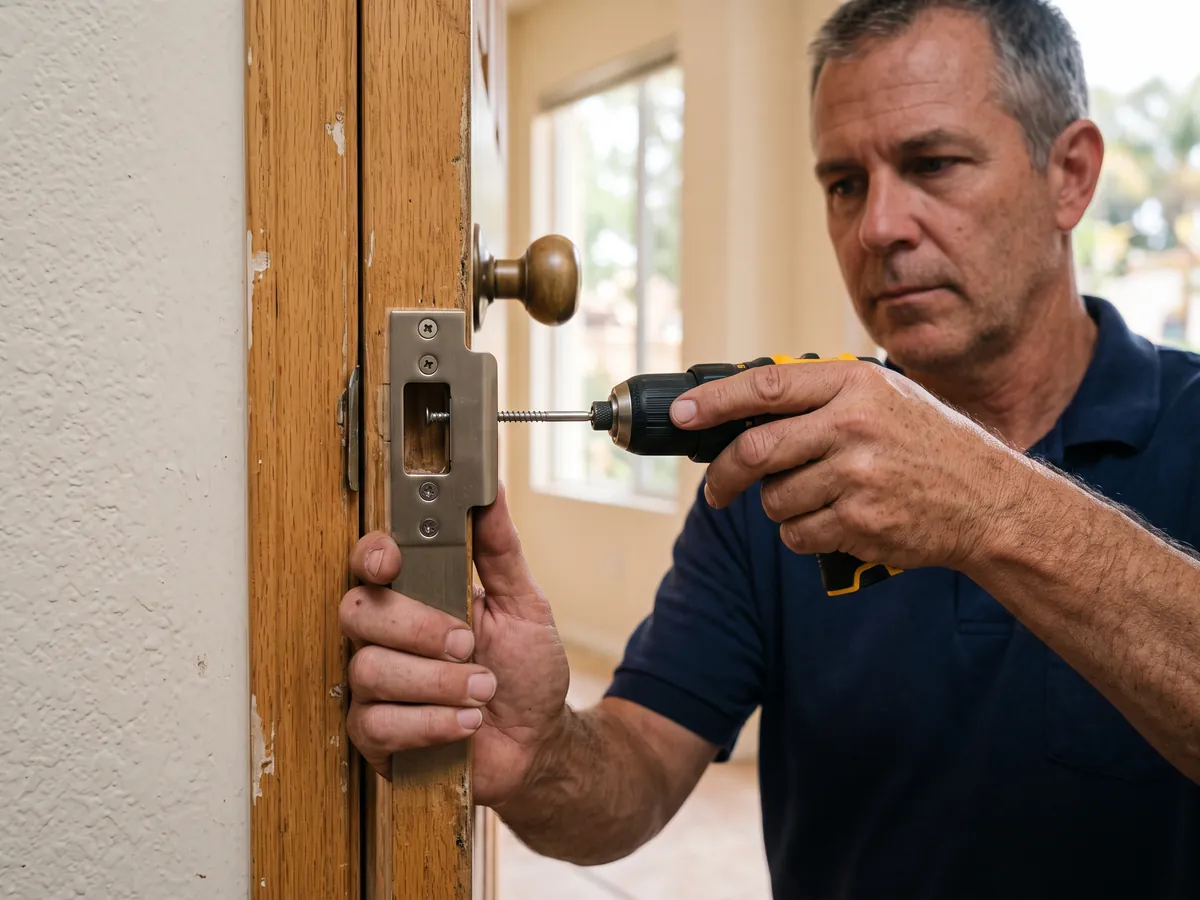
Before anyone drills into your Devore door, there's a decision to make: should the inside get a thumbturn or a second keyhole? A single-cylinder deadbolt, key outside and thumbturn inside, lets anyone in the house get out instantly, which is what fire safety and California's egress rules favor for a home's main exit. A double-cylinder deadbolt needs a key on both sides. People ask for one when there's glass within arm's reach of the lock, yet it can trap family members during a fire if the key isn't where it should be. Julian's Locksmith walks you through both options, plus better fixes for that glass, before installing. Call (951) 903-3193.
A deadbolt only protects a door when it is anchored into solid wood or steel. Many older Devore houses have a deadbolt set into a strike plate screwed only into the thin door jamb, which can split under a single kick. The upgrade we install most is simple: a Grade 1 or Grade 2 deadbolt, a heavy steel strike plate and 3-inch screws that reach through the jamb into the wall framing. Single or double cylinder is a safety choice. A single-cylinder deadbolt has a thumbturn inside, so anyone can leave quickly. A double-cylinder deadbolt needs a key on both sides, which helps if a window beside the door could be broken to reach the lock, but it can trap a family in a fire. In a place that has seen the Old Fire and the Blue Cut Fire, we usually favor a thumbturn that is easy to use and set away from glass, because a door that can't open fast is its own hazard. Building code expects main egress doors to open from inside without a key. Installing a deadbolt means drilling a clean 2-1/8-inch hole and a 1-inch bolt hole, setting the latch, and aligning the bolt to the strike. Cabin doors of odd thickness and manufactured-home doors may need a different model, which we carry.
How this works in Devore
Most houses around Devore are wood-framed with stucco outside, and the door frame is a softwood or finger-jointed jamb set into a rough opening with shims filling the gap. That gap is why short strike screws do so little. A 3/4-inch screw holds only in the jamb itself, while a 3-inch screw crosses the shim space and anchors in the 2x4 trimmer stud. Driving that long screw too hard, though, draws the jamb toward the stud and can make the door rub, so we snug it rather than crank it and add a shim where the gap is wide. Door construction changes the job too. Solid wood and wood-edged fiberglass doors bore cleanly. Steel doors have a thin skin over foam and a lock block that must be located before drilling. Hollow-core doors, which turn up on some older garage-entry and side openings, have almost nothing to hold a deadbolt, and we'll tell you if a door isn't worth reinforcing. Afternoon sun on west-facing doors swells and bows panels, so we leave the bolt enough clearance to work through that daily movement.
How we can help in Devore
- Grade 1 and high-security deadbolts. High-security deadbolts from Medeco, Mul-T-Lock and Schlage Primus add pick and drill resistance and, more important for many owners, restricted keys that can't be copied at a hardware kiosk. They make sense for homes with live-in help or frequent contractors, shared rentals, and anyone who has lost track of who holds a key.
- Double-cylinder and one-sided deadbolts, with an egress check. A one-sided deadbolt has a thumbturn inside and a smooth blank plate outside, with no keyhole at all. It suits doors you only lock from indoors, like a garage-to-house door or a back door to the patio. There's nothing to pick or bump from the exterior, and nobody gets trapped, because the inside turn is always there.
- Keyed alike to your existing keys. Keying alike is about convenience and control. One key for every exterior deadbolt means fewer copies in circulation and a simple rekey if one goes missing. We set up keyed-alike deadbolts for homes, rentals and small offices in Devore, and for property owners we can fit them into a master key system instead.
- Fixing deadbolts that drag or won't fully throw. Afternoon sun on a dark steel door or seasonal swelling in a wood one can push the bolt out of line for part of the day. We test the lock at several points in the door's swing and set clearances so it works on a cool morning and in late-afternoon heat, rather than tuning it for one moment.
- Rental, multi-unit and small-business deadbolts. For rentals, we install deadbolts that meet California's rule for main entry doors, with a throw of at least 13/16 inch beyond the door edge; most quality deadbolts throw a full inch. We key units individually or under a master system and record which key goes with which door for your turnover files.
Local factors in Devore
Inland heat around Devore can swell wood doors and expand dark steel ones by late afternoon. A deadbolt adjusted on a cool morning might drag by evening, especially on west-facing entries. We set strike clearances to allow for that movement, use metal box strikes that won't crumble as the jamb dries out, and recommend finishes that resist fading and peeling in direct sun.
Foothill homes near Devore face Santa Ana winds that push and rack doors, plus dust and sometimes ash in the air. Deadbolts here need clean alignment so wind pressure doesn't cause binding, and dry lubrication that won't gum up. If you evacuate during fire season, a properly thrown deadbolt with a reinforced strike helps keep the house secure while you're away, and keyed-alike doors simplify handing a key to a neighbor.
Older homes in Devore often have solid wood doors that take a deadbolt well, but the hardware on them may date back decades: short-throw bolts, worn cylinders and strikes held by tiny screws. Some still rely on a lone knob or an original mortise lockset. We work with the door's existing holes where possible, avoid cutting into decorative panels, and fit a modern deadbolt with a full throw and a long-screw strike, matching period finishes where we can.
Example situations
Say a family on a sloped lot above Kimbark Avenue has a slider and a front door that both rely on one cheap deadbolt. They want better protection but also want everyone able to get out in an emergency. We'd install a single-cylinder Grade 2 deadbolt on the front door with a reinforced strike and long screws, set a security bar in the slider track, and explain why we didn't use a double cylinder.
- For example, a family converts the space behind the main house into a detached casita for a grandparent. Its entry door came with only a basic knob. We'd install a single-cylinder deadbolt with a larger, easy-grip thumbturn, key it to the main house key so relatives carry one key, and reinforce the strike. Nobody inside the casita ever needs to hunt for a key to get out quickly.
- For example, the door from an attached garage into a kitchen is a solid steel unit with spring hinges that pull it shut, and it has only a knob. The owner wants a deadbolt. We'd check the hinge edge for a fire-rating label, follow the door maker's prep guidance, install a one-sided or single-cylinder deadbolt, and confirm the door still swings closed and latches on its own afterward.
- A typical example: a dark-painted steel front door facing west locks easily at breakfast, but by late afternoon the bolt drags and the key won't turn unless you lean on the door. The sun has bowed the panel slightly toward the stop. We'd enlarge the strike pocket just enough, lift the door with a long screw in the top hinge, and test the lock again with the door both warm and cool.
How the visit works
- Tell us about the door. On the first call we ask what you want the deadbolt to do: replace a failed one, add one to a door with only a knob, or step up to Grade 1 after a scare. That answer, plus the door type, tells us which hardware to load and how much time to plan.
- Assess the door, frame and options. On arrival we check for solid material around the lock area, look at the jamb for splits or old repairs, and watch how the door sits in its frame. Then we lay out the choices: single or double cylinder, Grade 1 or 2, and how much strike reinforcement the frame needs. You get a firm price before drilling.
- Prepare the door. For a blank door, we clamp a boring jig at the marked height, cut the 2-1/8-inch face hole halfway from each side, and drill the 1-inch edge hole square to the face. The faceplate recess is chiseled or routed so the bolt plate sits flush with the door's edge.
- Reinforce the strike and jamb. If you've chosen extra reinforcement, this is when the steel jamb strip, door-edge wrap and long hinge screws go in. Each piece is fitted around the existing trim and weatherstrip, so the door still closes softly and seals against dust and drafts in Devore.
- Mount, key and align. The bolt goes into the edge with the correct side facing up, the exterior cylinder and tailpiece pass through, and the interior turn piece is screwed on. We key the cylinder to your existing key or a new one, then test operation with the door open and again with it closed.
- Test and hand over. We cycle the lock several times from both sides, try every key, and confirm the bolt reaches full throw into the strike. You get your keys, a quick walkthrough of the hardware, and tips for keeping the deadbolt working through Devore's heat and dust.
How we quote the job
- Whether the door is already drilled. Door prep is usually the biggest variable. An undrilled solid-wood door bores easily; a steel door with a hidden lock block, or a thick custom door that needs a longer tailpiece, takes more effort. Describe the door when you call and we'll give you a realistic range before anyone drives out.
- How much strike and frame reinforcement. If the jamb has already been kicked or pried, repairing it before reinforcing adds time. Small splits can be glued and strapped with hardware; heavy damage may call for a carpenter. The cost depends on how much of the frame we're rebuilding versus simply strengthening sound wood.
- Door material, size and condition. Solid wood doors are the most straightforward. Steel doors need care with the skin and internal lock block, fiberglass needs sharp bits and patience, and thick custom doors may require extended tailpieces or special hardware. Each material affects both the time on site and the parts we bring.
Every job gets a clear quote before any work starts. Call (951) 903-3193 with the details and we'll tell you what to expect for your situation in Devore.
Mistakes to avoid
- Ignoring the inactive leaf on double doors. The deadbolt on the active door throws into the stationary door's edge, so if that leaf is held by weak flush bolts, both doors can be pushed open together despite a strong deadbolt on the active side.
- Putting a double-cylinder deadbolt on the main exit door and keeping the key in a drawer across the room. In a fire, smoke and panic make finding a key hard, and California's egress rules expect a home's exit door to open from inside without one.
- Drilling freehand without a jig. A face bore that's slightly off-angle or an edge bore that drifts makes the bolt rub and the tailpiece twist. The lock works at first but wears quickly, and fixing a misdrilled hole often means a reinforcement plate or filler block.
Advice before you book
- Check how far your deadbolt actually throws. Open the door, turn the thumbturn, and look at the bolt sticking out of the door edge. A good deadbolt extends about an inch. If yours shows much less, or stops short when the door is closed, it isn't giving you the protection you're counting on.
- Measure your backset before shopping. It's the distance from the door edge to the center of the round hole, usually 2-3/8 or 2-3/4 inch. Most current deadbolts adjust to either, but some decorative and high-security models don't, and a wrong backset can't be fixed with force.
- Turn the deadbolt package over before you buy. The BHMA grade or three-letter residential rating is usually printed in small type on the back. Ignore phrases like heavy duty or maximum security on the front; the grade or rating is what tells you how the lock actually performed in testing.
- If there's glass within arm's reach of your thumbturn, deal with the glass before reaching for a double-cylinder deadbolt. Security film, laminated glass or a solid sidelight addresses the reach-through risk without putting a keyed lock between your family and the way out.
Reaching Devore
Devore is about 8 miles from our San Bernardino base, roughly 14 minutes in light traffic via Kendall Drive or Palm Avenue to I-215 North, through the Devore junction onto I-15 North, exit Kenwood Avenue for Devore Heights. When you call, you get an arrival estimate based on where the technician is and the traffic at that moment.
Traffic matters more than mileage. We check conditions on Cajon Boulevard and its connecting routes before quoting you a time, and we don't pretend a long drive through heavy congestion is a short one.
About Devore: Devore is named for John A. Devore, who arrived in Southern California in 1901 to work for the Kenwood Corporation; the area was briefly known as Kenwood Heights around 1903.
| Neighborhoods | Verdemont, Kenwood Avenue corridor, Cable Canyon, Lytle Creek, Cajon Boulevard corridor, Glen Helen |
|---|---|
| ZIP codes | 92407 |
| Main routes | I-15, I-215, Cajon Boulevard, Kenwood Avenue |
| From our San Bernardino base | about 8 miles via Kendall Drive or Palm Avenue to I-215 North, through the Devore junction onto I-15 North, exit Kenwood Avenue for Devore Heights; Devore Road exit for Glen Helen and lower Cajon Boulevard |
New or replacement locks in Devore?
Call (951) 903-3193 and tell us which doors and what kind of hardware you have in mind. If you already bought the lock, keep the box handy so we can check it fits the door, and we'll quote the install before any work starts.
Frequently asked questions
How long does a deadbolt installation take?
Installing into a door that already has standard holes is a fairly short job once we're on site. Boring a new door, reinforcing the jamb, or working on steel or double doors takes longer, and a damaged frame adds more. We'll give you a realistic time estimate for your specific door in Devore when you call (951) 903-3193 and describe what you have.
Do you install deadbolts on business doors?
Yes. We install Grade 1 deadbolts and mortise deadlocks on office, retail and warehouse doors in Devore. Exit doors generally must open from inside without a key, and some business entrances may use a key-operated lock only with a specific posted sign. We'll review those requirements with you before anything is installed.
Why do I have to push or lift my door to lock the deadbolt?
The bolt and strike are out of alignment, often because of sagging hinges, a shifted frame, new weatherstripping or heat swelling the door. Forcing it wears out the tailpiece and cam. We diagnose the cause, adjust hinges or the strike, and set it so the key turns smoothly without any pressure on the door.
Why use 3-inch screws on the strike plate?
Standard strike screws are often about 3/4 inch long and only reach the wooden jamb, which is thin softwood. A 3-inch screw passes through the jamb and the shim space into the wall stud behind it. That means a kick has to break framing, not just a strip of trim, before the door gives way.
What's the difference between single- and double-cylinder deadbolts?
A single-cylinder deadbolt has a key outside and a thumbturn inside. A double-cylinder deadbolt needs a key on both sides. Single cylinders let anyone inside exit quickly. Double cylinders stop someone from reaching through nearby glass to turn the thumbturn, but they can trap people inside during an emergency if the key isn't right there.
Which grade of deadbolt should I buy for my front door?
For exterior doors on most Devore homes, Grade 1 or a strong Grade 2 deadbolt is the right range. Grade 3 is fine for interior doors and storage rooms. Just as important as the grade is how it's installed: a reinforced strike anchored with long screws makes any good deadbolt far harder to defeat.
How far is Devore from your base?
Devore is about 8 miles from our San Bernardino base, roughly 14 minutes in light traffic. Arrival time depends on traffic and on the job the technician is finishing, so we give you an estimate on the phone before you commit.
Related services in Devore
- Deadbolt Replacement in Devore
- Double Cylinder Deadbolt Installation in Devore
- Deadbolt Repair in Devore
- Smart Deadbolt Installation in Devore
- Lock Installation in Devore
- Front Door Lock Installation in Devore
- Security Lock Upgrade in Devore
- High Security Locks in Devore
- Lock Rekey in Devore
- Locksmith for Rental Property in Devore
Deadbolt Installation in nearby cities
- Deadbolt Installation in Glen HelenSan Bernardino County
- Deadbolt Installation in MuscoySan Bernardino County
- Deadbolt Installation in North FontanaSan Bernardino County
- Deadbolt Installation in RialtoSan Bernardino County
- Deadbolt Installation in FontanaSan Bernardino County
- Deadbolt Installation in EtiwandaSan Bernardino County
- Deadbolt Installation in San BernardinoSan Bernardino County
- Deadbolt Installation in BloomingtonSan Bernardino County