
Service category
Mailbox and Gate Locks: A Southern California Locksmith's Guide
Short answer: Mailbox and gate locks are outdoor hardware with unusual rules. Carrier master locks, parcel lockers and Postal Service-owned mailboxes are serviced only by postal staff, while compartment locks on HOA, landlord and private boxes can be changed by a locksmith with the owner's approval. Julian's Locksmith replaces those locks and installs weather-rated gate hardware across the Inland Empire, the San Gabriel and Pomona valleys, north Orange County and southeast Los Angeles County.
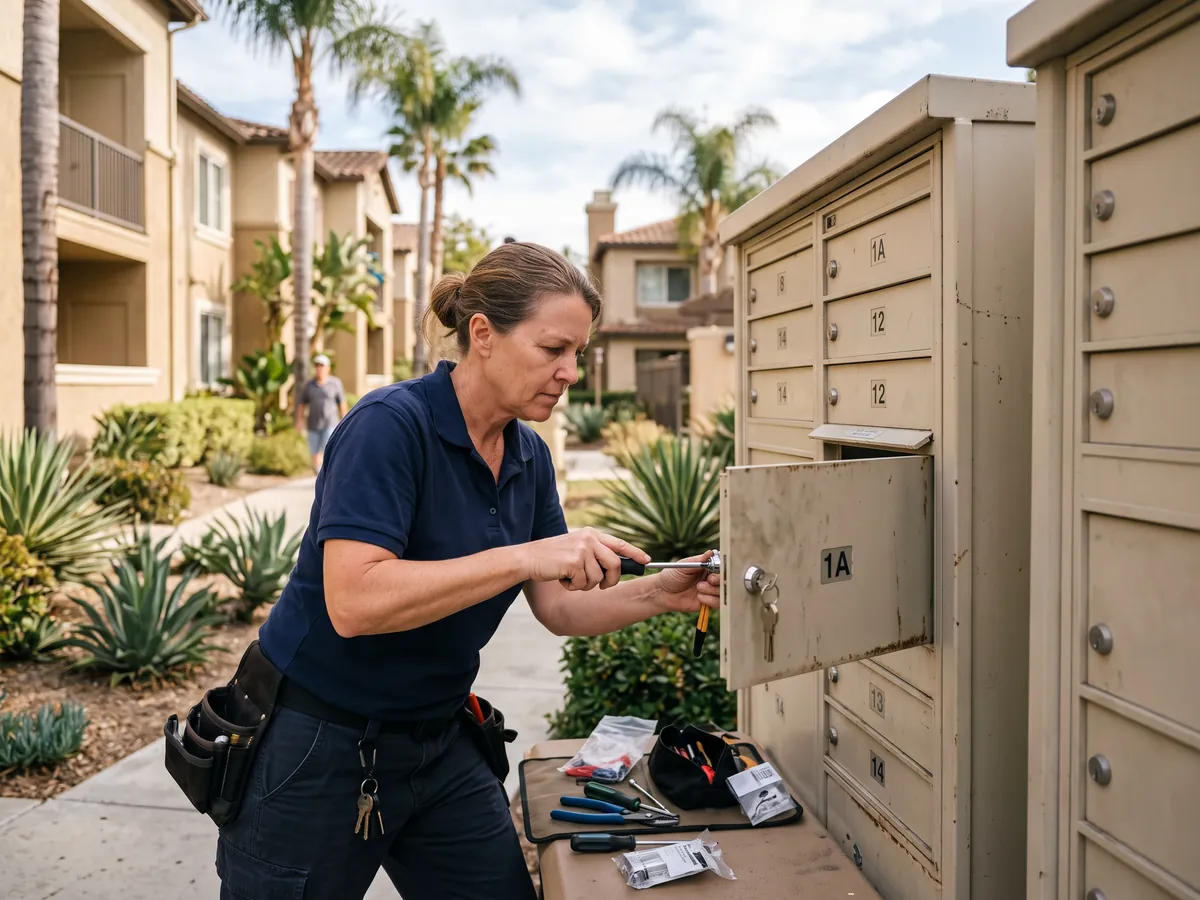
Two Outdoor Locks With Their Own Rules
Most locks on a property follow simple logic: the owner decides what happens to them, and a licensed locksmith does the work. Mailboxes and gates bend that logic in two different directions, which is why we treat them as their own category of work.
Mailboxes involve a third party with real authority. The Postal Service controls the carrier's side of every cluster unit and apartment mailbox bank, and in some neighborhoods it owns the entire unit. Federal law protects mail and postal locks, so the question of who may open or change a given lock has a definite answer, and that answer isn't always the person holding the key.
Gates have no federal overlay, but they face the toughest conditions any lock on a property sees. A front door lock sits under an overhang, shielded by the door frame and weatherstripping. A gate lock hangs in open air, takes direct sun through long summer afternoons, gets soaked by sprinklers, and moves every time wind catches the gate. Pool gates add a child-safety role on top of security, and gates on exit paths in apartment and commercial settings bring building and fire code into the picture.
This guide covers both halves of the category: how mailbox locks are built and who controls them, how gate hardware changes with the type of gate, what holds up in Southern California weather, and where a locksmith's job ends and another trade's begins.
The Mailboxes You'll Find Around Southern California
Before anyone orders a part, it helps to know exactly which kind of mailbox is involved. Across our service area, nearly every box falls into one of these groups:
- Cluster box units, often called CBUs. These are freestanding pedestal units, typically with 8 to 16 customer compartments plus one or more parcel lockers, set on a concrete pad along a street or in a common area. They're the standard for subdivisions built over the last few decades, and plenty of older tracts have them too.
- Horizontal 4C mailboxes. These are wall-recessed or surface-mounted banks found in apartment lobbies, mailrooms and office buildings, named for the Postal Service standard they're built to. On front-loading versions the carrier swings open an entire panel of compartments; rear-loading versions are filled from a secured mailroom behind the wall.
- Vertical apartment mailboxes. Tall, narrow compartments common in buildings from the middle of the twentieth century. Many are still in service, though replacement parts are getting scarce and the Postal Service sets the rules for replacing whole banks.
- Private residential mailboxes. Curbside boxes on posts, masonry columns with a box insert, and wall-mounted boxes next to a front door. Locking models accept mail through a slot or drop door and release it only through a keyed door.
- Through-wall and through-door slots. Common on older homes, with mail dropping into a receptacle inside the house or garage.
The first three groups share one design idea: a master door for the carrier and an individual door for each customer, each with its own small lock. The last two belong entirely to the homeowner. That single difference shapes nearly every decision that follows, from who pays for a lock to who is allowed to install it.
Who Owns the Box Decides Who Changes the Lock
Every cluster unit and apartment mailbox bank has two lock zones. The carrier's zone, meaning the master door, any outgoing-mail slot and the parcel lockers, is controlled by the Postal Service no matter who paid for the unit. The customer zone, meaning the individual compartment doors, is controlled by whoever owns the unit. Ownership is where most of the confusion starts, and it generally falls into three patterns.
- The Postal Service owns the unit. In some older delivery areas, the Postal Service bought and installed cluster units itself. On those units, customer locks are also postal business. Residents request a lock change through their local post office, typically for a fee, and postal staff handle it. A locksmith shouldn't be changing those locks, and a reputable one will say so before taking your money.
- An HOA, landlord or developer owns the unit. In most newer developments, the builder bought approved units as part of the project, and ownership passed to the homeowners association or to the individual owners. Apartment and commercial landlords own the mailbox banks inside their buildings. In each of these cases the owner is responsible for customer locks and repairs, and a locksmith can replace locks with the owner's authorization. Many associations spell out mailbox responsibilities in their CC&Rs or community rules.
- You own the box. A private curbside, column or wall-mounted mailbox belongs to you. You can change its lock, add a lock, or replace the whole box, as long as the replacement still meets the Postal Service's requirements for that type of delivery so carriers can keep using it.
Ownership isn't printed on the outside of a unit. Ask your HOA management company or property manager first. If they don't know, the post office that delivers to your address can tell you whether a unit is theirs. Find out before a key goes missing, because the answer decides whether your next call goes to a post office counter or a locksmith.
Master Locks, Parcel Lockers and What Stays Off-Limits
Some locks on a mailbox aren't available to anyone outside the Postal Service, including the person or association that owns the unit.
The master lock on the carrier door is postal property. Federal law makes it a crime to steal, copy, counterfeit or possess postal keys and locks without authority, and it separately protects mail and mail receptacles from theft and damage. Those protections exist because a single master key can open every box on a route, which is exactly why thieves target carriers for them. The Postal Service has been working to replace many traditional master locks with electronic versions for the same reason. No legitimate locksmith will open, rekey, copy or replace a postal master lock, whatever the circumstances.
Parcel lockers run on a captive-key principle. When a package won't fit your compartment, the carrier places it in a locker and leaves that locker's key in your compartment. When you turn the key to open the locker, the lock traps it, and the carrier collects it on a later delivery. Outgoing mail slots on cluster units are postal territory too. Jammed lockers, stuck packages and damaged carrier doors are matters for the post office.
What a locksmith can do around a damaged or troubled unit is narrower, but still useful: replace customer compartment locks on units that aren't postal property, open a compartment for a verified resident, and help the owner understand what was damaged. If a unit has been broken into, report it before anyone starts repairs, since investigators may want to see the damage as it was left.
Inside a Compartment Lock Change
Customer compartment locks are cam locks, and replacing one is a small job that rewards precision. Here's what's actually involved.
Identification comes first. Compartment locks vary in body length, cam style (flat, offset or hooked), cam length, rotation direction, and how far the cam swings. Most units use locks supplied by the mailbox manufacturer, and makers such as Salsbury, Florence and American Locker each have their own patterns. A lock that fits the hole but carries the wrong cam may turn without catching the frame, or catch so shallowly that the door can be pulled open with a fingertip.
With a working key, the job is straightforward. The door opens, the retaining clip or nut on the back of the door comes off, the old lock slides out, and the new one goes in with its cam set to the correct orientation and direction. With no key, the compartment has to be opened first. Most compartment cylinders are wafer or short pin-tumbler designs that a trained locksmith can pick. Drilling through the lock face is the fallback, and done carefully it still leaves the door reusable.
New keys come with the new lock, usually two or three, stamped with a code. Keep that code on file somewhere safe. It lets a locksmith cut matching keys later without disturbing the lock, and it lets a property manager track which code belongs to which unit.
Rekeying isn't usually the answer for these locks. Some higher-grade compartment locks can be re-pinned, but standard mailbox locks are inexpensive enough that replacement is faster and leaves a fresh mechanism behind. On apartment turnovers, swapping in a lock from a stock of matching spares is the normal practice.
Locking Mailboxes for Private Homes
Homeowners with an open curbside box often ask whether a locking mailbox is worth it. For anyone who receives checks, replacement bank cards, prescriptions or tax documents by mail, it usually is.
A residential locking mailbox has two openings. Mail goes in through a slot, a tilting drop door or a baffle that lets letters fall in but blocks a hand from reaching back out. Mail comes out through a front or rear retrieval door secured by a keyed cam lock. The carrier never needs a key.
Things worth checking before you buy or install one:
- Approval. Curbside and wall-mounted mailboxes used for delivery are expected to meet Postal Service standards, and most reputable locking models state that they do. Ask your post office if you're unsure.
- Capacity. A narrow slot rejects padded envelopes and small boxes, which then sit on the ground or go back to the post office.
- Construction. Heavier-gauge steel and a lock with a long, stiff cam resist prying far better than thin sheet metal and a stubby cam.
- Mounting. A box screwed to a wobbly wood post can be wrenched off whole and opened somewhere private. A steel post set in concrete, or a surface plate anchored into a slab, takes away that shortcut.
- Placement. Carriers expect curbside boxes at a consistent height and distance from the curb, and your post office can confirm what your route needs.
Because the box is yours, its keys can be copied freely and its lock can be replaced whenever you choose. Masonry columns can usually take a locking insert, which keeps the look of the column while adding a real lock.
Gate Hardware, Matched to the Gate
Gate locks aren't one product. The right hardware depends first on what the gate is made of and how people use it.
- Wood side and backyard gates. Thumb latches and gravity latches are standard, often with a pull string for opening from outside. Keyed two-sided latches replace the string with a cylinder. Wood moves with heat and moisture, so latches need some vertical tolerance, and hinge screws need solid wood to bite into or should be upgraded to through-bolts.
- Vinyl gates. Hollow rails and posts need internal inserts before anything is fastened to them. Latches made for vinyl allow for wider stiles and the flex of the material.
- Ornamental iron and steel gates. A standard door lock needs a lock box: a steel housing welded or bolted to the frame that creates a mounting surface and sets the backset. Deadbolts, mortise locks and gate-specific locks from manufacturers such as Locinox all go into this kind of setup. Open pickets create reach-through risk that the design has to address.
- Aluminum pool fencing. Thin tubes and safety rules call for purpose-made hardware, such as magnetic latches like D&D Technologies' Magna-Latch and adjustable self-closing hinges.
- Chain-link gates. Fork latches with a padlock eye, cane bolts on double drive gates, and heavy chain with a padlock for wide openings.
- Community and commercial pedestrian gates. Electric strikes, magnetic locks, exit devices, closers and keypad or reader trim, usually part of a larger access system.
- Motorized driveway gates. The operator does the closing, so lock hardware is limited to manual releases, padlocks for times the operator is disabled, and the pedestrian gate alongside.
Two design questions apply to every one of them. Which side needs a key: outside, inside, or both? And must the gate open without a key from one side because it's an exit path or a pool gate? Answering those before choosing hardware prevents most of the mismatches we're called to fix later.
Choosing Gate Locks That Survive the Weather Here
Southern California weather looks mild on paper, but outdoor locks here take a particular kind of beating. Each condition has a matching hardware choice.
- Sun and ultraviolet light. Plastic housings, nylon latch parts and rubber seals degrade under constant UV, fading first and cracking later. Metal latch bodies, UV-stabilized polymers where plastic can't be avoided, and lighter-colored housings last longer.
- Heat. Inland valleys see long stretches of very hot days. Batteries in electronic keypads lose capacity, alkaline cells may leak, and displays can wash out. Dark metal gets hot enough to burn a hand and expands slightly, which matters for tightly fitted strikes. Mechanical keypads sidestep the battery problem entirely, and a strike set with a little clearance keeps a gate latching through the hottest afternoons.
- Dust and wind. Fine dust packs into keyways, especially ones that have been oiled. Wind slams gates, works hinge screws loose, and can bounce a weak latch out of its catch. Dry lubricant, keyway covers, gate stops and latches with positive engagement all help.
- Water. Rain is occasional, but irrigation runs constantly. A lock that gets wet daily and dries in the sun corrodes quickly. Laminated steel padlocks rust along their plates, and zinc die-cast latches pit and swell. Solid brass, stainless steel, and a drain hole at the bottom of an iron lock box are the fixes.
- Salt air. Nearer the coast, choose 316 stainless over 304 where it's offered, and rinse hardware with fresh water now and then.
Fasteners deserve as much attention as the lock. Plain zinc-plated screws rust and streak stucco within a season or two, and a rusted screw in a wood post loses its grip. Stainless screws and through-bolts cost little more and keep everything tight.
Maintenance also matters more outdoors than in. A short check each spring and fall, tightening screws, applying dry lubricant, testing every key and code, catches most problems while they're still small and cheap.
Pool Gates, Exit Paths and Emergency Access
Some gates carry obligations beyond keeping property secure, and the hardware has to respect them.
Pool and spa gates come first. California's Swimming Pool Safety Act requires new or remodeled residential pools and spas to include at least two drowning-prevention features, and a qualifying enclosure is one of the options. Enclosure gates generally must open away from the pool, close on their own and latch on their own, with the release mounted out of a small child's reach. Local building departments enforce the specifics, and community and apartment pools face further health and building code requirements. From a hardware standpoint, the essentials are a self-closing hinge or closer with enough tension to bring the gate home from any position, a latch that engages even when the gate arrives slowly, and nothing a child can easily defeat. Magnetic pool latches with a high-mounted release are the common choice.
Exit-path gates are the second case. In apartment complexes, commercial courtyards and some HOA common areas, a gate may be part of the required way out of a building. Building and fire codes require those gates to open from the egress side without a key, a special tool or special knowledge. That rules out double-cylinder locks and inside padlocks. The usual combination is lever trim or an exit device on the inside, a shield to block reach-through from the street, and a keyed or access-controlled outside.
Fire department access is the third. Many fire departments require a way for crews to get through locked gates on private roads and in gated communities, often a key switch or padlock from Knox or a similar system. Those keys are controlled by the fire department, and the hardware is ordered with its authorization, so no locksmith can supply or copy them. We can, however, make sure the mechanical lock and latch that the emergency hardware works with are in good order.
Keypads, Access Control and Where a Locksmith's Work Ends
Keyless gate hardware ranges from a simple mechanical pushbutton lock to a networked system covering every gate in a community.
Mechanical pushbutton locks, from makers such as Lockey, release the latch when the right buttons are pressed in combination. They need no power, tolerate heat well, and are dependable on single-family gates and small complexes. Their limit is that they hold one code at a time, and changing it means partly disassembling the lock.
Standalone electronic keypads add multiple user codes, scheduled or expiring codes, and sometimes Bluetooth or Wi-Fi control through an app. Exterior ratings vary widely, so read them carefully before buying, and plan battery changes around the summer rather than discovering a dead unit in July.
Networked access control, with card or fob readers, controllers, power supplies and electric strikes or magnetic locks, is common on community pool gates and apartment entries. A locksmith handles the mechanical hardware: the strike, lock body, exit device, closer and hinges. Controllers, power supplies and cabling are low-voltage work that may call for a licensed low-voltage or electrical contractor, and we coordinate rather than improvise.
Motorized vehicle gates are another trade again. Operators are built to safety standards such as UL 325, and gates intended for automation are expected to follow ASTM F2200, including protection against entrapment. Gate operator companies maintain the motors, circuit boards and safety sensors. A locksmith's role there is limited to manual release locks, padlocks and the pedestrian gate next to the drive.
How We Handle Mailbox and Gate Lock Calls
Julian's Locksmith is a mobile locksmith based in San Bernardino, licensed by California's Bureau of Security and Investigative Services under license LCO7891, which you can verify at search.dca.ca.gov. We handle mailbox and gate locks across the Inland Empire, the San Gabriel and Pomona valleys, north Orange County and southeast Los Angeles County.
Verification comes before access. For mailboxes, we confirm you live at the address or hold the owner's authorization, using ID with the address, a lease, or a work order from the HOA or property manager. For common-area gates, we need approval from whoever controls them. That protects residents and keeps every job on the right side of state and federal law.
Pricing depends on factors we can walk through on the phone:
- Whether a working key exists, or the lock must be picked or drilled
- The specific lock or latch, and whether you choose a standard or weather-rated version
- The gate's material, plus any hinge, post or alignment work needed first
- How many locks are handled in a single visit
- Access arrangements at the property and travel distance from our base
We quote before starting, and if something changes once a lock is out, we stop and requote before continuing.
Our hours are 6:30 a.m. to 11:30 p.m., seven days a week. We're closed between 11:30 p.m. and 6:30 a.m. Most mailbox and gate work is scheduled, but a gate that won't close with a pool or animals behind it gets moved up the list. Call (951) 903-3193, describe the box or gate, and we'll tell you honestly whether it's a job for us, for the post office, or for another trade.
Frequently asked questions
Is a Do Not Duplicate stamp on a mailbox key legally binding?
The stamp itself is a request from the property owner, not a federal restriction. Compartment keys aren't postal keys, so copying them isn't covered by the laws that protect postal locks. Still, on apartment and HOA mailboxes the stamp usually reflects a key-control policy, and a careful locksmith will ask for the owner's authorization before cutting a copy. Truly restricted keys use patented keyways and blanks that only authorized dealers can cut, which is a different system altogether.
Our HOA isn't sure whether it owns the cluster mailboxes. What now?
Start with the paperwork. Developer turnover packets, reserve studies and maintenance records often list cluster units as association assets, and the CC&Rs may assign mailbox responsibilities. If the documents are silent, ask the post office that delivers to the community; it can say whether the units are postal property. Once ownership is settled, write it into the association's rules so residents know where to go when they lose a key, and so the board isn't paying for work that belonged to someone else.
Can I replace my own mailbox lock?
On a private mailbox, yes, provided you can identify the right lock: body length, cam shape, rotation and mounting style. On association or rental property you'll need the owner's permission, and many managers prefer to handle it themselves to keep key records accurate. On Postal Service-owned units, no; that request goes through the post office. The most common DIY failure is a lock with the wrong cam length, which turns without securing the door. Describe the box to a locksmith before ordering parts.
Should a mailbox lock be rekeyed or replaced?
Most standard compartment locks are replaced rather than rekeyed. They're inexpensive, their wafers or pins wear with daily use, and a new lock brings a fresh mechanism along with new keys. Some higher-grade compartment locks can be re-pinned, which can make sense for a building that wants to keep one consistent lock series. Either way the goal is identical: every old key stops working, and you leave with a key code on record for future copies.
How long should gate hardware last in inland Southern California?
It varies so much with exposure that any single number would mislead you. A bargain zinc latch in full afternoon sun with daily sprinkler spray may fail within a couple of seasons, while stainless hardware on a shaded gate that gets occasional maintenance can last many years. The biggest variables are material, direct sun, water exposure, how often the gate is used, and whether the gate stays aligned. Good fasteners and twice-yearly checks extend the life of almost any hardware.
Is a magnetic pool latch better than a standard gravity latch?
For pool gates, magnetic latches have practical advantages. They pull the latch bar in as the gate approaches, so a slowly closing gate still latches, and they're commonly built with the release at the top of a tall housing, away from small hands. Gravity latches can work when set up well, but they depend more on the gate arriving with enough force. Whatever the latch, the self-closing hinge or closer still has to deliver the gate reliably every time.
Can a smart lock be installed on a gate?
Some can, but most smart locks are designed for doors under a roof, not gates in open weather. Look for models rated for exterior gate use, compare the operating temperature range against your summer highs, and plan for battery changes. Wi-Fi models may struggle at a gate far from the house's router, while Bluetooth-only models need your phone nearby. For many gates, a mechanical keypad or an exterior-rated electronic keypad turns out to be the more reliable choice.
What should I do if my mailbox was broken into?
Report it first. Contact the U.S. Postal Inspection Service, which investigates mail theft, and file a report with local police. Tell the unit's owner, whether that's the post office, your HOA or your landlord. Watch your bank statements and credit reports if checks or cards may have been taken. Leave the damage alone until the reports are made. After that, repairs follow ownership: postal units are fixed by the Postal Service, others by the owner or a locksmith acting with their approval.
Mailbox & Gate Locks by city
Local details, routes and answers for mailbox and gate locks in each city we cover across four counties.
San Bernardino County
Riverside County
Los Angeles County
- Rosemead
- San Gabriel
- Temple City
- Arcadia
- Sierra Madre
- Monrovia
- Duarte
- Bradbury
- El Monte
- South El Monte
- Baldwin Park
- West Covina
- Covina
- Azusa
- Irwindale
- Glendora
- San Dimas
- La Verne
- Pomona
- Claremont
- Diamond Bar
- Walnut
- La Puente
- City of Industry
- Hacienda Heights
- Rowland Heights
- Avocado Heights
- Charter Oak
- Valinda
- West Puente Valley
- South San Gabriel
- East San Gabriel
- North El Monte
- Citrus
- La Habra Heights
- La Mirada
- Cerritos
- Artesia
- Hawaiian Gardens
- Lakewood
- Bellflower
- Norwalk
- Downey
- Pico Rivera
- Whittier
- Santa Fe Springs
Specific mailbox & gate locks needs
Choose your city on the next page for local details.
- Mailbox LocksmithSan Bernardino and nearby
- Lost Mailbox KeySan Bernardino and nearby
- Mailbox Lock ChangeSan Bernardino and nearby
- Mailbox Lock RepairSan Bernardino and nearby
- Mailbox Key ReplacementSan Bernardino and nearby
- Apartment Mailbox Lock ReplacementSan Bernardino and nearby
- Cluster Mailbox LockSan Bernardino and nearby
- Community Mailbox LockSan Bernardino and nearby
- Broken Mailbox Key ExtractionSan Bernardino and nearby
- New Mailbox Lock InstallationSan Bernardino and nearby
- Gate Lock InstallationSan Bernardino and nearby
- Gate Lock ReplacementSan Bernardino and nearby
- Outdoor Gate LockSan Bernardino and nearby
- Side Gate LockSan Bernardino and nearby
- Driveway Gate LockSan Bernardino and nearby
- Pedestrian Gate LockSan Bernardino and nearby
- Keypad Gate LockSan Bernardino and nearby
- Electronic Gate LockSan Bernardino and nearby
- Gate Latch RepairSan Bernardino and nearby
- Gate Won't LockSan Bernardino and nearby
- Weather-Resistant Gate LockSan Bernardino and nearby
- Locksmith for Gated PropertySan Bernardino and nearby
- Smart Gate Lock InstallationSan Bernardino and nearby

