
Service category
Apartment Lockout Service: Getting Tenants and Condo Owners Back Inside
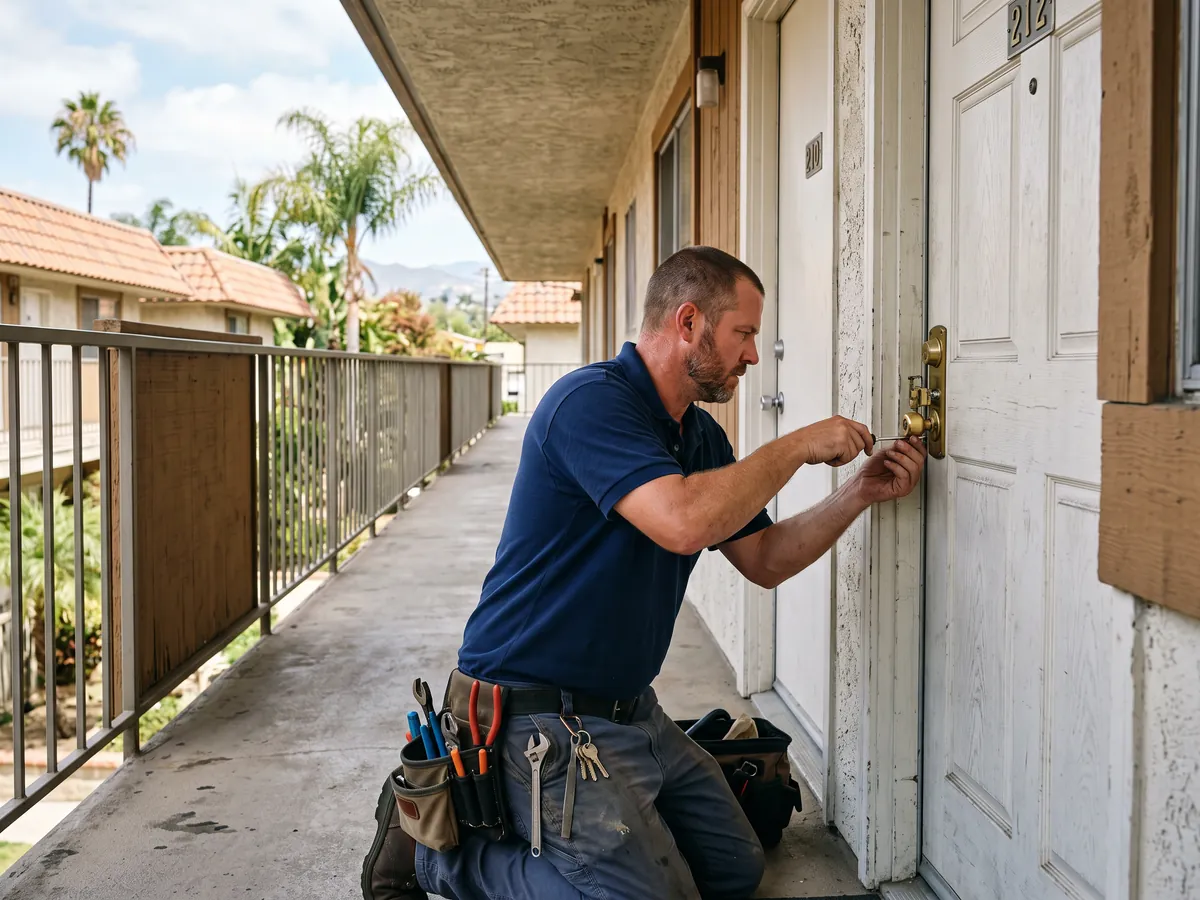
Short answer: An apartment lockout is usually solved one of two ways: the leasing office opens the door during its hours, or a licensed locksmith does it when the office can't. Julian's Locksmith verifies that you live in the unit, plans a legitimate way through gates and lobbies, and opens the door by picking or working the latch so the landlord's lock keeps working. We serve the Inland Empire and neighboring regions seven days a week.
Why an apartment door is a different kind of lockout
Opening a front door is the same mechanical problem whether it hangs on a ranch house or a third-floor unit. What changes in multifamily housing is everything around the lock, and that shapes how a careful locksmith approaches the job.
- The hardware usually belongs to the property owner, not the person standing outside. Whatever we do has to leave it working with the keys management already issued.
- Many buildings run unit cylinders on a master key system or interchangeable cores. A careless drill-and-replace can knock one door out of that system and create work for the property later.
- Neighbors live a wall away. Opening the wrong unit for the wrong person is the single worst outcome in this trade, so proof of residence carries more weight than it does at a detached house.
- Access is layered. A vehicle gate, a pedestrian gate, a lobby door, an elevator and a corridor door may all stand between the curb and your unit.
- Someone else sets the schedule. Leasing offices and maintenance teams keep their own hours and policies, and your lease may already spell out what a lockout costs when they handle it.
Julian's Locksmith plans every apartment call around those five realities. The sections below explain how each one plays out, what you can do to speed things along, and where the honest limits of a locksmith's role sit.
Leasing office, maintenance or a locksmith: deciding by the clock
The least expensive way back into a rental is often the person who already holds a key. While the office is open, most managers can let a resident in after an ID check, sometimes free and sometimes for a charge written into the lease. If the office is open and a short walk away, start there.
Once the office closes, the options narrow. Some communities keep a courtesy officer or an on-call technician who handles lockouts. Many limit the after-hours number to water leaks, fire alarms, gas odors and failed heat. Small landlords who own a duplex or fourplex may live across the county and answer when they can.
A quick way to decide:
- Office open and nobody inside needs help. Walk over or phone the office.
- Office closed, but a friend has a spare a short drive away. Go get the spare.
- Office closed, no spare, and you need to be inside tonight. Call a licensed locksmith.
- A child alone inside, someone in medical trouble, or smoke or a gas smell: call 911 before anyone else.
We'll tell you on the phone if waiting for management makes more sense than paying for a visit. A locksmith willing to talk you out of an unnecessary job is one you can trust with the necessary ones.
Proving you live there: what we accept and why
Verification isn't a formality. California licenses locksmith companies through the Bureau of Security and Investigative Services under the Locksmith Act, Business and Professions Code section 6980 and the sections that follow it, and a responsible locksmith confirms a customer's right to enter before opening anything. In an apartment building that matters even more, because the person outside a unit could be an ex-partner, a former roommate or someone who simply knows a resident's name.
What works:
- A photo ID whose address matches the unit.
- A photo ID plus a lease, a resident app screen, a utility bill, a renters insurance declaration or mail showing your name at that address.
- A manager or property owner confirming you by phone.
- A leaseholder vouching by phone or video for a partner or roommate who isn't on the lease, along with that person's ID.
- For condo owners, a deed, property tax bill or HOA statement.
When every document is locked inside, we look for a path that still protects you. Management can sometimes confirm a resident quickly. Failing that, we may open the door and review your paperwork with you on the spot before you go in alone. What we won't accept is a story by itself or a neighbor's assurance. Your name, ID details and the address go on our work order, which is the record that the right person asked us to open the right door.
Gates, call boxes, lobbies and long walkways
At many complexes the lock on your door is the easy part. Getting a service van and a technician to it is where the time goes. Here are the common setups and how we handle each:
- Telephone entry systems dial a resident's phone so the resident can let a guest through. If your phone is inside, the call box can't help, but a neighbor, the courtesy officer or the office can.
- Pedestrian gates with proximity readers need a fob. We'll meet you on the street side and walk in together once someone with a credential opens it.
- Vehicle gates with keypads often have a guest code. If you remember yours, share it; if not, we park outside.
- Staffed guard gates keep a visitor list. Call the gate from a borrowed phone and add us.
- Mid-rise buildings may require a fob for the lobby, the elevator and the parking garage. Expect us to use the stairs.
We don't climb gates, prop them, borrow a fire department key or slip in behind a resident who hasn't invited us. Those shortcuts weaken security for everyone who lives there, and you'd be right to distrust a locksmith who took them.
What helps most is detail. Tell us the building letter or number, the nearest feature inside the property such as the pool, the clubhouse or a mail kiosk, which stairwell serves your door, and where visitors may park. Large garden-style complexes can stretch across dozens of nearly identical buildings, and a clear description saves real time after dark.
The hardware on apartment doors and how each type opens
Multifamily doors carry a wider range of hardware than most people expect. Knowing what's on yours lets us bring the right tools and estimate honestly.
- Knob or lever with a spring latch. Many have a push-button or turn-button that holds the latch locked until someone turns the inside handle. If that's the only thing locked, the opening can be quick.
- Single-cylinder deadbolt. The most common unit lock, with a key outside and a thumbturn inside. Building and fire codes generally require apartment entry doors to open from the inside without a key, which is why double-cylinder deadbolts rarely appear on unit doors.
- Interconnected locksets. One inside lever retracts both the latch and the deadbolt in a single motion for faster exit. Schlage and Kwikset both make them, and newer buildings use them widely.
- Rekeyable cylinders such as Kwikset SmartKey, which let maintenance change the key between residents with a small tool. Their sidebar design doesn't respond to ordinary pin-tumbler picking, so they call for a different approach.
- Interchangeable cores from systems like Best or Schlage, removed with a control key. Management can swap one almost instantly, which is why the office may be your fastest fix when it's open.
- Mortise locks, found in older buildings and some upscale ones, where the lock body sits in a pocket cut into the door edge.
Our default is picking the cylinder or working the latch, which leaves no trace. Reaching the inside hardware with purpose-built tools is another non-destructive option on certain doors. Drilling comes last, never first.
High-security and restricted cylinders
Some property owners and condo associations invest in patented cylinders so keys can't be copied at a hardware store and an amateur can't pick the lock. Medeco uses angled cuts that rotate pins as well as lift them. Mul-T-Lock uses telescoping pin pairs. ASSA and Schlage Primus add a sidebar that reads a second set of cuts on the key. Every one of them makes a building more secure, and every one makes a lockout slower.
Here's how we approach one:
- We tell you on the phone that a patented cylinder may take a while, and why.
- We look for another route first. An attached garage entry door on a standard lock, a second unit door, or a manager with a key who can arrive soon.
- If we attempt a non-destructive opening, we keep you informed about whether it's going well and stop to talk if it isn't.
- If drilling becomes the sensible choice, we drill precisely and fit either a temporary cylinder or one management approves.
Restricted keyways are registered through authorized dealers, and new keys or cylinders for those systems usually have to come through that dealer with the property owner's authorization. We can't cut those keys from a blank on the van, and anyone who claims otherwise is undermining the building's key control. That isn't a limitation we hide. It's exactly why the building chose those cylinders in the first place.
Keypads, smart locks and management-controlled access
Electronic locks on apartment doors fall into two camps, and they fail in different ways.
Resident-installed consumer locks, such as Schlage Encode, Yale Assure, Kwikset Halo, August or Level, are typically approved by management and owned by the resident. Property-installed locks are tied to a management platform that issues and revokes codes from a dashboard the tenant never sees.
Common failures include:
- Dead or weak batteries. Exterior keypads in the inland sun and units with heavy daily traffic drain cells faster than the packaging suggests.
- Codes deleted or changed at lease renewal, at a roommate's move-out, or by an administrator's slip.
- A hub, bridge or Wi-Fi connection that dropped, which matters when your phone is your key.
- A phone that died with the digital key stored on it.
Our approach is to check whether the lock has a keyed override or emergency power terminals, open the door through the override without damaging the electronics, and confirm the keypad accepts codes again before we leave. On a management-controlled lock, we don't reprogram the system. A fresh code from the office is the right long-term fix, and if the office can issue one this evening, that may beat our arrival. We'll say so before you commit to a service call.
Condos and townhomes: owners, renters and HOAs
A condo looks like an apartment from the parking lot, but ownership changes who can authorize entry.
- Owner-occupants generally own their unit's door hardware. Bring a photo ID and a deed, property tax bill, HOA statement or utility bill, and you can authorize the opening yourself.
- Renters of an individually owned condo don't have a leasing office on site. The owner, or the owner's property manager, needs to confirm you.
- HOA management companies typically hold keys only to common areas: pool gates, gyms, trash enclosures and mail rooms. They rarely have a key to your unit and generally can't authorize opening it.
Townhomes often offer more than one way in. An attached garage with an interior door, a side entrance or a patio slider may be faster and gentler than a high-security front deadbolt. If the garage opener is inside, the overhead door itself is usually not the answer, but a garage side door might be.
After the lockout, check your CC&Rs before changing exterior hardware. Some associations regulate the finish and style of anything visible from common areas, and most require common-area locks to stay on the HOA's own key system. We'll note anything that might need board approval if you decide to upgrade later, so you don't install a handle set the association asks you to remove.
Landlord rights, tenant rights and California law
A handful of California rules shape apartment lock work, and knowing them helps you make good decisions after a lockout.
- Civil Code section 1941.3 requires landlords to provide and maintain an operable deadbolt on each main swinging entry door of a rental unit, along with security devices on certain windows. If your deadbolt jams or won't extend fully, report it in writing so the landlord has notice and can repair it.
- Civil Code sections 1941.5 and 1941.6 set lock-change rules for landlords in certain situations involving a protective order or similar documentation. The landlord generally must act within 24 hours of a request with the required documents, and if that doesn't happen, the tenant may change the locks under conditions those statutes set out.
- Civil Code section 1954 governs when a landlord may enter, generally with reasonable written notice except in emergencies. That's one reason most leases require the landlord to keep a working key and bar tenants from rekeying without approval.
- A landlord can't lawfully lock a tenant out to force a move. Civil Code section 789.3 prohibits changing locks to exclude a tenant outside the court eviction process.
What this means for a lockout: having your own door opened doesn't violate anyone's rights, but altering the lock may affect your lease. We open first and let you and management decide about any changes. If the situation is a dispute rather than a misplaced key, we step back and point you to the right resource.
After you're inside: lost keys, rekeys and master systems
Getting the door open ends most lockouts. When the keys are lost instead of locked in, a few minutes of thought before we pack up is worth it.
Ask yourself:
- Did the ring carry your unit number, building name or a gate fob that could lead someone to your door?
- Was it lost somewhere random, or taken with a bag or car that also holds your address?
- Who else has copies, and do you trust where they are?
If the answers point to real risk, the cylinder should be rekeyed. In a rental, that's management's decision and usually management's process. Many complexes rekey in-house with SmartKey tools or core swaps, and master-keyed buildings need the change made from the property's keying records so maintenance keys still work. With approval, we can rekey on the same visit. Without it, we'll write up the lockout so you can send the description to the office.
Duplicates are simpler. If your keyway isn't restricted, we can cut a new key on the van straight from the cylinder. Restricted keys, often stamped with a control number or a Do Not Duplicate notice, come from the property or its authorized dealer.
Don't forget the smaller locks. Mailbox compartments, storage cages, carport cabinets and bike rooms often ride on the same lost ring. With management's okay, we can open and replace those cam locks during the same trip.
When we pause, decline or send you elsewhere
Most apartment lockouts are exactly what they sound like. A few aren't, and an honest locksmith says no to those.
- A sheriff's lockout. After a court judgment and a writ of possession, the sheriff returns the unit to the landlord. We can't reopen it for a former tenant. Talk with the landlord or a legal aid office about retrieving belongings.
- A dispute between occupants. If someone inside refuses to let you in, or a roommate or partner is contesting your right to the space, that's a matter for law enforcement or the courts, not a locksmith.
- No verifiable link to the unit. We'll explain what proof would work and come back when you have it.
- Residence halls and university-owned housing, which run on campus key systems managed by campus staff.
- A balcony, upstairs window or rooftop route. We work at ground level or through the entry door itself.
Emergencies come before all of that. If a child is alone inside, someone is in medical distress, or you smell gas or see smoke, call 911. Firefighters can force a door when a life is at stake, and they won't wait for paperwork. We're the right call for urgent situations that aren't life-threatening: a pet in a warming apartment, a work shift you can't miss, or medication you need tonight. Tell us which one applies, and we'll weigh it honestly against the other calls in line.
Where we work and when we're available
Julian's Locksmith is a mobile service based in San Bernardino's University Heights area, near Cal State San Bernardino, and every apartment lockout we handle happens at your building. We cover apartment and condo communities across the Inland Empire, the San Gabriel Valley, the Pomona Valley, north Orange County and southeast Los Angeles County.
Our hours, plainly stated:
- Monday through Friday, 6:30 a.m. to 11:30 p.m.
- Saturday, 6:30 a.m. to 11:30 p.m.
- Sunday, 6:30 a.m. to 11:30 p.m.
We are not an overnight service, and we won't pretend to be. If you're locked out outside those hours, use the property's after-hours contact, a spare key, a friend's couch or a hotel room, and phone us when we open if you still need help. Inside our hours, call (951) 903-3193. Give us the community, building and unit, which locks you set, and how a visitor gets onto the property. We'll quote the work before we leave, share an honest arrival estimate, and verify your residence at the door.
Our California locksmith company license is LCO7891, issued by the Bureau of Security and Investigative Services. You can look it up yourself at search.dca.ca.gov before we arrive, which is a habit worth keeping with any locksmith you hire.
Frequently asked questions
Is a locksmith allowed to open an apartment without the landlord present?
Yes, when the person asking is the lawful occupant and can show it. A licensed locksmith doesn't need the landlord on site to open a door for a verified tenant, because opening the door doesn't alter the owner's lock. What does involve the landlord is changing, rekeying or replacing that lock, which most leases restrict. Our practice is to verify tenancy carefully, open the door without damage, and leave hardware changes to you and your property manager. If management wants to confirm you by phone first, we welcome the call.
Are California landlords required to provide a deadbolt?
Yes. Civil Code section 1941.3 requires an operable deadbolt on each main swinging entry door of a rental unit, along with locking devices on windows designed to open, subject to some exceptions in the statute. Tenants are expected to report a broken device, and the landlord's duty to repair generally begins once they have notice. If your deadbolt binds, spins or won't fully extend, send a written maintenance request. A bolt that barely works today is often the reason someone ends up locked out tomorrow.
Can I install my own smart lock or deadbolt in a rental?
In most cases, only with your landlord's permission. Leases commonly bar tenants from adding or changing locks, and the landlord generally needs a way to enter with proper notice. Many managers will approve a smart lock if you provide a code or key, store the original hardware and reinstall it when you move out. Get that approval in writing. Once you have it, we can install the lock, bag the original deadbolt parts for safekeeping and set up a code for management.
What happens with my locks if I have a protective order?
California Civil Code sections 1941.5 and 1941.6 require a landlord to change the locks within 24 hours of a tenant's written request in certain situations involving a protective order or similar documentation. If the landlord doesn't act in time, the tenant may change the locks under the conditions those statutes describe. We can do that work promptly during our hours. Bring the paperwork, and we'll keep the details confidential. If you're in immediate danger, call 911 before anyone else.
Who pays if my apartment cylinder has to be drilled?
Usually the person who called for the lockout, since the lockout isn't the landlord's doing. That's one reason we work so hard to avoid drilling. If it's unavoidable, the replacement may need to match the building's keyway or master system, which can mean a specific cylinder from management or its dealer. Your lease may also say how replacement hardware is handled. We explain the cost of drilling and replacing before we start, so the decision stays yours.
Can you copy a key stamped Do Not Duplicate?
A stamp alone isn't a legal barrier, but it signals the property's wishes, and in an apartment that usually reflects a lease rule against unauthorized copies. We'll cut a copy with management's approval. Patented keys are a different matter: the manufacturer's system restricts them, blanks are controlled, and copies come only through the authorized dealer with the owner's authorization. If you need a spare for a restricted apartment key, ask the leasing office, which already has the process in place.
Do you work with property managers and small landlords?
Yes. Managers call us for vacant-unit lockouts, maintenance room access, turnover rekeys and tenant lockouts when nobody from the office can respond. Small landlords who own a duplex or fourplex can authorize a tenant's lockout by phone and email, and we verify the tenant at the door before opening. With written authorization on file, we can also rekey units between residents and keep your keying consistent. Call to set up how you'd like approvals handled for your properties.
What if my apartment building has a concierge or front desk?
Start there. Many staffed buildings keep a resident roster, and some hold unit keys in a managed key cabinet, so the desk may solve your lockout without us. If they can't open units, they can usually confirm your residence and let us into the lobby and elevator. That combination makes the visit faster and the verification simple. We'll ask you to let the desk know we're coming so they aren't surprised when a locksmith walks in.
Apartment Lockout by city
Local details, routes and answers for apartment lockout in each city we cover across four counties.
San Bernardino County
Riverside County
Los Angeles County
- Rosemead
- San Gabriel
- Temple City
- Arcadia
- Sierra Madre
- Monrovia
- Duarte
- Bradbury
- El Monte
- South El Monte
- Baldwin Park
- West Covina
- Covina
- Azusa
- Irwindale
- Glendora
- San Dimas
- La Verne
- Pomona
- Claremont
- Diamond Bar
- Walnut
- La Puente
- City of Industry
- Hacienda Heights
- Rowland Heights
- Avocado Heights
- Charter Oak
- Valinda
- West Puente Valley
- South San Gabriel
- East San Gabriel
- North El Monte
- Citrus
- La Habra Heights
- La Mirada
- Cerritos
- Artesia
- Hawaiian Gardens
- Lakewood
- Bellflower
- Norwalk
- Downey
- Pico Rivera
- Whittier
- Santa Fe Springs