
Service category
Home Lockout Service for Houses, Apartments, Condos and Garages
Short answer: A home lockout service gets you back into a house, apartment, condo, garage or other residence without breaking in. A licensed locksmith verifies that you live there, surveys the doors to find the easiest entry, then picks or bypasses the lock so it keeps working with your keys. Julian's Locksmith provides this across the Inland Empire, San Gabriel Valley, Pomona Valley, north Orange County and southeast Los Angeles County.
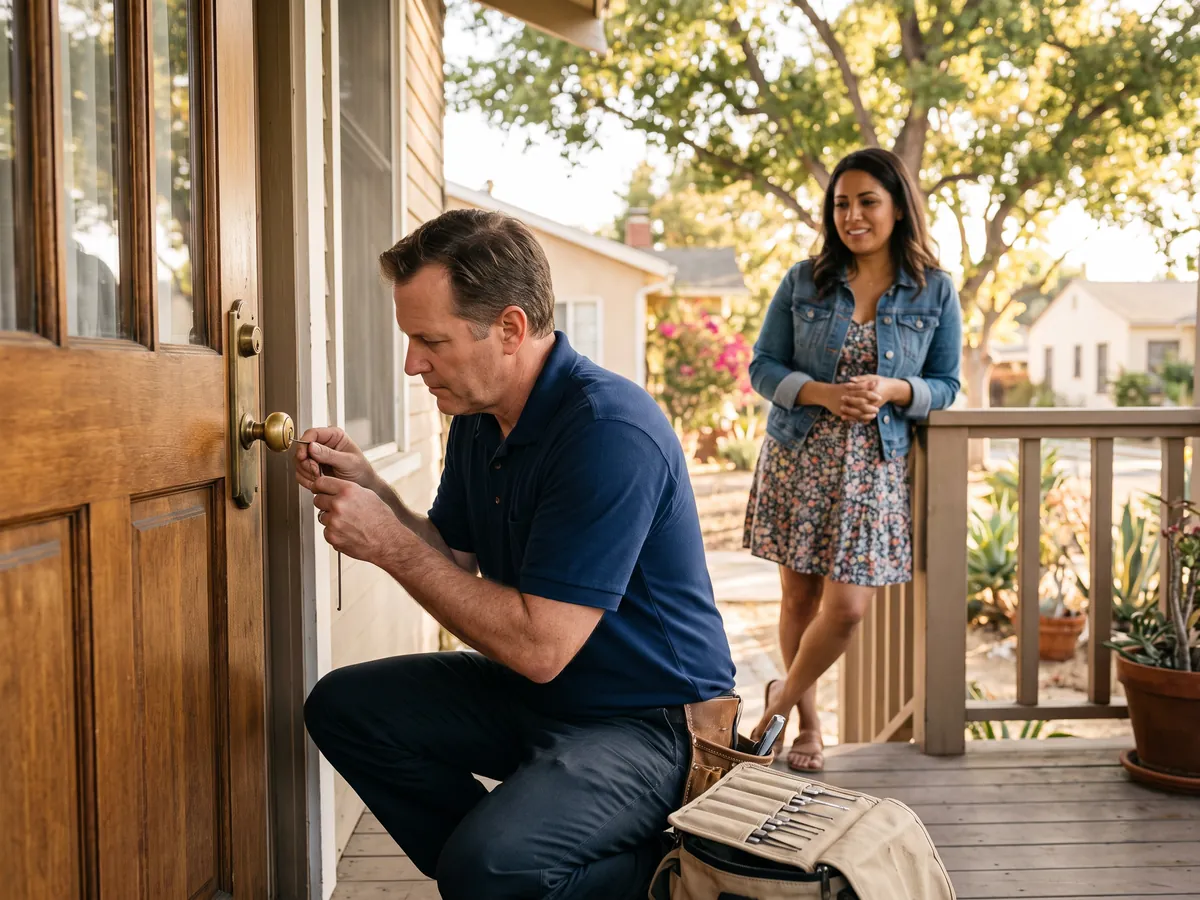
What counts as a home lockout
The phrase covers more ground than most people expect. Anything that keeps you out of the place you live, or out of one part of it, is a home lockout, and each version calls for a slightly different approach.
- Entry door lockouts. The knob latch or deadbolt on a front, back or side door locked with the keys inside or lost somewhere.
- Unit lockouts. Apartments, condos, townhomes and guest houses, where a landlord, HOA or gate guard becomes part of the picture.
- Garage lockouts. An overhead door that won't respond, a service door that latched, or a house-to-garage door that locked behind you.
- Sliding and French door lockouts. Patio doors with hook latches and track bars, and double doors with multipoint hardware.
- Electronic lockouts. Keypads and smart locks with dead batteries, forgotten codes, app trouble or failed motors.
- Hardware failures. A key that spins without moving the bolt, a key snapped off in the cylinder, or a lock frozen by grit and age.
- Interior lockouts. Bedrooms, bathrooms and home offices locked from the inside, often with a child or a laptop on the far side.
The common thread is that you have every right to be inside and simply can't get there. That distinction matters, because a locksmith's first responsibility is confirming it before touching a lock. The second is choosing the least destructive way through, which depends on which of these situations you're facing. The sections below walk through both, along with the honest limits of what any locksmith can do without damage.
The first ten minutes: triage before you call
Before calling anyone, spend a few minutes on the checks that resolve a surprising share of lockouts on their own. None of them involve force.
- Walk the entire perimeter. Try every door, including the garage service door and the door leading from the garage into the house. People routinely deadbolt the front and forget the back.
- Try the garage keypad and any smart lock app, even if you assume they won't help.
- Think through every possible spare. A neighbor, a relative, a roommate's work schedule, a housekeeper, a dog walker, or the lock box you forgot you installed last year.
- If you rent, call the office or the emergency maintenance number printed in your lease.
- Look for an unlocked window at ground level, but don't climb through anything above waist height or pry screens loose.
Then decide how urgent this really is. If a young child, someone who needs medical help or a pet in an overheating room is inside, or if something hazardous is running, such as a stove, an iron or a filling bathtub, call 911. Fire and police crews can force a door without waiting on anyone, and broken hardware is a fair trade when safety is at stake. Holding out for a locksmith in that situation is the wrong call.
If everyone is safe and you're simply on the wrong side of the door, a locksmith is the next step. Have the address, the type of home, the locks you can see and your relationship to the property ready, and the conversation will go quickly.
Door by door: what each entry point offers
Locksmiths think about a lockout in terms of doors, not houses. Every exterior door has its own hardware, its own weak points and its own risk of damage, and the right choice can turn a long job into a short one.
Front entry doors usually carry the heaviest hardware: a keyed knob or handleset plus a deadbolt, sometimes a smart lock. A thrown deadbolt has to be picked or otherwise opened, because unlike a spring latch it can't be pushed back with a thin tool.
Back and side doors are often the soft spot. They frequently get pulled shut without anyone throwing the deadbolt, leaving only a spring latch. If that latch's deadlatch plunger isn't seating against the strike, typically because the door has shifted, the latch can sometimes be bypassed without touching the cylinder at all.
Garage doors come in two kinds. Service doors behave like back doors. Overhead doors on an opener can't be lifted while the trolley is engaged, but on many sectional doors a specialized tool can reach the emergency release from outside. That technique is exactly why the release deserves a shield or a zip tie afterward.
Sliding patio doors are a last resort for entry. The hook latch can sometimes be manipulated, but a bar or dowel in the track ends the discussion.
French doors and tall fiberglass doors often use multipoint locks that engage at several points along the frame. Their cylinders can usually be picked, but they reward patience rather than speed.
Security screen doors always come first, since nothing reaches the entry door until the screen door swings open.
Houses, apartments, condos and manufactured homes
The type of property changes who else is involved and what proof makes sense.
Single-family houses are the simplest from a permission standpoint. The owner or resident shows proof of residence, and decisions about entry methods are theirs alone. The complication tends to be the number of doors and the variety of hardware, from original mortise locks in pre-war bungalows to builder-grade locksets and keypads in recent tracts.
Apartments add a landlord. Many communities keep keys to every unit and will open your door during office hours; some charge a fee, and some leases ask you to try management before calling anyone else. Buildings may use restricted keyways or master-keyed cylinders that only the owner can duplicate, so a locksmith should get you in without disturbing that system.
Condos and townhomes sit between the two. You own the unit, so a deed or tax bill is your proof, but the HOA may control vehicle gates, pedestrian entries and sometimes the look of exterior hardware. Attached garages often provide the easiest route into the unit.
Manufactured homes in parks and 55+ communities typically have out-swinging doors fitted with combination knob-and-deadbolt units. Because those doors swing outward, the hinges sit on the outside, which tempts people to drive out the pins. Picking the lock is cleaner and leaves the door hanging true.
Guest houses, ADUs and casitas behind a main house often have keys nobody has seen in a while. Proof here may be a lease from the property owner, or the owner's confirmation by phone.
How identity and residence are verified
Any locksmith who opens a home without asking questions is a risk to everyone, including you. The skills used to get you back inside would work just as well for a stranger claiming to live at your address. That's why a careful locksmith treats verification as part of the service rather than an obstacle to it.
In practice, the check looks like this:
- A government-issued photo ID compared against the address. A California driver license or ID card showing the current address settles most cases.
- If the ID shows a previous address, a second document bridges the gap: lease, deed, mortgage or property tax statement, utility bill, vehicle registration, or official mail bearing your name.
- Digital versions count when they're genuine and tie your name to the address, so account screenshots and emailed leases are genuinely useful.
- Renters can have the property manager confirm by phone, which helps when the lease is buried in a drawer.
- When the proof is locked inside, the door gets opened and the documents are reviewed on the spot, with the locksmith present, before anyone leaves.
The details go onto a signed work order. California's Locksmith Act, administered by the Bureau of Security and Investigative Services, licenses locksmith companies and holds them accountable for how they operate, and keeping proper records is part of that responsibility.
There are times a locksmith should say no. If two adults disagree about who has the right to be inside, or someone was recently ordered out of a home by a court, that's a matter for law enforcement or a judge. A locksmith isn't equipped to referee it and shouldn't try.
Non-destructive entry: the methods behind it
Damage-free entry isn't one trick. It's a toolkit, and the skill lies in matching the tool to the hardware in front of you.
Picking. A tension wrench applies light rotational pressure to the plug while a hook lifts each pin stack until it sets at the shear line. Single-pin picking is slower but precise; raking moves several pins at once and suits loosely toleranced residential locks. Done properly, picking leaves no damage, and your keys work exactly as they did before.
Latch bypass. A spring latch is beveled so the door can close without a key. When the deadlatch plunger isn't held in by the strike, a thin tool can push the latch back. A correctly adjusted door prevents this, which is one more reason to keep doors aligned.
Under-door and through-door tools. Lever handles can often be pulled down from the inside with a long tool fed beneath the door. Related reach tools work through mail slots or gaps around some doors to operate a thumb turn.
Impressioning and decoding. When a working key is needed anyway, a blank can be marked inside the lock and filed until it turns, or the lock can be decoded so a key is cut by its bitting. This suits older mortise locks and situations where every key is gone.
Electronic recovery. Emergency power contacts, USB-C ports, manufacturer override procedures and backup key cylinders handle most keypad and smart lock lockouts.
What's missing from that list is force. Pry bars, bump keys and drills aren't the starting point for a professional residential opening. Drilling has its place, covered below, but only after gentler options run out and you've agreed to it.
Smart locks, keypads and garage openers
Electronic hardware has made some lockouts rarer and others stranger. You can't leave a code on the kitchen counter, but you can absolutely forget one, and batteries don't send polite reminders while you're away for the weekend.
Common failure points include:
- Dead batteries. Most keypad deadbolts run on AA cells and flash warnings well before quitting, but those warnings are easy to miss. Heat speeds the decline. Several models provide 9-volt contacts or a USB-C port on the exterior so the keypad can be powered just long enough to accept a code.
- Lost codes or accounts. A phone upgrade, a changed password or a deleted app can cut off access when the lock depended on it. A second administrator on the account prevents this.
- Auto-lock surprises. Locks set to relock after a delay will happily engage while you're watering the front yard.
- Motor and alignment trouble. If the door has shifted, the motor strains against a binding bolt and stalls, sometimes leaving the bolt half-thrown.
- Garage keypads and openers. A power outage, a keypad that lost its programming or a dead keypad battery can strand you, especially when the house keys hang in the garage.
Many popular models from Schlage, Kwikset and Yale keep a mechanical key cylinder as a backup, and retrofit locks like August work with your existing deadbolt's key. Those cylinders can be picked like any other. Fully keyless designs depend on emergency power and the manufacturer's procedures, and when those fail, removal may be the only path. Once you're in, the codes, admin users and battery schedule can all be sorted out.
When drilling is the honest answer
No good locksmith enjoys drilling a lock, and a trustworthy one tells you clearly when it's coming and why. Situations that may lead there:
- High-security cylinders. Brands such as Medeco, Mul-T-Lock and ASSA build in sidebars, rotating or telescoping pins and hardened inserts specifically to resist both picking and drilling. Opening one without damage can take a very long time and may not succeed.
- Internal failure. When a cam, tailpiece or spindle breaks, the cylinder can turn freely without moving the bolt. Picking proves nothing, because the problem sits behind the plug.
- Seized or damaged cylinders. Locks packed with grit, corroded by years of sprinkler overspray or mangled by an earlier pry attempt may not respond to normal tools.
- Keyless electronics with no override that refuse emergency power.
Even then, drilling is targeted. On a pin tumbler lock, the bit goes through the pin stacks at the shear line so the plug can rotate; for some failures, a small access hole reaches the mechanism directly. Either way that cylinder is finished, so a replacement should go in before the locksmith leaves. Nobody should be left with a door that can't lock overnight.
Before any of this, you're entitled to hear the reason, the alternatives (another door, a reachable window you're comfortable with, waiting for a key holder) and the price of the replacement hardware. If a locksmith reaches for a drill first on an ordinary residential deadbolt, treat that as a warning sign rather than a technique.
What shapes the price of a home lockout
Honest locksmiths quote before they work, and every quote should be explainable. These are the variables that move it:
- The lock itself. A spring latch is a smaller job than a Grade 1 deadbolt, which is a smaller job than a patented high-security cylinder.
- The number of barriers. Each engaged lock between you and the inside, such as a security screen door plus an entry deadbolt, is its own task.
- Timing. Early-morning and late-evening visits may carry a different rate than midday ones, and you should hear about that up front.
- Distance and access. Drive time from the shop, gates that need a callback and long rural driveways all affect the visit.
- Hardware condition. Failed or previously damaged locks may need parts, and the repair should be priced separately from the entry.
- Optional extras. Rekeying, spare keys, new deadbolts or smart lock setup belong on the bill only if you agree to them.
Be cautious with quotes that sound too good on the phone. A well-known pattern in the trade involves an advertised low price followed by a much larger bill at the door, often after an unnecessary drilling job. Before anyone is dispatched, get a total for opening the door, request the company's state license number, and look it up at search.dca.ca.gov. A legitimate locksmith answers all three without hesitation and doesn't pressure you once on site.
After you're back inside
Getting the door open solves tonight. A few minutes of follow-up makes sure it doesn't happen again and that nothing about your security slipped while you were outside.
If the keys were lost or stolen, rekey. Rekeying replaces the pin stacks inside each cylinder so the old keys stop working, while the hardware stays on the door. It's the fastest way to close the gap left by a missing ring, especially one carrying an ID, mail or a garage remote. While the cylinders are apart, every exterior lock can be keyed alike so one key opens them all.
Make the next lockout less likely:
- Trade a knob that locks itself for a non-locking passage set, and secure the door with the deadbolt and its key instead.
- Install a keypad deadbolt that still has a keyed backup, and put battery changes on the calendar.
- Put a spare in a lock box out of street view, or with someone nearby you trust.
- Shield or zip-tie the garage opener's emergency release, or fit an outside quick-release lock if the garage is your only real entry.
- Keep the little emergency key for privacy locks somewhere every adult in the house knows.
- Add a second admin to any smart lock account.
Finally, fix whatever made the lock hard to use. A deadbolt that binds in its strike, a door that sags or a cylinder clogged with dust is tomorrow's lockout or snapped key waiting to happen. Adjusting a strike or setting longer hinge screws is a small job when someone's already standing there with tools.
Hours, service area and what to do when we're closed
Julian's Locksmith is a mobile service based in San Bernardino, near Cal State San Bernardino, and we drive to homes across the Inland Empire, the San Gabriel Valley, the Pomona Valley, north Orange County and southeast Los Angeles County. Every visit is quoted before work begins, under California locksmith company license LCO7891, issued by the Bureau of Security and Investigative Services and verifiable at search.dca.ca.gov.
Our hours are deliberately plain:
- Monday through Friday. 6:30 a.m. to 11:30 p.m.
- Saturday. 6:30 a.m. to 11:30 p.m.
- Sunday. 6:30 a.m. to 11:30 p.m.
We aren't a 24/7 operation, and we'd rather say so than leave you listening to voicemail at 2 a.m. Outside those hours, work through the options in order: anyone holding a spare, your property manager's after-hours maintenance line, a friend's couch until morning, and 911 if anyone's safety is at risk. Another licensed locksmith that runs overnight is also an option; check the license number before agreeing to anything.
When we're open, call (951) 903-3193. Tell us the address, the type of home, which locks are engaged and how you're connected to the property. You'll hear a price for the entry and an honest estimate of when we can arrive, based on where our technician is and the traffic in between. Then we come to you, confirm the details, and get you back inside without breaking anything we don't have to.
Frequently asked questions
Is it legal for a locksmith to open a house in California?
Yes, when the person requesting it has a right to be inside. California licenses locksmith companies through the Bureau of Security and Investigative Services under the Locksmith Act, and a licensed locksmith opening a home for its resident is doing ordinary, lawful work. The responsibility lies in verification: confirming identity and residence, documenting the job on a signed work order, and declining when the connection to the property can't be confirmed or is disputed.
What happens if I can't prove I live there at all?
Then a responsible locksmith won't open the door, and that's the outcome you'd want if someone else were standing at your house. Options at that point include reaching a landlord, co-owner or family member who can confirm by phone, pulling up digital records such as a utility account or lease, or waiting for someone with a key. In disputes over who may live in a home, the police or courts sort it out, not a locksmith.
Can a locksmith open any residential lock?
Nearly any lock can be opened one way or another, but not every lock can be opened without damage. Standard pin tumbler deadbolts and knobs usually yield to picking or bypass. Patented high-security cylinders, locks with broken internal parts and keyless smart locks with failed electronics may require drilling or removal. A trustworthy locksmith tells you which category your lock falls into before starting, rather than discovering it with a drill in hand.
Will homeowners or renters insurance pay for a lockout?
Some policies, home warranty plans, credit card benefits and membership programs include limited lockout reimbursement, while many don't cover it at all. Read your coverage documents or call the provider before assuming either way. If a plan does reimburse lockouts, it typically wants an itemized receipt showing the date, address and work performed, which a licensed locksmith's signed work order and invoice provide. Ask for both before the technician leaves.
What should I do while waiting for the locksmith?
Stay somewhere safe and shaded, especially in summer heat, and conserve your phone battery or borrow a charger. Keep trying any spare-key holder; if one turns up, call to cancel. Gather proof of residence on your phone, such as a lease, deed or utility bill, and check the doors once more in case one was missed. Avoid prying, forcing windows or pulling hinge pins, which only add repair costs to the visit.
How is a lockout service different from changing or rekeying locks?
A lockout service gets you through a locked door using the existing hardware, leaving the locks and keys as they were. Rekeying changes the internal pins so a new key operates the same lock and old keys don't. Changing locks replaces the hardware itself. After a lockout, you only need the second or third if keys are missing, the hardware failed, or you simply want an upgrade while someone is already there.
Can a landlord lock a tenant out in California?
Not as a way to remove a tenant. California law prohibits landlords from changing locks or otherwise shutting tenants out to force them to leave; eviction has to go through the courts. If you're a tenant and your landlord changed the locks on you, a locksmith isn't the right first call, because the dispute itself needs resolving. Contact a tenant rights organization, an attorney or local law enforcement about the lockout.
Why do some lockouts take longer than others?
The hardware is the main variable. A spring latch on a misaligned door might open almost immediately, while a tight, high-quality deadbolt takes careful picking, and a high-security cylinder can take far longer. Double lockouts behind a security screen door, multipoint locks, failed internal parts and electronic locks without power each add steps. Verification, gate access and choosing the best door take a few minutes too, and all of it helps keep the visit damage-free.
Home Lockout by city
Local details, routes and answers for home lockout in each city we cover across four counties.
San Bernardino County
Riverside County
Los Angeles County
- Rosemead
- San Gabriel
- Temple City
- Arcadia
- Sierra Madre
- Monrovia
- Duarte
- Bradbury
- El Monte
- South El Monte
- Baldwin Park
- West Covina
- Covina
- Azusa
- Irwindale
- Glendora
- San Dimas
- La Verne
- Pomona
- Claremont
- Diamond Bar
- Walnut
- La Puente
- City of Industry
- Hacienda Heights
- Rowland Heights
- Avocado Heights
- Charter Oak
- Valinda
- West Puente Valley
- South San Gabriel
- East San Gabriel
- North El Monte
- Citrus
- La Habra Heights
- La Mirada
- Cerritos
- Artesia
- Hawaiian Gardens
- Lakewood
- Bellflower
- Norwalk
- Downey
- Pico Rivera
- Whittier
- Santa Fe Springs
Specific home lockout needs
Choose your city on the next page for local details.
- Emergency Lockout ServiceSan Bernardino and nearby
- Locked Out of HouseSan Bernardino and nearby
- Locked Out of ApartmentSan Bernardino and nearby
- Condo LockoutSan Bernardino and nearby
- Office LockoutSan Bernardino and nearby
- Storefront LockoutSan Bernardino and nearby
- Commercial Building LockoutSan Bernardino and nearby
- Emergency Door UnlockingSan Bernardino and nearby
- Mobile Locksmith for House LockoutSan Bernardino and nearby