
Bloomington, San Bernardino County
Bloomington Lock Changes for Homeowners, Renters and Landlords
Short answer: To change locks in Bloomington, you have two real options: rekey the cylinders you already have so every old key stops working, or install new hardware. Rekeying fits when the locks are sound and you like them. Replacement fits worn, damaged, mismatched or low-grade hardware. Julian's Locksmith does either on-site after verifying that you live at or own the property.
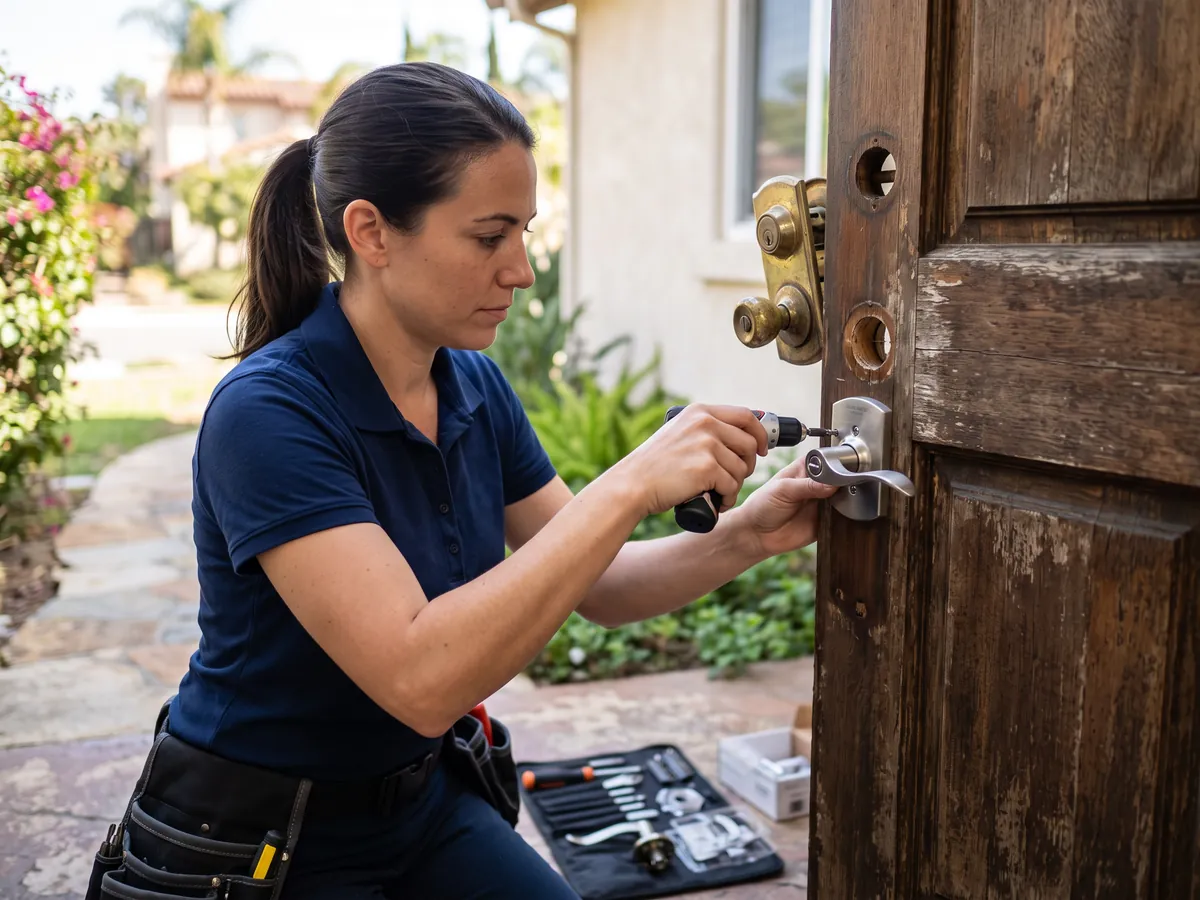
After a break-in, people want to change locks in Bloomington immediately, and that instinct is sound. But the lock usually isn't the part that failed. On a kicked door, the weak point is the jamb around the strike, where soft pine splits or short screws tear loose while the deadbolt itself survives. So a useful lock change after a burglary covers three things: new or rekeyed cylinders in case keys were taken, a reinforced strike anchored into the framing, and a look at the side and garage doors the intruder may have tried first. We describe what we find on a dated invoice, which helps with an insurance claim.
Changing locks means replacing the hardware, not just the pins, and it makes sense when the old lock has outlived its use. A knob that wobbles, a finish pitted by decades of sun, a style you dislike or a lock nobody can find keys for. Plenty of older Bloomington houses still have original knobs and tired deadbolts, and a change gives you new keys and better hardware in one visit. Compare change and rekey honestly. A rekey keeps your lock and replaces the key, usually the cheaper option. A change replaces the lock itself, the better choice when it is worn, undersized or being upgraded. Many owners change the front door for looks and rekey the rest. Tenants have rights too. California Civil Code §1941.3 requires landlords to provide working deadbolts on main swinging entry doors. Under Civil Code §§1941.5–1941.6, a landlord must change the locks within 24 hours of a tenant's written request in certain situations involving a protective order or similar documentation. Otherwise, tenants generally need the landlord's permission before changing locks. We act on the authority of the owner or manager, and verify it before any change.
What to know first in Bloomington
There are three ways to change locks, and choosing among them depends mostly on the condition of what's already on your doors. Rekeying keeps the hardware and swaps the pin stack inside each cylinder, so the old key no longer reaches the shear line. It's the right call for sound locks you like. Replacing only the cylinder works on mortise locks, rim locks and Euro-profile multipoint doors, where the cylinder is a separate part. Replacing the whole lockset makes sense when the latch sticks, the knob wobbles, the finish has peeled in the sun, or the lock is an ungraded bargain model. In Bloomington, many homes end up with a mix: re-pinned deadbolts on the front and garage entry, new levers on a back door that has worn out, and a matching cylinder added to the security screen door. We explain each recommendation door by door and price the options so you can choose. Nothing gets replaced just because we happen to have stock on the truck.
What we can do on-site
- Rekeying your existing locks. Rekeying is pure pin work. Inside a five-pin Schlage or Kwikset cylinder, the bottom pins are cut to lengths that match one key's cuts. We dump those pins, choose new lengths from a fresh bitting, and load them with tweezers and a plug follower so the springs and top pins never escape. Kwikset SmartKey cylinders reset with a tool instead.
- New lockset installation on existing door prep. Swapping hardware sounds simple until an old faceplate mortise is square-cornered and the new latch is round, or the door is 2 inches thick instead of 1-3/4. We carry adapters, thick-door kits and sharp chisels, so the new lock sits flush, the latch retracts freely and the deadbolt reaches full throw without dragging.
- Handlesets and front-door entry sets. Front doors often carry a handleset: a deadbolt above and a thumb-latch or lever grip below, bolted through the door at two points. Brands drill those through-holes at different spacings, so a straight swap may leave an old hole exposed. We check the spacing first and recommend a matching set or a cover plate before anything comes off.
- Strike and frame reinforcement. After forced entry, we assess the jamb, door edge and hinge screws before installing anything. A split jamb may need a repair kit or a carpenter, and we're honest about where locksmith work ends. When the frame is sound, a reinforced strike and longer hinge screws make the new lock worth what you paid for it.
- Older doors, mortise locks and unusual prep. European-style multipoint locks on newer fiberglass and wood doors use a Euro-profile cylinder held by a single screw. That makes changing locks simple: we replace or rekey the cylinder to your house key. If the gearbox inside the door edge is failing, we explain whether a matching part can be sourced or must come from the door's manufacturer.
Local factors in Bloomington
Inland heat is hard on locks. Doors expand, strikes misalign, and dark finishes on sun-facing doors fade or peel. When you change locks in Bloomington, choose finishes that tolerate direct sun and keypad locks rated for outdoor heat, and expect batteries to need replacing more often in summer. We set strikes with enough tolerance that the deadbolt still throws easily on the hottest afternoons.
Older homes often hide more keyed locks than people expect: original mortise locks, service porch doors, and decades of add-on deadbolts. Before you change locks in an older Bloomington house, we check whether original hardware can be rekeyed and serviced instead of replaced, which preserves period trim and avoids filling oversized door pockets. Where doors were bored at odd sizes or old jambs won't hold a modern strike, we explain the fix honestly, including when a carpenter should go first.
Families collect key holders: babysitters, grandparents, carpool neighbors, a teenager's best friend. Every few years it's worth asking who still has one. When we change locks in Bloomington family neighborhoods, many parents add a keypad deadbolt so kids come home with a code instead of a key on a shoelace, and a forgotten code costs nothing to replace. The keyed backup still gets rekeyed with the rest of the house.
Common situations
A first-time buyer closes on an older house in Crestmore, south of Jurupa Avenue. The knobs are loose, two doors are keyed differently and no one knows how many copies exist. She chooses to change rather than rekey. We would fit a Schlage handleset and deadbolt on the front, matching Grade 2 deadbolts on the back and garage doors, and key all three alike. She ends up with one key and doors that close cleanly.
- Picture a duplex owner in the 92316 ZIP code with one tenant moving out on a Friday and a new one moving in Monday. We'd schedule the turnover rekey for Sunday morning, replace a worn knob set with a lever and deadbolt, confirm the bolt throw meets California's rental deadbolt rule, and leave a labeled envelope of keys for the owner.
- Suppose a purse is stolen from a car at a gym, and inside are house keys and a driver's license showing the address. The owner cancels the cards first, then calls us. Because a stranger now holds both the keys and the address, we'd treat it as same-day work: rekey the front and garage entry doors first, then the remaining locks, and change the garage keypad code.
- A typical estate call: siblings inherit their parents' house and realize that neighbors, caregivers and a cleaning service all had keys at some point. The executor shows us letters testamentary and a photo ID. We'd rekey the doors to a new key, cut a set for each sibling who needs access, and replace a corroded side-gate padlock that no longer turns.
How the visit works
- Tell us the reason and count the doors. The reason behind a lock change sets its priority. A safety concern or a stolen keyring gets the earliest slot we can honestly offer within our hours; a planned move-in can be booked around your schedule. Either way, we give an arrival estimate based on where our technician is when you call.
- Verify residence or ownership. Before we change locks, we confirm you have the right to authorize it. Owners show photo ID plus something linking them to the address, such as a closing statement, deed or utility bill. Tenants show ID and a lease, and we may ask about landlord consent. It's how a licensed locksmith should work.
- Inspect each lock and choose rekey or replace. This is also when we talk about upgrades without pressure: a reinforced strike on the front door, a matching cylinder for the security screen door, or a keypad deadbolt for a rental. Each is optional and priced separately, so you can change locks on a tight budget and add the rest later.
- Re-pin or install the hardware. Strike work happens at this stage too. We chisel or file the strike pocket so the bolt enters cleanly, drive longer screws into the framing, and adjust the latch strike so the door closes without a shoulder push. A lock that latches easily is a lock that actually gets used.
- Test every key on every door. For smart locks, testing means locking and unlocking from the keypad, the app and the backup key, checking auto-lock timing, and confirming that deleted codes no longer work. We also check the battery level and explain the low-battery warning so the lock doesn't surprise you later.
- Hand over keys and records. We leave you with practical next steps: where to keep a spare, how to change keypad codes, when to lubricate, and what to watch for as doors shift with the seasons. If a lock feels different in the following days, call and describe it; small strike adjustments are common as new hardware settles.
What affects the cost
- Number of doors and cylinders. Doors that need separate keys, such as a rental unit behind the house or a gardener-only gate, cost about the same as keying them alike, but planning them in advance avoids rework. We'll help you decide which cylinders share a key before a single pin goes in.
- Hardware grade, brand and finish. You're welcome to buy your own hardware. We install customer-supplied locks, charging for the installation and any rekeying needed to match your house key. Just check that the lock is meant for an exterior door, fits your door's thickness and backset, and comes with all its parts, since missing screws and strikes are common.
- Door condition and prep work. Damage from a break-in changes the scope more than anything. A split jamb may need a reinforcement kit or a carpenter, and a crushed door edge may not hold a lock securely. We assess first, quote the lock work, and tell you honestly if part of the repair belongs to another trade.
Every job gets a clear quote before any work starts. Call (951) 903-3193 with the details and we'll tell you what to expect for your situation in Bloomington.
What not to do
- Assuming a smart lock means no rekey is needed. Retrofit models replace only the inside half and keep the old exterior cylinder, and full smart deadbolts still have a keyed override. If an old key turns that cylinder, the door opens no matter how many codes you delete from the app.
- Hiring from an ad with a suspiciously low lock-change price. Some unlicensed operators quote one figure, drill locks that could have been rekeyed, then charge far more. In California, a locksmith company must hold a BSIS license, so ask for the number and check it at search.dca.ca.gov before any work starts.
- Changing locks on a rental without telling the landlord. Even with a good reason, it can breach the lease and block emergency access or repairs. Ask in writing, provide a key, and keep a copy of the exchange. Safety situations under Civil Code 1941.5 and 1941.6 have their own rules and deadlines.
Advice before you book
- Avoid double-cylinder deadbolts on doors you might need to escape through during a fire. They require a key on both sides, and in a smoky hallway nobody finds a key. If glass beside the door worries you, consider laminated security film or a sturdier door instead. We can talk through options that keep getting out simple.
- Reset the garage door opener when you change locks. Most openers have a learn button on the motor unit; holding it until the indicator light goes out erases every stored remote. Then reprogram your own remotes, your car's built-in buttons and the outdoor keypad code. An old remote opens the garage, and the garage often leads into the house.
- Planning a lock change for a rental or vacation home in Bloomington? Consider a keypad deadbolt with a keyed backup on the main entry. Guests and cleaners each get their own code, and removing one takes seconds. Keep the mechanical keys few and accounted for, because the keypad is only as secure as its override cylinder.
- Ask for keys cut from code rather than copied from another copy. A key duplicated from a worn duplicate inherits its wear and gets sloppier with every generation. When we change locks, we cut original keys from the bitting on our machine, so every key you receive is as crisp as the first one.
Reaching Bloomington
Bloomington is about 14 miles from our San Bernardino base, roughly 22 minutes in light traffic via Belmont Avenue and Palm Avenue to I-215 South, SR-210 West to the Riverside Avenue exit. When you call, you get an arrival estimate based on where the technician is and the traffic at that moment.
Commercial jobs on busy stretches like Larch Avenue sometimes need a parking plan, especially for storefront doors or roll-up gates. Let us know about loading zones, red curbs or parking structures before we arrive.
About Bloomington: Kessler Park, at Jurupa and Linden Avenues, pairs baseball fields, a batting cage and a skate park with an equestrian arena reflecting the area's animal-keeping tradition.
| Neighborhoods | Santa Ana Avenue large-lot area, Slover Avenue industrial strip, Valley Boulevard corridor, Cedar Avenue corridor, Original 1888 town site, Crestmore |
|---|---|
| ZIP codes | 92316, 92335 |
| Main routes | I-10, Cedar Avenue, Valley Boulevard, Slover Avenue |
| From our San Bernardino base | about 14 miles via Belmont Avenue and Palm Avenue to I-215 South, SR-210 West to the Riverside Avenue exit, then south on Riverside Avenue and west on Bloomington Avenue; the alternate is I-215 South to I-10 West and the Cedar Avenue exit, about 17 miles |
New or replacement locks in Bloomington?
Call (951) 903-3193 and tell us which doors and what kind of hardware you have in mind. If you already bought the lock, keep the box handy so we can check it fits the door, and we'll quote the install before any work starts.
Frequently asked questions
Will you install locks I bought myself?
Yes. We install customer-supplied hardware and rekey it to your house key so you don't end up with a separate key for one door. Before buying, check that it's rated for exterior use, fits your door thickness and backset, and matches your existing bore. Have the box and every part at the door; strikes and screws go missing surprisingly often.
Can a renter change the locks in California?
Usually not without the landlord's consent. Most leases require it, and the landlord has a right to enter with proper notice. Ask in writing, offer to pay, and give the landlord a key. The exception is a tenant protected by a qualifying court order or police report: if the landlord doesn't change the locks within 24 hours of a written request, the tenant may have them changed.
Can all my locks work with one key?
If they share a keyway, yes: we rekey them all to the same new key. Schlage and Kwikset cylinders don't accept each other's keys, so a house with mixed brands needs some cylinders or locks replaced to match. Padlocks, security screen doors and gate locks can often join the system too. We'll list which locks can be keyed alike before quoting.
What does California Civil Code 1941.3 require for rental locks?
It requires landlords to install and maintain an operable deadbolt on each main swinging entry door of a dwelling unit, and a newly installed bolt must extend at least 13/16 inch when locked. Windows designed to open need working locks or security devices, with exceptions for certain window types and positions. Tenants must tell the landlord when a lock stops working, and the landlord must then fix it within a reasonable time.
How long does a lock change take?
A straightforward rekey moves quickly, and a typical house is usually finished in one short visit. Replacing hardware takes longer per door, especially when a strike needs relocating or a bore needs enlarging. Smart lock installs add time for pairing and code setup. We'll give you a realistic estimate once we know the door count and what you've chosen.
Can you change locks the same day I call?
Often, yes, within our hours: every day from 6:30 a.m. to 11:30 p.m. We're closed overnight. Rekeys use parts we carry, so same-day work in Bloomington is common. Special-order hardware may take longer; in that case we secure your doors with a rekey first and return to install it.
How far is Bloomington from your base?
Bloomington is about 14 miles from our San Bernardino base, roughly 22 minutes in light traffic. Arrival time depends on traffic and on the job the technician is finishing, so we give you an estimate on the phone before you commit.
Related services in Bloomington
- Rekey Locks in Bloomington
- Lock Replacement in Bloomington
- Deadbolt Installation in Bloomington
- Lock Installation in Bloomington
- Change Locks after Buying a House in Bloomington
- Smart Lock Installation in Bloomington
- High Security Locks in Bloomington
- Landlord Locksmith in Bloomington
- Tenant Turnover Rekey in Bloomington
- Keyed Alike Locks in Bloomington
Change Locks in nearby cities
- Change Locks in RialtoSan Bernardino County
- Change Locks in FontanaSan Bernardino County
- Change Locks in ColtonSan Bernardino County
- Change Locks in RubidouxRiverside County
- Change Locks in Grand TerraceSan Bernardino County
- Change Locks in North FontanaSan Bernardino County
- Change Locks in Jurupa ValleyRiverside County
- Change Locks in San BernardinoSan Bernardino County