
Devore, San Bernardino County
Commercial Lock Replacement in Devore: Match the Door, Not Just the Lock
Short answer: A replacement lock on a commercial door still has to follow building rules: exit doors must open from inside without a key, accessible routes need lever handles, and fire-rated doors need listed latching hardware. Julian's Locksmith checks those points on every Devore job. We are not code officials, so occupancy questions go to your fire marshal or building department.
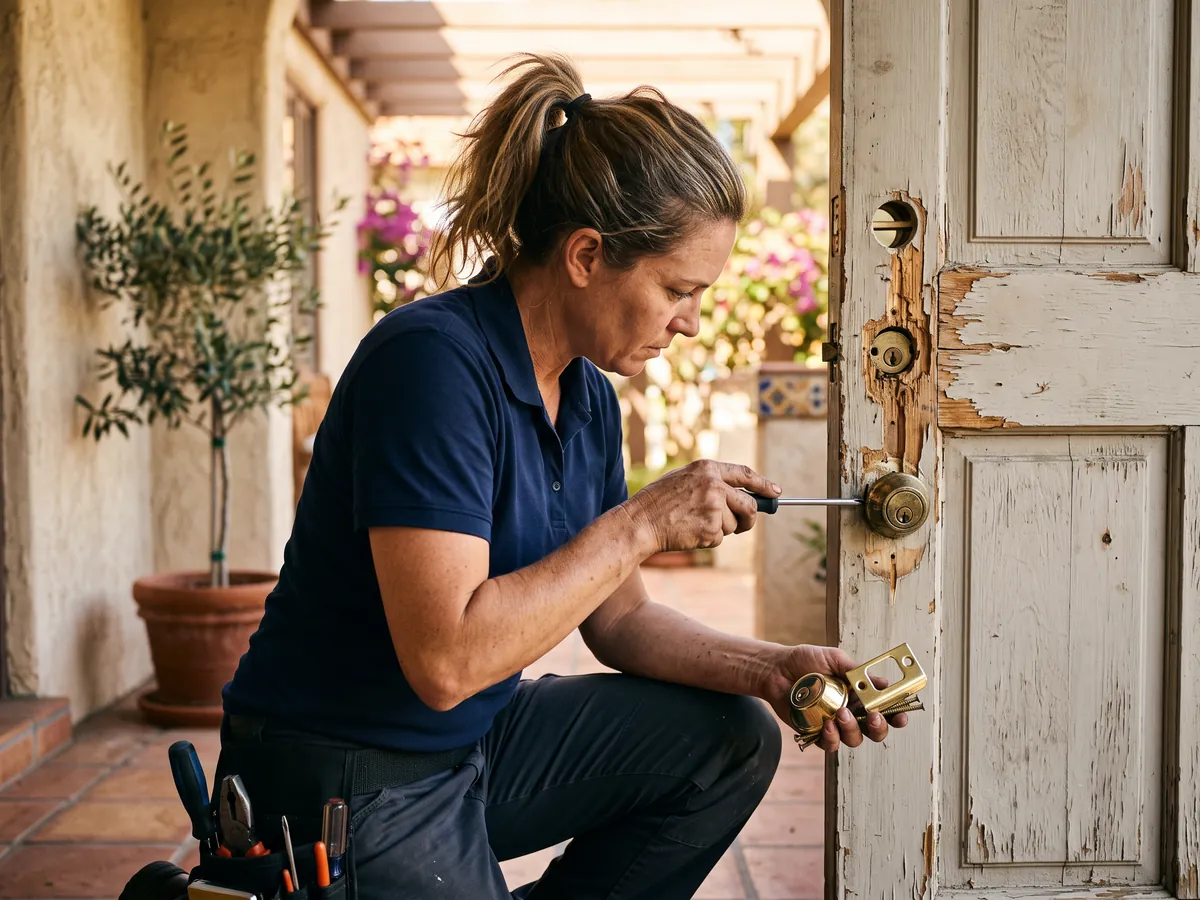
On a house, the worst outcome of a botched lock swap is a door that will not latch. On a commercial building it can be worse: an exit door that needs a key to leave, a fire door that no longer latches, or an accessible entrance fitted with a round knob. Commercial lock replacement lives inside rules that residential work mostly escapes, and getting them wrong costs more than the hardware. Julian's Locksmith replaces locks in Devore with those rules in view. We will point out problems we see, such as a labeled fire door or a missing lever, and send occupancy questions to the fire marshal or building department.
What to know first in Devore
The lock body is only half of a commercial replacement; the keying is the other half. If your suite sits on a building master key system, the new lock has to accept the right cylinder or core, otherwise the property manager's keys and the emergency-access lockbox keys will not work. Many commercial locks use a small format interchangeable core, a cylinder that a control key removes in seconds so it can be swapped or rekeyed without touching the lock. Others use conventional pin-tumbler cylinders that are rekeyed on the bench. With controlled keyways such as Schlage Primus or Medeco, blanks are restricted, so extra copies come only through authorized dealers. Before we install, we ask who holds keys today, whether a master key chart exists, and how many people should reach each door. Afterward, we give you the key numbers or bitting record for the new cylinders and explain how to store it. A lost master key is the costliest mistake in building security, so we treat records seriously.
How we can help in Devore
- Mortise lock cases and trim. A failed mortise lock is not always a lost cause. Springs, hubs and latch bolts are often serviceable, and the cylinder can be replaced on its own. When the case itself is worn out or the line is no longer supported, commercial lock replacement is the cleaner answer, and we can offer a current mortise lock built to fit the same pocket.
- Exit device locking trim and cylinders. When the device itself has failed, with a stuck latch, a bar that does not spring back or a bent chassis, the whole exit device is replaced. Rim, surface vertical rod and concealed rod devices each fit differently, so we measure door width and note whether the door is single or part of a pair before sourcing.
- Choosing the right lock function. Some rooms now call for an intruder-resistant function that lets staff secure the room from inside with the door closed, using a key or a thumbturn depending on the model, while exit stays free. Offices and classrooms are typical. The right choice depends on who uses the space, and we show you the options and trade-offs.
- Electrified locks and access-controlled doors. Part of an access-controlled commercial lock replacement belongs to the low-voltage side: power supplies, controllers, readers and fire-alarm release. We replace the mechanical lock and strike, test the door with the system, and when wiring or programming is needed we coordinate with your access control vendor instead of guessing in the ceiling.
- Glass doors and patch-fitting locks. All-glass entry doors use patch fittings, bottom-rail locks or cylinder-in-rail hardware, and the parts are specific to the glass system. We identify the system, confirm the part is still available and set expectations on lead time before touching a pane, because ordering the wrong patch lock helps no one.
How Devore shapes the job
Inland summer heat does real damage to commercial doors. Metal doors expand, closers thicken or leak, lubricants dry out and plastic parts turn brittle. A lock that worked in February may drag in August. In Devore, we check door alignment and closer settings after every lock swap, favor hardware with metal internals, and suggest dry lubricant on latch bolts. Sun-facing glass doors are usually the first to show wear.
Older neighborhoods around Kimbark Canyons still hold corner shops, small offices and converted houses with commercial doors from earlier decades. Many carry mortise locks, wood doors with worn edges and brass levers that no longer match anything. Replacement here means measuring carefully, protecting old door edges, and finding a modern Grade 1 lock that fits the original pocket. We aim to keep the character of the entrance while fixing the part that fails.
Situations this covers
- An apartment complex's leasing office has an old mortise lock whose line is discontinued. We would photograph the faceplate, measure the case and match a current mortise lock to the same pocket. If no perfect match exists, we would show the manager the retrofit plate option and a few finish samples, and agree on the fit before anything is ordered.
- Picture a dental practice in a medical building where the supply room door has a passage function, left over from an earlier tenant. The owner wants it locked at all times but still free to exit. A storeroom-function chassis fits the same holes, so we would swap it, key it to the practice's cylinders and hand over two keys with a written record.
- Suppose a self-storage office has an electric strike on its customer entrance that clicks but will not release. The keeper is worn. We would confirm whether the door is fail-secure, replace the strike with a matching model, and test the release from the keypad with the owner, so the wiring does not get blamed unfairly.
- A warehouse tenant near Kimbark Elementary School asks about a labeled stairwell door whose lock a general contractor replaced with a deadbolt that needs a key to exit. We would explain why that does not belong there, swap it for a listed fire-rated lever lock with free egress, and adjust the closer so the latch engages on every close.
Step by step with Julian's Locksmith
- Walk the doors and list them. For a single door, this is a few minutes of looking and measuring. For a multi-suite building, it is a systematic pass. Either way, we check the lock, strike, hinges and closer together, because a new lock on a door that drags will not last long.
- Match function, grade and prep. We pick the replacement from the maker's catalog by cross-referencing your lock's series and function. If the model is discontinued, we suggest a successor or retrofit and show you the differences in finish, trim and keying before anything is ordered.
- Quote, order and schedule. You receive a written quote for the commercial lock replacement, listing each door, the new lock and the work involved. Common parts are usually ready quickly, while specific mortise cases, finishes and electrified items can take longer to order. We tell you which is which and propose a visit that suits your business hours.
- Replace with every door secured. Old hardware leaves with us only if you want it to. Some managers keep failed locks for an insurance or warranty conversation, and others want them recycled. Tell us before we start, and we will bag and label what you want to keep.
- Adjust and test every function. A commercial lock is not finished when it turns. We test every function from both sides, key and lever, check that the latch enters the strike fully, and confirm the door closes and latches without a push. Exit doors get an egress test; electrified doors get a test with the system.
- Hand over keys and records. If the building uses a master system, we record where each new cylinder or core sits in the hierarchy so the next commercial lock replacement does not start from scratch. Tell us which employees or tenants should receive keys, and we will cut and label them.
What affects the cost
- Hardware grade and series. The biggest swing in a commercial lock replacement quote is the hardware itself. A Grade 1 mortise or heavy cylindrical lock from a major maker costs more than a light-duty Grade 2 lever, and finish, lever style and function change the part price. We show the options, and you decide where to spend.
- Number of doors and how they are grouped. One door in a commercial lock replacement means one trip and one set of parts. A whole suite or building spreads the setup across several openings, which is more efficient per door. We quote door by door, so you can see the total and also decide which doors to do now and which to defer.
- Function and keying. If keys have spread through many hands, rekeying every cylinder to a new key plan may cost less than replacing locks, and sometimes both happen at once. We tell you whether a lock needs replacement or only new keying, so you pay for the work that actually matters.
Every job gets a clear quote before any work starts. Call (951) 903-3193 with the details and we'll tell you what to expect for your situation in Devore.
Practical tips before you call
- Replace the strike during any commercial lock replacement. A worn strike with elongated screw holes makes a new latch drag or rattle, and short screws in a hollow metal frame loosen within weeks. A correctly mounted strike costs little compared with revisiting the door.
- Keep the old lock until the new one in your commercial lock replacement has been tested. A hardware cross-reference sometimes needs a second look at the original, and a failed lock may matter for a warranty or insurance conversation. A bag and a label with the door name is enough.
- Check the closer before blaming the lock. If a door does not latch on its own, adjust the latching speed first. A closer that slams or sweeps too slowly can wear a new latch and strike in months. Mention closer problems when you book so they get inspected during the visit.
- Mark which doors are exits. Before any commercial lock replacement, note the doors people use to leave in an emergency. Those must open from the inside without a key, so you will not accidentally approve a keyed deadbolt where one does not belong.
Mistakes to avoid
- Drilling or cutting a fire-rated door without checking its label. Extra holes, oversized bores or unlisted hardware can void the rating and fail an inspection. Read the label first, and ask whether the lock you want is listed for that opening.
- Skipping the closing-time test. A lock that works at noon can fail at night if the latch barely enters the strike. Lock and unlock each door from both sides, with the door closing on its own, before the installer leaves.
- Ignoring the closer, hinges and strike. A new lock on a sagging door or a worn strike will bind, rattle or fail to latch. Many lock problems are really alignment problems, so inspect the whole opening before you blame the lock.
Reaching Devore
Devore is about 8 miles from our San Bernardino base, roughly 14 minutes in light traffic via Kendall Drive or Palm Avenue to I-215 North, through the Devore junction onto I-15 North, exit Kenwood Avenue for Devore Heights. When you call, you get an arrival estimate based on where the technician is and the traffic at that moment.
Rush hour on I-15 can stretch a drive considerably. We'd rather give you a realistic arrival window than an optimistic one, and we'll call you if a closure or a crash changes the plan.
About Devore: Cajon Boulevard through Devore is an original stretch of U.S. Route 66, which crossed the Cajon Pass from 1926 until 1979, when Interstate 15 replaced it.
| Neighborhoods | Devore Heights, Kimbark Avenue area, Keenbrook, Cajon Boulevard corridor, Glen Helen, Kimbark Canyons |
|---|---|
| ZIP codes | 92407 |
| Main routes | I-15, I-215, Cajon Boulevard, Kenwood Avenue |
| From our San Bernardino base | about 8 miles via Kendall Drive or Palm Avenue to I-215 North, through the Devore junction onto I-15 North, exit Kenwood Avenue for Devore Heights; Devore Road exit for Glen Helen and lower Cajon Boulevard |
New or replacement locks in Devore?
Call (951) 903-3193 and tell us which doors and what kind of hardware you have in mind. If you already bought the lock, keep the box handy so we can check it fits the door, and we'll quote the install before any work starts.
Frequently asked questions
Do keypad and electronic locks need an electrician?
Battery-powered keypad and lever locks usually do not. Hard-wired systems with electric strikes, electrified levers, magnetic locks or card readers involve low-voltage wiring, power supplies and sometimes fire-alarm release, which may belong to another trade. We replace the mechanical parts, test the door with the system, and coordinate with your access vendor or electrician when wiring or programming is needed.
Can you replace locks on a whole building in one visit?
Sometimes. A small commercial lock replacement can be done in one visit. Larger buildings are best phased: main entrance, exits and sensitive rooms first, then interior doors. We keep exit routes working, secure each door before moving to the next, and schedule around occupants. A door survey tells us how many visits to plan, and we share that plan with you before any work starts.
How do I choose between office, storeroom and classroom functions?
Think about what the lock should do from each side. An office function lets staff lock the outside with a turn button or key. A storeroom function stays locked outside and always opens from inside. A classroom function lets staff lock the outside with a key while the inside stays free. Tell us how the room is used and who needs to enter, and we will recommend a function.
What records do I get after a replacement?
You receive an itemized invoice listing each door, the lock installed and the work done, along with the keys. For cylinders or cores with key numbers or bitting, we record those so you can order duplicates through authorized channels. If you have a master system, we note where each new cylinder sits in the hierarchy. Keep the record locked up and away from the keys.
How is commercial lock replacement priced?
We do not post flat prices because no two doors match. The main factors are the lock's grade and series, the number of doors, the condition of the door and frame, function and keying, code-driven items such as fire rating or electrification, and timing and parts lead time. Call (951) 903-3193, describe the doors, and we will quote before we start work in Devore.
Will a new lock fit my existing door without cutting?
Usually yes. Cylindrical locks use a standard 2-1/8 inch bore with a smaller edge hole, mortise locks use a pocket sized to a specific case, and storefront locks fit a narrow stile. We measure backset, thickness and faceplate and choose a replacement that matches. Cutting is only needed when you change lock type or the old prep is damaged or nonstandard, and we tell you before we start.
How far is Devore from your base?
Devore is about 8 miles from our San Bernardino base, roughly 14 minutes in light traffic. Arrival time depends on traffic and on the job the technician is finishing, so we give you an estimate on the phone before you commit.
Related services in Devore
- Lock Replacement in Devore
- Business Lock Replacement in Devore
- Commercial Lock Installation in Devore
- Commercial Lock Repair in Devore
- Commercial Door Hardware in Devore
- Commercial Rekey in Devore
- Storefront Door Lock Replacement in Devore
- Panic Bar Replacement in Devore
- Commercial Master Key System in Devore
- Commercial Locksmith in Devore
Commercial Lock Replacement in nearby cities
- Commercial Lock Replacement in Glen HelenSan Bernardino County
- Commercial Lock Replacement in MuscoySan Bernardino County
- Commercial Lock Replacement in North FontanaSan Bernardino County
- Commercial Lock Replacement in RialtoSan Bernardino County
- Commercial Lock Replacement in FontanaSan Bernardino County
- Commercial Lock Replacement in EtiwandaSan Bernardino County
- Commercial Lock Replacement in San BernardinoSan Bernardino County
- Commercial Lock Replacement in BloomingtonSan Bernardino County