
Bloomington, San Bernardino County
Commercial Lock Replacement in Bloomington: Match the Door, Not Just the Lock
Short answer: A replacement lock on a commercial door still has to follow building rules: exit doors must open from inside without a key, accessible routes need lever handles, and fire-rated doors need listed latching hardware. Julian's Locksmith checks those points on every Bloomington job. We are not code officials, so occupancy questions go to your fire marshal or building department.
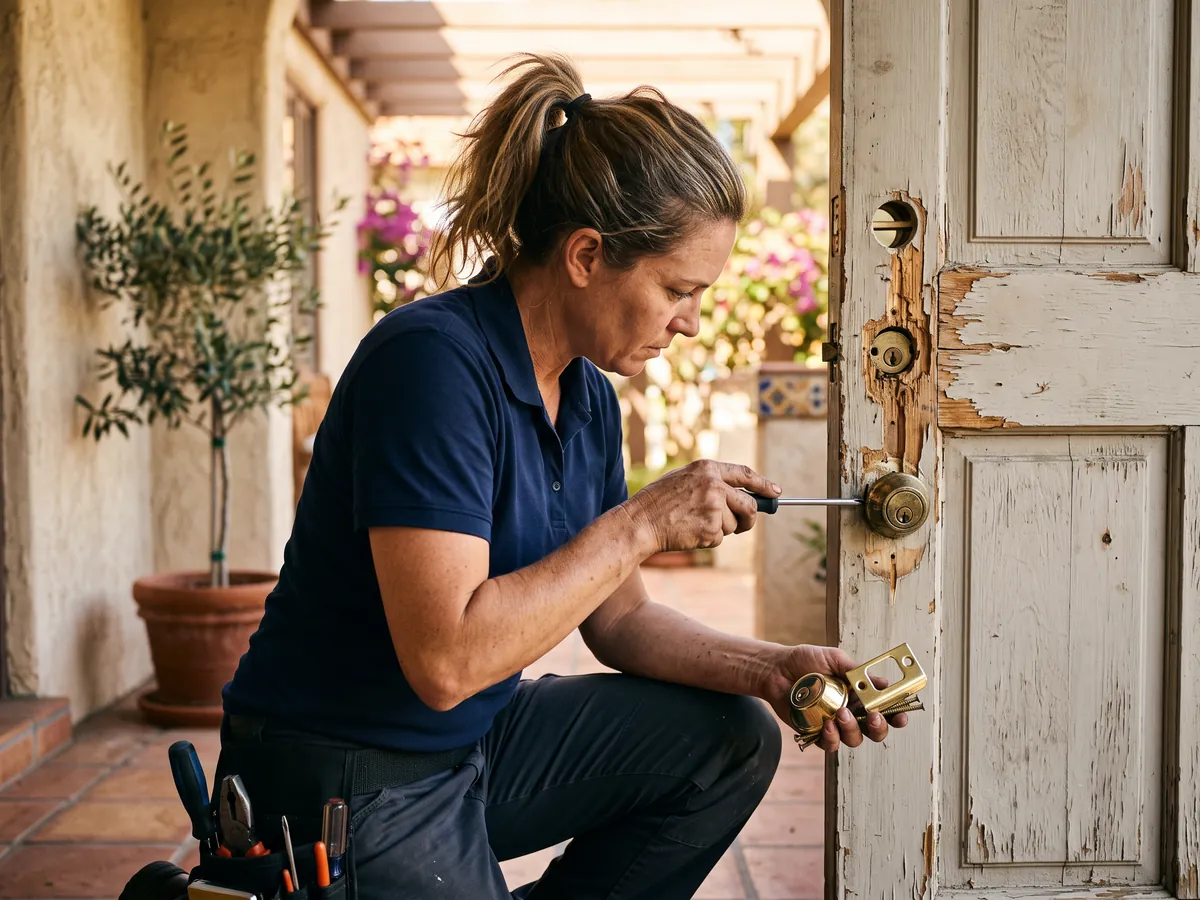
A commercial door lock earns its keep the hard way. It gets pushed, pulled, slammed and handled by dozens of people every day, in dust, heat and sometimes cleaning chemicals. Over time the lever starts to droop, the latch drags against the strike, the key needs a jiggle, and a door that once closed with a crisp click has to be shouldered shut. When you see those signs, commercial lock replacement is usually cheaper than a string of repair calls. Julian's Locksmith replaces worn and failed locks on offices, shops, clinics, warehouses and multi-tenant buildings across Bloomington, and we start by looking at what is actually on your door instead of guessing from a catalog photo.
How this works in Bloomington
Commercial doors sit inside a web of codes that residential doors mostly escape, and a good replacement respects all of it. Doors on the path out of a building must open from the inside without a key, a tool or special knowledge, which rules out a deadbolt that needs a key on the exit side. Doors on accessible routes need hardware operable with one hand, without tight grasping or twisting, so levers rather than knobs. Fire-rated doors carry a label on the hinge edge and must use latching hardware listed for that assembly, plus a working closer, and the label limits how much field drilling is allowed. California building and fire codes add details by occupancy, and your fire marshal or building department has the final say. We are locksmiths, not code officials, but we know where locks go wrong. When we spot a labeled fire door, a delayed-egress requirement or a missing lever, we say so before ordering parts, so you choose with the full picture.
How we can help in Bloomington
- Cylindrical lever locks on hollow metal doors. Cylindrical locks offer many functions on one chassis style, so a commercial lock replacement can often keep the same lever and change only how the lock behaves. Swapping a failed office lock for a storeroom function, or the reverse, is a chassis and cylinder change that needs no new holes. We carry common chassis and order the rest.
- Mortise lock cases and trim. A failed mortise lock is not always a lost cause. Springs, hubs and latch bolts are often serviceable, and the cylinder can be replaced on its own. When the case itself is worn out or the line is no longer supported, commercial lock replacement is the cleaner answer, and we can offer a current mortise lock built to fit the same pocket.
- Storefront deadlocks and latches. Storefront cylinders mount in the stile with a cam that must match the lock case. When replacement is needed after years of daily use, we bring cylinders in common lengths and cams, then key them to your existing key or to a new one, depending on who needs access to the front door.
- Exit device locking trim and cylinders. Panic hardware wears out where hands touch it, on the lever trim and the outside cylinder. Replacing a Von Duprin, Sargent or Detex trim set and cylinder is often enough to bring a rear door back to life while the device stays put. We confirm the device model, handing and fire rating, then order matching trim.
- Electrified locks and access-controlled doors. Part of an access-controlled commercial lock replacement belongs to the low-voltage side: power supplies, controllers, readers and fire-alarm release. We replace the mechanical lock and strike, test the door with the system, and when wiring or programming is needed we coordinate with your access control vendor instead of guessing in the ceiling.
What's different about Bloomington
Inland summer heat does real damage to commercial doors. Metal doors expand, closers thicken or leak, lubricants dry out and plastic parts turn brittle. A lock that worked in February may drag in August. In Bloomington, we check door alignment and closer settings after every lock swap, favor hardware with metal internals, and suggest dry lubricant on latch bolts. Sun-facing glass doors are usually the first to show wear.
Older neighborhoods around Crestmore still hold corner shops, small offices and converted houses with commercial doors from earlier decades. Many carry mortise locks, wood doors with worn edges and brass levers that no longer match anything. Replacement here means measuring carefully, protecting old door edges, and finding a modern Grade 1 lock that fits the original pocket. We aim to keep the character of the entrance while fixing the part that fails.
Warehouses and light-industrial buildings tend to have a front office, rear exits, personnel doors beside the dock doors and mechanical rooms, each with different traffic. Rear and dock-adjacent doors take the most abuse and deserve Grade 1 hardware and sturdy strikes. Pallet jacks and forklifts bend frames, so we check alignment, not just the lock. Give us the door label and tell us whether the yard has a check-in gate.
Example situations
- Say a boutique owner in North Bloomington reports that a key has snapped in the front door cylinder twice this year. We would pull the cylinder, find the lock out of alignment with its strike, replace the case with a Grade 1 model, and adjust the door. A new cylinder alone would repeat the same failure within months.
- Picture a dental practice in a medical building where the supply room door has a passage function, left over from an earlier tenant. The owner wants it locked at all times but still free to exit. A storeroom-function chassis fits the same holes, so we would swap it, key it to the practice's cylinders and hand over two keys with a written record.
- Suppose a self-storage office has an electric strike on its customer entrance that clicks but will not release. The keeper is worn. We would confirm whether the door is fail-secure, replace the strike with a matching model, and test the release from the keypad with the owner, so the wiring does not get blamed unfairly.
- A typical call: the property manager of a small office building off I-10 wants every suite entry matched. Three of the eight locks are different brands, two sag, and one tenant holds a master key nobody can account for. We would walk the doors with a clipboard, write a schedule, replace the worn ones with matching Grade 1 levers and pin them all to a single key plan.
Step by step with Julian's Locksmith
- Walk the doors and list them. We start by walking the building with you, or with whoever handles maintenance. Each door goes on a simple list with its location, type, handing, thickness, current lock and condition, plus a photo of the lock and strike. You get a clear picture of what needs replacing and what can wait.
- Match function, grade and prep. We pick the replacement from the maker's catalog by cross-referencing your lock's series and function. If the model is discontinued, we suggest a successor or retrofit and show you the differences in finish, trim and keying before anything is ordered.
- Quote, order and schedule. Scheduling matters as much as parts. The doors on a building's exit path should never all be out of service at once, so we sequence the work. Evening and early-morning visits fit our hours, which run every day from 6:30 a.m. to 11:30 p.m.
- Replace with every door secured. During the swap we watch for hidden issues behind the lock: a cracked door edge, a stripped screw hole, a strike mounted with short screws, or a latch that never reaches its keeper. We fix small problems on the spot and quote bigger ones separately.
- Adjust and test every function. The closer decides whether a good lock keeps working. We check sweep and latching speed, tighten loose hardware, and make sure the strike lines up with the latch so the door does not bind in summer heat when metal expands.
- Hand over keys and records. Before we go, we mention follow-up items we noticed but did not touch: a tired closer, a door that needs new hinges, a lock that will fail soon. You decide what to do and when, with the facts in hand and our license number, LCO7891, on the invoice.
Pricing factors
- Hardware grade and series. The biggest swing in a commercial lock replacement quote is the hardware itself. A Grade 1 mortise or heavy cylindrical lock from a major maker costs more than a light-duty Grade 2 lever, and finish, lever style and function change the part price. We show the options, and you decide where to spend.
- Function and keying. Asking the new lock to do something different, such as changing from office to storeroom function or adding a classroom security function, is a chassis choice rather than extra labor, but it affects the part price. We outline function options so you can pick the right one for each room.
- Timing, access and lead time. In commercial lock replacement, parts on hand cost less to install than parts on order. Special finishes, mortise cases and electrified items can take days to reach us, which stretches the schedule rather than the labor. We say which parts are in stock and which need ordering when we quote.
Every job gets a clear quote before any work starts. Call (951) 903-3193 with the details and we'll tell you what to expect for your situation in Bloomington.
Mistakes to avoid
- Ordering by brand name alone. Two locks from one maker can differ in function, backset, hand and prep. Without the series, function and measurements, a part that looks right can arrive wrong and delay the job. Send photos and the stamped numbers.
- Buying a residential lock for a commercial door. Home-grade deadbolts and knobs are tested for far lighter use and commonly fail early on a busy entrance. They may also lack the bolt strength, the correct function or the fire listing that the opening needs.
- Ignoring the closer, hinges and strike. A new lock on a sagging door or a worn strike will bind, rattle or fail to latch. Many lock problems are really alignment problems, so inspect the whole opening before you blame the lock.
Practical tips before you call
- Keep the master key chart and treat it like cash. Store it locked, away from the keys, and limit who can see it. When we replace locks in a master-keyed system, the chart tells us how to pin the new cylinders. If you do not have one, tell us and we will help you start one.
- Ask for the ANSI/BHMA grade and series, not just the word commercial. A lock sold as commercial can still be Grade 2 or a light-duty line. Request both in the quote so you can compare like with like and see exactly what you are paying for on each door.
- Keep the old lock until the new one in your commercial lock replacement has been tested. A hardware cross-reference sometimes needs a second look at the original, and a failed lock may matter for a warranty or insurance conversation. A bag and a label with the door name is enough.
- Photograph every lock before you call: both faces of the door, the edge with the faceplate, the cylinder, and any label or stamped number. Those few pictures often let us name the lock and bring the right part before we arrive. Send them with the door's location and what the room is used for.
Service in Bloomington
Bloomington is about 14 miles from our San Bernardino base, roughly 22 minutes in light traffic via Belmont Avenue and Palm Avenue to I-215 South, SR-210 West to the Riverside Avenue exit. When you call, you get an arrival estimate based on where the technician is and the traffic at that moment.
Stuck on the shoulder or in a parking lot along Locust Avenue? Get somewhere safe, turn on your hazards, and give us the nearest exit or business so we can find the car without guessing.
About Bloomington: Union Pacific's Alhambra Subdivision crosses Bloomington and includes a hump yard, and Amtrak's Sunset Limited uses the same tracks without stopping in the community.
| Neighborhoods | Crestmore, Slover Avenue industrial strip, Locust Avenue and Alder Avenue horse properties, North Bloomington, Valley Boulevard corridor, Cedar Avenue corridor |
|---|---|
| ZIP codes | 92316, 92335 |
| Main routes | I-10, Cedar Avenue, Valley Boulevard, Slover Avenue |
| From our San Bernardino base | about 14 miles via Belmont Avenue and Palm Avenue to I-215 South, SR-210 West to the Riverside Avenue exit, then south on Riverside Avenue and west on Bloomington Avenue; the alternate is I-215 South to I-10 West and the Cedar Avenue exit, about 17 miles |
New or replacement locks in Bloomington?
Call (951) 903-3193 and tell us which doors and what kind of hardware you have in mind. If you already bought the lock, keep the box handy so we can check it fits the door, and we'll quote the install before any work starts.
Frequently asked questions
How is commercial lock replacement priced?
We do not post flat prices because no two doors match. The main factors are the lock's grade and series, the number of doors, the condition of the door and frame, function and keying, code-driven items such as fire rating or electrification, and timing and parts lead time. Call (951) 903-3193, describe the doors, and we will quote before we start work in Bloomington.
What is the difference between commercial lock replacement and rekeying?
Rekeying changes the internal pins of a lock you already have so a different key operates it, and the hardware stays. Replacement removes the lock and installs new hardware. If the lock is in good shape and the concern is who holds keys, rekey. If the lever sags, the bolt sticks, the door was forced or parts are discontinued, replace it. We inspect the door in Bloomington and tell you which route fits.
Are you licensed to do commercial work?
Julian's Locksmith holds California locksmith company license LCO7891, issued by the Bureau of Security and Investigative Services, and you can verify it at search.dca.ca.gov. We also verify your authority to approve work on the building before replacing any lock, which protects owners and tenants alike. For electrical or fire-alarm work outside locksmithing, we coordinate with licensed trades.
What does Grade 1 mean on a commercial lock?
Grades come from ANSI/BHMA standards that test locks for durability, strength and abuse resistance. Grade 1 is the highest rating and belongs on busy entrances, exits and high-use doors. Grade 2 handles moderate traffic, and Grade 3, where offered, is meant for light residential use. Ask for the grade and series in writing, because the word commercial on a package does not tell you which grade you are getting.
Do keypad and electronic locks need an electrician?
Battery-powered keypad and lever locks usually do not. Hard-wired systems with electric strikes, electrified levers, magnetic locks or card readers involve low-voltage wiring, power supplies and sometimes fire-alarm release, which may belong to another trade. We replace the mechanical parts, test the door with the system, and coordinate with your access vendor or electrician when wiring or programming is needed.
Can you replace just the lock on my panic bar?
Often yes. Many exit device problems come from the lever trim or outside cylinder, which can be replaced without removing the device. If the bar itself is damaged or the latch fails, the whole device is replaced. We identify the make, handing and fire rating, test the push bar from inside afterward, and never leave an exit door needing a key to get out.
How far is Bloomington from your base?
Bloomington is about 14 miles from our San Bernardino base, roughly 22 minutes in light traffic. Arrival time depends on traffic and on the job the technician is finishing, so we give you an estimate on the phone before you commit.
Related services in Bloomington
- Lock Replacement in Bloomington
- Business Lock Replacement in Bloomington
- Commercial Lock Installation in Bloomington
- Commercial Lock Repair in Bloomington
- Commercial Door Hardware in Bloomington
- Commercial Rekey in Bloomington
- Storefront Door Lock Replacement in Bloomington
- Panic Bar Replacement in Bloomington
- Commercial Master Key System in Bloomington
- Commercial Locksmith in Bloomington
Commercial Lock Replacement in nearby cities
- Commercial Lock Replacement in RialtoSan Bernardino County
- Commercial Lock Replacement in FontanaSan Bernardino County
- Commercial Lock Replacement in ColtonSan Bernardino County
- Commercial Lock Replacement in RubidouxRiverside County
- Commercial Lock Replacement in Grand TerraceSan Bernardino County
- Commercial Lock Replacement in North FontanaSan Bernardino County
- Commercial Lock Replacement in Jurupa ValleyRiverside County
- Commercial Lock Replacement in San BernardinoSan Bernardino County