
Devore, San Bernardino County
Door Lock Replacement in Devore: Start With the Door
Short answer: We replace door locks on site in Devore, with no shop visit and no need to take the door off its hinges. Julian's Locksmith confirms that you live at or own the property, quotes the work, installs the new lock and tests every key. Hours are 6:30 a.m. to 11:30 p.m., seven days a week. Call (951) 903-3193.
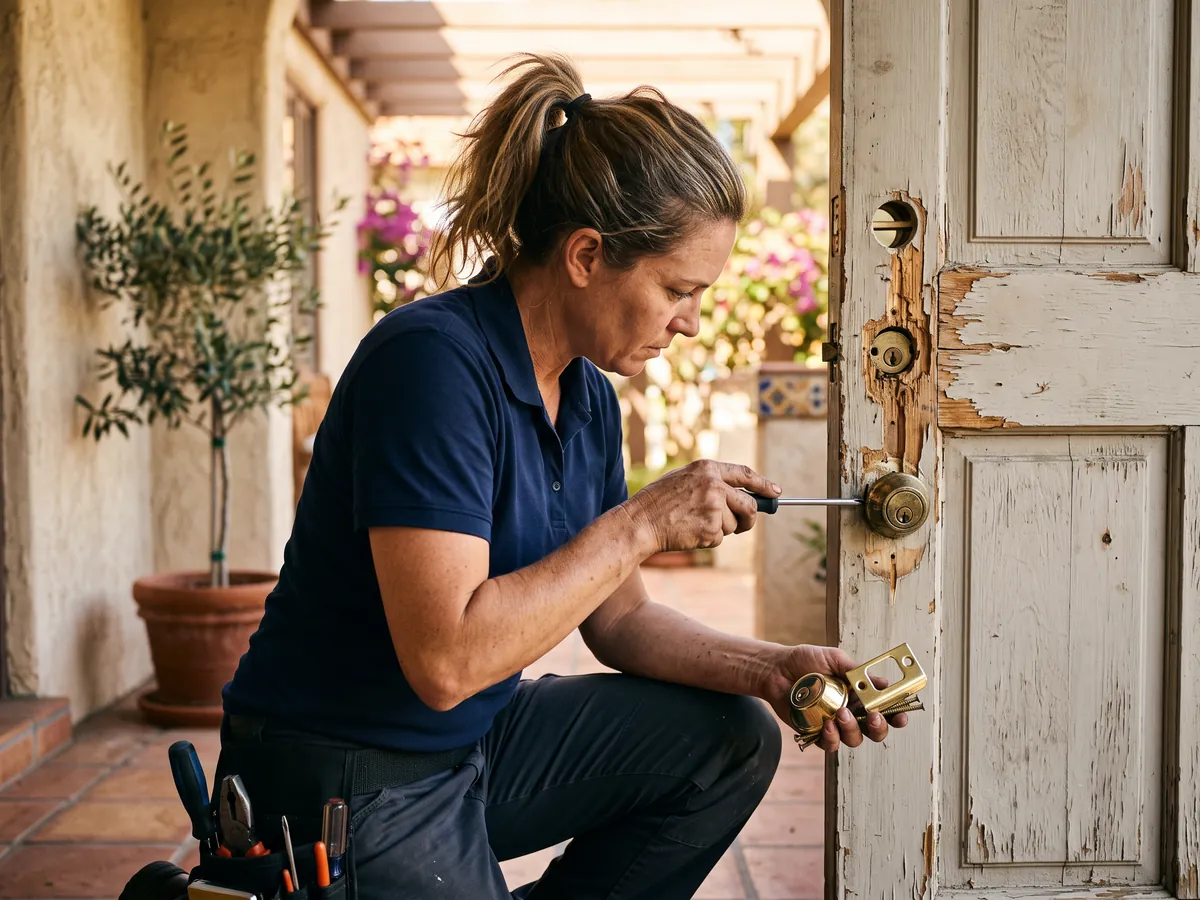
A little preparation makes door lock replacement quicker. Before you call, note which door it is, whether it is wood, metal or fiberglass, and what the lock is doing, or not doing. A photo of both faces of the lock helps, as does the brand name stamped on the edge of the latch. Mention whether you want the new lock keyed to your other doors. Call (951) 903-3193 and we will ask a few questions, give you an honest arrival estimate for Devore and describe what we expect to bring. Then we measure the door, confirm the plan and quote before any screws come out.
How this works in Devore
Door lock replacement begins with the door, because its material decides what can safely be cut, drilled and fastened into. Solid wood doors are forgiving: they take a standard bore, hold screws well and can be filled and redrilled if needed. Hollow-core interior doors are thin and light, so they suit passage and privacy latches, never a deadbolt. Steel doors have a thin skin over a foam or wood core, with a solid block of wood at the lock edge; the bore must not wander or the skin dents. Fiberglass doors look like wood but can crack around an oversized hole, and a cut that eats the lock block leaves nothing for screws to bite. Aluminum-framed and glass doors have narrow stiles, so they use slim hardware, hook bolts or mortise cases instead of a round bore. We check the material first, then choose a lock designed to fit it. That is why we ask for the door type on the phone, and why we look at it before we quote.
Work included on a typical visit
- Solid wood and solid-core entry doors. A wood door gives us room to work. If the old lock left chewed edges or a hole that has grown, we can fill and redrill it, or cover it with a wider trim plate. Because wood swells and shrinks with the seasons, we check the latch lines up with the strike in both hot and damp weather.
- Interior passage, privacy and dummy sets. A privacy lock that jams can shut a child in a bathroom. We replace worn privacy sets with ones that have a reliable outside release, check that the latch retracts smoothly and fix strikes that sit too tight, so the door closes quietly without being slammed.
- Sliding glass door locks. Some patio doors accept a keyed outside handle, which lets you lock the door from the yard. We can fit a keyed handle and key it to your house key, and add a secondary pin or bar for nights and trips, since a thin factory hook alone is a modest barrier.
- Garage-to-house and fire-rated doors. Fire-rated doors carry a label on the edge, and changing their prep can affect the rating. We select replacement hardware that fits the existing holes, avoid new cutting, and tell you plainly if a door needs a rated replacement rather than a modified lock.
- Aluminum-frame, glass and screen doors. Security screen and storm doors use their own latches and keyed handles, and the originals are often light. We replace worn latch sets and keyed cylinders, add a deadbolt-style option where the frame allows, and key it to the house if you want one key for both doors.
Local factors in Devore
Foothill and hillside homes in Devore deal with wind, dust and wildfire-season ash, all of which wear locks faster than people expect. Exterior door hardware should be well sealed against grit, and cylinders do better with dry lubricant than oil. Doors that face the weather may warp or shift, which makes a lock bind even when the lock is fine. In door lock replacement here, we check alignment and exposure before choosing a lock and favor finishes that hold up to sun.
Devore has plenty of older houses where door lock replacement is not plug-and-play. Original doors may carry mortise locks, skeleton-key escutcheons, glass knobs or bores drilled to sizes no longer standard. Thick old wood often takes modern hardware well once the prep is cleaned up, and we can sometimes keep a period knob while updating the mechanism inside. We check the latch mortise, the bore and the frame before we quote, because old doors like to surprise people.
On larger lots around Devore, doors do more varied work: farmhouse entries, workshop doors, pump houses and detached garages. Door lock replacement may mean weather-rated hardware that survives dust, sun and the occasional hose spray. Remote buildings need locks that discourage casual trouble when nobody is watching, and long driveways mean it pays to arrive with the right parts the first time. Tell us every door you want considered and we will plan one visit.
Example situations
- A family near Glen Helen Amphitheater has a sliding patio door whose handle snapped off in a hand. The hook latch hangs loose inside the frame. We read the screw-hole spacing, match a replacement lock, adjust the keeper on the jamb and clean the track so the door glides. We also suggest a simple bar for nights away, since a factory hook alone is a modest barrier.
- A keypad lock on a rear door stopped responding after leaking batteries corroded its contacts. The old unit can't be cleaned back to life. We replace it with a new keypad deadbolt that fits the existing holes, set fresh codes, key the backup cylinder to the house key and show the owner where the low-battery warning appears.
- A typical call: a bedroom privacy lock with a push button has jammed with a small child inside. We use the outside release to open the door, then find the latch spring has broken. We replace the set with a privacy lock that has a reliable emergency release, check the strike and confirm the door closes quietly. The child is fine, and the hall now has one matching set.
- For example, a homeowner in Glen Helen says the back-door deadbolt turns only if she lifts the door by the handle. The wood has swelled a little and the bolt rubs the lower edge of the strike. We reset the strike and ease the mortise, and the original deadbolt works smoothly again. Door lock replacement wasn't needed, so she kept her keys and her budget.
Step by step with Julian's Locksmith
- Tell us which door and what it's doing. Start with the problem, then the preference. Is the lock broken, or do you just want a different style, a lever instead of a knob, or a keypad? Knowing whether this is a repair, a rekey or a straight swap lets us tell you on the phone which of those we think it is.
- Confirm who you are, then look at the door. California's Locksmith Act is administered by the Bureau of Security and Investigative Services, and our license, LCO7891, can be checked at search.dca.ca.gov. We ask for ID and proof of residence or ownership, then look over the door, frame and strike before anything comes off.
- Read the door and match the hardware. If a door has an oddity, such as a nonstandard hole, a rated edge or a narrow glass stile, this is when we find it. We then tell you whether the new lock fits as is, needs a trim ring or plate, or calls for a different style entirely.
- Agree the quote, then take the old lock off. Once we know what the door needs, we give you a quote covering the lock, any parts and the labor. You decide before we start. When you approve, we remove the old hardware carefully and keep it handy so you can compare parts or take it with you.
- Fit, align and make it close properly. The new lock goes in square, with the latch bevel facing the way the door closes and the screws pulled evenly. We set or replace the strike with long screws and adjust the hinges if the door hangs crooked, because a lock only works as well as the door behind it.
- Key it, test it and hand it over. If the new lock should match your other locks, we key it to your existing key or rekey a group of doors together. Then we test each key in each lock, so nobody discovers later that the back door key does not work.
Pricing factors
- Grade, brand and finish. Locks come in grades. Grade 3 suits light residential use, Grade 2 is a solid choice for most front and back doors, and Grade 1 is the heaviest-duty option. Brand and finish move the price too, so we show you the trade-offs between them.
- Keying and number of keys. Smart locks add another layer, because codes, app setup and backup keys all have to be configured. Even a basic keypad needs codes entered. We include that setup time in the quote so it never arrives as a surprise on a later invoice.
- Repairs the door or frame needs. A lock is only as secure as the wood or metal holding it. Reinforcement plates, longer screws, a new strike or a repaired door edge add to the quote, but they are often what separates a lock that holds from one that loosens within months.
Every job gets a clear quote before any work starts. Call (951) 903-3193 with the details and we'll tell you what to expect for your situation in Devore.
Common errors that cost time and money
- Testing the new lock only with the door open. Many bolts bind only when the door is shut, because the bolt meets the strike at a slight angle. Test with the door closed, from both sides, but keep a key in your pocket and a way back inside until you are sure it works every time.
- Replacing a lock that was never the problem. When a door sticks, the bolt misses the strike or the key works only when you lift the handle, the cause is often a sagging hinge, a shifted strike or seasonal swelling. A new lock in the same spot misses the same way.
- Cutting a bigger or new hole to make a lock fit. Hollow-core doors can't hold a deadbolt, and steel or fiberglass doors can crack or lose strength if the bore wanders into the lock block. If a lock doesn't suit the existing holes, an adapter or a different model is the answer.
Advice before you book
- Keep a thumb-turn or lever on the inside of every exit door. A lock that needs a key to open from inside can slow escape in a fire, and building codes expect exit doors to open without a key. If you want a keyed inside cylinder for some reason, talk to us first.
- Remove door hardware before painting rather than taping around it. Paint that glues itself to a latch edge or a strike makes the bolt drag and the lock feel sticky. If the door has already been painted over, a careful scrape of the latch edge and strike often restores smooth movement.
- Remember that wood doors move with the seasons. A lock that binds in humid weeks and runs freely in dry ones is usually reacting to a swollen door. Adjusting the strike or a hinge fixes it more reliably than a new lock, and we are happy to check before you replace anything.
- Check which way your door swings and which side its hinges are on. The angled face of the latch should point toward the frame as the door closes. Many modern levers are reversible, but some are handed, so read the box before buying.
Service in Devore
Devore is about 8 miles from our San Bernardino base, roughly 14 minutes in light traffic via Kendall Drive or Palm Avenue to I-215 North, through the Devore junction onto I-15 North, exit Kenwood Avenue for Devore Heights. When you call, you get an arrival estimate based on where the technician is and the traffic at that moment.
Traffic matters more than mileage. We check conditions on Devore Road and its connecting routes before quoting you a time, and we don't pretend a long drive through heavy congestion is a short one.
About Devore: The Devore Water Company received water rights in 1904 and 1911 and still operates as the community's local water producer.
| Neighborhoods | Kimbark Avenue area, Glen Helen, Devore Heights, Lytle Creek, Cajon Boulevard corridor, Verdemont |
|---|---|
| ZIP codes | 92407 |
| Main routes | I-15, I-215, Cajon Boulevard, Kenwood Avenue |
| From our San Bernardino base | about 8 miles via Kendall Drive or Palm Avenue to I-215 North, through the Devore junction onto I-15 North, exit Kenwood Avenue for Devore Heights; Devore Road exit for Glen Helen and lower Cajon Boulevard |
New or replacement locks in Devore?
Call (951) 903-3193 and tell us which doors and what kind of hardware you have in mind. If you already bought the lock, keep the box handy so we can check it fits the door, and we'll quote the install before any work starts.
Frequently asked questions
How do I know what size lock my door needs?
Measure four things. The big round hole through the door face is usually 2-1/8 inches across, the smaller hole in the door edge is usually 1 inch, the backset from the edge to the center of the big hole is 2-3/8 or 2-3/4 inches, and the door is typically 1-3/8 or 1-3/4 inches thick. Most new locks fit those standards. If your numbers differ, tell us when you call in Devore, and we will bring the right adapter.
What are your hours for door lock replacement in Devore?
We work every day from 6:30 a.m. to 11:30 p.m., weekends included. Fridays, Saturdays and Sundays run the same hours. We are not a 24/7 service, so if a lock fails between 11:30 p.m. and 6:30 a.m., secure the door as best you can and call as soon as we reopen. Call (951) 903-3193 for an honest arrival estimate.
Do I need to be home while you replace the lock?
An adult who lives at or owns the property should be there, because we verify ID and proof of residence or ownership before replacing a door lock. You don't need to watch every minute, but you do need to approve the quote and test the new lock at the end. If you are away, a property manager or owner can authorize the work by phone.
How long does door lock replacement take?
A single standard door is usually a short visit, because the old lock comes out and the new one goes into the same holes. Reinforcing a strike, repairing a damaged edge or adapting an unusual door adds time, as does each additional door. When you call, we give you an honest estimate, and on site we confirm it once we have measured the door.
Can you replace the lock on a sliding glass door?
Yes. Sliding door locks are small hook latches set into the door edge, and most can be matched by their screw spacing and hook shape. We also check the keeper, the rollers and the track, since a door that drags can keep a new lock from engaging. Some sliders accept a keyed handle. We can add a secondary bar or pin too, which many households find worthwhile.
Will my new lock work with my old key?
Only if we fit a lock or cylinder of the same brand and keyway and pin it to your key, or rekey the new lock to match. A new lock from a box arrives with its own key. If you want one key for several doors, tell us which doors are involved, and we will arrange the keying so the key you already carry opens the new lock.
How far is Devore from your base?
Devore is about 8 miles from our San Bernardino base, roughly 14 minutes in light traffic. Arrival time depends on traffic and on the job the technician is finishing, so we give you an estimate on the phone before you commit.
Related services in Devore
Door Lock Replacement in nearby cities
- Door Lock Replacement in Glen HelenSan Bernardino County
- Door Lock Replacement in MuscoySan Bernardino County
- Door Lock Replacement in North FontanaSan Bernardino County
- Door Lock Replacement in RialtoSan Bernardino County
- Door Lock Replacement in FontanaSan Bernardino County
- Door Lock Replacement in EtiwandaSan Bernardino County
- Door Lock Replacement in San BernardinoSan Bernardino County
- Door Lock Replacement in BloomingtonSan Bernardino County