
Devore, San Bernardino County
Commercial Master Key System in Devore: Levels, Hardware and Records
Short answer: If a master key is lost, don't wait. Tell us which level is missing, how many doors it opens and whether anyone outside your company may hold a copy. We'll judge the risk and plan a partial or full rekey, often by swapping interchangeable cores. Julian's Locksmith works 6:30 a.m. to 11:30 p.m., seven days a week. Call (951) 903-3193.
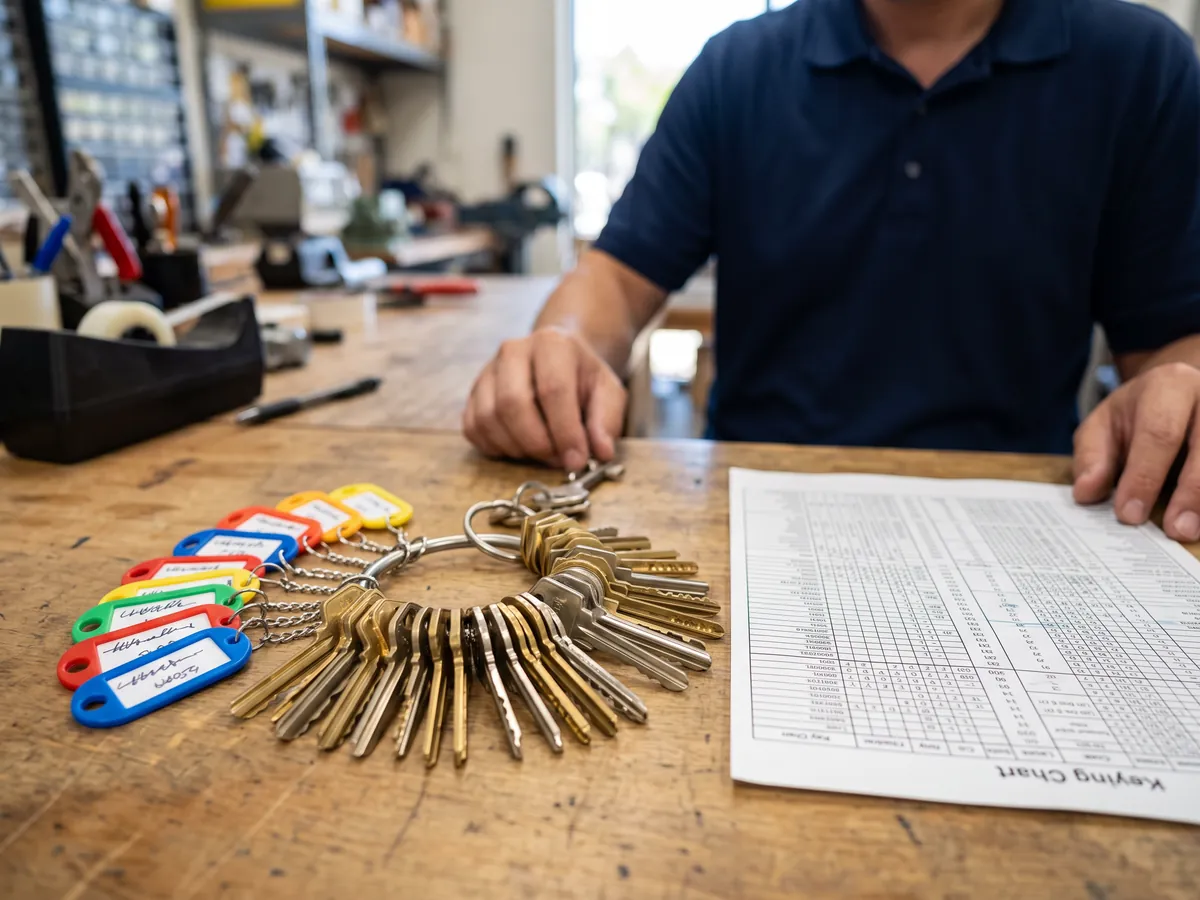
Every tenant who moves out takes a handful of keys along, whether they mean to or not. Rekeying a suite each time works, but it repeats cost and effort for years. A commercial master key system built on interchangeable cores changes the equation: someone holding a control key can pull one core and drop in another in moments, and the old keys stop working. It costs more up front and not every lock accepts a core, so the choice deserves an honest conversation. Julian's Locksmith can walk through both approaches for your Devore property and help you decide. Call (951) 903-3193.
Commercial Master Key System in Devore: what to expect
How big a system can be depends on the keyway and the number of pin positions. A six-pin cylinder with ten possible depths has a large theoretical number of combinations, but master keying uses far fewer of them. Every master level takes combinations out of the pool, and rules such as the maximum adjacent cut specification, which stops two neighboring cuts from differing too much, rule out many more. The practical result is that a basic open keyway can run short of usable change keys in a building with a couple hundred doors, or force you to reuse combinations that open each other's locks, known as cross-keying. That is why we ask about growth before we ask about price. If you may add a second building, convert warehouse space or bring on more tenants, we reserve blocks of combinations now, so adding doors later won't force a rebuild of what you've already installed.
What we can do on-site
- Interchangeable cores for tenant turnover. Not every lock accepts a core. Cylindrical levers, mortise cases, rim cylinders and many exit device trims do, usually through the right housing or ring. We check each lock first and tell you honestly which doors can take cores and which need a different solution. Where a lock can't take a core, we say so before you buy anything.
- Janitorial, maintenance and contractor tiers. Contractors rotate, and keys walk. With a conventional system, retiring a contractor's key means rekeying every lock it opened. With interchangeable cores, it is a core swap. We help you choose based on how often your contractors change and how many doors they touch. The cheapest answer is not always the same for a six-door site and a sixty-door one.
- Adding tiers to an existing system. Sometimes the original locksmith is gone and the chart went with them. We can survey each lock, decode the pinning where possible and rebuild a chart from scratch. It takes patience, but it turns an unknown system into one you can expand. The rebuilt chart gives your next locksmith something to work from.
- Restricted keyways and key registration. Not every building needs a patented system. For small properties, a restricted keyway from a major commercial line, combined with written key control, may provide enough protection at lower cost. We explain the differences so you pay for the level of control you will actually use. Whichever you choose, the key control rules matter more than the brand name.
- Keying schedules, bitting lists and handover. At handover you receive the keying chart, the bitting list, a door schedule showing which cylinder sits on which door, and the key issuance record. These documents belong to you. If you change locksmiths, the next one can pick up where we left off. We also mark the document with a revision date so everyone knows which version is current.
How Devore shapes the job
Agricultural and rural commercial properties, such as feed stores, shops, packing sheds and farm offices around Devore, often have many outbuildings, gates and padlocks. A master key system can put shop doors, storage sheds and gate locks on the same chart, so the owner carries one key and each worker carries only what they need. Padlocks on gates should be shrouded, weather-resistant and keyed into the system.
Established neighborhoods around Lytle Creek contain older commercial buildings, converted houses with several tenants and small professional offices that have collected locks of many brands and ages. A master key system for such a property often means replacing cylinders that cannot be master keyed, matching what remains to a single chart and recording everything for the first time. It's tidy work that makes a rambling old building much easier to manage.
Inland heat is hard on key systems in unexpected ways. Metal keys left on a hot dashboard can bend, cylinders in sun-baked exterior doors collect grit that wears pins, and plastic key tags turn brittle. Quality cylinders, solid brass or nickel-silver keys and a dry lubricant on exterior locks all help. For Devore properties, we favor sturdy keyways and schedule maintenance checks before summer.
Common situations
- Consider a coworking space with thirty private offices and several shared rooms, where members come and go. Keys would multiply fast, so we'd suggest a hybrid: card access on the main entrance and shared rooms, and master-keyed cylinders on private offices with cores for quick swaps. The front desk holds the building master in a key cabinet, signed in and out.
- A nonprofit renting a commercial suite in Devore wants staff keys that open the classrooms but not the office with financial records. We'd set up a small system with a classroom sub-master, a separate office key and a director's master. The point isn't complexity; it's making sure each person's key matches their job and nothing more, with a simple chart the director can read.
- Say you manage a car dealership off Kimbark Avenue: showroom, service bays, parts room, key cage, sales offices. Each department needs its own tier, and the owner needs a master. We'd key the parts room and key cage on separate, tighter levels so a service manager's key never opens the room where customer vehicle keys hang.
- Picture an industrial park in Devore with eight units. Tenants turn over regularly and lose keys often. We'd propose interchangeable cores across the unit doors, each unit on its own sub-master, with the landlord's master reaching utilities and yard gates. When a tenant leaves, we swap one core per door instead of rekeying every lock in the building.
How the visit works
- Survey the property and count the openings. We walk every door with you or your manager, noting the type of door, the lock brand, the keyway and whether the cylinder can be master keyed. Gates, padlocks and cabinets you want on the system go on the list too. The survey gives us a count to build the chart around.
- Map who needs access to what. We sit down with the owner and manager and ask who needs access to which doors, at what times and under whose authority. The result is an access matrix, a simple grid of people or roles against doors or zones. It's the foundation of the hierarchy.
- Choose the platform and design the hierarchy. We draft the hierarchy on paper first: grand master, masters, sub-masters and change keys, with the number of keys expected at each level. You see how it would work for your building before any cylinders are ordered.
- Write the keying chart and get sign-off. We prepare the keying chart and bitting list, showing which key opens which doors and the exact cut specification. You review it, ask questions and sign off. Nothing is pinned or ordered until you approve.
- Build, cut and install. Most conventional systems are built on site from our stock and parts. Restricted and patented systems need manufacturer lead time for blanks and keys, so we schedule installation around delivery and tell you when parts will arrive.
- Issue keys and hand over the records. We set reorder rules in writing: who can request keys, how they are verified and how long it takes. For restricted systems, the manufacturer's authorization cards or registrations are explained to you and logged in the records.
Pricing factors
- Conventional pinning or interchangeable cores. Some locks need additional parts, such as housings or rings, to accept a core, and older hardware may not accept them at all. We check each opening so your cost estimate includes the actual parts needed, not an assumption made at the counter.
- Existing hardware and its condition. Mixing brands on the same system works best when each brand's cylinders can be keyed to the same chart, which isn't always the case. If a few odd locks resist, we may recommend swapping them rather than building around them.
- Scheduling, phasing and documentation. Distance and timing matter as well. We drive from San Bernardino to Devore, and traffic on I-215 varies by hour. Larger projects usually consolidate visits, which spreads the travel across more work and trims the number of trips we need to make to your door. We tell you how we would sequence them.
Every job gets a clear quote before any work starts. Call (951) 903-3193 with the details and we'll tell you what to expect for your situation in Devore.
Advice before you book
- Never stamp door numbers or the building address on a key. A key found in a parking lot in Devore shouldn't lead anyone to a door. Use a code that only your records can decode, and keep the code list in a different place than the keys, ideally with the keying chart itself.
- Order spare cylinders or cores when the system is built. Matching a new cylinder to an old chart later is possible, but ordering extras at the start is cheaper, quicker and keeps the batch consistent. Keep them labeled and stored with the records, and note in the chart which combinations they carry.
- Store spare masters, extra cores and control keys in a locked cabinet, not a desk drawer. A key cabinet with numbered hooks and a sign-out sheet costs little and shows at a glance what's missing. Check it at the end of every week, and compare the sign-out sheet with what hangs on the hooks.
- When a tenant moves out, collect keys, check the count and swap the suite's core or rekey its cylinders before the next tenant moves in. Relying on a handshake that the old tenant returned every key leaves doors open to anyone with a spare, including their former employees and contractors.
What not to do
- Giving the grand master to too many people. Each additional copy multiplies the number of ways the whole building can be opened. Limit it to ownership or senior management, and give everyone else a lower-level key that does the job.
- Skipping the documentation. A system without a chart is a puzzle for the next locksmith and a liability for you. Insist on a keying chart, bitting list and door schedule at handover, and keep them in a secure location away from the building.
- Waiting for a lost master to become a crisis. If a master or control key goes missing, report it the same day and call a locksmith. Prompt action may limit the response to a partial rekey; waiting often leads to a larger, more expensive fix.
Getting to Devore
Devore is about 8 miles from our San Bernardino base, roughly 14 minutes in light traffic via Kendall Drive or Palm Avenue to I-215 North, through the Devore junction onto I-15 North, exit Kenwood Avenue for Devore Heights. When you call, you get an arrival estimate based on where the technician is and the traffic at that moment.
Our path into Devore depends on where the previous job wrapped up. Sometimes that's a straight run via Cajon Boulevard; other times it's surface streets the whole way. Either way, you get a heads-up call when the technician is close.
About Devore: The Devore Animal Shelter on Shelter Way is the San Bernardino County shelter for unincorporated areas of the county as well as Highland and Yucaipa.
| Neighborhoods | Verdemont, Kimbark Canyons, Kenwood Avenue corridor, Lytle Creek, Kimbark Avenue area, Keenbrook |
|---|---|
| ZIP codes | 92407 |
| Main routes | I-15, I-215, Cajon Boulevard, Kenwood Avenue |
| From our San Bernardino base | about 8 miles via Kendall Drive or Palm Avenue to I-215 North, through the Devore junction onto I-15 North, exit Kenwood Avenue for Devore Heights; Devore Road exit for Glen Helen and lower Cajon Boulevard |
Business lock or door work in Devore?
Call (951) 903-3193 with the address, the doors or hardware involved and when the site is open. We'll quote the job before any work starts and book a time within our hours that suits your schedule.
Frequently asked questions
Should I choose conventional cylinders or interchangeable cores?
Choose conventional pinning for small, stable systems where rekeying is rare. Choose interchangeable cores if tenants, contractors or staff change often, since a core swap is faster than re-pinning cylinders. Cores cost more per lock and the control key needs protection. Not every lock accepts a core. We check your hardware and tell you honestly which option suits each door. Many properties end up with a mix, using cores on suites and conventional cylinders on stable utility doors.
What does a restricted keyway add?
It controls the blanks. With an open keyway, anyone can buy a blank and copy your key at a hardware store. With a restricted keyway, blanks are sold only to authorized dealers, and copies need your authorization. That is real key control. Patented systems add legal protection and tighter tolerances. We help you choose the level you will actually use. Ask us which dealers handle your keyway so you know where copies come from.
Can you design a system across several properties?
Yes. We design multi-site charts that give each property its own block of combinations and building master, plus a company-level grand master that reaches all of them. Each building can be rekeyed independently without touching the others. Property management companies with several small commercial buildings often find this cleaner than separate systems. Each property keeps its own keys, which also protects you if you sell one building.
Can you add to my existing master key system?
Often, yes. We start by finding the original chart, or by decoding the locks to rebuild one. If the original design left room, we can add keys, tiers or doors without disturbing what exists. If the system is full, or the locksmith who built it left no records, we'll explain what a partial or full rebuild would involve. Either way, you'll know the answer before you spend anything on parts.
Do you cut keys on site?
For conventional systems we cut keys by code on our mobile machine, after the chart is approved. Keys for restricted and patented keyways come through the manufacturer's authorized process, which requires signed authorization from people on your list. We explain which applies to your system and what turnaround to expect before you order. Either way, we write the approval rules down so a new employee can't override them by accident.
Can a master key system work with electronic access control?
Yes. Many properties use card or fob access on exterior and shared doors, and master-keyed mechanical cylinders on suites and utility rooms. Key overrides on electronic locks can be keyed into the same system. We handle the mechanical side, while a low-voltage contractor handles wiring and software. Together they give you audit trails where you want them and mechanical backup everywhere. Hybrid setups are common, and the mechanical side gives you a fallback when power or software fails.
How far is Devore from your base?
Devore is about 8 miles from our San Bernardino base, roughly 14 minutes in light traffic. Arrival time depends on traffic and on the job the technician is finishing, so we give you an estimate on the phone before you commit.
Related services in Devore
Commercial Master Key System in nearby cities
- Commercial Master Key System in Glen HelenSan Bernardino County
- Commercial Master Key System in MuscoySan Bernardino County
- Commercial Master Key System in North FontanaSan Bernardino County
- Commercial Master Key System in RialtoSan Bernardino County
- Commercial Master Key System in FontanaSan Bernardino County
- Commercial Master Key System in EtiwandaSan Bernardino County
- Commercial Master Key System in San BernardinoSan Bernardino County
- Commercial Master Key System in BloomingtonSan Bernardino County