
Ontario, San Bernardino County
Mailbox and Gate Lock Service in Ontario: Know Who Owns What
Short answer: For gates in Ontario, pick the lock for the weather first and the look second. Stainless or solid-brass bodies resist corrosion, mechanical pushbutton keypads shrug off heat that drains batteries, and a self-closing hinge plus a positive latch keeps wind from swinging the gate open. We install and adjust gate hardware every day, 6:30 a.m. to 11:30 p.m.
A gate in Ontario has a harder job than it looks. It has to stay shut against Santa Ana gusts, keep dogs and toddlers in, keep strangers out, and still open easily on trash day and for the pool service. When the latch stops catching, the latch is rarely the only culprit: a hinge has sagged, a post has leaned, or the sun has turned a plastic part brittle. Julian's Locksmith looks at the whole gate before replacing anything, then installs keyed latches, lock boxes, keypads or padlocks suited to the gate's material and exposure. If a motorized operator is part of the picture, we'll be clear about which piece belongs to a gate technician.
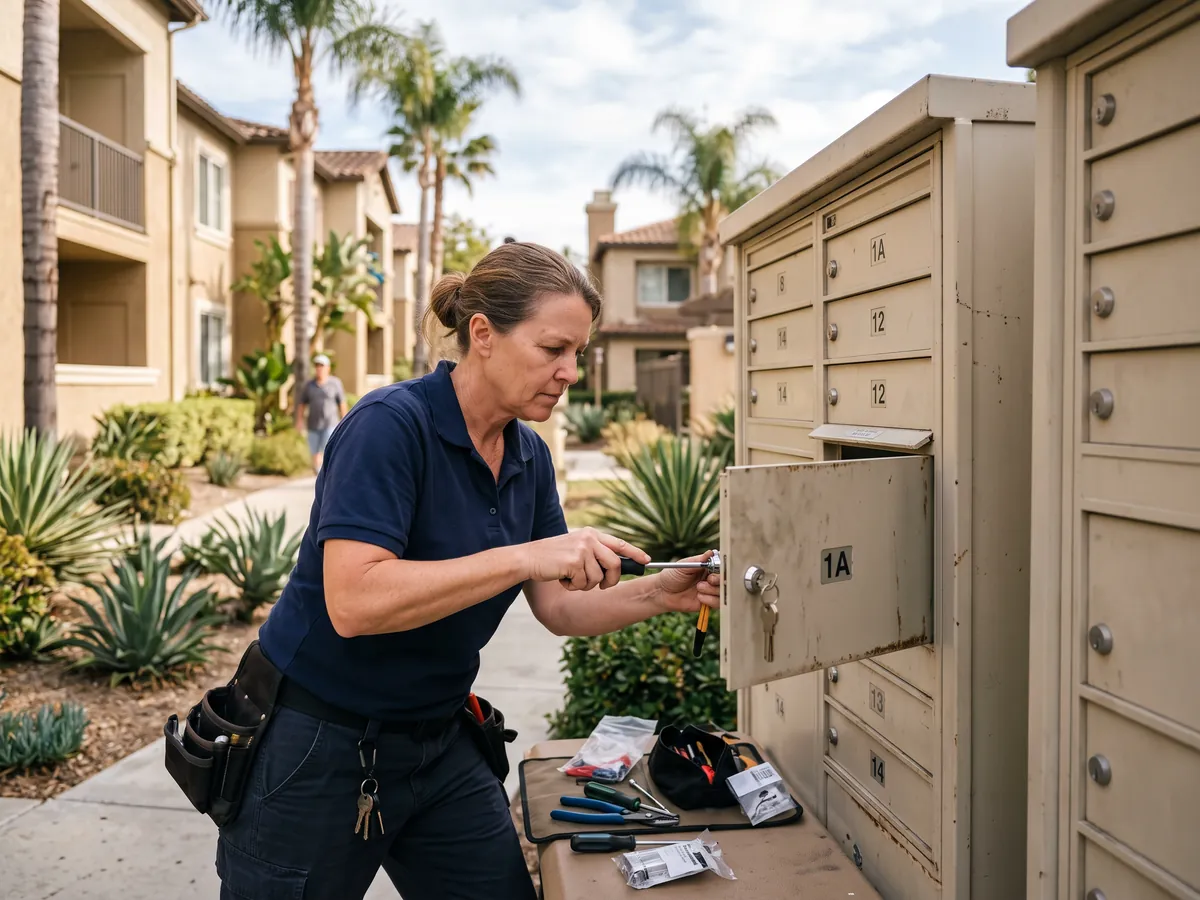
Mailboxes and gates sit at the edge of your property, and they take the worst of the weather. In Ontario that means summer sun that fades finishes and warps wood, Santa Ana gusts that rattle mailbox doors and slam gates, and dust that gums up cam locks and padlocks. Start with the mailbox, because who owns the lock depends on the box. In many newer tracts, mail goes to cluster box units set by the street, and the postal service usually controls those doors. A lost key for your compartment is a question for the post office, not a locksmith. Private boxes on a wall or post, and apartment mailbox banks owned by a landlord or HOA, use ordinary cam locks that we can replace or key. Gates come in several kinds. Side gates on older lots, pedestrian gates at apartment complexes, and fenced yards behind businesses near the airport all fail in similar ways: sagging, rust, a latch post that has shifted. Fixes are usually modest. Re-hang the gate, firm up the post, or fit a heavy-duty latch with a lockable catch. Stainless or powder-coated hardware lasts longer outdoors than bare steel. We work on the parts you or your association own. If a lock belongs to the postal service, we'll say so rather than touch it.
What to know first in Ontario
Here's how a mailbox or gate lock call with Julian's Locksmith usually goes in Ontario. You call (951) 903-3193 and describe the box or gate, the lock, and what's wrong. We ask who owns it, because that decides whether we can legally touch a mailbox lock and whose approval we need on common-area hardware. On-site, we verify residency or authorization, identify the exact hardware, and look for the underlying cause, such as a sagging hinge, a leaning post or a sun-damaged part. You get a price before work begins, with options where they matter. Then we do the job, test it repeatedly, and hand over keys and any key codes. We're also candid about limits. We don't service postal master locks or parcel lockers, we don't repair gate operator motors or circuit boards, and if an iron gate needs new welding, we'll say so and coordinate with a fabricator or suggest bolt-on hardware. Our hours are 6:30 a.m. to 11:30 p.m., seven days a week.
What we can do on-site
- Lost mailbox key: opening the compartment. No key at all? On a privately owned or association-owned box, we pick the compartment lock when the cylinder allows it, or drill it cleanly when it doesn't, then fit a new lock and cut keys. Your mail stays where it is and the door isn't bent. We confirm residency first, so have ID showing the address ready.
- Lock boxes and deadbolts on iron gates. An ornamental iron gate can't hold a standard deadbolt without a lock box, a steel housing that gives the lock a door-like edge to sit in. We install bolt-on boxes, set the backset and strike, and fit a Grade 1 or Grade 2 deadbolt or a gate-specific lock. If the job truly needs welding, we tell you before starting.
- Weather-resistant padlocks and chain. Shrouded-shackle padlocks resist bolt cutters by leaving very little shackle exposed. Paired with a heavy hasp or a latch built for them, they're a strong choice for equipment yards, RV gates and ranch entries. We'll also look at the chain, because a premium lock on light hardware-store chain just moves the weak point.
- Self-closing hinges and pool gate latches. Pool and spa gates need to swing shut and latch on their own, every time, from any open position. We install self-closing hinges and magnetic pool latches, set the tension so the gate closes against wind without slamming, and check that the latch catches from a small opening, which is exactly how inspectors and toddlers test it.
- Pedestrian gate access hardware. Gates on a required exit path have to let people out without a key or special knowledge. We install exit devices and lever trim made for gates, with shields that keep someone outside from reaching through to the release. That keeps the gate secure from the street side while meeting fire and building code on the inside.
How Ontario shapes the job
Older neighborhoods in Ontario tend to have the widest variety of mailboxes: original wall-mounted slots, through-door chutes, aging cluster units the Postal Service may own, and curbside boxes on rotting posts. Gates are often decades-old wood with tired hinges, or iron with lock boxes rusted inside. We match vintage hardware where possible and reinforce what's sound instead of tearing everything out.
Warehouses and yards in Ontario use gates and padlocks hard: rolling yard gates, fenced equipment storage, truck court entries. We supply heavy shrouded padlocks, keyed-alike or master-keyed sets so supervisors carry fewer keys, and weather-rated hasps. Wall-mounted mailboxes and drop slots for business suites get locks changed when staff turn over, with a record of who holds keys. We can also rekey a yard's padlocks after a driver or contractor relationship ends.
Summer heat in Ontario is hard on mailbox and gate hardware. Electronic keypads drain batteries fast, plastic latch parts go brittle in direct sun, and dark metal gates get hot enough to make tight hardware bind. We recommend mechanical keypads or lithium-powered electronic ones, metal latches over plastic, and slightly relaxed strike fit so gates still latch reliably on afternoons when temperatures peak.
Example situations
A homeowner in Creekside has lost the keys to the wall-mounted mailbox on her stucco pillar, and the side gate no longer latches after a windy week. We replace the mailbox cam lock with a new cylinder and two keys, then re-hang the gate and swap the worn latch for a heavy-duty one with a lockable catch. She gets all the keys on one ring and a note on what to check after the next round of wind.
- Picture a homeowners association in a newer tract near Ontario International Airport, where the builder installed the cluster units and the association now owns them. Over a few months, five residents report lost keys. Instead of five separate visits, the manager batches them. We'd replace all five customer locks in one stop, record each key code against its unit number, and leave sealed spare locks with the manager for future move-ins.
- For example, a homeowner in an established neighborhood calls because her cluster box lock is stiff and the key has started to bend. A couple of questions reveal that the Postal Service owns that unit, which is common in older delivery areas. We'd explain that the lock change has to be requested at her local post office, and save her paying for a visit that couldn't legally go ahead.
- For example, a homeowner near Toyota Arena finds the door of a locking curbside mailbox bent back and the cam lock twisted out of its hole. Because the box is private, we can act right away: remove what's left of the old lock, install a new one with a heavier cam, and recommend anchoring the post on a surface plate or in concrete so the whole box can't be wrenched loose next time.
From your call to the finished job
- Call and describe the box or gate. Describe the problem in plain words: key lost, lock spins, latch won't catch, keypad dead, gate drags on the ground. We'll ask a few follow-up questions, give you an honest ETA, and tell you during that first call if it sounds like a post office matter rather than a locksmith job.
- Confirm ownership and authorization. Common-area hardware always belongs to someone, and that someone has to approve the work. For HOA mailboxes and gates we'll ask for a work order or an email from the board or manager. For rentals we need the landlord's approval. At your own home, proof that you live there is enough.
- Inspect the hardware and its conditions. We look for what caused the failure, not just what failed. A latch that won't catch may be sitting on a sagging gate; a mailbox lock that sticks may work fine once packed grit is cleared. Diagnosing first prevents installing new hardware on top of a problem it can't fix.
- Quote the options before starting. For associations and property managers, we can quote a batch: a set number of compartment locks, several gates, or a mix of both. That lets you approve the whole scope at once and keeps every unit on matching hardware, which makes future turnovers simpler.
- Do the work on-site. Where welding or a new post is needed, we say so before starting and either coordinate with your fabricator or recommend bolt-on hardware that avoids it. Motorized gate operators stay with the gate technician; we handle the locks, latches, keypads, strikes and hinges.
- Test, hand over keys, keep records. For associations and landlords, we provide a written record of which locks went on which units and which key codes they use. That record speeds up the next turnover and settles questions later about who should be holding which key.
Pricing factors
- Mailbox lock type and parts. On most mailbox jobs, the lock itself is a small part of the total; the visit and labor make up most of it. That's why changing several locks in one trip, or handling a mailbox and a gate together, usually costs noticeably less per lock than booking separate calls weeks apart.
- Hardware grade and weather rating. Electronic gate keypads vary widely. A basic single-code unit is modest; models with many user codes, audit trails or app control cost more and take longer to set up. We recommend only the features your gate actually needs, not the most expensive model on the shelf.
- Timing, access and distance. A gate that won't close with a dog or an unfenced pool behind it is urgent; a stiff mailbox lock usually isn't. We'll help you judge which is which. Bundling a mailbox lock, a gate repair and a house rekey into one visit often saves money compared with three separate trips.
Every job gets a clear quote before any work starts. Call (951) 903-3193 with the details and we'll tell you what to expect for your situation in Ontario.
What not to do
- Keeping the same gate code for years and writing it on the gate post for convenience. Every former gardener, pool tech and guest still knows it. Codes should change when people stop needing access, and they belong in a phone note or a property manager's file, not in permanent marker on the hardware.
- Mounting an indoor-rated keypad or smart lock on a gate in full sun. Interior electronics aren't sealed against dust, sprinkler spray or the heat a dark housing reaches in summer. Screens fade, buttons stick and batteries fail early. Choose hardware the manufacturer rates for exterior gates, or a mechanical keypad with no batteries at all.
- Leaving a single-cylinder deadbolt or a lever with an inside thumbturn on an iron gate with open pickets. Anyone can reach through and turn it from the sidewalk. A reach-through shield, a solid panel behind the lock, or a double-cylinder lock where code allows closes that gap while keeping the gate usable.
Practical tips before you call
- Ask for your gate padlocks and keyed latches to be keyed alike. One key for the side gate, the back gate and the trash enclosure means fewer keys on the ring and less temptation to leave a gate unlocked because the right key is buried in a kitchen drawer somewhere.
- Before the fall wind season, walk your gates. Tighten hinge and latch screws, check that the gate swings freely without dragging, and add a gate stop if wind can blow it past its latch. A gate that slams repeatedly loosens its own hardware, and a loose latch is the one that fails during a storm.
- If your gate keypad runs on AA batteries and the manufacturer allows lithium, use lithium. They hold up far better in inland summer heat and don't leak the way alkaline cells can. Swap them in late spring rather than waiting for the low-battery beep in the middle of a heat wave.
- Keep your mailbox key on its own small ring, or keep a copy with a trusted neighbor. People lose mailbox access most often by losing the whole car-and-house key bundle at once. A separate spare means one bad day doesn't also turn into a week of trips to the post office.
Getting to Ontario
Ontario is about 25 miles from our San Bernardino base, roughly 33 minutes in light traffic via I-215 North to the I-15 junction at Devore. When you call, you get an arrival estimate based on where the technician is and the traffic at that moment.
Commercial jobs on busy stretches like Fourth Street sometimes need a parking plan, especially for storefront doors or roll-up gates. Let us know about loading zones, red curbs or parking structures before we arrive.
About Ontario: Ontario International Airport serves as the West Coast air and truck hub for UPS and a major distribution point for FedEx Express.
| Neighborhoods | Creekside, Euclid Avenue historic corridor, Guasti, Park Place, North Ontario near Chaffey High School, Ontario Center |
|---|---|
| ZIP codes | 91761, 91762, 91764 |
| Main routes | I-10, SR-60, I-15, Euclid Avenue |
| From our San Bernardino base | about 25 miles via I-215 North to the I-15 junction at Devore, then I-15 (Ontario Freeway) South to I-10 West and Holt Boulevard for downtown and the airport; stay on I-15 South to Ontario Ranch Road or SR-60 for Ontario Ranch. SR-210 West to I-15 South is the usual alternate. |
Mailbox or gate lock in Ontario?
Call (951) 903-3193 and tell us whether it's a private mailbox, a cluster box unit or a gate. We'll tell you whether the job is ours or the Postal Service's, and quote our part before any work starts.
Frequently asked questions
What do you need from me before opening my mailbox?
Proof that you're entitled to that box. Photo ID with the matching address works, as does a lease or utility bill with ID. For apartment or HOA mailboxes, we may also need approval from the manager or association. Mail theft is a serious problem in Southern California, and that check keeps us from opening a box for the wrong person.
Why did my gate stop latching?
Most often the gate has moved, not the latch. Wood gates sag as hinge screws loosen in dried-out posts, posts lean after wet winters, and heat can make tight-fitting metal gates bind. Sometimes a latch spring weakens or a plastic catch cracks in the sun. We find the cause first, because a new latch on a sagging gate fails again.
Can my mailbox be keyed to match my house key?
Sometimes, on a private mailbox. Cam locks exist in common house keyways like Kwikset and Schlage, and some private boxes accept them. Cluster units and apartment mailboxes are different: their compartment locks need to match the manufacturer's door design, so you'll usually carry a separate small key. Gate locks are easier to match to your house key.
Will you have to drill my mailbox lock if the key is lost?
Not always. Many compartment locks are simple wafer or short pin cylinders that can be picked open without damage. Drilling is the backup when the lock is a higher-security type, badly worn, or packed with debris. Either way, the old lock gets replaced and you receive new keys, so nobody holding the lost one can use it.
Can you open the parcel locker or the master door on our mailbox?
No. The carrier's master lock and the parcel locker locks on cluster units are controlled by the Postal Service, and only postal staff service them. If a parcel locker is jammed or a package is stuck, contact your local post office. We work only on the customer compartment locks of units that aren't postal property.
Do you work on automatic driveway gates in Ontario?
We handle the lock side: manual release locks, padlocks, keypads on pedestrian gates beside the driveway, and strikes or latches on the gate leaf. The operator motor, circuit board, safety sensors and wiring belong with a gate operator company, since those systems follow their own safety standards. We're happy to coordinate so the locks and the operator work together.
How far is Ontario from your base?
Ontario is about 25 miles from our San Bernardino base, roughly 33 minutes in light traffic. Arrival time depends on traffic and on the job the technician is finishing, so we give you an estimate on the phone before you commit.
Related services in Ontario
- Mailbox Lock Replacement in Ontario
- Gate Lock Repair in Ontario
- Cluster Mailbox Lock in Ontario
- Lost Mailbox Key in Ontario
- Keypad Gate Lock in Ontario
- Weather-Resistant Gate Lock in Ontario
- Locksmith for Gated Property in Ontario
- Gate Latch Repair in Ontario
- Community Mailbox Lock in Ontario
- Mailbox Key Duplication in Ontario
Mailbox & Gate Locks in nearby cities
- Mailbox & Gate Locks in MontclairSan Bernardino County
- Mailbox & Gate Locks in ChinoSan Bernardino County
- Mailbox & Gate Locks in UplandSan Bernardino County
- Mailbox & Gate Locks in Rancho CucamongaSan Bernardino County
- Mailbox & Gate Locks in ClaremontLos Angeles County
- Mailbox & Gate Locks in EastvaleRiverside County
- Mailbox & Gate Locks in PomonaLos Angeles County
- Mailbox & Gate Locks in EtiwandaSan Bernardino County


