
City of Industry, Los Angeles County
Mailbox and Gate Lock Service in City of Industry: Know Who Owns What
Short answer: Julian's Locksmith handles mailbox and gate locks across City of Industry: we replace cam locks on private and association-owned mailboxes, open compartments when the key is lost, and install, repair or upgrade gate latches, keyed gate locks, keypads and padlocks. Locks on Postal Service-owned cluster units go through your post office instead. Call (951) 903-3193; we verify residency or ownership and quote before starting.
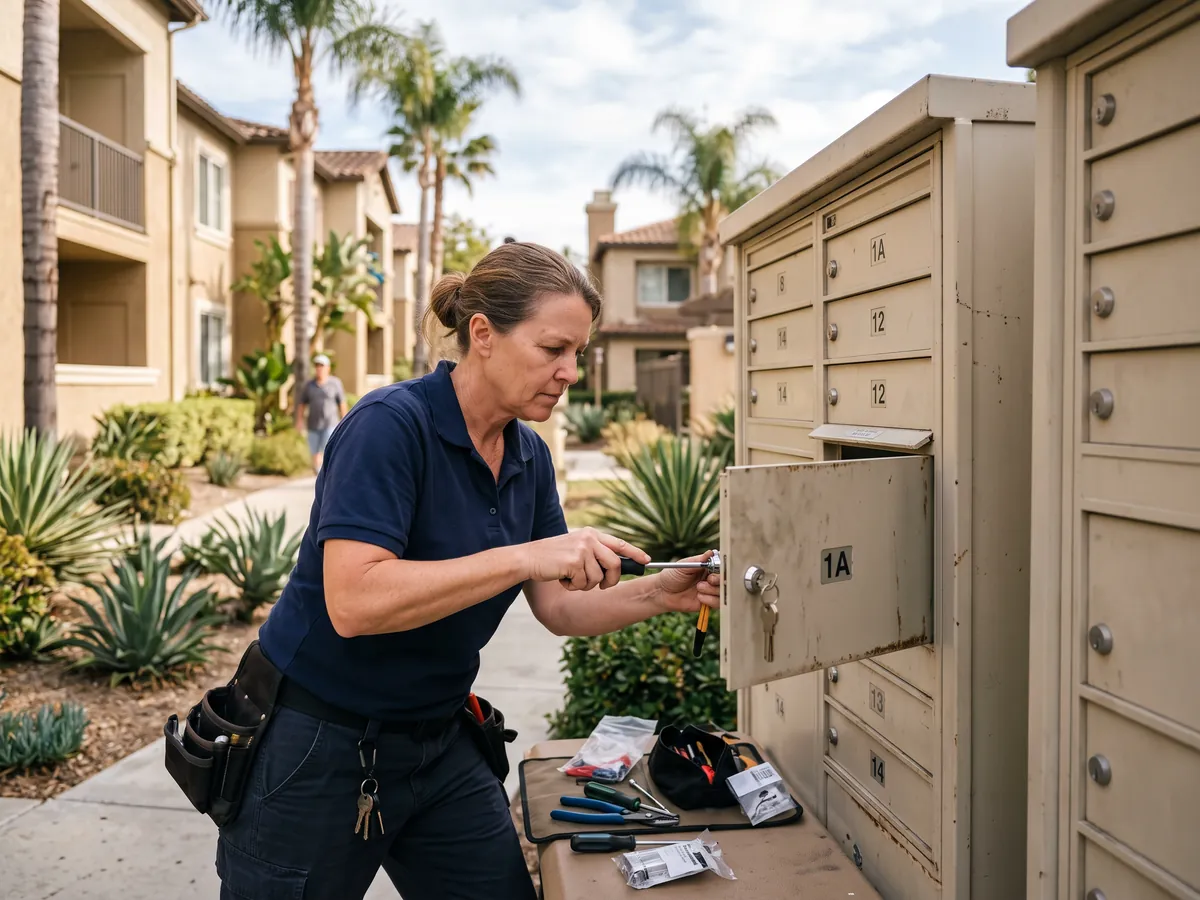
Bought a home in City of Industry and received a single mailbox key, a side gate padlock nobody knows the combination to, and a pool gate that only latches when you slam it? That's a common move-in package. The previous owner's housekeeper, gardener and dog walker may all have had access to those locks, and there's no way to know for sure. Julian's Locksmith can change the mailbox lock once you've confirmed who owns the box, replace or rekey gate hardware so it matches your house key where the brands allow, and fix the latch so the gate closes on its own. One visit, one ring of keys, and a clear quote first.
Mailbox and gate hardware looks minor until it fails, and in City of Industry both take a beating. Sun, dust from trucks and trains, and the occasional winter rain all work on exposed locks. Mailboxes first, because who owns the lock decides who fixes it. On a cluster box unit, the USPS arrow lock on the carrier door is replaced only by the Postal Service, while the individual tenant doors belong to the property and can be rekeyed or replaced by a locksmith. Private wall-mounted boxes and business mailbox banks belong to the owner, and we change those cam locks. Gate locks come in three common forms here: chain-link yard gates secured with a padlock and hasp, swing gates with a keyed latch, and sliding or cantilever gates driven by an operator. Hot steel that warps, rust at the latch and a leaning gate post all keep the lock from lining up. Dust packs into the keyway, so we recommend dry lubricant rather than oil. Pool and pedestrian gates at hotels and event venues need self-closing, self-latching hardware, with the latch placed according to local code. We handle the lock. For gate operators and safety sensors, a gate-operator technician may need to join us.
How this works in City of Industry
Mailbox and gate locks cover two families of outdoor hardware that share a few traits: they're small, fully exposed, and usually ignored until they fail. On the mailbox side in City of Industry you'll see four main types. Cluster box units, the pedestal-mounted banks common in newer tracts, put a small cam lock on each customer door and a postal master lock on the carrier panel. Horizontal 4C mailboxes in apartment lobbies and mailrooms work the same way but are built into a wall. Older buildings may still have vertical boxes with narrow brass doors. Private homes may have a locking curbside, column or wall-mounted box the owner bought outright. Gate hardware is more varied: gravity and thumb latches on wood side gates, keyed two-sided latches, bolt-on or welded lock boxes holding a deadbolt on iron gates, mechanical and electronic keypads, padlocks on fork latches and chains, self-closing hinges, and electric strikes or magnetic locks on community pedestrian gates. We work on all of it, and every job starts with identifying exactly what's installed, because the correct part depends on details like cam length, gate thickness and backset.
How we can help in City of Industry
- Lost mailbox key: opening the compartment. Pry bars ruin mailbox doors, and replacement doors for cluster units are often harder to source than the lock itself. Picking is our first approach, since most compartment cylinders are simple wafer or short pin designs. When drilling is unavoidable, we drill only through the lock face, which keeps the door and the surrounding frame reusable.
- Cluster box and apartment mailbox locks. Parcel lockers on cluster units use captive-key locks: the carrier leaves a key in your compartment, you open the locker, and the key stays trapped until the carrier retrieves it. If one jams or the key goes missing, the fix depends on who owns the unit. We'll tell you which route applies rather than forcing anything.
- Locking mailbox installation for homes. Open curbside boxes are easy pickings. A locking mailbox accepts mail through a slot or drop door and only gives it back through a keyed retrieval door that you control. We install post-mounted, column and wall-mounted models, set them at the height and setback carriers expect, and choose locks and hinges rated for full sun.
- Lock boxes and deadbolts on iron gates. An ornamental iron gate can't hold a standard deadbolt without a lock box, a steel housing that gives the lock a door-like edge to sit in. We install bolt-on boxes, set the backset and strike, and fit a Grade 1 or Grade 2 deadbolt or a gate-specific lock. If the job truly needs welding, we tell you before starting.
- Self-closing hinges and pool gate latches. Selling a home with a pool in City of Industry? Home inspectors often flag gates that won't self-close or self-latch. We can put those gates back in working order quickly, and if the real issue is the fence, a gap or the enclosure layout rather than hardware, we'll tell you plainly instead of swapping parts that can't fix it.
How City of Industry shapes the job
Warehouses and yards in City of Industry use gates and padlocks hard: rolling yard gates, fenced equipment storage, truck court entries. We supply heavy shrouded padlocks, keyed-alike or master-keyed sets so supervisors carry fewer keys, and weather-rated hasps. Wall-mounted mailboxes and drop slots for business suites get locks changed when staff turn over, with a record of who holds keys. We can also rekey a yard's padlocks after a driver or contractor relationship ends.
Summer heat in City of Industry is hard on mailbox and gate hardware. Electronic keypads drain batteries fast, plastic latch parts go brittle in direct sun, and dark metal gates get hot enough to make tight hardware bind. We recommend mechanical keypads or lithium-powered electronic ones, metal latches over plastic, and slightly relaxed strike fit so gates still latch reliably on afternoons when temperatures peak.
Example situations
A property manager of a small business park off Valley Boulevard reports that two tenants' wall-mounted mailbox locks have jammed and one key is lost. The boxes belong to the landlord, so we confirm his authority and replace those cam locks with new ones keyed to the tenants. As we pack up, he mentions the pedestrian gate beside the truck entrance, where the padlock hasp no longer meets its post. We'd fit a new hasp and a hardened padlock before leaving.
- Imagine a stucco home in City of Industry with a decorative iron front gate and a thumbturn deadbolt in a lock box. Anyone standing on the walkway can slide an arm between the pickets and open it. We'd fit a perforated steel shield around the lock area, or a double-cylinder deadbolt if the gate isn't part of an exit path, so it still opens easily from inside but not by reaching through.
- For example, a homeowner near Vineland Drive-In finds the door of a locking curbside mailbox bent back and the cam lock twisted out of its hole. Because the box is private, we can act right away: remove what's left of the old lock, install a new one with a heavier cam, and recommend anchoring the post on a surface plate or in concrete so the whole box can't be wrenched loose next time.
- A typical call: a renter moves into a City of Industry apartment and learns the previous tenant never returned the mailbox key. The manager approves a lock change by email. We'd meet the new resident at the mailroom, check the approval against their lease, pick the compartment lock, install a new cam lock of the same size, and hand over keys along with a code the office can log for next time.
How the visit works
- Call and describe the box or gate. The most useful calls start with specifics: any brand name stamped on the lock face or mailbox door, how many locks need work, and whether you still have a working key. If someone else owns the box or the gate, such as an HOA or landlord, have their contact details handy so approval doesn't hold things up.
- Confirm ownership and authorization. If ownership is unclear, which happens with older cluster units, we pause and help you find out rather than guess. A call to the local post office or the association's management company usually settles it, and nobody pays for work that turns out not to be allowed.
- Inspect the hardware and its conditions. On gates, we swing the gate from several positions, check the posts for plumb, look at hinge pins for wear, and watch how the latch behaves when the gate is pushed or bumped. On mailboxes, we test the key, the door fit, and how far the cam overlaps the frame.
- Quote the options before starting. For associations and property managers, we can quote a batch: a set number of compartment locks, several gates, or a mix of both. That lets you approve the whole scope at once and keeps every unit on matching hardware, which makes future turnovers simpler.
- Do the work on-site. Outdoors we use stainless fasteners, through-bolt where screws would strip, and seal drilled holes in metal so rust doesn't start there. On vinyl gates we add internal reinforcement before mounting any lock, because screws alone eventually pull out of hollow vinyl rails.
- Test, hand over keys, keep records. We test every key in every lock, close the gate from wide open and from a few inches open, and confirm the latch catches each time. You get your keys, the key code where one exists, and a short note listing what was installed and where.
What affects the cost
- Key in hand or opening required. If you still have a working key, changing a mailbox lock is a quick swap. If the key is lost, we first have to open the compartment by picking or drilling, which adds time and occasionally a small door repair. Telling us which situation you're in when you call keeps the quote honest.
- How many locks and gates. Buildings with heavy turnover often keep spare compartment locks on hand. When we stock your building's specific lock type, each move-out becomes a fast swap instead of a parts hunt, which keeps both the bill and the new resident's wait short.
- Gate material and mounting prep. Older iron gates can hide rust inside lock boxes and hinge barrels that isn't visible until the lock comes out. If the box has rusted through or the hinges are seized, we stop, show you what we found, and quote the extra work before continuing.
Every job gets a clear quote before any work starts. Call (951) 903-3193 with the details and we'll tell you what to expect for your situation in City of Industry.
Common errors that cost time and money
- Propping open a pool gate, tying back its self-closing hinge, or loosening the hinge spring because the gate closes too hard. Each of those defeats the main safety feature of the enclosure. If the gate slams, the fix is tension adjustment or a hydraulic closer, not disabling the mechanism that keeps the gate shut.
- Leaving a single-cylinder deadbolt or a lever with an inside thumbturn on an iron gate with open pickets. Anyone can reach through and turn it from the sidewalk. A reach-through shield, a solid panel behind the lock, or a double-cylinder lock where code allows closes that gap while keeping the gate usable.
- Replacing a latch on a gate that has sagged without fixing the sag. The new latch lines up for a week, then the gate drops a little more and it misses again. The real repair is at the hinge side: tightened or relocated hinges, an anti-sag kit, or a braced post. Then the latch has something stable to catch.
Advice before you book
- On vinyl gates, ask about reinforcement before adding any lock or latch. Hollow vinyl rails won't hold screws under daily use; an aluminum or wood insert inside the rail gives fasteners something solid to bite into. Skipping it means the latch works loose within months, usually right when you need the gate closed.
- Where sprinklers hit a gate lock or padlock, adjust the spray heads first. Constant wetting followed by hot sun is what rusts shackles and seizes lock boxes. On padlocks, a keyway cover helps, and hanging the lock so the keyway faces down keeps water and grit from settling into the cylinder.
- Look closely at your mailbox key and the face of the lock. Many carry a short stamped code. Write it down along with the box brand and keep that note somewhere other than your keyring. When a key is lost or the lock wears out, that code lets a locksmith cut a replacement or match the lock without guesswork.
- Keep your mailbox key on its own small ring, or keep a copy with a trusted neighbor. People lose mailbox access most often by losing the whole car-and-house key bundle at once. A separate spare means one bad day doesn't also turn into a week of trips to the post office.
Service in City of Industry
City of Industry is about 46 miles from our San Bernardino base, roughly 52 minutes in light traffic via I-215 North to I-15 at Devore, I-15 South through Rancho Cucamonga and Ontario. When you call, you get an arrival estimate based on where the technician is and the traffic at that moment.
Our path into City of Industry depends on where the previous job wrapped up. Sometimes that's a straight run via Crossroads Parkway; other times it's surface streets the whole way. Either way, you get a heads-up call when the technician is close.
About City of Industry: Industry Hills is scheduled to host the mountain biking events of the 2028 Summer Olympics in Los Angeles.
| Neighborhoods | Civic Center, Crossroads Business Park, Industry Hills, Gale Avenue corridor, Nogales Street and Fullerton Road, Industry Business Center |
|---|---|
| ZIP codes | 91744, 91748, 91745, 91746, 91789, 90601, 91732 |
| Main routes | SR-60, I-605, SR-57, Valley Boulevard |
| From our San Bernardino base | about 46 miles via I-215 North to I-15 at Devore, I-15 South through Rancho Cucamonga and Ontario, then SR-60 West (Pomona Freeway) through the 57/60 confluence; exit Fairway Drive for the east-end business parks and Metrolink station, Nogales Street, Fullerton Road or Azusa Avenue for central Industry and Puente Hills Mall, and Hacienda Boulevard for City Hall and the Homestead Museum. Alternate: SR-210 West to SR-57 South to SR-60 West |
Mailbox or gate lock in City of Industry?
Call (951) 903-3193 and tell us whether it's a private mailbox, a cluster box unit or a gate. We'll tell you whether the job is ours or the Postal Service's, and quote our part before any work starts.
Frequently asked questions
Do you work on automatic driveway gates in City of Industry?
We handle the lock side: manual release locks, padlocks, keypads on pedestrian gates beside the driveway, and strikes or latches on the gate leaf. The operator motor, circuit board, safety sensors and wiring belong with a gate operator company, since those systems follow their own safety standards. We're happy to coordinate so the locks and the operator work together.
Can my mailbox be keyed to match my house key?
Sometimes, on a private mailbox. Cam locks exist in common house keyways like Kwikset and Schlage, and some private boxes accept them. Cluster units and apartment mailboxes are different: their compartment locks need to match the manufacturer's door design, so you'll usually carry a separate small key. Gate locks are easier to match to your house key.
Can a locksmith change my mailbox lock in City of Industry?
Yes, as long as the mailbox isn't Postal Service property and you have the right to authorize the work. Private curbside and wall boxes are yours. Cluster units and apartment mailboxes owned by an HOA or landlord need their approval. If the Postal Service owns the unit, the lock change has to be requested at your local post office.
What's the best gate lock for full sun in City of Industry?
Choose metal over plastic and corrosion-resistant metal over plain steel. Stainless or solid-brass latches and padlock bodies, stainless fasteners, and mechanical keypads with no batteries hold up well in inland heat. If you want an electronic keypad, pick one rated for exterior gates and use lithium batteries where the manufacturer allows. Dark plastic housings in direct afternoon sun fail first.
Can you key my gate lock to my house key?
Often, yes. Many keyed gate latches and lock-box deadbolts use standard cylinders that can be pinned to a Kwikset or Schlage house key. Padlocks are trickier; some brands can be rekeyed, others are sold keyed alike in sets. We'll tell you what's possible with your gate before you buy hardware so you don't end up with yet another key.
How do I stop someone reaching through my iron gate to open it?
Add a reach-through shield: a perforated or solid steel plate around the lock area that keeps an arm from reaching the inside handle or thumbturn. Another option is a double-cylinder lock, but only on gates that aren't required exit paths. Exit-path gates need hardware that opens freely from inside, so a shield is the usual answer there.
How far is City of Industry from your base?
City of Industry is about 46 miles from our San Bernardino base, roughly 52 minutes in light traffic. Arrival time depends on traffic and on the job the technician is finishing, so we give you an estimate on the phone before you commit.
Related services in City of Industry
- Mailbox Lock Replacement in City of Industry
- Gate Lock Repair in City of Industry
- Cluster Mailbox Lock in City of Industry
- Lost Mailbox Key in City of Industry
- Keypad Gate Lock in City of Industry
- Weather-Resistant Gate Lock in City of Industry
- Locksmith for Gated Property in City of Industry
- Gate Latch Repair in City of Industry
- Community Mailbox Lock in City of Industry
- Mailbox Key Duplication in City of Industry
Mailbox & Gate Locks in nearby cities
- Mailbox & Gate Locks in Hacienda HeightsLos Angeles County
- Mailbox & Gate Locks in La PuenteLos Angeles County
- Mailbox & Gate Locks in ValindaLos Angeles County
- Mailbox & Gate Locks in La Habra HeightsLos Angeles County
- Mailbox & Gate Locks in Rowland HeightsLos Angeles County
- Mailbox & Gate Locks in West Puente ValleyLos Angeles County
- Mailbox & Gate Locks in West CovinaLos Angeles County
- Mailbox & Gate Locks in Avocado HeightsLos Angeles County

