
Claremont, Los Angeles County
Mailbox and Gate Locks in Claremont
Short answer: Lost your mailbox key in Claremont? If the box isn't Postal Service property, a locksmith can pick or drill the compartment's cam lock, fit a new lock and cut fresh keys, usually in a single visit. We'll ask for ID showing the address, or a note from your manager or HOA, before opening anything. Call (951) 903-3193 and describe the box when you do.
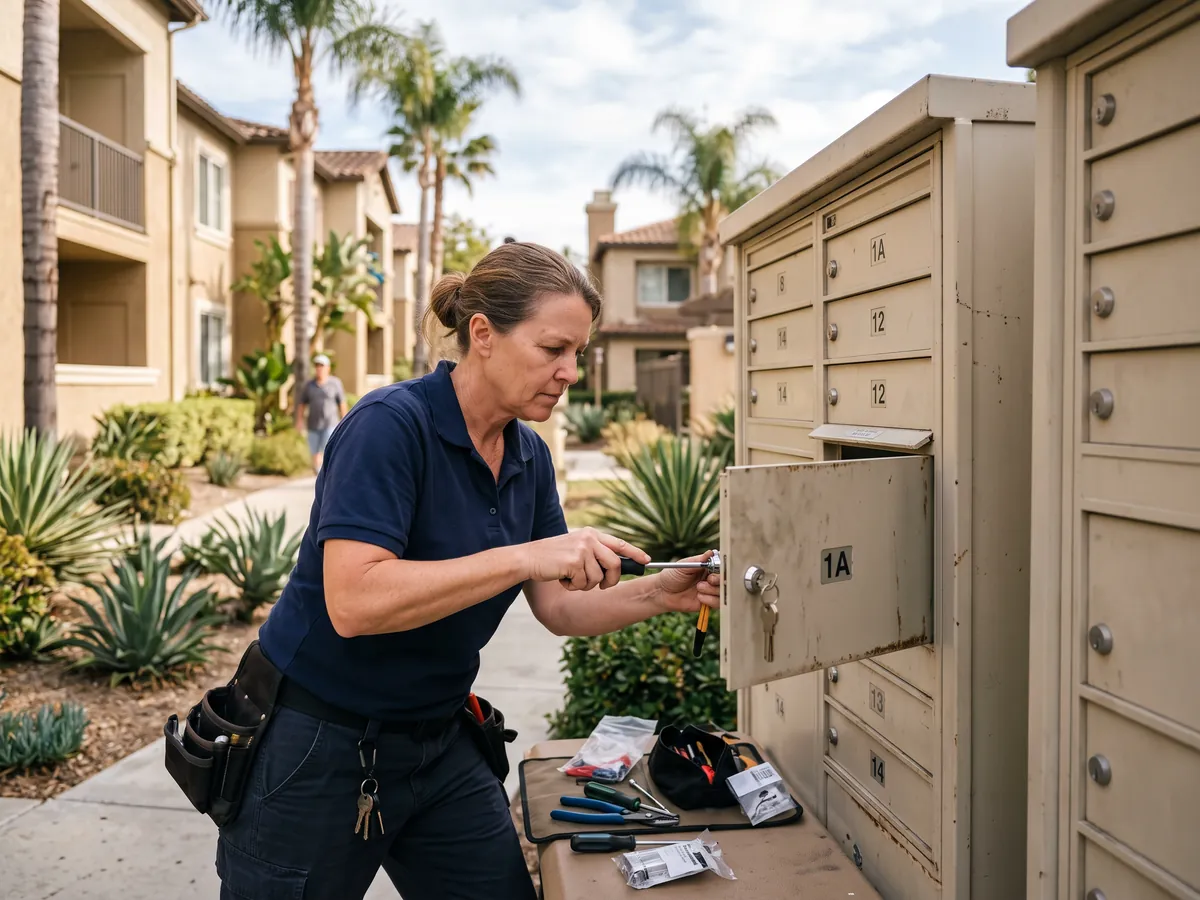
The first question about a mailbox lock in Claremont isn't technical. It's who owns the box. A cluster unit at the end of your street may belong to the Postal Service, to your homeowners association, or to a builder who never handed it over cleanly. Ownership decides who may change the lock, who pays, and whether a locksmith is permitted to open it at all. We'll help you sort that out on the phone. When the box is privately owned, or the owner authorizes the work, Julian's Locksmith replaces the compartment lock and cuts new keys on-site. When it's postal property, we'll say so and point you to the right counter at the post office.
Mailbox and gate locks look unrelated, but they fail for similar reasons: weather, grit and age. In Claremont, fall Santa Ana winds blow leaf litter and dust into mailbox cams and gate latches, summer sun fades and cracks plastic, and sprinklers rust anything steel. Mailboxes first. Private curbside and wall-mounted boxes can take a new lock or replacement cam, which we change on the spot. An apartment bank belongs to the property, so we work with the owner or manager. USPS cluster box units belong to the Postal Service, and its local post office handles those locks and keys, not us. That is a clear line, and we explain it before touching anything. Gates are the other half. Side gates in the older neighborhoods are often wood and sag over the years. Pedestrian and pool gates need locks that cooperate with self-closing hinges. Driveway gates in Claraboya and Padua Hills may be motorized, and a motor failure is a gate contractor's job, but the lock, latch and manual release are ours. We repair first and replace only when the parts are beyond saving, and where the hardware allows it we key gate and mailbox locks to your house key.
Mailbox & Gate Locks in Claremont: what to expect
Mailbox and gate locks cover two families of outdoor hardware that share a few traits: they're small, fully exposed, and usually ignored until they fail. On the mailbox side in Claremont you'll see four main types. Cluster box units, the pedestal-mounted banks common in newer tracts, put a small cam lock on each customer door and a postal master lock on the carrier panel. Horizontal 4C mailboxes in apartment lobbies and mailrooms work the same way but are built into a wall. Older buildings may still have vertical boxes with narrow brass doors. Private homes may have a locking curbside, column or wall-mounted box the owner bought outright. Gate hardware is more varied: gravity and thumb latches on wood side gates, keyed two-sided latches, bolt-on or welded lock boxes holding a deadbolt on iron gates, mechanical and electronic keypads, padlocks on fork latches and chains, self-closing hinges, and electric strikes or magnetic locks on community pedestrian gates. We work on all of it, and every job starts with identifying exactly what's installed, because the correct part depends on details like cam length, gate thickness and backset.
How we can help in Claremont
- Lost mailbox key: opening the compartment. A lost mailbox key is a security issue as much as a hassle, because anyone who finds it may be able to match the tag or code to your box. We open the compartment, replace the lock rather than copying the old key, and suggest keeping a spare somewhere other than the keyring that just disappeared.
- Cluster box and apartment mailbox locks. Cluster box units and 4C horizontal mailboxes in Claremont carry two kinds of locks: customer locks controlled by whoever owns the unit, and the carrier's master lock, which belongs to the Postal Service. We work only on the customer side, and only with authorization from the unit's owner, which is often an HOA or property manager.
- Keyed gate latches and lockable latches. A gate latch you can lock and open from both sides lets you come in from the street without reaching over the top. We fit keyed two-sided latches on wood, vinyl and metal gates, align the catch with the gate's real resting position, and key the cylinder to your house key when the brands are compatible.
- Lock boxes and deadbolts on iron gates. An ornamental iron gate can't hold a standard deadbolt without a lock box, a steel housing that gives the lock a door-like edge to sit in. We install bolt-on boxes, set the backset and strike, and fit a Grade 1 or Grade 2 deadbolt or a gate-specific lock. If the job truly needs welding, we tell you before starting.
- Keypad gate locks: mechanical and electronic. Keypads make sense where lots of people come and go: pool services, gardeners, dog walkers, short-term guests. Mechanical pushbutton locks need no batteries and tolerate inland heat well. Electronic keypads add multiple user codes and, on some models, app control. We match the type to who uses the gate and how much direct sun it takes.
How Claremont shapes the job
In 55-plus communities around Claremont, small mailbox keys and stiff gate latches can be a daily obstacle for arthritic hands. With association approval, we install smooth new compartment locks, cut keys on easier-to-grip blanks where the keyway allows, and fit lever-operated or easy-push gate latches. Keypad locks can also replace small keys entirely for residents who find turning them difficult.
Summer heat in Claremont is hard on mailbox and gate hardware. Electronic keypads drain batteries fast, plastic latch parts go brittle in direct sun, and dark metal gates get hot enough to make tight hardware bind. We recommend mechanical keypads or lithium-powered electronic ones, metal latches over plastic, and slightly relaxed strike fit so gates still latch reliably on afternoons when temperatures peak.
Older neighborhoods in Claremont tend to have the widest variety of mailboxes: original wall-mounted slots, through-door chutes, aging cluster units the Postal Service may own, and curbside boxes on rotting posts. Gates are often decades-old wood with tired hinges, or iron with lock boxes rusted inside. We match vintage hardware where possible and reinforce what's sound instead of tearing everything out.
Situations this covers
A fourplex on Claremont Boulevard near El Barrio Park has a rusted side-gate latch that no longer catches and a bank of mailbox cam locks with two keys missing. In one visit we would replace the gate latch with a stainless keyed lock and realign the keeper, then swap the cam locks and tag each key to its unit. If the box turns out to be a USPS cluster unit, we would tell the owner to call the post office instead.
- A typical summer call: the wood side gate of a ranch house off Foothill Boulevard has dropped half an inch, the gravity latch now rides below its catch, and the family dog has slipped out twice this week. We'd add an anti-sag cable or reset the hinges, remount the latch at the gate's true height, and add a keyed latch so the gate stays shut and can be opened from the street side.
- For example, a home sale in Claremont stalls after the inspection report notes that the pool gate only latches when pushed. The seller needs it fixed before close of escrow. We'd adjust or replace the self-closing hinges, realign the magnetic latch so it catches from a partly open position, test it repeatedly from different angles, and explain the repair so the agent can document it for the buyer.
- Picture a homeowners association in a newer tract near Memorial Park, where the builder installed the cluster units and the association now owns them. Over a few months, five residents report lost keys. Instead of five separate visits, the manager batches them. We'd replace all five customer locks in one stop, record each key code against its unit number, and leave sealed spare locks with the manager for future move-ins.
Step by step with Julian's Locksmith
- Call and describe the box or gate. The most useful calls start with specifics: any brand name stamped on the lock face or mailbox door, how many locks need work, and whether you still have a working key. If someone else owns the box or the gate, such as an HOA or landlord, have their contact details handy so approval doesn't hold things up.
- Confirm ownership and authorization. If ownership is unclear, which happens with older cluster units, we pause and help you find out rather than guess. A call to the local post office or the association's management company usually settles it, and nobody pays for work that turns out not to be allowed.
- Inspect the hardware and its conditions. On gates, we swing the gate from several positions, check the posts for plumb, look at hinge pins for wear, and watch how the latch behaves when the gate is pushed or bumped. On mailboxes, we test the key, the door fit, and how far the cam overlaps the frame.
- Quote the options before starting. We explain the trade-offs in plain language. A bargain latch may last one season in full sun; a stainless one can last for years. A keypad saves handing out keys but needs someone to manage codes. You choose, and the price you approved is the price you pay.
- Do the work on-site. Outdoors we use stainless fasteners, through-bolt where screws would strip, and seal drilled holes in metal so rust doesn't start there. On vinyl gates we add internal reinforcement before mounting any lock, because screws alone eventually pull out of hollow vinyl rails.
- Test, hand over keys, keep records. Before leaving, we show you how the new hardware works: changing a keypad code, adjusting hinge tension, where to put a little dry lubricant. Most outdoor lock trouble starts with neglect, and a minute of upkeep a few times a year heads off most of it.
What affects the cost
- Mailbox lock type and parts. Standard compartment cam locks are common and relatively inexpensive to replace. Brand-specific or discontinued locks, unusual cam shapes, and high-security upgrades cost more. Knowing the mailbox brand and whether the lock body is short or long before we arrive keeps the quote accurate and avoids a second trip for parts.
- Gate material and mounting prep. Wood gates are the simplest to fit with new latches. Vinyl needs internal reinforcement before a lock can be mounted. Iron gates need lock boxes and careful strike placement, sometimes welding. Aluminum pool fencing needs hardware sized for its thin tubes. The gate itself drives much of the labor on any gate lock job.
- Timing, access and distance. A gate that won't close with a dog or an unfenced pool behind it is urgent; a stiff mailbox lock usually isn't. We'll help you judge which is which. Bundling a mailbox lock, a gate repair and a house rekey into one visit often saves money compared with three separate trips.
Every job gets a clear quote before any work starts. Call (951) 903-3193 with the details and we'll tell you what to expect for your situation in Claremont.
Mistakes to avoid
- Keeping the same gate code for years and writing it on the gate post for convenience. Every former gardener, pool tech and guest still knows it. Codes should change when people stop needing access, and they belong in a phone note or a property manager's file, not in permanent marker on the hardware.
- Leaving a single-cylinder deadbolt or a lever with an inside thumbturn on an iron gate with open pickets. Anyone can reach through and turn it from the sidewalk. A reach-through shield, a solid panel behind the lock, or a double-cylinder lock where code allows closes that gap while keeping the gate usable.
- Propping open a pool gate, tying back its self-closing hinge, or loosening the hinge spring because the gate closes too hard. Each of those defeats the main safety feature of the enclosure. If the gate slams, the fix is tension adjustment or a hydraulic closer, not disabling the mechanism that keeps the gate shut.
What to do before we arrive
- Don't hide a spare gate key on the gate, under a nearby rock or on top of the post. Those are the first places anyone looks. If several people need access, a keypad lock or a key lockbox mounted somewhere less obvious is a much better answer than a key everyone knows about.
- Test a pool gate once a month the way a child would. Open it a few inches and let go. Open it all the way and let go. It should swing shut and latch on its own both times. If it stops short or bounces off the latch, call for an adjustment before it becomes a habit.
- Change gate keypad codes whenever a contractor, employee or tenant stops needing access, and never use 1234, a birth year, or your street number. Write the new code somewhere private, not on the inside of the gate. A code that every past visitor knows works about as well as an unlocked gate.
- Before the fall wind season, walk your gates. Tighten hinge and latch screws, check that the gate swings freely without dragging, and add a gate stop if wind can blow it past its latch. A gate that slams repeatedly loosens its own hardware, and a loose latch is the one that fails during a storm.
Service in Claremont
Claremont is about 30 miles from our San Bernardino base, roughly 34 minutes in light traffic via University Parkway to I-215 South. When you call, you get an arrival estimate based on where the technician is and the traffic at that moment.
Commercial jobs on busy stretches like Mount Baldy Road sometimes need a parking plan, especially for storefront doors or roll-up gates. Let us know about loading zones, red curbs or parking structures before we arrive.
About Claremont: The Claremont Colleges consortium, founded in 1925, includes Pomona, Scripps, Claremont McKenna, Harvey Mudd and Pitzer colleges plus Claremont Graduate University and Keck Graduate Institute.
| Neighborhoods | Claraboya, Historic core around Memorial Park, North Claremont, Pilgrim Place and Claremont Manor, Village South, The Claremont Colleges district |
|---|---|
| ZIP codes | 91711 |
| Main routes | I-10, SR-210, Foothill Boulevard, Base Line Road |
| From our San Bernardino base | about 30 miles via University Parkway to I-215 South, then SR-210 West (Foothill Freeway) through Rialto, Fontana, Rancho Cucamonga and Upland to the Base Line Road exit for north Claremont or the Towne Avenue exit for Foothill Boulevard and the Village; I-10 West to Towne Avenue or Indian Hill Boulevard for the south side |
Mailbox or gate lock in Claremont?
Call (951) 903-3193 and tell us whether it's a private mailbox, a cluster box unit or a gate. We'll tell you whether the job is ours or the Postal Service's, and quote our part before any work starts.
Frequently asked questions
How much do mailbox and gate locks cost?
It depends on the hardware and the job. A mailbox lock swap with a working key is simpler than opening a box with no key. Gate costs vary with the gate material, the lock you choose, and whether hinges or posts need work first. We quote before starting, and we explain the options so you can choose what fits.
Can my mailbox be keyed to match my house key?
Sometimes, on a private mailbox. Cam locks exist in common house keyways like Kwikset and Schlage, and some private boxes accept them. Cluster units and apartment mailboxes are different: their compartment locks need to match the manufacturer's door design, so you'll usually carry a separate small key. Gate locks are easier to match to your house key.
Why did my gate stop latching?
Most often the gate has moved, not the latch. Wood gates sag as hinge screws loosen in dried-out posts, posts lean after wet winters, and heat can make tight-fitting metal gates bind. Sometimes a latch spring weakens or a plastic catch cracks in the sun. We find the cause first, because a new latch on a sagging gate fails again.
Can a locksmith change my mailbox lock in Claremont?
Yes, as long as the mailbox isn't Postal Service property and you have the right to authorize the work. Private curbside and wall boxes are yours. Cluster units and apartment mailboxes owned by an HOA or landlord need their approval. If the Postal Service owns the unit, the lock change has to be requested at your local post office.
When can you come out for a mailbox or gate lock in Claremont?
We work every day from 6:30 a.m. to 11:30 p.m., weekends included. We're closed between 11:30 p.m. and 6:30 a.m. Most mailbox and gate work is scheduled, but a gate that won't close with a pool or pets involved gets priority. Call (951) 903-3193 and we'll give you an honest ETA.
Can you put a lock on a vinyl gate?
Yes, but vinyl needs preparation. Hollow vinyl rails and posts won't hold screws under daily use, so we add an aluminum or wood insert inside before mounting the lock or latch. We also use latches designed for vinyl gate widths and through-bolt where possible. Done that way, a vinyl gate lock holds up as well as one on wood.
How far is Claremont from your base?
Claremont is about 30 miles from our San Bernardino base, roughly 34 minutes in light traffic. Arrival time depends on traffic and on the job the technician is finishing, so we give you an estimate on the phone before you commit.
Related services in Claremont
- Mailbox Lock Replacement in Claremont
- Gate Lock Repair in Claremont
- Cluster Mailbox Lock in Claremont
- Lost Mailbox Key in Claremont
- Keypad Gate Lock in Claremont
- Weather-Resistant Gate Lock in Claremont
- Locksmith for Gated Property in Claremont
- Gate Latch Repair in Claremont
- Community Mailbox Lock in Claremont
- Mailbox Key Duplication in Claremont
Mailbox & Gate Locks in nearby cities
- Mailbox & Gate Locks in MontclairSan Bernardino County
- Mailbox & Gate Locks in La VerneLos Angeles County
- Mailbox & Gate Locks in UplandSan Bernardino County
- Mailbox & Gate Locks in PomonaLos Angeles County
- Mailbox & Gate Locks in San DimasLos Angeles County
- Mailbox & Gate Locks in OntarioSan Bernardino County
- Mailbox & Gate Locks in ChinoSan Bernardino County
- Mailbox & Gate Locks in Charter OakLos Angeles County

