
Home Gardens, Riverside County
Mailbox and Gate Lock Service in Home Gardens: Know Who Owns What
Short answer: Who fixes a mailbox lock in Home Gardens depends on who owns the box. If the Postal Service owns your cluster unit, request the change at your local post office. If the HOA, landlord or builder owns it, get their approval and we can swap the lock. A private curbside or wall box is yours to change. Gates are always the property owner's call.
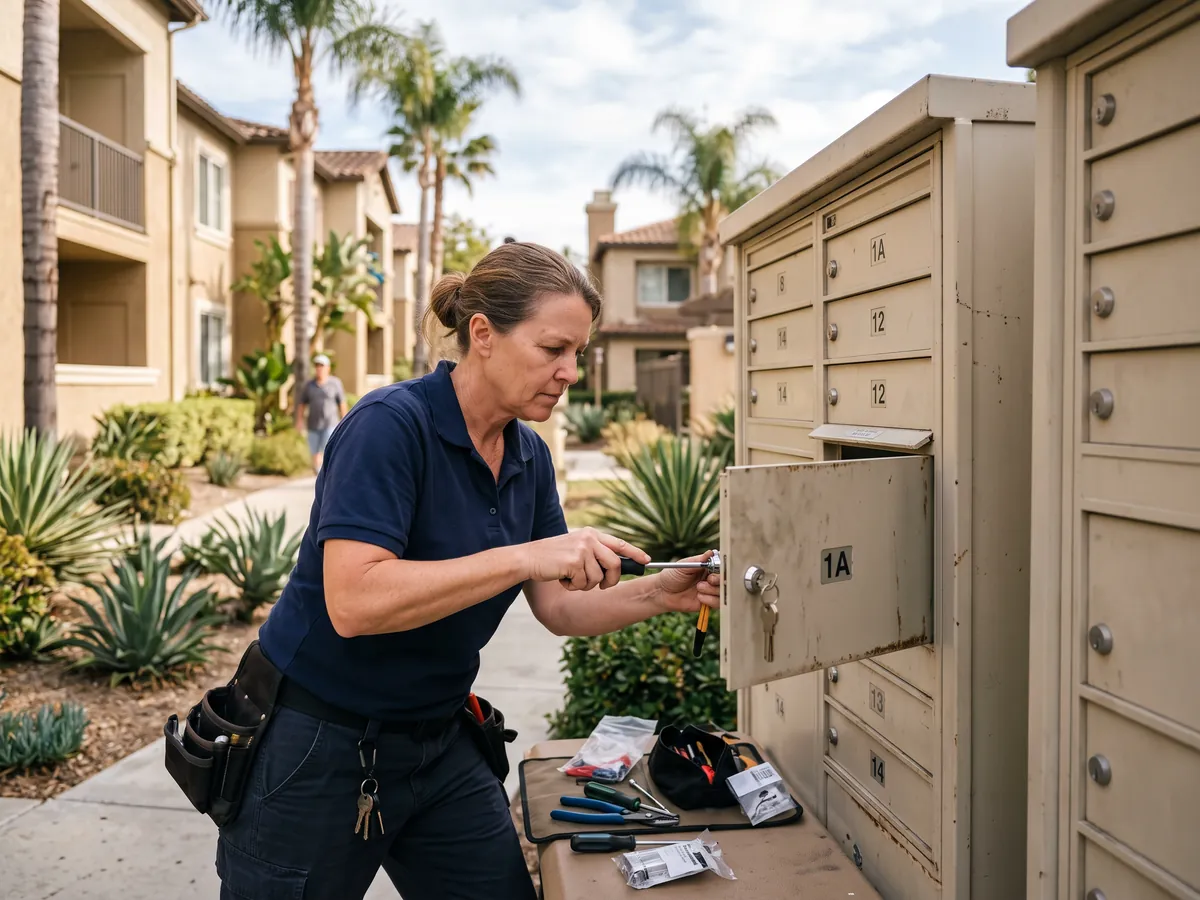
The first question about a mailbox lock in Home Gardens isn't technical. It's who owns the box. A cluster unit at the end of your street may belong to the Postal Service, to your homeowners association, or to a builder who never handed it over cleanly. Ownership decides who may change the lock, who pays, and whether a locksmith is permitted to open it at all. We'll help you sort that out on the phone. When the box is privately owned, or the owner authorizes the work, Julian's Locksmith replaces the compartment lock and cuts new keys on-site. When it's postal property, we'll say so and point you to the right counter at the post office.
Mailboxes and gates are the first and last lines of a property, and in Home Gardens both take a beating from sun and wind. Most houses here use a curbside or wall-mounted box that carries no lock at all, though some residents add locking boxes after a mail-theft scare. Small buildings and a few tracts may have cluster units, and who owns them decides who fixes them. The rule of thumb is simple. A cluster box unit installed and controlled by the US Postal Service is handled through the local post office, while an apartment or privately owned box is the responsibility of its owner or HOA. If you aren't sure whose box it is, ask the post office before calling anyone, since the carrier's arrow lock belongs to the Postal Service and we don't touch it. Gates are a different story. Side-yard gates, driveway gates and shared-drive gates on streets such as Estelle Street suffer from rust, sag and warped frames. A latch in direct afternoon sun can swell and bind, then loosen by winter. We repair, replace and rekey gate locks and private mailbox locks, and we recommend materials that survive heat and wind: stainless steel latches, powder-coated locks and weather-sealed keypads.
How this works in Home Gardens
Here's how a mailbox or gate lock call with Julian's Locksmith usually goes in Home Gardens. You call (951) 903-3193 and describe the box or gate, the lock, and what's wrong. We ask who owns it, because that decides whether we can legally touch a mailbox lock and whose approval we need on common-area hardware. On-site, we verify residency or authorization, identify the exact hardware, and look for the underlying cause, such as a sagging hinge, a leaning post or a sun-damaged part. You get a price before work begins, with options where they matter. Then we do the job, test it repeatedly, and hand over keys and any key codes. We're also candid about limits. We don't service postal master locks or parcel lockers, we don't repair gate operator motors or circuit boards, and if an iron gate needs new welding, we'll say so and coordinate with a fabricator or suggest bolt-on hardware. Our hours are 6:30 a.m. to 11:30 p.m., seven days a week.
Work included on a typical visit
- Mailbox cam lock replacement. New tenant, new owner, or no idea who has copies? Swapping the compartment lock is the cleanest way to cut off every old key. We carry common mailbox lock sizes from the major cluster and apartment box makers, confirm you're entitled to the box, and leave you with new keys stamped with a code for future copies.
- Lost mailbox key: opening the compartment. Pry bars ruin mailbox doors, and replacement doors for cluster units are often harder to source than the lock itself. Picking is our first approach, since most compartment cylinders are simple wafer or short pin designs. When drilling is unavoidable, we drill only through the lock face, which keeps the door and the surrounding frame reusable.
- Locking mailbox installation for homes. Before buying a locking mailbox, confirm it's approved for curbside or wall delivery and that its slot accepts the mail you actually get, including padded envelopes and small parcels. We can advise on steel gauge, anchoring and lock quality, then mount it so that a pry bar can't simply lift the whole box off the post.
- Lock boxes and deadbolts on iron gates. Open pickets let anyone reach through and turn a thumbturn. On iron gates we either fit a double-cylinder lock where that's permitted, or add a perforated reach-through shield around the lock so the inside turn stays usable but hard to reach. Gates on a required exit path need egress hardware instead, and we'll explain why.
- Pedestrian gate access hardware. When a pool or courtyard gate at an HOA or apartment complex won't latch, the cause is often a closer too weak to overcome the strike, or a strike set so tight it binds on hot afternoons. We adjust or replace closers and strikes so the gate shuts reliably and the access system registers it as secure.
What's different about Home Gardens
Summer heat in Home Gardens is hard on mailbox and gate hardware. Electronic keypads drain batteries fast, plastic latch parts go brittle in direct sun, and dark metal gates get hot enough to make tight hardware bind. We recommend mechanical keypads or lithium-powered electronic ones, metal latches over plastic, and slightly relaxed strike fit so gates still latch reliably on afternoons when temperatures peak.
Older neighborhoods in Home Gardens tend to have the widest variety of mailboxes: original wall-mounted slots, through-door chutes, aging cluster units the Postal Service may own, and curbside boxes on rotting posts. Gates are often decades-old wood with tired hinges, or iron with lock boxes rusted inside. We match vintage hardware where possible and reinforce what's sound instead of tearing everything out.
Family homes in Home Gardens rely on gates to keep kids and dogs in the yard and the pool out of reach. Most problems come from sagging wood gates, gravity latches that don't catch, and pull strings anyone can tug from outside. We fix the sag, fit keyed or high-mounted latches, and add self-closing hinges so a gate left open by a busy household shuts itself.
Example situations
Say a homeowner on Brotherton Street calls about two things in one visit. The small locking mailbox by the street has a key that no longer turns, and the side gate latch has rusted shut. We replace the mailbox's cam lock and cut keys, drill out the old gate latch and fit a stainless latch with a lockable thumb piece. Both can be keyed alike if she chooses, which leaves one fewer key on her ring.
- For example, a homeowner near Cresta Verde Park finds the door of a locking curbside mailbox bent back and the cam lock twisted out of its hole. Because the box is private, we can act right away: remove what's left of the old lock, install a new one with a heavier cam, and recommend anchoring the post on a surface plate or in concrete so the whole box can't be wrenched loose next time.
- Imagine a stucco home in Home Gardens with a decorative iron front gate and a thumbturn deadbolt in a lock box. Anyone standing on the walkway can slide an arm between the pickets and open it. We'd fit a perforated steel shield around the lock area, or a double-cylinder deadbolt if the gate isn't part of an exit path, so it still opens easily from inside but not by reaching through.
- Imagine a short-term rental host in Home Gardens who wants cleaners and guests to use the side gate without anyone handling physical keys. We'd install an outdoor-rated keypad gate lock with several user codes, add a self-closing hinge so the gate never sits open between stays, and show the host how to retire the old guest code and issue a new one at every checkout.
From your call to the finished job
- Call and describe the box or gate. The most useful calls start with specifics: any brand name stamped on the lock face or mailbox door, how many locks need work, and whether you still have a working key. If someone else owns the box or the gate, such as an HOA or landlord, have their contact details handy so approval doesn't hold things up.
- Confirm ownership and authorization. Before we open or change a mailbox lock, we confirm you live at that address or own the box: ID showing the address, a current lease, or written approval from the manager or HOA. Mail is federally protected, and that check protects you as much as anyone else on the route.
- Inspect the hardware and its conditions. We look for what caused the failure, not just what failed. A latch that won't catch may be sitting on a sagging gate; a mailbox lock that sticks may work fine once packed grit is cleared. Diagnosing first prevents installing new hardware on top of a problem it can't fix.
- Quote the options before starting. We explain the trade-offs in plain language. A bargain latch may last one season in full sun; a stainless one can last for years. A keypad saves handing out keys but needs someone to manage codes. You choose, and the price you approved is the price you pay.
- Do the work on-site. Outdoors we use stainless fasteners, through-bolt where screws would strip, and seal drilled holes in metal so rust doesn't start there. On vinyl gates we add internal reinforcement before mounting any lock, because screws alone eventually pull out of hollow vinyl rails.
- Test, hand over keys, keep records. For associations and landlords, we provide a written record of which locks went on which units and which key codes they use. That record speeds up the next turnover and settles questions later about who should be holding which key.
How we quote the job
- Mailbox lock type and parts. Standard compartment cam locks are common and relatively inexpensive to replace. Brand-specific or discontinued locks, unusual cam shapes, and high-security upgrades cost more. Knowing the mailbox brand and whether the lock body is short or long before we arrive keeps the quote accurate and avoids a second trip for parts.
- Key in hand or opening required. Gates follow the same logic. A padlock with a lost key may be picked or shimmed, saving the hasp and chain; a rusted solid one gets cut. A seized deadbolt inside an iron lock box may require opening the box itself. Each path carries a different amount of labor, and we price it accordingly.
- How many locks and gates. Buildings with heavy turnover often keep spare compartment locks on hand. When we stock your building's specific lock type, each move-out becomes a fast swap instead of a parts hunt, which keeps both the bill and the new resident's wait short.
Every job gets a clear quote before any work starts. Call (951) 903-3193 with the details and we'll tell you what to expect for your situation in Home Gardens.
What to do before we arrive
- Change gate keypad codes whenever a contractor, employee or tenant stops needing access, and never use 1234, a birth year, or your street number. Write the new code somewhere private, not on the inside of the gate. A code that every past visitor knows works about as well as an unlocked gate.
- If your gate keypad runs on AA batteries and the manufacturer allows lithium, use lithium. They hold up far better in inland summer heat and don't leak the way alkaline cells can. Swap them in late spring rather than waiting for the low-battery beep in the middle of a heat wave.
- Look closely at your mailbox key and the face of the lock. Many carry a short stamped code. Write it down along with the box brand and keep that note somewhere other than your keyring. When a key is lost or the lock wears out, that code lets a locksmith cut a replacement or match the lock without guesswork.
- Before the fall wind season, walk your gates. Tighten hinge and latch screws, check that the gate swings freely without dragging, and add a gate stop if wind can blow it past its latch. A gate that slams repeatedly loosens its own hardware, and a loose latch is the one that fails during a storm.
Common errors that cost time and money
- Propping open a pool gate, tying back its self-closing hinge, or loosening the hinge spring because the gate closes too hard. Each of those defeats the main safety feature of the enclosure. If the gate slams, the fix is tension adjustment or a hydraulic closer, not disabling the mechanism that keeps the gate shut.
- Spraying household oil into an outdoor lock that's getting stiff. In dusty inland areas it works briefly, then binds with grit into a paste that seizes pins and wafers. By the time someone calls, the cylinder often needs replacing instead of a simple cleaning. Dry graphite or PTFE lubricant avoids the problem.
- Calling a locksmith to change a lock on a Postal Service-owned cluster box, or worse, asking anyone to work on the carrier's master lock. Postal locks are federal property, and no legitimate locksmith will touch them. Check ownership first, and if the unit belongs to the Postal Service, start at the post office counter.
Reaching Home Gardens
Home Gardens is about 31 miles from our San Bernardino base, roughly 39 minutes in light traffic via I-215 South from San Bernardino through Colton and Riverside. When you call, you get an arrival estimate based on where the technician is and the traffic at that moment.
Our path into Home Gardens depends on where the previous job wrapped up. Sometimes that's a straight run via Harvill Lane; other times it's surface streets the whole way. Either way, you get a heads-up call when the technician is close.
About Home Gardens: The Riverside County Library System runs the Home Gardens Library at 3785 South Neece Street, and the YMCA has programs at both the library and the neighborhood school.
| Neighborhoods | Brotherton, Magnolia Avenue corridor, Estelle Street, Indiana Avenue and Harvill Lane, Avenida, Park Lane Mobile Home Estate |
|---|---|
| ZIP codes | 92879 |
| Main routes | SR-91, Magnolia Avenue, North McKinley Street, Indiana Avenue |
| From our San Bernardino base | about 31 miles via I-215 South from San Bernardino through Colton and Riverside, then SR-91 West (Riverside Freeway) about 13 miles to the North McKinley Street exit in Corona; south on North McKinley Street to Magnolia Avenue, the main street through Home Gardens. Neece Street and Tolton Avenue are southwest along Magnolia Avenue, and Indiana Avenue and Harvill Lane are to the east. |
Mailbox or gate lock in Home Gardens?
Call (951) 903-3193 and tell us whether it's a private mailbox, a cluster box unit or a gate. We'll tell you whether the job is ours or the Postal Service's, and quote our part before any work starts.
Frequently asked questions
How much do mailbox and gate locks cost?
It depends on the hardware and the job. A mailbox lock swap with a working key is simpler than opening a box with no key. Gate costs vary with the gate material, the lock you choose, and whether hinges or posts need work first. We quote before starting, and we explain the options so you can choose what fits.
Do you work with HOAs and property managers on mailbox and gate locks?
Yes. We take work orders, batch several lost-key or turnover calls into one visit, quote multi-unit jobs up front, and keep records of which lock and key code went to which unit. For pedestrian gates with access control, we handle the mechanical hardware and coordinate with your low-voltage vendor on wiring and controllers.
Can you open the parcel locker or the master door on our mailbox?
No. The carrier's master lock and the parcel locker locks on cluster units are controlled by the Postal Service, and only postal staff service them. If a parcel locker is jammed or a package is stuck, contact your local post office. We work only on the customer compartment locks of units that aren't postal property.
Can a locksmith change my mailbox lock in Home Gardens?
Yes, as long as the mailbox isn't Postal Service property and you have the right to authorize the work. Private curbside and wall boxes are yours. Cluster units and apartment mailboxes owned by an HOA or landlord need their approval. If the Postal Service owns the unit, the lock change has to be requested at your local post office.
How do I stop someone reaching through my iron gate to open it?
Add a reach-through shield: a perforated or solid steel plate around the lock area that keeps an arm from reaching the inside handle or thumbturn. Another option is a double-cylinder lock, but only on gates that aren't required exit paths. Exit-path gates need hardware that opens freely from inside, so a shield is the usual answer there.
Can you key my gate lock to my house key?
Often, yes. Many keyed gate latches and lock-box deadbolts use standard cylinders that can be pinned to a Kwikset or Schlage house key. Padlocks are trickier; some brands can be rekeyed, others are sold keyed alike in sets. We'll tell you what's possible with your gate before you buy hardware so you don't end up with yet another key.
How far is Home Gardens from your base?
Home Gardens is about 31 miles from our San Bernardino base, roughly 39 minutes in light traffic. Arrival time depends on traffic and on the job the technician is finishing, so we give you an estimate on the phone before you commit.
Related services in Home Gardens
- Mailbox Lock Replacement in Home Gardens
- Gate Lock Repair in Home Gardens
- Cluster Mailbox Lock in Home Gardens
- Lost Mailbox Key in Home Gardens
- Keypad Gate Lock in Home Gardens
- Weather-Resistant Gate Lock in Home Gardens
- Locksmith for Gated Property in Home Gardens
- Gate Latch Repair in Home Gardens
- Community Mailbox Lock in Home Gardens
- Mailbox Key Duplication in Home Gardens
Mailbox & Gate Locks in nearby cities
- Mailbox & Gate Locks in El CerritoRiverside County
- Mailbox & Gate Locks in CoronaRiverside County
- Mailbox & Gate Locks in NorcoRiverside County
- Mailbox & Gate Locks in EastvaleRiverside County
- Mailbox & Gate Locks in PedleyRiverside County
- Mailbox & Gate Locks in Mira LomaRiverside County
- Mailbox & Gate Locks in RiversideRiverside County
- Mailbox & Gate Locks in Jurupa ValleyRiverside County

