
Corona, Riverside County
Mailbox and Gate Locks in Corona
Short answer: Julian's Locksmith handles mailbox and gate locks across Corona: we replace cam locks on private and association-owned mailboxes, open compartments when the key is lost, and install, repair or upgrade gate latches, keyed gate locks, keypads and padlocks. Locks on Postal Service-owned cluster units go through your post office instead. Call (951) 903-3193; we verify residency or ownership and quote before starting.
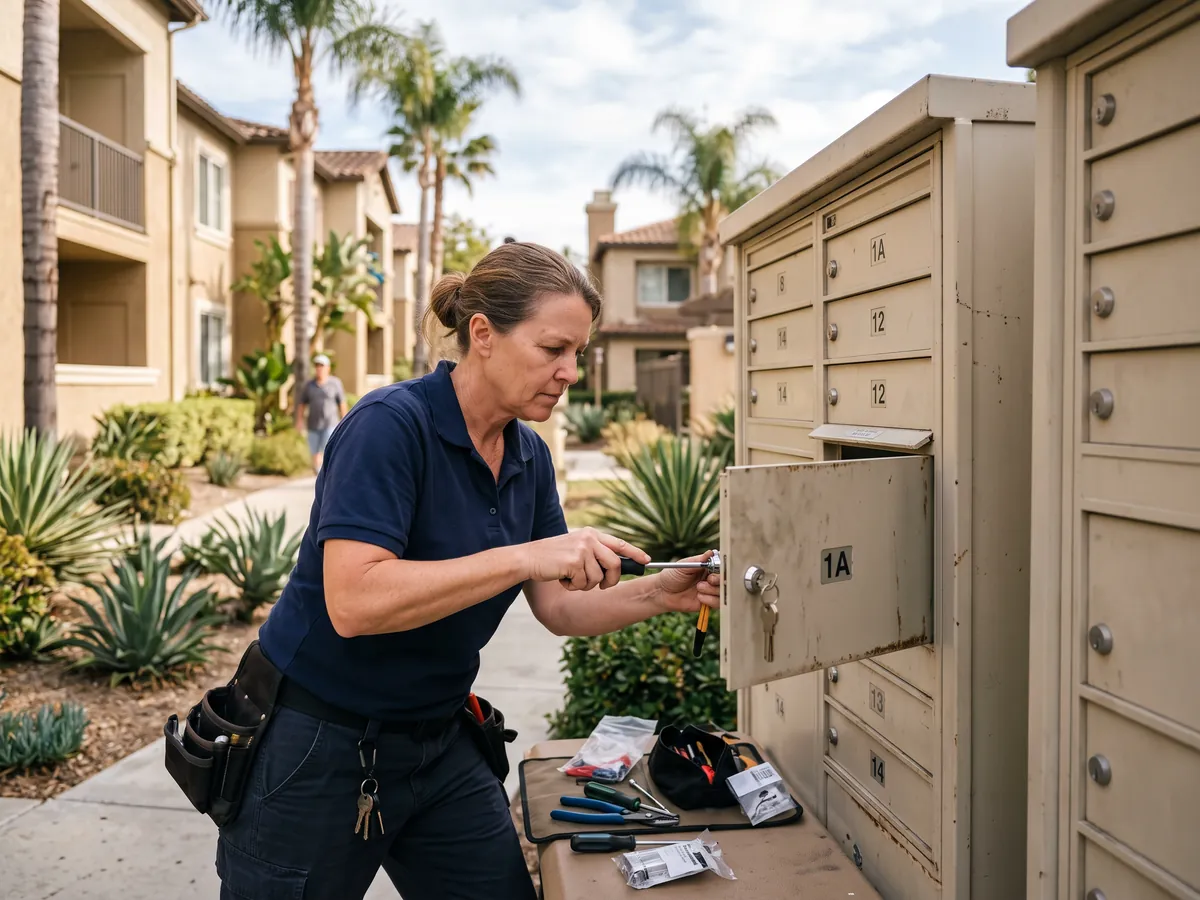
For HOA boards and property managers in Corona, mailbox and gate locks show up as a steady trickle of small work orders: a resident lost a compartment key, the pool gate quit latching, a pedestrian gate keypad needs new codes after a staff change. Julian's Locksmith handles those calls on-site and documents them, so you know which units got new locks and which keys went to whom. We confirm authority before touching common-area hardware, quote each job up front, and tell you plainly when a task belongs to the Postal Service, a gate-operator company or a low-voltage contractor instead of a locksmith. Call (951) 903-3193 to set up a visit.
Mailbox and gate locks look like small jobs until you run into the question of who is responsible. In many newer Corona tracts, mail goes to cluster box units, the grouped boxes the carrier opens with a postal key. Whether a damaged tenant compartment is the Postal Service's job, the HOA's or yours depends on the unit and how it was installed, so the first call is to your local post office or property manager. A private wall-mounted or curbside mailbox at an older home belongs to you, and we can change its lock. Gates are more straightforward. Side yard gates, driveway gates and pedestrian gates in HOA communities face weather every day. Santa Ana winds slam them, afternoon sun fades latches and sprinklers rust hardware, and a gate that stops latching leaves the backyard open. We adjust and replace latches, add keyed or keypad locks and match HOA rules for color and style. Pool gates need self-closing, self-latching hardware, which we check and adjust.
Mailbox & Gate Locks in Corona: what to expect
Outdoor locks in Corona fail for reasons indoor locks never see, and the right hardware choice starts with those reasons. Ultraviolet light breaks down plastic latch parts and keypad housings until they crack. Summer heat drains keypad batteries, makes alkaline cells leak, and can bind a tightly fitted steel gate in the late afternoon. Fine dust from windy weeks packs into keyways, especially where someone sprayed oil that turned to paste. Sprinkler overspray and the occasional winter storm rust laminated padlocks, zinc die-cast latches and the inside of iron lock boxes. Wind slams gates, loosens hinge screws and bounces cheap latches out of their catches. Better choices exist for every one of those problems: stainless or solid-brass bodies, stainless fasteners, mechanical keypads or lithium-powered electronic ones, keyway covers on padlocks, drain holes in lock boxes, self-closing hinges with real tension, and dry lubricant in place of oil. Mailbox cam locks face the same sun and grit, which is why daily-use compartment locks wear out faster than most people expect.
How we can help in Corona
- Mailbox cam lock replacement. Most compartment locks are inexpensive cam locks: a small cylinder, a retaining nut or clip, and a flat or offset cam that swings behind the frame. We match body length, cam shape and turn direction to your box, install the new lock, and hand you fresh keys. On boxes you or your association own in Corona, it's usually a short visit.
- Lost mailbox key: opening the compartment. Pry bars ruin mailbox doors, and replacement doors for cluster units are often harder to source than the lock itself. Picking is our first approach, since most compartment cylinders are simple wafer or short pin designs. When drilling is unavoidable, we drill only through the lock face, which keeps the door and the surrounding frame reusable.
- Cluster box and apartment mailbox locks. Parcel lockers on cluster units use captive-key locks: the carrier leaves a key in your compartment, you open the locker, and the key stays trapped until the carrier retrieves it. If one jams or the key goes missing, the fix depends on who owns the unit. We'll tell you which route applies rather than forcing anything.
- Weather-resistant padlocks and chain. Lost the padlock key, or the lock has seized? Older padlocks can often be picked or shimmed open, which saves the hasp and chain. If one has to be cut, we cut only the lock body, then fit a replacement keyed to your existing padlocks so you're not adding yet another key to the ring.
- Self-closing hinges and pool gate latches. Selling a home with a pool in Corona? Home inspectors often flag gates that won't self-close or self-latch. We can put those gates back in working order quickly, and if the real issue is the fence, a gap or the enclosure layout rather than hardware, we'll tell you plainly instead of swapping parts that can't fix it.
Local factors in Corona
Older neighborhoods in Corona tend to have the widest variety of mailboxes: original wall-mounted slots, through-door chutes, aging cluster units the Postal Service may own, and curbside boxes on rotting posts. Gates are often decades-old wood with tired hinges, or iron with lock boxes rusted inside. We match vintage hardware where possible and reinforce what's sound instead of tearing everything out.
In gated HOA neighborhoods in Corona, mailbox and gate locks are usually common-area property, so the association's board or management company has to approve the work. We take work orders, batch lost-key calls into a single visit, and keep a record of which cluster unit locks and key codes went to which addresses. Pedestrian gates with keypads or electric strikes get the mechanical side handled by us, with any controller or wiring issues coordinated with the association's low-voltage vendor.
Family homes in Corona rely on gates to keep kids and dogs in the yard and the pool out of reach. Most problems come from sagging wood gates, gravity latches that don't catch, and pull strings anyone can tug from outside. We fix the sag, fit keyed or high-mounted latches, and add self-closing hinges so a gate left open by a busy household shuts itself.
Example situations
A homeowners association board in a Green River community has three problems at once: a cluster mailbox with a broken door, a pedestrian gate by the clubhouse whose latch no longer catches and a side gate that blows open in the wind. We would meet the board president, sort out which items belong to the Postal Service and which to the HOA, repair the gate latches and leave the board a short list of mailbox steps that start with a call to the post office.
- A typical call: a renter moves into a Corona apartment and learns the previous tenant never returned the mailbox key. The manager approves a lock change by email. We'd meet the new resident at the mailroom, check the approval against their lease, pick the compartment lock, install a new cam lock of the same size, and hand over keys along with a code the office can log for next time.
- A typical rural call: a horse property on the edge of Corona has a pipe gate held by a chain and a padlock rusted solid after years of sprinkler overspray. We'd cut only the lock, keep the chain if it's still sound, and fit a brass or stainless shrouded padlock keyed alike with the barn and tack room locks, so one key handles every gate and door on the property.
- Picture a pedestrian gate at a small condo complex in Corona where the electronic keypad goes dark every August. The batteries are cooking inside a black housing that faces west. We'd replace it with a mechanical pushbutton lock, or move an electronic unit to a shaded mount running lithium cells, then set new codes and walk the manager through changing them whenever a resident moves out.
How the visit works
- Call and describe the box or gate. The most useful calls start with specifics: any brand name stamped on the lock face or mailbox door, how many locks need work, and whether you still have a working key. If someone else owns the box or the gate, such as an HOA or landlord, have their contact details handy so approval doesn't hold things up.
- Confirm ownership and authorization. If ownership is unclear, which happens with older cluster units, we pause and help you find out rather than guess. A call to the local post office or the association's management company usually settles it, and nobody pays for work that turns out not to be allowed.
- Inspect the hardware and its conditions. At the box or gate we identify the exact hardware: lock brand, cam length and rotation on a mailbox; gate material, frame thickness, backset and hinge condition on a gate. We also note sun exposure, sprinklers and drainage, since those decide which replacement will last.
- Quote the options before starting. We explain the trade-offs in plain language. A bargain latch may last one season in full sun; a stainless one can last for years. A keypad saves handing out keys but needs someone to manage codes. You choose, and the price you approved is the price you pay.
- Do the work on-site. Where welding or a new post is needed, we say so before starting and either coordinate with your fabricator or recommend bolt-on hardware that avoids it. Motorized gate operators stay with the gate technician; we handle the locks, latches, keypads, strikes and hinges.
- Test, hand over keys, keep records. Before leaving, we show you how the new hardware works: changing a keypad code, adjusting hinge tension, where to put a little dry lubricant. Most outdoor lock trouble starts with neglect, and a minute of upkeep a few times a year heads off most of it.
Pricing factors
- Key in hand or opening required. Picking a simple wafer lock is quick; a pin-tumbler upgrade, a damaged cylinder or a lock packed with debris may need drilling. Drilling destroys the old lock, so a replacement becomes part of the job automatically. Either way, we explain which approach we plan to use before we start.
- Gate material and mounting prep. Wood gates are the simplest to fit with new latches. Vinyl needs internal reinforcement before a lock can be mounted. Iron gates need lock boxes and careful strike placement, sometimes welding. Aluminum pool fencing needs hardware sized for its thin tubes. The gate itself drives much of the labor on any gate lock job.
- Hardware grade and weather rating. Bargain latches and padlocks are cheap for a reason and tend to fail fast in full sun and sprinkler spray. Stainless or marine-grade hardware, mechanical keypads, and brass or stainless padlocks cost more up front but last much longer outdoors. We'll quote both levels so you can weigh the difference.
Every job gets a clear quote before any work starts. Call (951) 903-3193 with the details and we'll tell you what to expect for your situation in Corona.
Common errors that cost time and money
- Calling a locksmith to change a lock on a Postal Service-owned cluster box, or worse, asking anyone to work on the carrier's master lock. Postal locks are federal property, and no legitimate locksmith will touch them. Check ownership first, and if the unit belongs to the Postal Service, start at the post office counter.
- Spraying household oil into an outdoor lock that's getting stiff. In dusty inland areas it works briefly, then binds with grit into a paste that seizes pins and wafers. By the time someone calls, the cylinder often needs replacing instead of a simple cleaning. Dry graphite or PTFE lubricant avoids the problem.
- Keeping the same gate code for years and writing it on the gate post for convenience. Every former gardener, pool tech and guest still knows it. Codes should change when people stop needing access, and they belong in a phone note or a property manager's file, not in permanent marker on the hardware.
Practical tips before you call
- Outdoor locks in Corona should get dry lubricant, never oil. Graphite or a PTFE-based lock spray keeps pins moving without collecting the fine dust that blows in on windy days. General-purpose penetrating oil feels like it helps for a week, then turns into a gummy paste that jams wafers and pins.
- Ask for your gate padlocks and keyed latches to be keyed alike. One key for the side gate, the back gate and the trash enclosure means fewer keys on the ring and less temptation to leave a gate unlocked because the right key is buried in a kitchen drawer somewhere.
- Find out who owns your cluster mailbox before anything goes wrong. Ask your HOA management company, or ask at the post office counter that serves your ZIP code. Knowing whether it's postal property or association property saves you a wasted call and a delay the day your key snaps or disappears.
- On vinyl gates, ask about reinforcement before adding any lock or latch. Hollow vinyl rails won't hold screws under daily use; an aluminum or wood insert inside the rail gives fasteners something solid to bite into. Skipping it means the latch works loose within months, usually right when you need the gate closed.
Reaching Corona
Corona is about 36 miles from our San Bernardino base, roughly 40 minutes in light traffic via I-215 South through Colton and Riverside to SR-91 West, exiting at Main Street or Lincoln Avenue for central Corona. When you call, you get an arrival estimate based on where the technician is and the traffic at that moment.
Commercial jobs on busy stretches like SR-91 sometimes need a parking plan, especially for storefront doors or roll-up gates. Let us know about loading zones, red curbs or parking structures before we arrive.
About Corona: Tin was discovered in nearby Temescal Canyon in 1857, and President Benjamin Harrison stopped in South Riverside in 1891 to see tin bars from the mine.
| Neighborhoods | Sierra del Oro, Green River, Sierra Bella, Cresta Verde, Auburndale, Grand Boulevard Historic District |
|---|---|
| ZIP codes | 92879, 92880, 92881, 92882, 92883 |
| Main routes | SR-91, I-15, SR-71, Main Street |
| From our San Bernardino base | about 36 miles via I-215 South through Colton and Riverside to SR-91 West, exiting at Main Street or Lincoln Avenue for central Corona; SR-91 West to I-15 South for Dos Lagos, Eagle Glen and The Crossings; I-10 West to I-15 South as the alternate into north Corona |
Mailbox or gate lock in Corona?
Call (951) 903-3193 and tell us whether it's a private mailbox, a cluster box unit or a gate. We'll tell you whether the job is ours or the Postal Service's, and quote our part before any work starts.
Frequently asked questions
When can you come out for a mailbox or gate lock in Corona?
We work every day from 6:30 a.m. to 11:30 p.m., weekends included. We're closed between 11:30 p.m. and 6:30 a.m. Most mailbox and gate work is scheduled, but a gate that won't close with a pool or pets involved gets priority. Call (951) 903-3193 and we'll give you an honest ETA.
Will you have to drill my mailbox lock if the key is lost?
Not always. Many compartment locks are simple wafer or short pin cylinders that can be picked open without damage. Drilling is the backup when the lock is a higher-security type, badly worn, or packed with debris. Either way, the old lock gets replaced and you receive new keys, so nobody holding the lost one can use it.
How do I stop someone reaching through my iron gate to open it?
Add a reach-through shield: a perforated or solid steel plate around the lock area that keeps an arm from reaching the inside handle or thumbturn. Another option is a double-cylinder lock, but only on gates that aren't required exit paths. Exit-path gates need hardware that opens freely from inside, so a shield is the usual answer there.
Do you work on automatic driveway gates in Corona?
We handle the lock side: manual release locks, padlocks, keypads on pedestrian gates beside the driveway, and strikes or latches on the gate leaf. The operator motor, circuit board, safety sensors and wiring belong with a gate operator company, since those systems follow their own safety standards. We're happy to coordinate so the locks and the operator work together.
Can you copy my mailbox key?
Usually, yes. Compartment keys on private, HOA and apartment mailboxes aren't postal keys, so copying them isn't restricted by federal law. Some are stamped Do Not Duplicate, and on association or rental property we may ask for the owner's okay. The one key nobody may copy is the postal master key that opens the carrier's panel.
How much do mailbox and gate locks cost?
It depends on the hardware and the job. A mailbox lock swap with a working key is simpler than opening a box with no key. Gate costs vary with the gate material, the lock you choose, and whether hinges or posts need work first. We quote before starting, and we explain the options so you can choose what fits.
How far is Corona from your base?
Corona is about 36 miles from our San Bernardino base, roughly 40 minutes in light traffic. Arrival time depends on traffic and on the job the technician is finishing, so we give you an estimate on the phone before you commit.
Related services in Corona
- Mailbox Lock Replacement in Corona
- Gate Lock Repair in Corona
- Cluster Mailbox Lock in Corona
- Lost Mailbox Key in Corona
- Keypad Gate Lock in Corona
- Weather-Resistant Gate Lock in Corona
- Locksmith for Gated Property in Corona
- Gate Latch Repair in Corona
- Community Mailbox Lock in Corona
- Mailbox Key Duplication in Corona
Mailbox & Gate Locks in nearby cities
- Mailbox & Gate Locks in Home GardensRiverside County
- Mailbox & Gate Locks in El CerritoRiverside County
- Mailbox & Gate Locks in NorcoRiverside County
- Mailbox & Gate Locks in EastvaleRiverside County
- Mailbox & Gate Locks in Mira LomaRiverside County
- Mailbox & Gate Locks in PedleyRiverside County
- Mailbox & Gate Locks in Jurupa ValleyRiverside County
- Mailbox & Gate Locks in Glen AvonRiverside County

