
Emergency Locksmith
Mobile Locksmith Service: A Fully Equipped Shop That Drives to You
Short answer: A mobile locksmith brings the workshop to you: a van with key-cutting machines, car key programmers, blanks and lock hardware, so keys get cut, cars get programmed and locks get rekeyed or replaced on site, then tested in place. Julian's Locksmith, license LCO7891, runs that service across the Inland Empire, San Gabriel Valley, Pomona Valley, north Orange County and southeast Los Angeles County. Call (951) 903-3193 for a quote.
What a mobile locksmith actually is
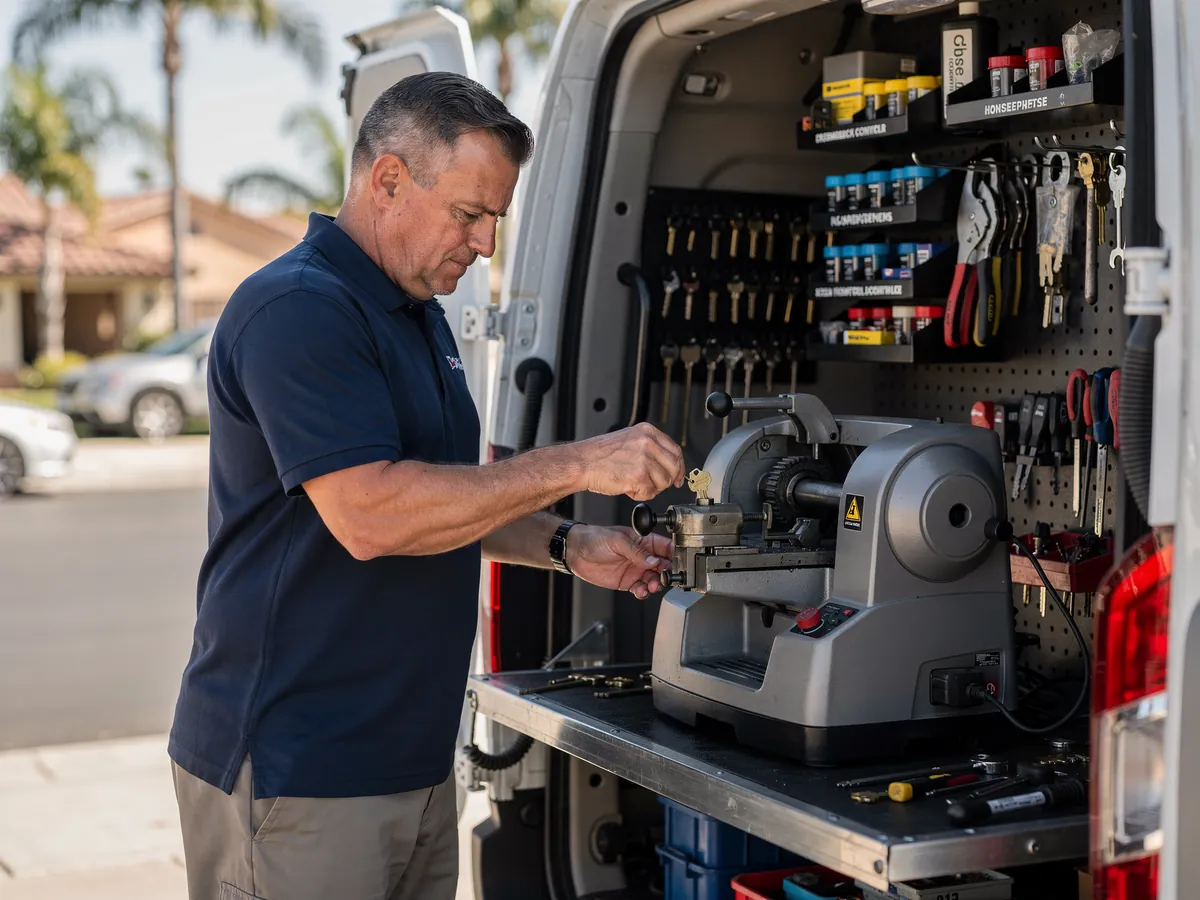
A mobile locksmith is a locksmith company whose shop is a vehicle. There's no counter to walk up to and no wall of padlocks on display. The cutting machines, programming tools, parts inventory and workbench ride in a service van that parks at your house, your business, or wherever your car happens to be stranded.
The idea isn't new, but the equipment has changed enormously. A locksmith's truck a generation ago might have held picks, a duplicator and some boxes of blanks. A van built for current work has to handle transponder chips, proximity fobs, side-milled car blades, smart deadbolts and commercial cylinders. That takes computerized key machines, diagnostic programmers and a parts system organized as carefully as any storefront's back room.
Putting the shop on wheels doesn't change the legal requirements. In California, anyone who opens, rekeys, installs or repairs locks for the public, or programs transponder keys, works under the Locksmith Act and needs a company license from the Bureau of Security and Investigative Services. Julian's Locksmith holds license LCO7891. A hardware store clerk who copies a house key from an existing key doesn't need that license. A technician who rekeys your front door or programs your car key does.
It also helps to separate a real mobile locksmith from a dispatch operation. Some phone numbers that advertise mobile service are call centers that pass jobs to whoever is closest, often without the right parts and sometimes without a license. A genuine mobile locksmith answers with a company name, owns the van and what's in it, and can tell you on the phone whether it carries what your lock or car needs.
Inside the van: bench, machines and power
Slide open the side door of a well-built locksmith van and you'll usually find a workbench running along one wall at standing height, with a vise, bright task lighting and a parts tray. That bench is where cylinders get taken apart and re-pinned, broken key fragments get fished out of plugs, and immobilizer modules get read when a car's data has to be pulled directly. Having it in the van means none of that fiddly work happens on your porch steps or the hood of your car.
The key machines are bolted down so nothing shifts on the road:
- A computerized code machine. Enter a key code or a set of decoded cut depths, clamp the blank, and it mills the key to the manufacturer's spacing and depth specifications. It handles edge-cut house keys, edge-cut car keys and the side-milled high-security blades found on many newer vehicles.
- A manual duplicator. For a sound original in a common keyway, a tracer copy is quick and accurate.
- Measuring tools. A key gauge or caliper reads each cut on an existing key, which shows whether it has worn and what the original depths probably were.
Programming gear travels in padded cases: handheld programmers that talk to the car through the OBD-II port, cloning tools for copying transponder chip data, adapters for reading certain modules on the bench, and a battery maintainer that keeps the car's voltage steady during programming.
All of it needs electricity, and a locksmith can't count on borrowing an outlet. Our van runs its machines from its own auxiliary battery and inverter, and the drills are cordless. That lets us cut keys in a dark parking lot, at a new house before utilities are connected, or at the far end of a ranch driveway.
Key blanks: the inventory that decides one visit or two
A locksmith can only cut what it carries, and keys are the hardest inventory to manage because there are thousands of keyways. A keyway is the profile of the slot in the lock, and a blank has to match it exactly before a single cut is made. A van stocked for Southern California calls prioritizes the profiles that actually turn up.
For homes, that means five-pin and six-pin versions of the Kwikset and Schlage profiles found on most tract houses, Weiser, Yale, Arrow and other builder-grade keyways, plus padlock and cabinet blanks. Commercial drawers add Sargent, Corbin Russwin and Best-style interchangeable core keyways, along with keys for the mortise cylinders found in older office buildings.
Automotive blanks fall into three groups:
- Plain mechanical blades for older vehicles, door-only use and glove boxes.
- Transponder keys, which carry a chip the immobilizer has to recognize. Chip families vary by make and year, so a blank that fits the ignition is useless if the chip is wrong.
- Remote-head keys, flip keys and proximity fobs, which combine a chip, a transmitter and often an emergency blade.
The car drawers cover edge-cut profiles common on older Toyota, Ford and Chrysler vehicles as well as internal-track blades such as the HON66 used by Honda and Acura, the HU66 used by Volkswagen and Audi, and the HU100 found on many newer GM models.
Fobs are where planning matters most. A proximity key has to match the car's FCC ID, frequency and chip, and the variations run into the hundreds. No van holds every one, which is why we ask for the year, make and model on the phone and confirm compatibility before driving out. When an uncommon model needs a fob we don't stock, we say so and order it before scheduling, rather than arriving empty-handed.
Three ways to cut a key on site
Every key the van produces starts from one of three sources of information, and the choice affects how well the finished key works.
Cutting by code. Many locks and most vehicles have a key code, a short number that corresponds to a specific set of cut depths. Codes appear on the card packaged with new locks, stamped on some padlocks and cabinet locks, on the original key tag for certain older cars, or through a vehicle code lookup that a licensed locksmith can request once ownership is established. A key cut by code matches the factory specification, no matter how worn your current key is.
Decoding the lock. When there's no code, the lock itself holds the answer. For many car locks and some residential ones, a Lishi-style pick-decoder reads each wafer or pin position through the keyway without taking anything apart. For house locks, we can also pull the cylinder and read the pin stack directly. Either way, the depths go into the code machine, which cuts a clean key.
Duplicating an existing key. A tracer machine follows the cuts of your key and reproduces them on a new blank. That's fast and perfectly good when the original is sound. It's the wrong choice for a key that's already a tired copy, because the tracer faithfully reproduces the wear along with the cuts.
There's also a middle path. Manufacturers use a fixed set of depths for each key system, so a worn key can be measured with a gauge and each cut corrected to the nearest standard depth, then confirmed by trying the result in the lock.
Whatever the method, the new key goes into the lock it was made for before the job is called finished. That immediate trial is the quiet advantage of cutting beside the door instead of at a counter across town.
Programming car keys where the car is parked
A modern car key has two jobs. The blade, if there is one, turns the door lock or ignition. The electronics prove to the car that the key is authorized. Transponder immobilizers spread through the US market in the late 1990s and 2000s, and today an engine simply won't stay running on a key the immobilizer doesn't recognize, however perfect the blade.
Programming that recognition is the part of car key work that used to mean a trip to the dealer. A locksmith van now carries diagnostic programmers that connect through the OBD-II port under the dash. Depending on the make and model, the job takes one of several forms:
- On-board programming, where the car accepts a new key through a sequence of ignition cycles or button presses, usually only when one or two working keys are present.
- Tool-based key adding, where the programmer puts the immobilizer into learn mode, sometimes after a manufacturer security delay that can stretch past half an hour.
- PIN-based programming, which needs a security code obtained through authorized locksmith data access.
- All-keys-lost procedures, which can mean reading data from the immobilizer box, engine computer or instrument cluster on the van bench before a key can be added.
- Cloning, which copies the chip data from a working key onto a new chip, so the car's computer is never touched.
Two practical details matter at the curb. Voltage comes first: programming writes data to the car's modules, and a weak battery that dips mid-procedure can cause a failed write, so we connect a maintainer before starting. Completeness comes second: on many vehicles the programming step erases any key that isn't present, so every key you want to keep working needs to be in hand.
There are honest limits. Some late-model vehicles put diagnostic access behind a secure gateway that requires authorized credentials, and certain makes and model years, particularly some European brands and the newest releases, can only be programmed by a dealer. We'll tell you which category your car falls into before the van leaves.
The hardware shelf: locks, cylinders and small parts
Keys get most of the attention, but a big share of a mobile locksmith's van is hardware. Carrying it is what turns a diagnosis into a finished repair instead of a second appointment.
Residential stock typically includes:
- Deadbolts and knob or lever entry sets in the finishes most common on Southern California homes: satin nickel, matte black, and the dark bronze tones builders favor on Spanish and Craftsman-style elevations.
- ANSI/BHMA Grade 1 and Grade 2 deadbolts for doors that deserve an upgrade, along with handlesets for front entries.
- Keypad and smart deadbolts from lines such as Schlage Encode, Kwikset Halo and Yale Assure.
- Reinforced strike plates and long screws that reach the wall framing behind the jamb.
Commercial stock covers the doors that keep a business open:
- Mortise cylinders in several lengths, with cams to suit Schlage, Yale, Sargent, Corbin Russwin and Adams Rite-style hardware.
- Rim cylinders for exit devices such as Von Duprin and comparable panic hardware.
- Small-format interchangeable cores and the control keys that go with them.
- Cam locks for mailboxes, cabinets, lockers and display cases, plus padlocks in several sizes.
Then come the small parts that rescue a job: pinning kits for every common residential keyway, master pins, springs, plug followers, tailpieces, retaining clips, set screws and spare spindles. A missing tailpiece is a silly reason to come back tomorrow.
What no van holds: every finish of every designer line, full commercial mortise lock bodies in every function, and exit devices in every width and finish. For those, we measure on the first visit, order the exact part, and if the door can't wait, leave it secure in the meantime.
Why the work goes better at the door
The strongest argument for mobile service isn't convenience. It's that locks and keys get tested where they live.
A lock never works in isolation. A deadbolt that operates perfectly on a bench can bind in a door that has dropped a sixteenth of an inch on its hinges, or whose strike was set a little high when the house was framed. Wood doors and jambs also shrink and swell with the seasons, so a latch that caught cleanly in a dry August may rub after a rainy week in February. When we rekey or replace a lock on site, we see that behavior and correct it: driving a longer screw through the top hinge into the stud, shimming a hinge, enlarging or moving a strike, or adjusting the bolt.
Installation details get checked against the real door, too. Most residential doors use a 2-1/8 inch cross bore with a 2-3/8 or 2-3/4 inch backset, and a deadbolt should project its full throw, typically one inch, into the strike. Older doors may carry odd bores from hardware installed decades ago. Steel and fiberglass doors need different fasteners and more care than solid wood.
Car keys benefit in the same way. A blade cut at the van gets tried in the door and ignition right away, and a programmed key has to start the engine before anyone packs up. If something needs a second cut or another programming attempt, the car, the machine and the tools are all in one place.
Compare that with the storefront routine: remove the lock, carry it in, wait, carry it home, reinstall it, and only then discover whether it works in your door.
Mobile locksmith or storefront counter: an honest comparison
A storefront isn't a poor choice for everything, and a mobile locksmith isn't automatically the right call. Here's how they compare for common needs.
A key counter usually makes sense when:
- You need a plain copy of an ordinary house key, you have a good original, and you're already near the store.
- You want to browse hardware in person and install it yourself.
A mobile locksmith usually makes more sense when:
- You're locked out of a home, a business or a car. The lock can't come to the shop.
- Your car needs a key and no working original exists. Towing a car across town adds cost and often days of waiting.
- You want locks rekeyed or replaced. That work involves the door and frame, not just the cylinder.
- Your only key is worn, and copying it would copy the problem.
- You run a business that can't close, or can't leave a door unsecured while someone drives to a store.
- Getting out is genuinely hard. A parent home with small kids, a senior who no longer drives, someone recovering from surgery.
Cost is the honest wrinkle. At a counter, the travel is yours: your gas, your time, your afternoon. A mobile service call covers the drive, the van and the stocked inventory, so for a single simple key it can cost more than walking into a store. The comparison flips when the alternative involves a tow, a missed shift, a new set of locks you didn't really need, or a second trip because the first copy wouldn't turn. Bundling several jobs into one visit, such as a car spare plus a rekey, spreads the service call over more work.
What a van can't do, and what happens then
No mobile locksmith carries everything, and the ones worth calling are clear about the edges.
- Restricted and patented key systems. Medeco, Mul-T-Lock, ASSA Abloy high-security lines, Schlage Primus and similar systems control their blanks through patents and dealer agreements. Keys are cut by an authorized dealer or the factory, and only with the registered owner's signature or authorization card. That control is precisely why businesses choose them, and nobody legitimate should cut those keys in a van without it.
- Dealer-only vehicles. Certain makes and model years need manufacturer software or credentials independent locksmiths can't access. We may still open the car, cut the mechanical blade or extract a broken key, so the dealer only has to handle programming.
- Safes. Many safes open by manipulation, by an override key, or through the manufacturer's records once ownership is proven. Others need drilling at a precise point, and drilling a high-security safe takes planning, specific tools and sometimes a return visit.
- Electrified hardware and access control. Card readers, maglocks, electric strikes and REX sensors involve wiring, power supplies and life-safety rules for doors in an exit path. A licensed low-voltage contractor often handles that wiring, and we coordinate rather than improvise.
- Fire-rated doors. Labeled fire doors allow only limited field modification, and replacement hardware has to be listed for that use. We'll tell you when a door's label narrows the options.
When a job crosses one of these lines, the goal is still to leave you secure: a temporary cylinder, a rekeyed existing lock, or at minimum a door that locks properly while the right part is on order.
What to tell us so the right parts are on board
Whether a job takes one visit or two is usually decided during the phone call. These details help us load the van correctly:
- House and business locks. The brand on the lock face, a photo of the keyway and the door edge, how many locks are involved, and whether any already share a key. If you still have the code card from the original packaging, read us the number.
- Cars. The year, make and model, the VIN (visible through the windshield at the driver's side of the dash), whether it has push-button start, and how many working keys you still have.
- Commercial doors. The door type (aluminum storefront, hollow metal or wood), whether there's an exit device, and the name of the key system if your keys are stamped with one.
- Access. Gate codes, parking rules, loading zones, the level and stall number in a parking structure, and whether a full-height van will clear the entrance.
- Verification. What ID and proof of ownership or residency you'll have on hand, and whether those papers are locked inside.
With that information, we can usually tell you during the call whether the job can be finished in one trip, what range the price is likely to fall in, and when the van can realistically get there. If something sounds like it needs an order or a dealer, you'll hear that before anyone starts the engine.
Paperwork, ID checks and California rules
A van that can cut a key to any lock it decodes is a powerful tool, which is exactly why California regulates who operates one. The Locksmith Act, Business and Professions Code section 6980 and following, is administered by the Bureau of Security and Investigative Services. It requires a company license, requires employees to register with the Bureau, and requires locksmiths to keep records when they open homes, businesses or vehicles, or make keys for vehicles.
In practice, that shows up at your door or car in a few ways:
- We ask for photo ID plus something tying you to the property or vehicle: a lease, utility bill, deed, registration or title.
- You sign a work order with your name, address, contact details and ID number, and for vehicles the identifying details of the car. Those records are kept as the law requires.
- If your documents are inside the locked home or car, we open it first and check them before any key is made.
Renters have specific protections. California law requires landlords to provide working deadbolts on the main swinging entry doors of rental units, and a tenant with a protective order or qualifying police report can require the landlord to change the locks within 24 hours of a written request. Outside those situations, renters should check with the landlord before changing locks, since the lease usually governs it.
You can confirm any California locksmith company's license at search.dca.ca.gov. Julian's Locksmith's number is LCO7891. If someone won't give you a license number, or doesn't ask who you are before opening a door, that's reason enough to send them away.
Where our van works and when it runs
Julian's Locksmith operates only as a mobile service. Our base is at 2544 Rosemary Ln in San Bernardino, in the University Heights area near Cal State San Bernardino, but it isn't a walk-in shop. The van comes to you.
We cover the Inland Empire, the Pomona Valley, the San Gabriel Valley, north Orange County and southeast Los Angeles County. Interstate 215, Interstate 10 and State Route 210 put much of the Inland Empire within a fairly short drive of the base. The western Pomona Valley and San Gabriel Valley are farther out along the 10 and the 210, while north Orange County and southeast LA County are reached by the 60, the 57 and the 91. When you call, we'll tell you where the van is and give an honest arrival estimate based on distance and current traffic. Afternoon congestion on the 10 and the 60 is real, and we'd rather say so than pretend otherwise.
Hours, Pacific time:
- Sunday. 6:30 a.m. to 11:30 p.m.
- Monday through Friday. 6:30 a.m. to 11:30 p.m.
- Saturday. 6:30 a.m. to 11:30 p.m.
We aren't a 24/7 service. A call that comes in while we're closed gets returned when we open. For a car lockout outside our hours, roadside assistance through your insurer or auto club can often open the vehicle. For a home, a trusted neighbor or relative holding a spare is the best backup. If anyone's safety is at risk, such as a child or pet locked in a hot car, call 911 first.
To book a mobile visit or get a quote, call (951) 903-3193 or email info@julians-locksmith.com.
Frequently asked questions
Can I bring my lock or key to your location instead?
We don't run a walk-in counter, so there's no shop to bring it to. Julian's Locksmith is set up entirely as a mobile service, which keeps the machines, programmers and parts in the van where the work happens. That usually works out better for you anyway: a rekeyed lock can be tested in its own door, and a car key can be programmed at the car. If you've already taken a lock off, we can still work on it at your address and reinstall it properly.
Do you need an outlet or power at my home or business?
No. The van carries its own power for the key machines and programming equipment, and our drills and saws are cordless. That means we can work at a property where the power is out, a new house before utilities are hooked up, or a car in an open lot. For car key programming, we clip a battery maintainer onto the vehicle so its voltage stays steady, which protects the car's modules while data is being written.
Is a key cut in the van as good as one from the dealer?
The blade can be identical. A key cut by code on a computerized machine follows the manufacturer's depth and spacing specifications, and for many cars it's the same code a dealer would use. Differences show up in the electronics and the shell. We can supply OEM keys or quality aftermarket keys depending on the vehicle and your budget, and we'll explain any trade-off, such as a slightly different button feel or a fob type that only some models accept reliably.
Can you work in rain, wind or summer heat?
Mostly, yes. Cutting happens inside the van, and the open side door shelters the bench. Rain matters more for electronics, so we keep programmers and fobs dry and may ask to work in a garage or carport during a downpour. Santa Ana winds carry dust that can foul a key machine, so we close up between cuts. Summer heat is hardest on parts, because fob batteries and circuit boards suffer in a hot cabin, which is why electronic stock stays shaded and ventilated.
How many spare keys should I have made while you're here?
For a car, two working keys is the minimum we'd suggest, because an all-keys-lost job is more involved than adding a spare. If your car accepts more, a third key kept at home is worth considering. For a house, one key per adult plus one with someone you trust nearby usually covers it. Skip the fake rock outdoors. Because cutting extras adds little time once the van is already parked, the visit itself is the easiest moment to do it.
Can you meet me at work instead of at home?
For car keys and car lockouts, yes. We can work in an office lot, a campus parking structure or a shopping center, as long as the property allows service vehicles and the van can park reasonably close to your car. You'll still need ID and the vehicle's registration or title. For a home or business lockout, we work at the property itself, and the person signing the work order needs to be there to show residency or authority.
Can a locksmith cut a key from a photo?
A sharp photo of a key's cuts can contain enough information to decode it, which is why you should never post pictures of your keys online or leave them visible in social media shots. We won't cut a key from a photo for anyone we can't verify as the lock's owner. For your own lock, decoding the cylinder or using a key code is more reliable than a picture, so that's the route we take on site.
Do you work on RV, trailer and boat locks?
Often, yes. Many RV compartment doors share a handful of very common keys, and entry door locks, trailer coupler locks and tongue-box padlocks can usually be rekeyed or replaced on site. Some RV entry locks come from specialty suppliers, and a matching replacement may need to be ordered. Many boat cabin and console locks are simple cam locks. Ignition keys and proprietary marine hardware vary widely, so describe the make and model and send a photo before we come out.
Mobile Locksmith by city
Local details, routes and answers for mobile locksmith in each city we cover across four counties.
San Bernardino County
Riverside County
Los Angeles County
- Rosemead
- San Gabriel
- Temple City
- Arcadia
- Sierra Madre
- Monrovia
- Duarte
- Bradbury
- El Monte
- South El Monte
- Baldwin Park
- West Covina
- Covina
- Azusa
- Irwindale
- Glendora
- San Dimas
- La Verne
- Pomona
- Claremont
- Diamond Bar
- Walnut
- La Puente
- City of Industry
- Hacienda Heights
- Rowland Heights
- Avocado Heights
- Charter Oak
- Valinda
- West Puente Valley
- South San Gabriel
- East San Gabriel
- North El Monte
- Citrus
- La Habra Heights
- La Mirada
- Cerritos
- Artesia
- Hawaiian Gardens
- Lakewood
- Bellflower
- Norwalk
- Downey
- Pico Rivera
- Whittier
- Santa Fe Springs


