
Devore, San Bernardino County
Lock Rekey Service in Devore
Short answer: Choose a lock rekey when your hardware still works and the only problem is who holds keys: a move-in, a lost ring, a roommate or employee leaving. Choose replacement when a lock is damaged, worn loose or you want a stronger grade. In Devore, have a working key for each cylinder ready if you can, plus ID and proof of residence, and most jobs finish in one stop.
Plenty of Devore front doors now have a keypad or a phone app, and owners assume the key question went away. It didn't. A Schlage Encode, a Kwikset Halo or a keyed Yale Assure still carries a mechanical override cylinder, and retrofit units like August or Level work with the deadbolt cylinder already in your door. Anyone holding a copy of that key skips every code you set. A lock rekey closes the gap: we re-pin or reset the backup cylinder, match it to your other doors when the keyway allows, and remind you to purge old user codes and app invitations during the same visit. Digital access and physical keys get cleaned up together, so neither becomes the forgotten side door.
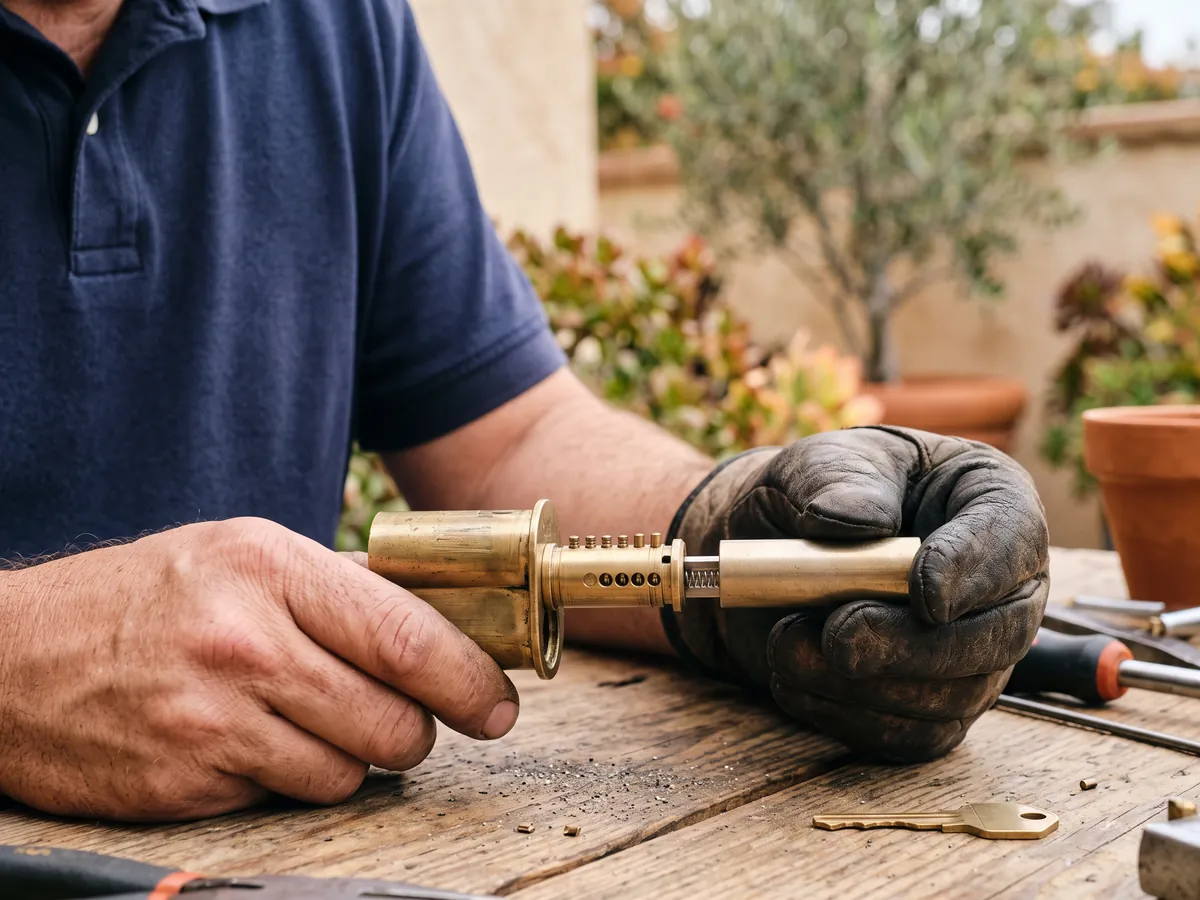
The mechanics of a rekey are simple to describe, though it takes practice to do cleanly. Inside a typical house lock, five or six spring-loaded pin stacks sit in the cylinder. The right key lifts each stack so the break between the pins lines up with the shear line, and the plug turns. To rekey, we remove the cylinder, pull the plug, swap the bottom pins for ones sized to the new key's cuts, and reassemble it with a fresh key cut for the new combination. Done properly, the old key lifts the wrong pins and won't turn. Not every lock allows that. Kwikset SmartKey locks can be rekeyed in seconds with a small tool, but only to another SmartKey. Schlage locks need a kit with new pins. Many import and discount deadbolts can't be rekeyed because their parts don't match standard sizes, and a few older knobs have corroded so badly in the dust and wind that the plug won't come out. Devore adds a practical wrinkle. Locks on old gates and sheds often have swollen, dirty cylinders, so we clean as we rekey and check the springs. Where a lock is part of a master system, we rebuild with master pins so the owner's key still opens it. We confirm residence or ownership before rekeying.
How this works in Devore
Inside a standard residential cylinder sits a brass plug that rotates within a fixed housing. Five or six holes run through both parts, and each hole holds a stack: a key pin at the bottom, a driver pin above it and a spring on top. With no key inserted, the drivers straddle the gap between plug and housing and block rotation. The right key lifts each stack so the split between key pin and driver lands exactly at that gap, called the shear line, and the plug turns. A lock rekey changes only the key pins. We slide the plug out with a follower that holds the drivers and springs in the housing, dump the old key pins, insert the new key and drop in pins whose lengths match each cut. When every pin sits flush with the plug's surface, the cylinder belongs to that key and nothing else. In Devore, that means you keep the deadbolts, levers and knobs you already have while the old keys stop working. Done carefully, the cylinder also gets cleaned, checked for worn chambers and lubricated with a dry product before it goes back in the door.
How we can help in Devore
- Master pin removal or rebuilding. Older systems often show signs of shortcuts: cylinders cross-keyed so one tenant's key opens a neighbor's door, or master wafers so thin they can flip sideways and jam the plug. We try every key against every door to expose those problems, then rebuild the stacks with proper increments. The audit alone usually explains why certain keys work where they never should have.
- Interchangeable core swaps. Small format and large format interchangeable cores come out with a control key, which makes rekeying quick: we pin a new core on the bench, pull the old one and slide the new one in. If the control key is lost, the job takes longer because the existing core has to be picked or drilled out first.
- Keying locks to a key you already carry. Bought new hardware at a home center? Boxed locks arrive keyed to random combinations, or keyed alike only within the same pack. Hand us the boxes before installation and we'll pin every new cylinder to the key you already use, so a new back-door lever and the original front deadbolt open with the same key from the first day.
- Padlocks, cam locks and gate cylinders. Padlocks split into two camps. Some, including many commercial models, accept a removable cylinder or interchangeable core and rekey like a door lock. Plenty of others are riveted shut and can't be opened without destroying them. Before you count on one key for the gate, shed and storage room, we sort which padlocks can join your system and which should be swapped for rekeyable models.
- Smart lock and keypad backup cylinders. A rekey does nothing about codes. Former guests, cleaners or an ex can still punch in a PIN or open the app. When we re-pin a smart lock's cylinder in Devore, we walk you through deleting old users, changing the master code and checking auto-lock settings, so the keyed side and the digital side are reset on the same day.
Local factors in Devore
Foothill homes in Devore deal with wind-driven grit and, in fire season, the possibility of an evacuation. Santa Ana gusts push fine dust into keyways on exposed doors, so a rekey here includes a full cleaning and dry lubrication of every cylinder. If an evacuation put spare keys in the hands of neighbors, relatives or crews, a lock rekey afterward resets the count without replacing hardware that survived.
If you leave before sunrise and get home after dark, scheduling matters as much as the lock work. We start at 6:30 a.m. every day and work into the evening, so a lock rekey can happen before your commute or after it. If you can't be there, an adult you authorize can meet us with documentation, and the new keys go only to that person.
Older houses in Devore often carry original Schlage, Weiser or Weslock hardware with decades of wear. These cylinders usually rekey well, but pins and springs may be coated in brass dust or fatigued, and discontinued keyways can need specific blanks. We check chamber wear before re-pinning, replace tired springs and tell you plainly when a vintage cylinder should be retired. Original mortise locks in older doors can often be re-pinned too, preserving period hardware you'd hate to lose.
Common situations
A typical call: a Schlage deadbolt on a cabin near Cable Canyon has a stiff key and a plug that hardly turns. On a clean lock, rekeying would be a quick job, yet this one is clogged with dust and old graphite. We'd disassemble it, clean the pin chambers, install fresh pins cut to a new key, and finish with a dry lubricant. The cylinder works smoothly again and the former tenants' keys no longer do.
- Say a homeowner tries to reset a Kwikset SmartKey deadbolt with the tool, gets interrupted halfway, and now neither the old key nor the new one turns. That's a familiar SmartKey failure. We work the cylinder back into a known state, complete the reset with a properly cut key, then check the remaining SmartKey locks in the house so all of them end up sharing the same key.
- Here's a familiar one: a homeowner rekeys a Kwikset deadbolt with a store kit, and the new key won't turn. On the bench, every pin turns out to be the right size but loaded in reverse, counted from the tip instead of the bow. We reorder the stack, check each chamber for nicks from the tweezers, then key the matching knob so both locks run on the same key.
- An office tenant asks us to rekey a door fitted with a Medeco cylinder after a key holder leaves. The cylinder is on a restricted system registered through a dealer years ago. We explain that blanks for that keyway are controlled, help the property manager track down the registration card, and coordinate the re-pin and new keys through the proper channel instead of improvising.
How the visit works
- Count cylinders and confirm authorization. Before we arrive, we ask how many keyed cylinders you have, the brands, and whether any are master keyed or high-security. At the door we confirm photo ID and proof that you live at or own the property, or written authorization from the owner or manager.
- Choose the new bitting. This is also when you decide on structure. Should the garage-entry and front door share a key? Does the pool gate or a casita get its own? We sketch the plan with you, assign a bitting to each group and confirm keyways so the plan is buildable before parts come out.
- Remove each cylinder. We work one door at a time, so a home or shop is never left with holes in several doors at once. Screws, retainers and cams go into a labeled tray for that opening, and the tailpiece orientation is noted before anything slides out, which removes guesswork at reassembly.
- Re-pin at the shear line. With the old key in, we push the plug out using a follower that keeps drivers and springs in the housing. Old key pins come out, the new key goes in, and fresh pins sized to each cut are dropped in until every one sits flush with the plug.
- Reassemble and test on the door. Our test is a checklist, not a quick turn. Every new key goes in and out of each cylinder, the bolt is thrown from outside and from the thumbturn, the key has to return to rest and pull out cleanly after locking and unlocking, and an old key gets a fair try.
- Cut keys and leave a record. You get exactly the number of keys you request, each run across a deburring wheel so no sharp edge scrapes the pins later. Rental owners usually want an extra owner key with a label; offices often like key-tag colors per department. The count is written on the invoice so it's on paper.
How we quote the job
- How many cylinders. Count every keyed cylinder, not every door. An entry handleset with a deadbolt above it is two cylinders; a sliding patio door with a keyed handle may be a third. Telling us the count up front lets us quote accurately and load the right number of blanks.
- Cylinder condition. You can get a rough read yourself. If the key wobbles up and down in the keyway, turns only with pressure, or the cylinder face is pitted and green, expect extra parts. A spring or two adds very little; a worn-out cylinder costs more, and we'll show you the wear rather than just naming a figure.
- Access and missing keys. Timing and access count as well. Working around business hours, a gated community's entry rules or a tenant's schedule can affect when we do the job, and lost keys for a SmartKey or an interchangeable core add steps. We quote all of it before starting.
Every job gets a clear quote before any work starts. Call (951) 903-3193 with the details and we'll tell you what to expect for your situation in Devore.
Mistakes to avoid
- Buying a rekey kit for the wrong brand. Kwikset and Schlage pins are not interchangeable, and many kits include parts for only one keyway. Owners end up with mismatched stacks, a plug that won't turn and springs scattered across the kitchen table.
- Interrupting a SmartKey reset. Pulling the tool or key at the wrong moment can leave the internal sliders partly set, so no key turns at all. Follow the steps exactly, or call a locksmith before forcing the cylinder and damaging the sidebar.
- Forgetting the digital side. Rekeying the override cylinder on a keypad or smart lock stops old keys, but an ex-roommate's PIN, a past guest code or a shared app login still opens the door. Delete old users and change the master code on the same day the cylinder gets re-pinned.
Practical tips before you call
- Write down how many keys exist after a rekey and who holds each one. Knowing the count is the whole point of rekeying. For a business in Devore, a simple sign-out sheet keeps that number accurate through staff changes and promotions.
- Check the keyway before planning one key for everything. Look at the brand stamped on each lock face or on your keys. Kwikset and Schlage keyways are different shapes, so mixing brands means either carrying two keys or replacing a cylinder or lock.
- Use a dry lubricant. Graphite or a dry PTFE spray keeps pins moving freely. Wet oils attract dust and pollen, then thicken in warm weather and gum up the chambers, which is a common reason keys start sticking a year after a rekey.
- Don't expect a rekey to fix a lock that's failing mechanically. If the latch sticks, the knob wobbles or the deadbolt won't extend fully, new pins won't help. Rekeying changes which key works, not how the mechanism moves, so repair or replacement may be the real answer.
Reaching Devore
Devore is about 8 miles from our San Bernardino base, roughly 14 minutes in light traffic via Kendall Drive or Palm Avenue to I-215 North, through the Devore junction onto I-15 North, exit Kenwood Avenue for Devore Heights. When you call, you get an arrival estimate based on where the technician is and the traffic at that moment.
Stuck on the shoulder or in a parking lot along Glen Helen Parkway? Get somewhere safe, turn on your hazards, and give us the nearest exit or business so we can find the car without guessing.
About Devore: A two-story Santa Fe depot served Devore as a railroad station from 1908 to 1930 and was demolished around 1958.
| Neighborhoods | Devore Heights, Verdemont, Kenwood Avenue corridor, Kimbark Avenue area, Cable Canyon, Glen Helen |
|---|---|
| ZIP codes | 92407 |
| Main routes | I-15, I-215, Cajon Boulevard, Kenwood Avenue |
| From our San Bernardino base | about 8 miles via Kendall Drive or Palm Avenue to I-215 North, through the Devore junction onto I-15 North, exit Kenwood Avenue for Devore Heights; Devore Road exit for Glen Helen and lower Cajon Boulevard |
Planning a rekey in Devore?
Call (951) 903-3193 and tell us how many doors you want on the new key and the brand of the locks if you know it. We'll quote the rekey before any work starts.
Frequently asked questions
Can every lock be rekeyed?
No. Most pin-tumbler cylinders can, but some imported keypad locks use proprietary cylinders with no available pins, cheap wafer locks often cost less to replace, and cylinders with worn chambers, broken cams or break-in damage won't hold new pinning reliably. Restricted high-security cylinders can be rekeyed, but keys and parts may have to come through an authorized dealer.
When can you come out for a rekey?
We work every day from 6:30 a.m. to 11:30 p.m. Call with your address in Devore and we'll give you an honest ETA. Early-morning slots work well for businesses that want locks rekeyed before opening, and evenings suit households after work. Tell us how many locks need rekeying and how many new keys you want, so the quote matches the job.
Is rekeying as secure as installing new locks?
Against old keys, yes. Once re-pinned, a cylinder simply won't turn with the previous key. Rekeying doesn't upgrade the lock's grade, strike, bolt length or pick resistance, though. If your hardware is flimsy or damaged, replacing it may make more sense, and we can add security driver pins to many cylinders during the rekey for better pick resistance.
Can a landlord rekey between tenants, and what about protective orders?
Landlords commonly rekey between tenancies so an outgoing tenant's copies stop working. Separately, under Civil Code §1941.5 and §1941.6, a landlord must change the locks within 24 hours of a tenant's written request in certain situations involving a protective order or similar documentation. Re-pinning the existing cylinders is often the quickest way to meet that request, with the landlord's authorization.
Can you rekey a lock if I've lost every key?
Usually. With proof that you own or live at the property, we can pick or shim most pin-tumbler cylinders, re-pin them and cut new keys. A SmartKey with no working key has to be disassembled or replaced, and some high-security cylinders are handled by ordering a key through the registered dealer record. Drilling is rare, and when it happens it means installing a new cylinder.
How long does a rekey take?
A standard Kwikset or Schlage cylinder takes a few minutes once it's off the door; removing and reinstalling trim often takes longer than the re-pinning itself. A typical home with several exterior locks is handled in one visit. Master keyed systems, mortise locks and cylinders without a working key take longer, and we tell you that when we quote.
How far is Devore from your base?
Devore is about 8 miles from our San Bernardino base, roughly 14 minutes in light traffic. Arrival time depends on traffic and on the job the technician is finishing, so we give you an estimate on the phone before you commit.
Related services in Devore
Lock Rekey in nearby cities
- Lock Rekey in Glen HelenSan Bernardino County
- Lock Rekey in MuscoySan Bernardino County
- Lock Rekey in North FontanaSan Bernardino County
- Lock Rekey in RialtoSan Bernardino County
- Lock Rekey in FontanaSan Bernardino County
- Lock Rekey in EtiwandaSan Bernardino County
- Lock Rekey in San BernardinoSan Bernardino County
- Lock Rekey in BloomingtonSan Bernardino County
