
El Monte, Los Angeles County
El Monte Lock Rekey: New Keys Pinned Into Your Existing Cylinders
Short answer: Rekeying usually costs less than new hardware because you keep the locks and pay mainly for labor, pins and keys. The total depends on how many cylinders you have, the brand, any master key system and how many keys you want cut. We quote in El Monte before touching a lock, confirm you own or live at the property, and typically finish a home in one visit.
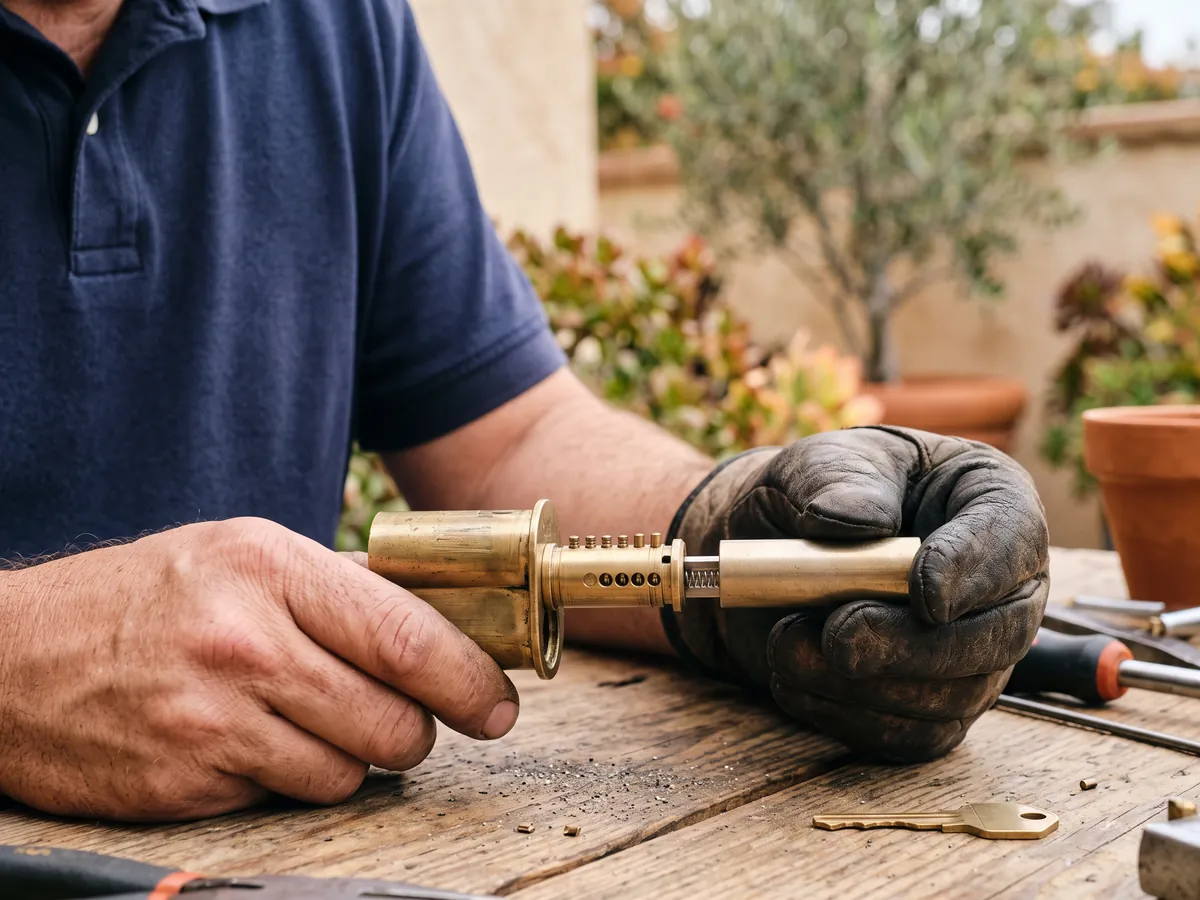
How many keys to your El Monte home are out there right now? Most people can't answer that, and that uncertainty is exactly what a lock rekey fixes. A five-pin Kwikset cylinder offers seven possible depths per pin and a Schlage offers ten, so there's plenty of room to choose a new combination that shares nothing useful with the old one, even after the manufacturer's rules about neighboring cuts are applied. We pick that combination, re-pin every cylinder you name, and cut a set number of keys. The moment we finish, the count starts over at whatever we hand you, and every copy floating around from before turns into scrap brass.
A lock rekey is a small mechanical job, and knowing what happens inside the cylinder helps you judge a quote. A standard pin tumbler lock holds five or six pin stacks. Your key lifts each stack to the shear line and lets the plug turn. To rekey, we remove the cylinder, pull the plug, swap in new bottom pins sized to a different key and reassemble it, and a key gauge confirms the depths. Master pins, when used, add a second shear line so two keys can open the same lock. On El Monte houses the work is mostly Kwikset KW1 and Schlage SC1 deadbolts and knobs. Kwikset SmartKey cylinders rekey with a learn tool and no re-pinning at all. Some locks can't be rekeyed: a few budget security-door locks and cheap padlocks have fixed cylinders, and some very old mortise locks are missing parts. We tell you which ones need replacing. It's also the moment to look at wear. Sun-baked exterior cylinders on west-facing doors collect dust and old lubricant, so we clean them and use graphite or a dry lubricant rather than oil, which attracts dirt and gums up the pins.
What to know first in El Monte
A lock rekey decides which key works; it doesn't automatically make a cylinder tougher. Still, the plug is already out on the bench, which makes it the cheapest moment to add resistance. Standard driver pins are plain little cylinders that set cleanly when a pick lifts them. Spool drivers, shaped like a thread spool, and serrated drivers, ringed with fine grooves, catch at the shear line and feed a picker false feedback. They're made for the common residential and commercial keyways, and they don't change how your key feels. Pulling master pins that no longer serve a purpose is another quiet improvement, since each one adds an extra height at which the plug will turn. Bump keys, which exploit plain pin stacks, also become less reliable against security drivers. There are limits, though. A builder-grade knob with a short latch, a strike held by short screws or a cylinder that pulls out under force needs hardware changes, not pins. In El Monte, we often pair a rekey with three-inch strike screws and a reinforced strike plate, and for real pick and drill resistance we point people toward restricted, UL 437-listed cylinders rather than overselling what new pins can do.
Work included on a typical visit
- Deadbolt, knob and lever rekeying. We remove the cylinder from each deadbolt, knob or lever, re-pin it to a new bitting and reinstall it with the original trim. Front, side, garage-entry and back doors can all share one key when they use the same keyway. Every cylinder is tested on the door, locked and unlocked, before we move on to the next one.
- Kwikset SmartKey resets. Not sure your lock is a SmartKey? Look for a tiny slot beside the keyway on the cylinder face. Kwikset revised the mechanism over the years, and older units are more likely to stall partway through a reset. We check which version you have, confirm every new key reads cleanly in each cylinder, and recommend replacing any SmartKey that feels gritty or loose.
- Master pin removal or rebuilding. Master pins are thin spacers stacked between the key pin and the driver. Adding them lets a manager's key open many doors; taking them out restores single-key operation. We work from your keying chart when one exists and build one when it doesn't, so the next change is faster and stays consistent.
- Keying locks to a key you already carry. Have a key you like? If the keyway matches, we can pin your other cylinders to it so one key runs the house. We decode that key first, and if its cuts are worn we correct them to factory depth, so future copies work in every lock rather than just the one you started with.
- Rekeying locks with no working key. Some cylinders resist the usual no-key methods. A SmartKey without a working key has to be disassembled or replaced, since the reset tool needs a key that already turns. Many high-security cylinders have a registered key number on file with the dealer, so the owner can order a working key by card instead of anyone attacking the lock.
What's different about El Monte
If you leave before sunrise and get home after dark, scheduling matters as much as the lock work. We start at 6:30 a.m. every day and work into the evening, so a lock rekey can happen before your commute or after it. If you can't be there, an adult you authorize can meet us with documentation, and the new keys go only to that person.
Summer heat in El Monte bakes south- and west-facing doors, thins out wet lubricants and turns dust into a paste inside cylinders. When we rekey, we flush the chambers, discard gummed oil, replace weakened springs and use a dry lubricant that won't migrate in the heat. We also test the deadbolt with the door hot and closed, because expansion often shows up as a key that only sticks in the afternoon.
Apartment rekeys are about turnover speed and key control. Many complexes run a master system so maintenance can enter every unit, which means each unit's cylinder carries master pins. We re-pin unit cylinders to new change keys while keeping the master working, or swap interchangeable cores where the property uses them. Tenants need landlord authorization for a rekey, and California law gives tenants with protective orders specific lock-change rights.
Situations this covers
Imagine a Schlage deadbolt on a front door near Santa Fe Trail Historical Park that turns hard, and you also want old keys cut off. We would remove the cylinder, pull the plug and find grit and a worn pin. After cleaning, we'd re-pin it to a new key, cut two copies and test the bolt against its strike. If the bolt still drags after rekeying, the door has shifted, and we'd say so and adjust the strike.
- Picture a small private school whose doors run on small format interchangeable cores, and the facilities lead retires without handing over the control key. Without it, no core can be swapped. We pick one core to the control line, decode the control bitting from its pins and cut a new control key. The school then decides whether to re-core every door to a fresh control system.
- An office tenant asks us to rekey a door fitted with a Medeco cylinder after a key holder leaves. The cylinder is on a restricted system registered through a dealer years ago. We explain that blanks for that keyway are controlled, help the property manager track down the registration card, and coordinate the re-pin and new keys through the proper channel instead of improvising.
- Consider a ranch-style home where the back gate padlock and the garage side door both fight the key every summer afternoon. When we rekey them to match the house key, we find packed dust and gummy oil residue on the pins. We clean the chambers, replace a rusted spring, lubricate with a dry product and test the cylinders while they're hot, the way they'll actually be used.
How the visit works
- Count cylinders and confirm authorization. A good rekey starts with an inventory. We walk the property with you, note every keyed lock, including garage-entry, side gate and padlocks, and check identification or ownership documents before a single cylinder comes off a door in El Monte.
- Choose the new bitting. The new combination is chosen deliberately: no near-flat cuts, no steep jumps between neighbors and no repeat of the old bitting. For master keyed doors, we calculate every master pin size from the keying chart before opening anything.
- Remove each cylinder. Deadbolt cylinders come out after the interior side is unscrewed. Knobs and levers often need a hidden catch released with a pin tool. Mortise cylinders unthread after a set screw is loosened, and rim cylinders drop free after two screws on the inside. Nothing gets pried.
- Re-pin at the shear line. Pins are chosen by number from the bitting, not by eye. Once they're loaded, a fingernail or flat edge drawn across the plug tells the story: a pin standing proud or sitting low is the wrong size. If you asked for security drivers, they go into the shell at this stage.
- Reassemble and test on the door. Bench testing isn't enough, so we also test in place: the deadbolt has to throw fully with the door shut, the latch has to retract smoothly and old keys must fail. Binding at this stage usually points to strike alignment, which we adjust or flag for you.
- Cut keys and leave a record. Before we leave El Monte, every key is tried in every lock it should operate. Commercial keys can be stamped with identifiers, and you receive a record of what was cut and issued, so your key control starts from an accurate count.
How we quote the job
- How many cylinders. Most of the labor is per cylinder, so a condo with two keyed locks and a house with seven are different jobs. A front entry set usually counts as two cylinders, the knob or lever plus the deadbolt, and garage-entry, side and back doors each add more.
- Cylinder condition. A clean cylinder re-pins quickly. One packed with grit or gummed with wet oil needs flushing first, and a cylinder with seized parts may not be worth rekeying. Condition is the one factor we can only judge with the lock in hand, so we explain any change before proceeding.
- Access and missing keys. Rekeying is quickest when you have a working key for each lock. If no key exists, the cylinder may need to be picked, decoded or, for some designs, drilled before it can be re-pinned. That extra work is quoted separately and explained before we begin.
Every job gets a clear quote before any work starts. Call (951) 903-3193 with the details and we'll tell you what to expect for your situation in El Monte.
Practical tips before you call
- Rekey from a code, not from your oldest key. Ask your locksmith to decode the key and pin the lock to factory depths. A lock pinned to a worn key will feel fine with that key and stiff with every fresh copy someone cuts for you later.
- Include the door between the garage and the house. People remember the front door and forget that one, even though anyone holding an old key and a garage remote can walk straight in. Reset the opener codes on the same day.
- Use a dry lubricant. Graphite or a dry PTFE spray keeps pins moving freely. Wet oils attract dust and pollen, then thicken in warm weather and gum up the chambers, which is a common reason keys start sticking a year after a rekey.
- Before the visit, gather every key you can find, including the spare in the kitchen drawer and the one a neighbor holds, and tag them. Sorting them early tells us which cylinders have working keys, which speeds the job, and it makes the old keys easy to collect and toss once the new set is tested.
Common errors that cost time and money
- Pinning to a worn key. Using the key in your pocket feels efficient, but its cuts are already shallower than spec. New copies cut correctly won't line the pins up, and you end up with a lock that only cooperates with one aging key.
- Interrupting a SmartKey reset. Pulling the tool or key at the wrong moment can leave the internal sliders partly set, so no key turns at all. Follow the steps exactly, or call a locksmith before forcing the cylinder and damaging the sidebar.
- Rekeying only the front door. Old keys still open the garage-entry door, the side door or a keyed patio handle if those cylinders are left out, which defeats the purpose of the rekey. Walk every exterior door before scheduling and list each keyed cylinder.
Getting to El Monte
El Monte is about 47 miles from our San Bernardino base, roughly 55 minutes in light traffic via I-215 South briefly to SR-210 West. When you call, you get an arrival estimate based on where the technician is and the traffic at that moment.
Most trips into El Monte use Valley Boulevard for at least part of the drive, and the technician keeps an eye on live traffic along the way so the arrival estimate you heard on the phone stays honest.
About El Monte: Santa Fe Trail Historical Park on Santa Anita Avenue is California Historical Landmark No. 975, and the city cleared the site in 2023 to build a new park there.
| Neighborhoods | Rio Hondo and Santa Fe Trail area, Mountain View, Flair Park, Garvey Avenue corridor, Five Points, Downtown El Monte |
|---|---|
| ZIP codes | 91731, 91732, 91733 |
| Main routes | I-10, I-605, Rosemead Boulevard, Santa Anita Avenue |
| From our San Bernardino base | about 47 miles via I-215 South briefly to SR-210 West (Foothill Freeway), continuing on I-210 West to I-605 South, then exit Ramona Boulevard or I-10 West into central El Monte; alternate route is I-10 West the whole way, exiting at Peck Road or Santa Anita Avenue |
Planning a rekey in El Monte?
Call (951) 903-3193 and tell us how many doors you want on the new key and the brand of the locks if you know it. We'll quote the rekey before any work starts.
Frequently asked questions
Can all my locks use one key after a rekey?
Yes, if they share a keyway. Kwikset locks can be keyed together, and so can Schlage locks, but a Kwikset key can't operate a Schlage cylinder. When brands are mixed, you can keep two keys or replace the odd cylinders or locks with ones that match. We'll look at your hardware in El Monte and lay out both options with a quote for each.
When can you come out for a rekey?
We work every day from 6:30 a.m. to 11:30 p.m. Call with your address in El Monte and we'll give you an honest ETA. Early-morning slots work well for businesses that want locks rekeyed before opening, and evenings suit households after work. Tell us how many locks need rekeying and how many new keys you want, so the quote matches the job.
Is rekeying as secure as installing new locks?
Against old keys, yes. Once re-pinned, a cylinder simply won't turn with the previous key. Rekeying doesn't upgrade the lock's grade, strike, bolt length or pick resistance, though. If your hardware is flimsy or damaged, replacing it may make more sense, and we can add security driver pins to many cylinders during the rekey for better pick resistance.
How long does a rekey take?
A standard Kwikset or Schlage cylinder takes a few minutes once it's off the door; removing and reinstalling trim often takes longer than the re-pinning itself. A typical home with several exterior locks is handled in one visit. Master keyed systems, mortise locks and cylinders without a working key take longer, and we tell you that when we quote.
Can padlocks, cabinet locks and gate locks be rekeyed to my house key?
Some can. Padlocks built around a removable cylinder or core rekey easily, and many file cabinet and gate locks use pin tumblers in a compatible keyway. Riveted padlocks and wafer cam locks usually can't, or aren't worth the labor. Set them out when we visit, and we'll tell you which ones can match your house key and which should be swapped for something rekeyable.
Can every lock be rekeyed?
No. Most pin-tumbler cylinders can, but some imported keypad locks use proprietary cylinders with no available pins, cheap wafer locks often cost less to replace, and cylinders with worn chambers, broken cams or break-in damage won't hold new pinning reliably. Restricted high-security cylinders can be rekeyed, but keys and parts may have to come through an authorized dealer.
How far is El Monte from your base?
El Monte is about 47 miles from our San Bernardino base, roughly 55 minutes in light traffic. Arrival time depends on traffic and on the job the technician is finishing, so we give you an estimate on the phone before you commit.
Related services in El Monte
Lock Rekey in nearby cities
- Lock Rekey in North El MonteLos Angeles County
- Lock Rekey in South El MonteLos Angeles County
- Lock Rekey in Temple CityLos Angeles County
- Lock Rekey in Avocado HeightsLos Angeles County
- Lock Rekey in RosemeadLos Angeles County
- Lock Rekey in Baldwin ParkLos Angeles County
- Lock Rekey in West Puente ValleyLos Angeles County
- Lock Rekey in ArcadiaLos Angeles County
