
Home Lockout
House Lockout Service for Single-Family Homes
Short answer: Most house lockouts end without damage. A licensed locksmith confirms you live there, looks at every door, then opens the easiest one by bypassing a knob latch, picking a deadbolt or powering a dead keypad. Drilling is saved for failed or high-security locks. If a child or anyone at risk is inside, call 911 first. Julian's Locksmith, license LCO7891, serves the Inland Empire and neighboring regions at (951) 903-3193.
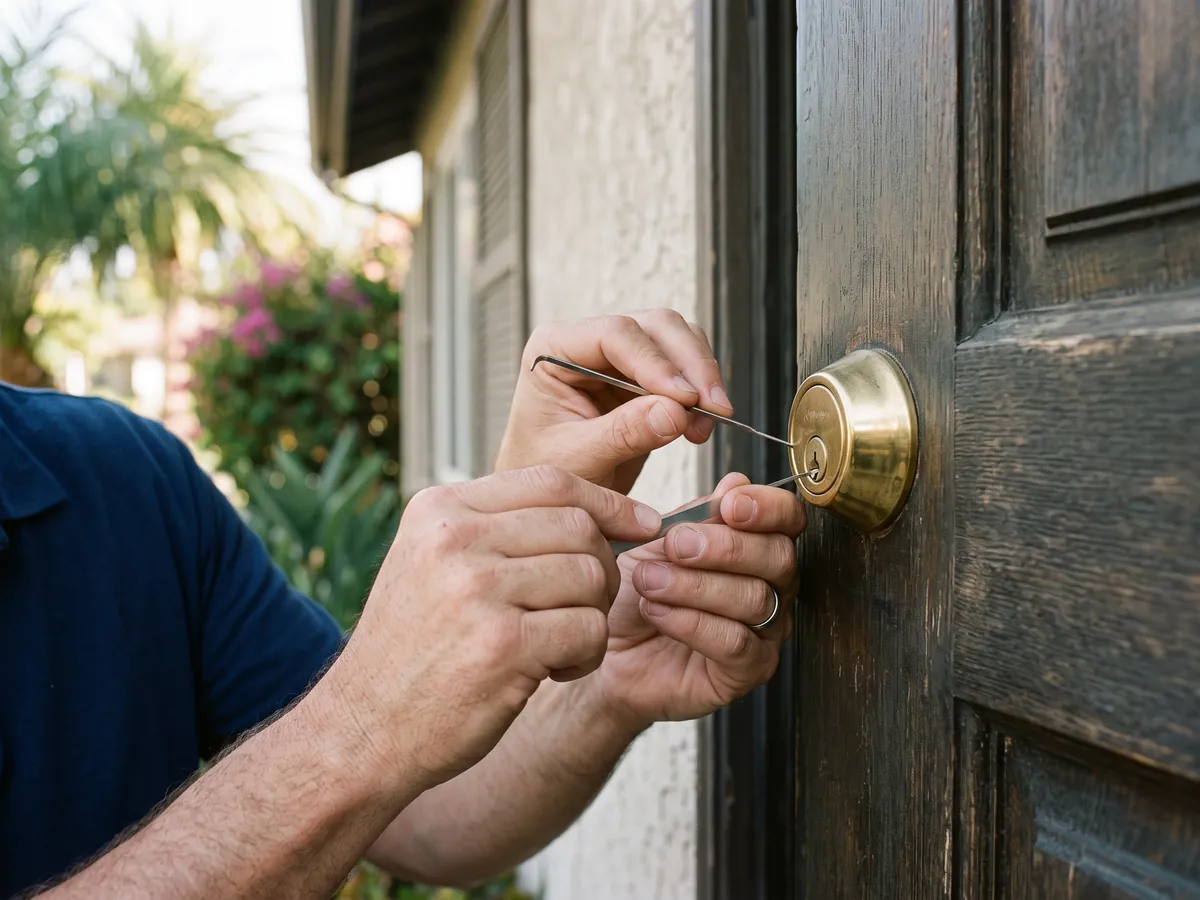
Why a house lockout is its own kind of job
An apartment usually has a single entry door, a leasing office and a manager holding a master key. A car has a handful of doors that all share one locking system. A single-family house is different from both. It might have five ways in, each fitted with hardware from a different decade, and nobody but your household holds a key to any of them.
That combination shapes how a house lockout gets solved. More doors mean more chances that one of them is easy: a knob-only lock on the garage service door, a back door nobody deadbolted, a keypad that just needs power. But there's no office to call and no spare hanging on a hook down the hall. If you haven't hidden a key or given one to a neighbor, the job falls to you or to a locksmith.
Houses also bring variables an apartment rarely has. Attached garages with openers that quit in an outage. Self-closing doors between the garage and the kitchen. Side yards with gates and dogs. Smart deadbolts installed by a previous owner who never passed along the master code. Original 1950s knobs sitting a few feet from a Grade 1 deadbolt bought last spring.
This guide walks through how those pieces fit together, from the first safety question to the moment the door swings open. The goal is simple: you should know what's reasonable to expect, what a good locksmith will and won't do at your house, and which details on the phone make the visit quicker and cheaper.
First, decide whether this is a 911 call
Most house lockouts are inconvenient, not dangerous. A few are genuinely urgent, and sorting one from the other takes a moment of honest thinking before you dial anyone.
Call 911 first if any of these is true:
- A baby, toddler or young child is by themselves in the house with no way to get out.
- An older adult, or anyone with a medical condition, is inside and may need help.
- Food is cooking on a lit burner, a tub or sink is running, or you smell gas or smoke.
- A pet is shut in on a hot day with the air conditioning off, and you think it may be struggling.
Fire crews are equipped to force entry fast, and their stations are usually closer to you than any locksmith's van. They will break something to get in, and that is the right trade. A splintered jamb can be repaired tomorrow; the alternative can't be undone.
When nobody is at risk, a locksmith is the right call, and it still helps to tell us who or what is inside. A calm eight-year-old watching cartoons behind a locked door moves the call up our list. A protective dog in the entry hall changes the way we open the door: slowly, with you standing in the opening so the first face the dog sees is yours, and with a leash or a treat ready so it doesn't dash for the street.
If a child inside is old enough, you can try talking them through it. Ask them to turn the small knob on the inside of the deadbolt, then press or twist the button on the doorknob. Keep it light. A frightened child is better left on the couch than coached into tears at a door that won't cooperate.
What to try before you call anyone
A surprising share of house lockouts end before a locksmith ever starts the van. Work through this list first:
- Walk the whole perimeter. Try the back door, the kitchen or laundry-room door and the service door into the garage. Doors that rarely get used are the ones people forget to lock.
- Try the garage. If the keypad outside still works, the door from the garage into the house may be unlocked or held only by its knob.
- Check your phone. Many smart deadbolts connected through Wi-Fi or a hub can be opened from the app. If your phone is inside, anyone else on the account, such as a partner at work, may be able to open it from wherever they are.
- Call everyone who might hold a key. Household members, a neighbor, a relative, a house cleaner, a dog walker. People forget they still have one.
- If you rent the house, call the landlord or property manager. Many keep a copy of every key to their rentals.
What you shouldn't try matters just as much. Leave the windows alone, especially upstairs ones, and don't send a child through a pet door. Don't pry at the gap between door and frame with a screwdriver, and don't try to lift a sliding glass door out of its track. Those attempts tend to cost more than the lockout they were meant to avoid, and they can leave the house harder to secure tonight.
If none of the free options pans out, that's when to pick up the phone. Having checked every door already will also make the call shorter, because you'll be able to say exactly which locks are engaged.
Knob or deadbolt: what's actually holding your door
The most useful thing you can tell a locksmith on the phone is which lock is engaged, because a house door can be held shut in two very different ways.
A knob or lever lock uses a spring latch, the angled bolt that snaps into the strike every time the door closes. On most residential knobs, a push-button or turn-button on the inside locks the outside handle, and the latch catches on its own. That's the classic house lockout: someone presses the button, pulls the door closed and notices the keys on the counter a second too late. A properly fitted latch has a small plunger beside the main bolt, called the deadlatch or anti-shim pin. When the door closes against the strike, that plunger is held in and locks the latch in place. If the door gap is too wide or the strike sits off center, the plunger never seats, and the latch can sometimes be slipped from outside.
A deadbolt is a different animal. Its bolt is square-ended, doesn't spring back and reaches about an inch into the frame. It only moves when someone turns the key or the thumbturn. If the deadbolt is thrown, no amount of latch work will help; the cylinder has to be picked, bypassed or, as a last resort, drilled.
Two variations cause more than their share of trouble:
- Storeroom-function levers stay locked from outside all the time. They sometimes get installed on garage and side doors by mistake, and they lock people out over and over.
- Double-cylinder deadbolts need a key on both sides. A child inside can't open one even if they can reach it, and building codes expect a home's main exit to open from inside without a key, which is why we generally advise single-cylinder deadbolts on houses.
How a locksmith opens a house without damage
Good lockout work follows a ladder: start with the least invasive method and climb only when the rung below doesn't work. At a single-family house, that ladder usually runs like this.
- Survey. Every exterior door gets checked for which locks are engaged, the brand and grade, how the door sits in its frame and whether a latch guard covers the edge.
- Power or override. If a dead keypad is the problem, emergency power or the key cylinder usually gets you in without touching anything else.
- Latch bypass. A door held only by its spring latch can often be opened with thin, flexible tools worked between door and stop. On lever handles, a tool fed under the door can catch the inside lever and pull it down.
- Picking. For a thrown deadbolt, a tension wrench and picks set each pin at the shear line and turn the plug exactly as the key would. Standard five- and six-pin cylinders from Kwikset, Schlage, Defiant and Yale usually cooperate. Spool and serrated security pins slow things down.
- Specialized entry. Some doors allow tools that reach the inside thumbturn or work a bolt directly. These depend on the door's geometry and a careful hand.
- Drilling. When a cylinder is broken inside, seized, or a high-security design with no practical bypass, drilling is the honest answer. It's done precisely, and new hardware goes in before we leave.
The order matters for your wallet. Every rung on that ladder preserves your lock except the last one. A locksmith who goes straight to the drill on a builder-grade deadbolt is selling hardware rather than solving a lockout. It's fair to ask what was tried first and why it didn't work, and to stop the job if the answers don't hold together.
Keypad and smart deadbolt lockouts
Electronic deadbolts cut down on lost-key lockouts and replace them with a new set of failure modes. Knowing which one you're facing narrows the fix.
Dead or weak batteries cause most of them. The interior pack, usually four AA cells, runs both the keypad and the motor. Heat on a west- or south-facing door shortens battery life, and many manufacturers call for alkaline cells and warn against rechargeables, which run at a lower voltage. Warnings tend to start weeks early as beeps, a blinking light or an app notification, and they're easy to ignore until the keypad goes dark.
How you get in depends on the lock's design:
- Several Yale keypad models have contacts under the keypad where a 9-volt battery can be held long enough to enter your code. Some other brands use a USB emergency port instead.
- Schlage Encode, Kwikset Halo and most keypad deadbolts with a visible keyway have a mechanical override cylinder. If that key is missing, the cylinder can be picked, although Kwikset's SmartKey design resists conventional picking and needs a different approach.
- Retrofit locks such as August and the Level Bolt work from the inside of the door and leave your original exterior cylinder in place, so the lockout is really a standard deadbolt opening.
The second common failure is a stalled motor. If the bolt rubs the strike because the door has sagged or swollen, the motor strains, reports a jam and drains the batteries faster. Auto-lock is the third: a timer throws the bolt while you're at the curb with the trash cans.
Once you're inside, the fix is usually modest: fresh batteries, a strike adjusted so the bolt slides freely, and an auto-lock delay that matches how your household actually comes and goes.
Garage, side and back doors deserve a look
Front doors get the attention, but side and garage entries are where many house lockouts start and where many of them end.
An attached garage is really three locks in a row. The overhead door is controlled by the opener, which runs on house current, while the keypad outside has its own small battery. Since July 2019, California has required residential openers sold or installed in the state to include battery backup, but plenty of older units have none, and a backup battery that's never been replaced may not do much. During an outage or a utility power shutoff, an opener without working backup leaves the big door closed.
Next is the garage service door, the ordinary side door many garages have. It often carries the cheapest lock on the property, sometimes a knob nobody has had a key for since the house last sold. That makes it a convenient entry point for a locksmith, and frankly for a burglar too.
The third layer is the door from the garage into the house. California's residential code calls for that door to be self-closing, so it swings shut and latches behind you while you're unloading groceries. Many carry a push-button knob, and that's a reliable trap.
Around back, swinging back doors and kitchen doors are fair game for entry. Sliding patio doors usually aren't. Between a security bar in the track, anti-lift blocks and the glass itself, opening a slider from outside without damage is rarely practical. French doors held by flush bolts behave much the same way.
After a lockout through the garage, consider having the release cord on the opener's trolley shielded or secured, so nobody can fish it through the gap at the top of the door.
When the lock fails instead of the person
Not every house lockout involves keys left inside. Sometimes the key is in your hand and the door still won't open, and that's a different problem with different fixes.
- The key turns but the latch doesn't move. Inside a knob or lever, a broken spindle or worn latch retractor disconnects the handle from the latch, so the door stays shut even though it's technically unlocked.
- The key turns but the deadbolt stays out. A cracked tailpiece or cam, or a bolt pinched hard against a misaligned strike, keeps the bolt extended. Pushing or lifting the door while turning the key sometimes frees it.
- The key won't go in or won't turn. Debris, a bent key, worn pins or a cylinder dried out by heat and dust are the usual suspects. Graphite or a dry lubricant may help; household oil collects grit and makes things worse over time.
- The key snaps off in the plug. The fragment blocks the keyway, so nothing can be picked until it's extracted with thin hooked tools.
These failures call for diagnosis before technique. Depending on the cause, a locksmith may work the latch through the door gap, extract a broken key and then pick the cylinder, or drill through to reach a broken cam. Pulling hinge pins only works on doors that swing outward, which most Southern California entry doors don't, and out-swinging exterior doors are often fitted with security studs for exactly that reason.
Once the door is open, the failed part gets replaced or the lock gets rebuilt. A mechanism that failed once will fail again, and the next time you might not be standing on the porch with your phone in hand.
Proving you live there, and calls we turn down
Opening a house for someone is an act of trust, and California treats it seriously. Locksmith companies are licensed by the Bureau of Security and Investigative Services under the Locksmith Act, Business and Professions Code section 6980 and following. Julian's Locksmith holds license LCO7891, which anyone can look up at search.dca.ca.gov.
Before we open a house, we need reasonable proof that you live there or own it. In practice that means:
- A driver's license or state ID showing the property address.
- If your ID is inside or out of date, documents we check once the door is open: a utility bill, property tax bill, mortgage statement, lease or escrow papers, matched against your photo ID.
- For renters, a lease in your name, or authorization from the landlord or property manager.
- For house sitters, relatives and caregivers, the owner reachable by phone and willing to confirm, plus the caller's own ID.
Renters in a single-family house have one more point worth knowing. California's Civil Code section 1941.3 makes the landlord responsible for a working deadbolt on the main swinging entry door, so a worn-out deadbolt that caused the lockout is the owner's repair.
Some requests we decline however reasonable the person seems. We won't open a house when someone inside is refusing entry; that belongs with law enforcement or the courts, even when both people live there. We won't help anyone back into a home after a sheriff has carried out a court-ordered eviction. And if a landlord wants the locks changed to push a tenant out, the answer is no, because California law bars lockouts as a way of forcing tenants to leave.
The same rules that add a short delay to your own entry are what stop a stranger from talking a locksmith into opening your house while you're away.
What sets the price of a house lockout
We don't publish lockout prices, because the honest number depends on details that only come out on the phone or at the door. Here's what moves it:
- Which mechanism is engaged. A spring latch alone is the simplest case. A thrown deadbolt takes longer, and both together on the only reachable door takes longer still.
- The hardware itself. Builder-grade cylinders open faster than Grade 1 deadbolts with security pins. Patented cylinders such as Medeco, Mul-T-Lock or Schlage Primus can turn a routine opening into a long one.
- Electronic locks. A drained battery pack is a small fix. A failed circuit board or seized motor means diagnosis and possibly a replacement lock.
- Failed parts. Broken spindles, cams and keys add extraction or repair work.
- Drilling. When it can't be avoided, replacement hardware becomes part of the bill, and you choose it before the drill comes out.
- Distance and timing. We're a mobile company based in San Bernardino, so the drive matters, and so does how close your call falls to the end of our working day.
- Add-ons. Spare keys, rekeying, strike adjustment and new batteries are optional and quoted separately.
You get a quote before we head out and another before any change of plan at the door. If you find a key in a jacket pocket while we're on the way, call and cancel. That happens, and it's fine.
Older homes, new tracts and high-security houses
Across Southern California, the age of a house says a lot about what we'll find at the door.
Prewar Craftsman bungalows and Spanish revival homes, common in the older cores of the Inland Empire and the San Gabriel Valley, may still have mortise locks: a single steel case set into the edge of the door holding both a latch and a bolt, with a threaded cylinder secured by a set screw. They pick like any pin tumbler, but their internals are often worn, and swollen wood doors put real strain on the bolt.
Postwar ranch houses are often a patchwork: the 1950s knobset still on the laundry door, a deadbolt retrofitted during some later remodel, perhaps a keypad lock added by the last owner. That variety usually means at least one door opens easily.
Tract homes built since the 1990s in master-planned communities usually came with Kwikset or Schlage builder hardware, often SmartKey cylinders, and were frequently keyed alike from day one. Newer homes sometimes ship with a builder-installed keypad deadbolt whose master code never reached the buyer.
Custom and estate homes bring Baldwin and Emtek trim, multipoint locks on tall entry doors, high-security cylinders and alarm systems with an entry delay to beat. Those call for patience and a clear plan before anyone touches the door.
Climate plays a part too. Inland heat cooks keypad batteries and swells doors against their strikes. Santa Ana winds pack fine grit into exposed keyways. Damp marine air that reaches north Orange County corrodes cheap plated hardware faster than most owners expect.
Making the next lockout less likely
Every house lockout points to something that can be changed. A few habits and small fixes handle most of them.
- Put one spare key with someone nearby you trust and a second in a combination key safe mounted out of sight. Skip the planter, the doormat and the fake rock.
- Have your exterior doors rekeyed to a single key, so every spare opens every door.
- If you own a keypad deadbolt, learn its emergency power method now and change the batteries on a schedule instead of waiting for the beeps.
- Choose smart locks with a mechanical override, keep at least one override key outside the house, and give auto-lock a delay long enough for real life.
- Fix the deadbolt that only throws when you push on the door. A strike adjustment is a small job, and it protects both keys and motors.
- Replace storeroom-function levers on garage and side doors with entry-function hardware, and drop the habit of locking a knob by pressing its button on the way out.
- Trade double-cylinder deadbolts for single-cylinder models with a thumbturn, so anyone inside can get out, and can let you in.
- Teach older kids to work the thumbturn and the knob button, and practice once while nothing is at stake.
If lost keys started the lockout, rekeying is the step that matters most. A ring of house keys that left with someone else, especially alongside a garage remote or an ID showing your address, stays a risk until the cylinders are re-pinned to a new key.
Where we work and when to call
Julian's Locksmith is a mobile company based at 2544 Rosemary Ln in San Bernardino, in the University Heights area near Cal State San Bernardino. There's no storefront to visit. We come to your house with picks, extraction tools, key machines, batteries and common lock hardware already in the van.
Our service area covers the Inland Empire, the San Gabriel Valley, the Pomona Valley, north Orange County and southeast Los Angeles County. Homes near our base are a short trip, and homes at the far edges of that area take longer. Either way, you'll get a straight estimate based on where our van is and how the freeways look when you call.
Our hours, Pacific time:
- Monday through Friday, 6:30 a.m. to 11:30 p.m.
- Saturday and Sunday, the same hours
- Overnight, closed from 11:30 p.m. to 6:30 a.m.
We aren't a 24/7 service. If you're locked out while we're closed, work through the free options first: other doors, other key holders, a landlord or the smart lock app. If anyone could be hurt by waiting, 911 comes first. Otherwise, leave a message and we'll return your call once we open.
When you do call (951) 903-3193, have a few things ready: the address, which door and which lock you think is engaged, the lock brand if you can see it, whether anyone or any pet is inside, and what ID you have with you. That's enough for a quote and an honest arrival estimate.
Frequently asked questions
Can you open a door that has a double-cylinder deadbolt?
Usually, yes. From outside, a double-cylinder deadbolt picks like any other, since the exterior cylinder is a standard pin tumbler. The trouble with these locks is on the inside: nobody can open the door without a key, including a child who's locked in or someone trying to get out during a fire. After we open the door, we'll suggest a single-cylinder model with a thumbturn instead, though the choice is entirely yours.
Why can't a locksmith just slip the lock with a credit card?
Sometimes a latch can be slipped, but only when the deadbolt isn't thrown and the knob's anti-shim plunger isn't doing its job. On a properly fitted door, that small plunger locks the latch once the door closes, and a guard plate over the gap blocks tools entirely. Plastic cards also tend to snap or tear weatherstrip. Locksmiths use purpose-made flexible tools, and only after checking that the door and latch make a bypass realistic.
Can my smart lock be opened remotely if I'm stuck outside?
If it connects to Wi-Fi directly or through a hub or bridge, often yes. Open the app and send an open command, or have another person on the account do it from their own phone, wherever they happen to be. Bluetooth-only locks need a phone close by, so they won't help if yours is inside. If the batteries are dead, no app can move the bolt, and you'll need emergency power or the key override.
My key turns but the door still won't open. What's wrong?
Something inside the lock has failed. In a knob or lever, a broken spindle or worn retractor can leave the latch stuck out no matter how the handle turns. In a deadbolt, a cracked tailpiece or cam, or a bolt pinched against its strike, can keep the bolt extended. Try pushing or lifting the door while you turn the key. If that doesn't free it, stop forcing it; we can open the door and replace the failed part on the same visit.
We just closed escrow and never got keys. Can you let us in?
Yes, once you show the house is yours. A photo ID plus your closing statement, escrow papers or the recorded deed in your name works. We'll open the door, then strongly recommend rekeying every exterior lock and changing keypad and garage codes, because there's no way to know how many keys the sellers, agents and contractors handed out. If escrow hasn't closed yet, we need the current owner's authorization before opening anything.
Should I take the hinges off to get in?
Almost never. Most house entry doors swing inward, so the hinge pins are inside where you can't reach them. On an out-swinging door the pins are exposed, but many have security studs or non-removable pins that keep the door in the frame anyway. Even when the pins come out, a door held by a deadbolt has to be pried away from the hinge side, which usually damages the jamb. Picking the lock is cleaner and cheaper.
Will opening my door set off the alarm?
It can. Most home alarm systems start an entry delay when a monitored door opens, and if nobody enters the code in time, the siren sounds and the monitoring company may dispatch. Before we arrive, have your alarm code ready, or call the monitoring company to say a locksmith is opening the house and confirm your passcode with them. If the code lives on your phone, keep it handy so you can disarm the system right away.
How do I know the locksmith at my door is legitimate?
Ask for the company's name and California locksmith license number before anyone drives out, and look it up at search.dca.ca.gov. At the door, the company name on the paperwork should match that license. You should get a price before work begins, and the technician should want to see your ID before opening anything. Someone who drills right away, won't give a total, or doesn't care whether you live there is a reason to stop the job.
House Lockout by city
Local details, routes and answers for house lockout in each city we cover across four counties.
San Bernardino County
Riverside County
Los Angeles County
- Rosemead
- San Gabriel
- Temple City
- Arcadia
- Sierra Madre
- Monrovia
- Duarte
- Bradbury
- El Monte
- South El Monte
- Baldwin Park
- West Covina
- Covina
- Azusa
- Irwindale
- Glendora
- San Dimas
- La Verne
- Pomona
- Claremont
- Diamond Bar
- Walnut
- La Puente
- City of Industry
- Hacienda Heights
- Rowland Heights
- Avocado Heights
- Charter Oak
- Valinda
- West Puente Valley
- South San Gabriel
- East San Gabriel
- North El Monte
- Citrus
- La Habra Heights
- La Mirada
- Cerritos
- Artesia
- Hawaiian Gardens
- Lakewood
- Bellflower
- Norwalk
- Downey
- Pico Rivera
- Whittier
- Santa Fe Springs