
Muscoy, San Bernardino County
Muscoy House Lockouts: Deadbolts, Keypads and Garage Doors
Short answer: What's actually locked decides how a house lockout in Muscoy goes. A door held only by a knob or lever latch can often be bypassed quickly. A thrown deadbolt usually gets picked, which takes longer on Grade 1 or security-pinned cylinders. A keypad lock may only need emergency battery power. We look at every door on the house before choosing a method.
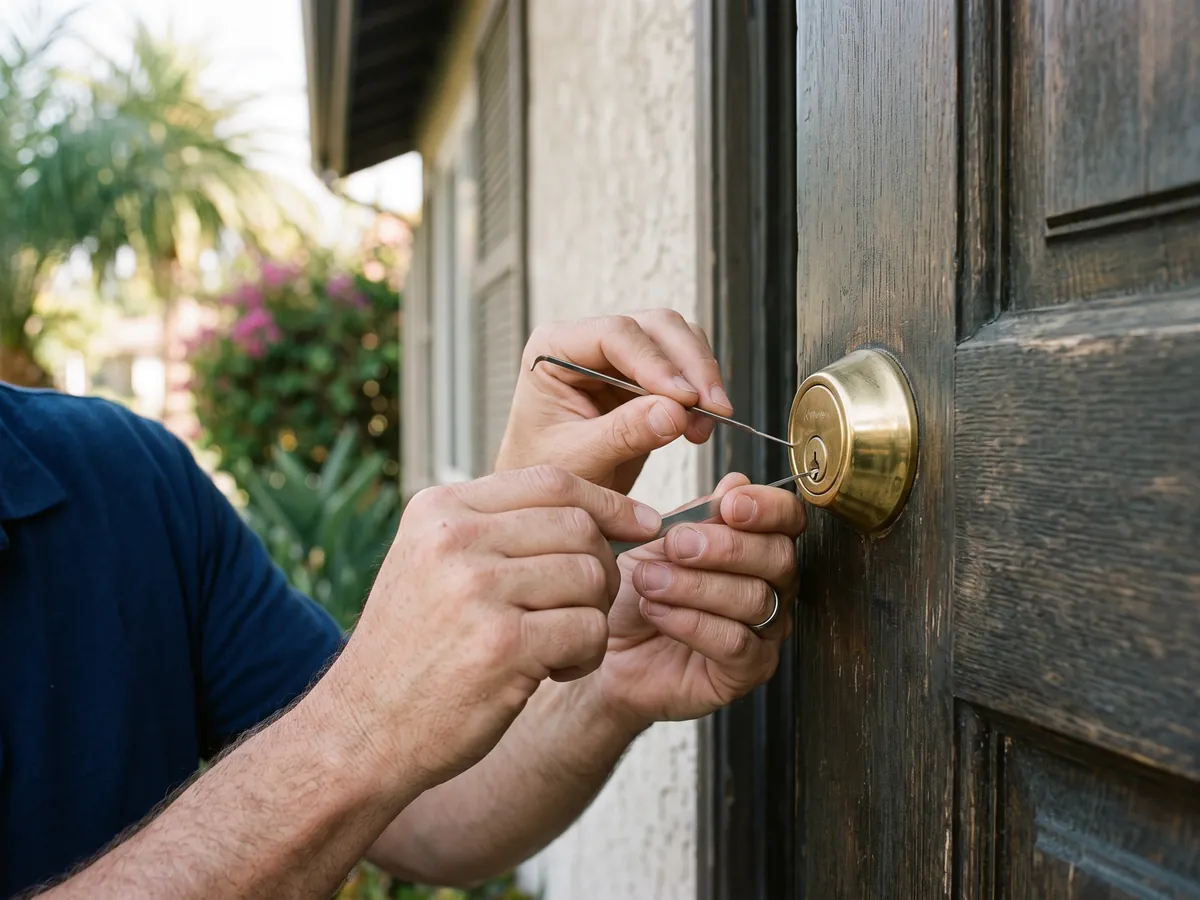
A single-family house in Muscoy rarely has just one way in, and that works in your favor during a house lockout. Before you call, walk the outside: the kitchen side door, the service door into the garage, the slider off the patio, even a back door you never use. Plenty of lockouts end with a door someone forgot to lock. If everything is secure, call Julian's Locksmith at (951) 903-3193. We look at all of your doors too, because a knob-only side entry is usually quicker and cheaper to open than a Grade 1 deadbolt on the front. We check that you live there, open the easiest door without damage, and make sure it still locks properly before we leave.
House lockouts in Muscoy tend to happen at the doors people forget about. The front deadbolt is locked, the keys are in a work jacket, the kitchen side door has only a knob lock, and the garage person door has a spring latch that a credit card could slip. A single-family house here, often a postwar ranch on a big lot, usually has three or four exterior doors and a mix of Kwikset, Schlage and unbranded hardware, so what we do depends on what's actually on the door. Spring latches and simple knob locks usually give way to a gentle bypass with no damage. Deadbolts call for picking or a decoder, and we try those before considering drilling, which is a last resort that we explain first. Some keypad deadbolts have contacts on the outside where a 9-volt battery will wake a lock whose cells died in the heat. If children or pets are inside, tell us right away, and call 911 if anyone is in distress. We ask for ID and proof that you live at the address. A tenant in a back house gets the same check, plus the owner's okay if the lease is unclear.
How this works in Muscoy
The locks on a typical single-family house tell a story, and reading it is half of a quick house lockout. Tract homes in Muscoy built since the 1990s usually came with builder-grade Kwikset or Schlage knobsets and deadbolts, often keyed alike at the front and garage doors. Older ranch houses tend to be a mix: an original knob on the side door, a deadbolt someone added in the 1980s, maybe a newer smart lock on the front that shares nothing with the rest. Kwikset SmartKey cylinders, recognizable by the small slot beside the keyway, resist ordinary picking, so we plan a different approach for them. Mortise locks on older Spanish and Craftsman-era homes have their own mechanics and their own weak points. Higher-end homes may carry Baldwin, Emtek or high-security cylinders that are slow to open by design. Every door is different, so we look before we promise anything, and we explain which door we'd open and why. That inspection also tells us whether you'd benefit from keying the doors alike afterward, so one spare key covers the whole house next time.
What we can do on-site
- Deadbolt lockouts opened by picking. When the deadbolt is thrown, we pick the cylinder rather than drilling it. A tension wrench and pick set each pin at the shear line, the plug turns, and the bolt retracts exactly as it would with your key. On a standard five- or six-pin residential deadbolt that's usually straightforward, and the lock keeps working normally afterward.
- Garage service doors and garage-to-house doors. When a power outage or a dead keypad leaves the garage door down, we don't force the opener. We look at the service door, the door from garage to house and the front entry, then work the lock that's least trouble. On Muscoy homes with an outside emergency release cylinder on the garage door, we can open that lock too.
- Back, side, patio and French doors. Back doors and kitchen side doors often have different locks from the front, installed decades apart. We check all of them during a house lockout, because a 1970s knob on the side door may open far quicker than a modern deadbolt in front. If one of them is an obvious weak spot, we'll mention it once you're back in.
- Broken key in the front door. Keys break most often in locks that were already stiff: worn pins, a misaligned strike that loads the bolt, or a cylinder baked by afternoon sun. After removing the fragment in Muscoy, we find out why it broke. Otherwise the next key will snap in the same lock, maybe at a worse time and with nobody home.
- Keys cut on site after entry. A house lockout is a good reminder that one key isn't enough. After opening your door in Muscoy, we can cut spares for the front, side and garage doors, and if they're keyed differently, we can rekey them so one key fits all. It's quoted separately and completely optional, so skip it if you like.
What's different about Muscoy
In family neighborhoods, house lockouts often involve kids: a toddler who pressed a knob button, a teenager home from school without a key, or a parent locked out in the middle of a bedtime routine. We treat a child inside as a priority and ask questions to confirm they're safe. Afterward, a keypad lock with a separate code for each kid can break the cycle of lost keys in Muscoy.
Inland heat is hard on house locks. Sun-facing doors in Muscoy expand and shift, deadbolts start binding in their strikes, and keypad batteries lose capacity faster than the label suggests. Many summer lockouts turn out to be a smart lock that stalled mid-throw or a key that twisted in a hot cylinder. After opening your door, we can adjust the strike and treat the cylinder with a dry lubricant that won't collect dust.
Horse properties around Muscoy keep a lot of keys in circulation: barn locks, tack rooms, arena gates, plus the house itself. When a house lockout happens in the middle of feeding time, the house keys are often hanging on a ring in the barn or riding in a truck that just left. We open the house and can key the outbuilding padlocks alike so one key covers the property.
Common situations
Here's a familiar version. A man heads out to buy feed with his keys in a work jacket, pulls the front door shut and notices at the truck that the jacket is on a hook inside. His dog is in the house and the afternoon is nearing 98 degrees. The side door has a keypad deadbolt whose batteries have run flat. After confirming he lives there, we power the keypad from outside and open the side door. He gets fresh batteries and a reminder to change them each spring.
- For example, picture a stucco house near Muscoy United Methodist Church where the keypad deadbolt on a west-facing door has been chirping low-battery warnings since July. One evening it goes dark completely. The phone app can't help, and the override key is somewhere in a kitchen drawer. We'd power the keypad from outside through its emergency terminals, let the owner enter the code, then install fresh batteries in the interior pack.
- A typical call: you step out to grab the mail, and your two-year-old, fiddling with the front knob, presses the lock button. The door clicks shut behind you. The child is fine and watching cartoons, but can't reach the deadbolt or understand the button. If you're at all worried, call 911. If the child is calm and safe, we'd treat it as a priority, bypass the knob latch and get you through the door.
- Picture new owners who closed escrow on a resale house in the 92407 ZIP code last month. They've been using the keypad code the sellers left, and nobody ever handed over the deadbolt's override keys. When the batteries die on a Sunday morning, they're stuck on the porch. We'd pick the override cylinder, change the batteries, cut keys for the override and suggest rekeying every exterior door.
How the visit works
- Call and safety check. The call starts with triage. Is a child, an elderly relative or a pet inside? Is anything cooking or running? Then the practical questions: front deadbolt or knob, keypad brand, garage access, and whether your ID is on you or inside the house.
- Quote and honest ETA. Before dispatching, we give you a price based on what you've described and a realistic arrival estimate from where our van actually is. If something at the door turns out to be different, such as a high-security cylinder, we stop and requote before doing anything.
- Arrival and verification. Verification is quick but never optional. We match a name and address, ask a few questions if your ID is out of date, and note the details. House sitters and family members need the owner on the phone, and sometimes written permission by text as well.
- Survey every door. Before touching a lock, we walk the house with you: front, side, back, the garage service door and the door from garage to house. We note which locks are engaged and their brands, then choose the door that opens quickest without damage. Often it isn't the front.
- Non-destructive entry. Entry is calm and careful, especially with kids or pets inside. We keep you at the door so a dog sees a familiar face, and we open slowly. If a cylinder won't pick and drilling becomes necessary, we pause and get your go-ahead before continuing.
- Test, explain and prevent. Once you're in, we test every lock we touched with your key or code, confirm the deadbolt throws fully, and check the strike. Then we explain what caused the lockout and offer fixes, such as spare keys, a rekey or new batteries, each quoted separately.
What affects the cost
- Which lock is holding the door. Count the locks on the door you need opened. One knob, one deadbolt, a keypad lever plus a deadbolt, or a mortise set with a separate cylinder: each additional locked mechanism adds time. We'll often choose a different door with fewer engaged locks to keep your cost down.
- Lock grade and security features. The more security your hardware has, the longer a non-destructive opening can take, and the more a replacement costs if drilling turns out to be unavoidable. In Muscoy homes with restricted-key systems, a drilled cylinder may need to be ordered, so a temporary lock may go in meanwhile.
- Drilling and replacement hardware. If a cylinder is seized, broken internally or too secure to bypass, replacement hardware becomes part of the cost. Matching the finish and keyway of your other doors may affect which lock we recommend. We always tell you before the drill comes out, never after the fact.
Every job gets a clear quote before any work starts. Call (951) 903-3193 with the details and we'll tell you what to expect for your situation in Muscoy.
What to do before we arrive
- Teach older children how to turn the deadbolt thumbturn and the knob button from inside, and practice once together. During a lockout, a calm eight-year-old can often open the door before help arrives. Never pressure a frightened or very young child, and call 911 if their safety is in question.
- Leave a spare house key with a neighbor or relative you trust, not under the mat, in a planter or inside the fake rock by the porch. Burglars check those spots first. If nobody nearby can hold a key, a combination key safe mounted out of sight is a reasonable backup.
- If you rely on the garage to get in, find out whether your opener has battery backup. California has required backup batteries on newly installed residential openers since 2019, but older units in Muscoy may have none. Plan a second way in for outage days.
- If your knob has a push-button or turn-button lock, get in the habit of locking the house with the key from outside instead of pressing the button and pulling the door shut. That one habit prevents most knob-latch lockouts, especially on side and garage doors.
Common errors that cost time and money
- Waiting too long when a child or pet is inside on a hot day. A closed house can heat up quickly during a Muscoy summer, especially with the air conditioning off. If anyone inside might be at risk, call 911 rather than waiting for a locksmith, and sort out the door later.
- Lifting a sliding patio door off its track. Panels are heavy, glass can shatter, and rollers and anti-lift blocks get damaged. Even when it works, the door may never slide or latch correctly again. A swinging door with a pickable lock is nearly always the better way in.
- Climbing through a second-story window or squeezing a child through a dog door. Falls from ladders and ledges send homeowners to emergency rooms, and kids pushed through small openings get stuck, cut or frightened. No lockout is worth that risk when a locksmith or 911 is one phone call away.
Getting to Muscoy
Muscoy is about 5 miles from our San Bernardino base, roughly 11 minutes in light traffic via Belmont Ave and Palm Ave to I-215 South, exit 48 University Pkwy, which passes under the freeway and becomes State St into central Muscoy. When you call, you get an arrival estimate based on where the technician is and the traffic at that moment.
Once the evening commute thins out on Highland Avenue, drive times usually shrink. That makes an evening call before closing a practical option for non-urgent jobs that you couldn't fit into the workday.
About Muscoy: The word Muscupiabe traces to a Serrano term usually translated as place of little pines.
| Neighborhoods | Kerry Street, Kern Street and Nolan Street, Darby Street and Mallory Street, Macy Street civic core, State Street corridor, Lytle Creek wash edge |
|---|---|
| ZIP codes | 92407 |
| Main routes | I-215, SR-210, State Street, University Parkway |
| From our San Bernardino base | about 5 miles via Belmont Ave and Palm Ave to I-215 South, exit 48 University Pkwy, which passes under the freeway and becomes State St into central Muscoy |
We start at half past six every morning, seven days a week. Every day the phones stay on until 11:30 at night, so an after-dinner lockout is usually still within reach. Saturday is no exception, with service ending at 11:30 at night. Call early that day if the problem can't wait until Sunday morning.
California's Locksmith Act requires a signed work order when a locksmith opens a residence or commercial property, recording the requester's name, address, phone number, date of birth and ID number. Business and Professions Code §6980.55 has us keep those records for two years, available to BSIS and peace officers on request.
Locked out in Muscoy?
Call (951) 903-3193 with the address and what's locked. You'll get an arrival estimate and a quote before anyone heads out, and when we arrive we'll ask for ID that ties you to the property. If a child or pet is shut inside a hot car or building, call 911 first.
Frequently asked questions
Can you make a new key after opening my door?
Yes. Our van carries key machines, so we can cut a key from the lock's code, decode the cylinder, or rekey the lock to a new key on site. If you have several doors in Muscoy with different keys, we can rekey them so one key fits all, quoted separately from the lockout itself.
My child is locked inside. Should I call you or 911?
Call 911 if a young child is alone inside, can't open the door, or could be in any kind of danger. Fire departments serving Muscoy can force entry and often arrive faster than any locksmith. If the child is safe and calm, say watching TV behind a door that simply locked, call us at (951) 903-3193 and we'll treat the call as a priority.
How much does a house lockout cost in Muscoy?
It depends on which lock is engaged, the lock's security level, whether drilling is needed and how far we drive. A knob latch is usually the simplest job; a high-security deadbolt or a failed smart lock takes longer. We don't list prices online, but you get a quote on the phone before we come out, and we requote before doing anything different.
Someone inside won't let me in. Can you open the door?
No. If a person inside the house is refusing entry, it's a police or civil matter, even if you live there too. We won't force entry against an occupant. Call law enforcement if there's a safety concern or a dispute about who has the right to be there, and talk to an attorney about regaining access.
Do you need to drill my lock?
Rarely. We drill only when a cylinder is seized, broken internally, or is a high-security model where other methods aren't practical. You'll hear the reason and the cost of replacement hardware first. When we do drill, we install a new lock during the same visit, so your house isn't left unsecured overnight.
My keypad lock is dead. Can you open it without breaking it?
Usually. Many keypad deadbolts can be powered briefly from outside, through 9-volt terminals on some Yale and Lockly models or a USB port on others, so you can enter your code. If the lock has a key override, we can pick that cylinder. Afterward we replace the batteries and look at why they died early.
How far is Muscoy from your base?
Muscoy is about 5 miles from our San Bernardino base, roughly 11 minutes in light traffic. Arrival time depends on traffic and on the job the technician is finishing, so we give you an estimate on the phone before you commit.
Related services in Muscoy
- Home Lockout in Muscoy
- Locked Out of House in Muscoy
- Mobile Locksmith for House Lockout in Muscoy
- Emergency Locksmith in Muscoy
- Rekey Locks after Losing Keys in Muscoy
- Smart Lock Troubleshooting in Muscoy
- Broken Key Stuck in Door in Muscoy
- Spare House Key in Muscoy
- Deadbolt Replacement in Muscoy
- House Rekey in Muscoy
House Lockout in nearby cities
- House Lockout in RialtoSan Bernardino County
- House Lockout in San BernardinoSan Bernardino County
- House Lockout in Glen HelenSan Bernardino County
- House Lockout in DevoreSan Bernardino County
- House Lockout in ColtonSan Bernardino County
- House Lockout in BloomingtonSan Bernardino County
- House Lockout in North FontanaSan Bernardino County
- House Lockout in FontanaSan Bernardino County