
Lakewood, Los Angeles County
Lakewood House Lockouts: Deadbolts, Keypads and Garage Doors
Short answer: If a young child or a vulnerable adult is alone inside, or a pan is sitting on a lit burner, call 911 before anyone else; firefighters can force entry and are usually closer than any locksmith. For an ordinary house lockout in Lakewood, even with a dog barking behind the door, call (951) 903-3193. We confirm residence and open the door without damage.
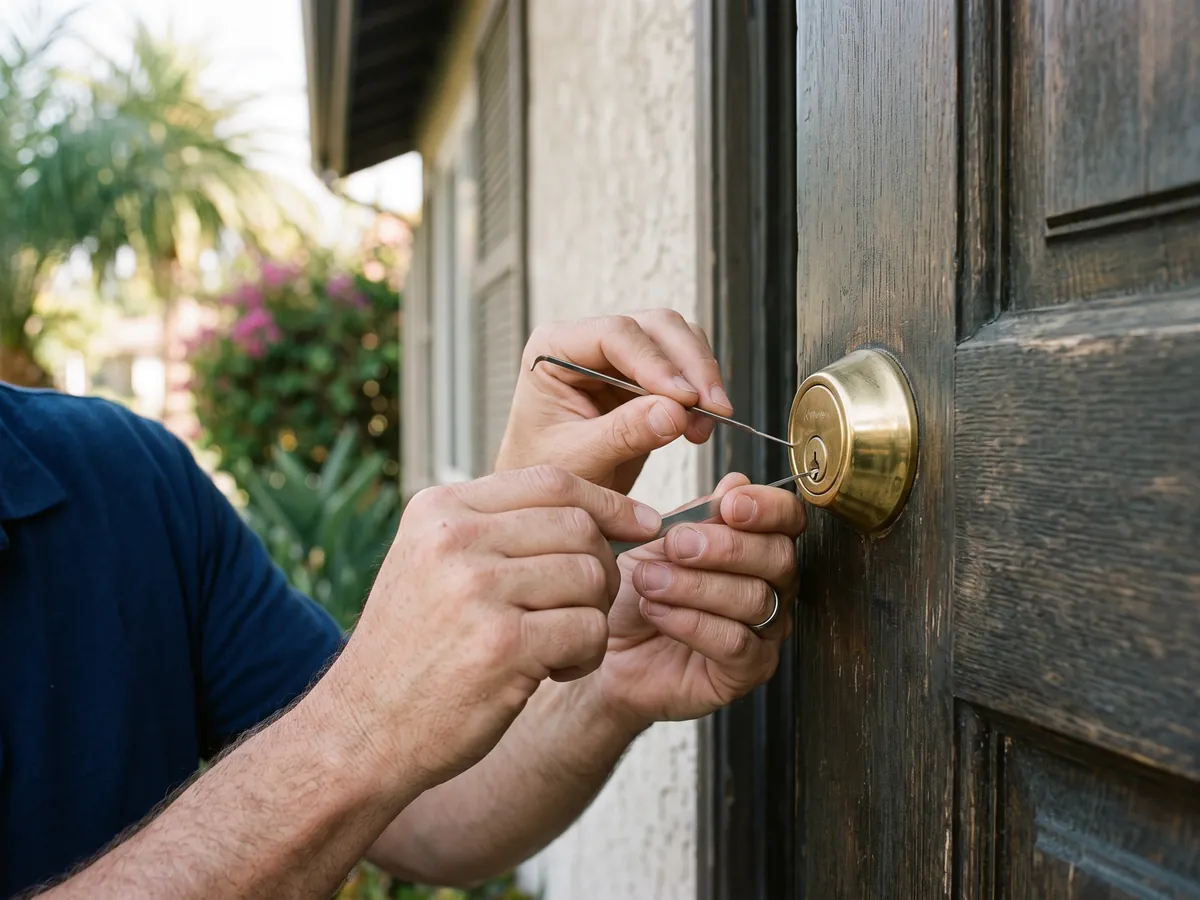
Most house lockouts in Lakewood start the same way: the door swings shut, and either the knob was set to lock or someone turned the deadbolt on the way out. Those are two very different problems. A spring latch in a knob or lever can often be slipped or bypassed with thin tools, as long as its anti-shim plunger isn't doing its job. A deadbolt throws a solid steel bolt about an inch into the frame, and the usual non-destructive answer is picking the cylinder pin by pin. Tell us which lock you think is engaged when you call (951) 903-3193. It helps us bring the right tools, choose the right door and give you a more accurate quote before we drive out.
A single-family house in Lakewood gives a locksmith more options than an apartment does, which usually works in your favor. The postwar tract homes typically have a front door, a door from the garage, a rear slider and often a gate into the fenced backyard. We look for the weakest lock among them, which tends to be a basic knob on a side door or a latch nobody ever upgraded, and open that one with picks or a bypass tool. Deadbolts are the harder case. A Schlage or Kwikset bolt that was thrown when the door closed has to be picked or decoded, which takes patience but leaves the door unmarked. Garage keypads cause their own calls: a dead battery or sun-faded buttons can keep the overhead door shut when your keys are inside. If a child, an older relative or a pet is shut in the house, tell us when you call. Someone in distress is a 911 call first, and an animal in a closed, hot garage is just as pressing. We also check ID and proof that you live at the address before any door opens.
House Lockout in Lakewood: what to expect
The locks on a typical single-family house tell a story, and reading it is half of a quick house lockout. Tract homes in Lakewood built since the 1990s usually came with builder-grade Kwikset or Schlage knobsets and deadbolts, often keyed alike at the front and garage doors. Older ranch houses tend to be a mix: an original knob on the side door, a deadbolt someone added in the 1980s, maybe a newer smart lock on the front that shares nothing with the rest. Kwikset SmartKey cylinders, recognizable by the small slot beside the keyway, resist ordinary picking, so we plan a different approach for them. Mortise locks on older Spanish and Craftsman-era homes have their own mechanics and their own weak points. Higher-end homes may carry Baldwin, Emtek or high-security cylinders that are slow to open by design. Every door is different, so we look before we promise anything, and we explain which door we'd open and why. That inspection also tells us whether you'd benefit from keying the doors alike afterward, so one spare key covers the whole house next time.
Work included on a typical visit
- Deadbolt lockouts opened by picking. When the deadbolt is thrown, we pick the cylinder rather than drilling it. A tension wrench and pick set each pin at the shear line, the plug turns, and the bolt retracts exactly as it would with your key. On a standard five- or six-pin residential deadbolt that's usually straightforward, and the lock keeps working normally afterward.
- Keypad and smart lock lockouts. Smart deadbolts such as Schlage Encode, Kwikset Halo and Yale Assure fail in a few predictable ways: depleted batteries, a motor that stalls against a tight strike, or an app and Wi-Fi link that drops out. We figure out which one it is at your door in Lakewood, open the door, then fix the cause rather than just the symptom.
- Back, side, patio and French doors. In Lakewood, a lot of house lockouts begin in the backyard: someone steps onto the patio, a child flips the slider latch inside, and every other door is already locked. We come through the side gate if you can open it, then work the easiest swinging door. Tell us about dogs in the yard before we arrive.
- Broken key in the front door. Keys break most often in locks that were already stiff: worn pins, a misaligned strike that loads the bolt, or a cylinder baked by afternoon sun. After removing the fragment in Lakewood, we find out why it broke. Otherwise the next key will snap in the same lock, maybe at a worse time and with nobody home.
- Rekeying after lost house keys. If a stolen purse or wallet caused your lockout, the thief may have both your keys and your address from your ID. That's a strong reason to rekey the same day, and to change garage keypad codes and smart lock user codes too. We'll walk each exterior door with you and explain what needs changing.
Local factors in Lakewood
Older houses in Lakewood often carry a patchwork of locks: an original knob on the side door, a deadbolt added decades later, maybe a mortise lock on a front door that predates both. During a house lockout that variety helps, because one of those doors is usually easy to open without damage. We also run into warped wood doors and painted-over strikes that bind, so we check alignment once you're back inside.
Early commuters in Lakewood tend to lock themselves out before sunrise: stepping outside to start the car, juggling a lunch bag and coffee, and letting a self-latching door close behind them. Our day starts at 6:30 a.m. seven days a week. If you're locked out before work, call right away, and if your car keys are inside the house too, we'll open the house first.
In family neighborhoods, house lockouts often involve kids: a toddler who pressed a knob button, a teenager home from school without a key, or a parent locked out in the middle of a bedtime routine. We treat a child inside as a priority and ask questions to confirm they're safe. Afterward, a keypad lock with a separate code for each kid can break the cycle of lost keys in Lakewood.
Common situations
Say you step out to water the front lawn at a house near Bolivar Park, off Del Amo Boulevard, and a gust pushes the door shut with the deadbolt already thrown. The keys are on the counter and the dog is inside. The dog is fine, so we begin by testing the garage side door and the sliding glass door for an easier way in. If the deadbolt has to be picked, we do that, then test the lock. We ask to see mail addressed to the house first.
- Imagine a jogger whose house keys, garage remote and a gym tag printed with her address slip out of a jacket pocket on a trail near Mayfair Park. She borrows a phone and calls from the trailhead. We'd meet her at the house, open the deadbolt, confirm residence with her ID and mail inside, and offer to rekey every exterior lock and reset the opener that same afternoon.
- An early-morning example: a commuter off Paramount Boulevard starts the car, steps back inside for a lunch bag, then walks out again and lets the front door swing shut. The knob was locked; the car key is in hand, but the house keys and a work badge sit on the kitchen counter. We'd open the house with a latch tool so the day still starts close to schedule.
- Consider a house sitter feeding cats at a home near Lakewood Center while the owners travel. The keypad code the owners texted doesn't work; they changed it before leaving and forgot to say so. Before opening anything, we'd reach the owners by phone, confirm the sitter's name against an ID, and only then work on the lock. If no owner could be reached, we'd decline, frustrating as that is.
From your call to the finished job
- Call and safety check. The call starts with triage. Is a child, an elderly relative or a pet inside? Is anything cooking or running? Then the practical questions: front deadbolt or knob, keypad brand, garage access, and whether your ID is on you or inside the house.
- Quote and honest ETA. We quote by situation, not guesswork: knob latch, deadbolt, keypad, broken key or likely drilling. Then we tell you when to expect us. If it's late in our day, we'll say plainly whether we can reach you before closing.
- Arrival and verification. When we arrive, we check a photo ID that shows the property address. If your wallet is inside, we open the door and then confirm with a bill, lease, escrow papers or your ID before we leave. Our work order records who requested the entry.
- Survey every door. A quick look around the house in Lakewood can save you time and money. A knob-only side door or a keypad that only needs power beats picking a Grade 1 deadbolt. We'll explain which door we're choosing and why, so nothing about the job surprises you.
- Non-destructive entry. Entry is calm and careful, especially with kids or pets inside. We keep you at the door so a dog sees a familiar face, and we open slowly. If a cylinder won't pick and drilling becomes necessary, we pause and get your go-ahead before continuing.
- Test, explain and prevent. Before leaving, we confirm ownership if we couldn't at the start, run each lock several times, and look for the real cause: a misaligned strike, an auto-lock setting, a worn key. You decide whether anything else gets fixed today, and nothing is added without asking.
How we quote the job
- Lock grade and security features. Builder-grade Kwikset and Schlage cylinders tend to open quickly. Grade 1 deadbolts with spool or serrated security pins take longer, and patented high-security cylinders such as Medeco, Mul-T-Lock or Schlage Primus may require specialized methods. Better locks protect you every day, so the extra time during a lockout is a fair trade.
- Drilling and replacement hardware. Replacement cost depends on what goes back in the door: a standard deadbolt, a Grade 1 model, a smart lock you already bought, or a restricted cylinder. Keying the new lock to match your existing key is often possible in Lakewood, and it saves you from carrying two keys afterward.
- Extras after entry. Small fixes often prevent the next lockout: adjusting a strike so the deadbolt throws freely, replacing a worn latch, resetting a smart lock's auto-lock timer. We price each one separately at your house in Lakewood so you can choose only what matters to you.
Every job gets a clear quote before any work starts. Call (951) 903-3193 with the details and we'll tell you what to expect for your situation in Lakewood.
Mistakes to avoid
- Climbing through a second-story window or squeezing a child through a dog door. Falls from ladders and ledges send homeowners to emergency rooms, and kids pushed through small openings get stuck, cut or frightened. No lockout is worth that risk when a locksmith or 911 is one phone call away.
- Prying at the strike with a screwdriver or pry bar. Exterior doors in Lakewood homes usually hang in softwood jambs that split easily, and a split jamb means the deadbolt can no longer hold. You end up paying for frame repair, a strike and maybe a door, plus the lockout.
- Waiting too long when a child or pet is inside on a hot day. A closed house can heat up quickly during a Lakewood summer, especially with the air conditioning off. If anyone inside might be at risk, call 911 rather than waiting for a locksmith, and sort out the door later.
Practical tips before you call
- Keep a photo of your ID and a recent utility bill in a secure album on your phone. If your wallet is locked inside, a digital copy helps a locksmith verify residence sooner, although we may still ask to see the originals once the door is open.
- Turn off auto-lock on a smart deadbolt, or lengthen its delay, before yard work, unloading groceries or carrying trash to the curb. Many lockouts in Lakewood happen in the few seconds a door is out of sight. Keep your phone or key on you whenever you step out, even briefly.
- Pay attention to a deadbolt that needs you to push or pull the door before it throws. That misaligned strike will eventually jam, snap a key or stall a smart lock motor. Getting it adjusted early is a small job compared with a lockout in Lakewood at the end of a long day.
- Leave a spare house key with a neighbor or relative you trust, not under the mat, in a planter or inside the fake rock by the porch. Burglars check those spots first. If nobody nearby can hold a key, a combination key safe mounted out of sight is a reasonable backup.
Reaching Lakewood
Lakewood is about 62 miles from our San Bernardino base, roughly 68 minutes in light traffic via University Parkway to I-215 South. When you call, you get an arrival estimate based on where the technician is and the traffic at that moment.
Traffic matters more than mileage. We check conditions on I-605 and its connecting routes before quoting you a time, and we don't pretend a long drive through heavy congestion is a short one.
About Lakewood: On March 24, 1950, the first day of sales, an estimated 30,000 people lined up to walk through seven model houses at the Lakewood Park sales office.
| Neighborhoods | Bolivar Park area, Mayfair Park area, Mayfair, Lakewood Center area, Monte Verde Park area, Biscailuz Park area |
|---|---|
| ZIP codes | 90712, 90713, 90715 |
| Main routes | I-605, I-405, SR-91, Lakewood Boulevard |
| From our San Bernardino base | about 62 miles via University Parkway to I-215 South, then I-10 West through Rialto, Fontana, Ontario, Pomona and West Covina to I-605 South, past I-5 and SR-91 to the South Street, Del Amo Boulevard or Carson Street exits; alternate is SR-91 West from Riverside through Corona and Anaheim to I-605 South when the 10 is jammed |
Planning a non-urgent job like a rekey, a smart lock install or a safe combination change? Every day of the week, appointments are available from first thing in the morning into the late evening, with 11:30 p.m. as closing time. Fridays and Saturdays follow the same schedule.
Safes get the same scrutiny. Before drilling or manipulating one, we need reason to believe it's yours: a purchase record, the fact that it sits in your home or business, or estate paperwork if you inherited it. A safe exists to keep people out, so proof of ownership isn't optional.
Locked out in Lakewood?
Call (951) 903-3193 with the address and what's locked. You'll get an arrival estimate and a quote before anyone heads out, and when we arrive we'll ask for ID that ties you to the property. If a child or pet is shut inside a hot car or building, call 911 first.
Frequently asked questions
Is it faster to open the front door or the side door?
Often the side or garage door. Those frequently have only a knob or lever lock, which can be bypassed more quickly than a Grade 1 deadbolt on the front. During a house lockout in Lakewood, we check every door and choose the one that's quickest to open without damage, unless you'd prefer a particular entry.
How much does a house lockout cost in Lakewood?
It depends on which lock is engaged, the lock's security level, whether drilling is needed and how far we drive. A knob latch is usually the simplest job; a high-security deadbolt or a failed smart lock takes longer. We don't list prices online, but you get a quote on the phone before we come out, and we requote before doing anything different.
Will you damage my door or lock?
In most house lockouts, no. We pick the cylinder, bypass a latch or power a dead keypad, and the lock keeps working afterward. Drilling is reserved for seized, broken or high-security locks with no practical alternative, and we explain why and quote replacement hardware before we start. Damage usually comes from kicking, prying or breaking a window.
My dog is inside. Is that an emergency?
Usually it's urgent rather than an emergency, as long as the air conditioning is running or the house is cool. If it's hot and the pet may be in distress, call 911 or animal services. Otherwise call us, mention the dog, and keep a leash ready at the door; we'll open slowly so it doesn't run past us.
My child is locked inside. Should I call you or 911?
Call 911 if a young child is alone inside, can't open the door, or could be in any kind of danger. Fire departments serving Lakewood can force entry and often arrive faster than any locksmith. If the child is safe and calm, say watching TV behind a door that simply locked, call us at (951) 903-3193 and we'll treat the call as a priority.
Someone inside won't let me in. Can you open the door?
No. If a person inside the house is refusing entry, it's a police or civil matter, even if you live there too. We won't force entry against an occupant. Call law enforcement if there's a safety concern or a dispute about who has the right to be there, and talk to an attorney about regaining access.
How far is Lakewood from your base?
Lakewood is about 62 miles from our San Bernardino base, roughly 68 minutes in light traffic. Arrival time depends on traffic and on the job the technician is finishing, so we give you an estimate on the phone before you commit.
Related services in Lakewood
- Home Lockout in Lakewood
- Locked Out of House in Lakewood
- Mobile Locksmith for House Lockout in Lakewood
- Emergency Locksmith in Lakewood
- Rekey Locks after Losing Keys in Lakewood
- Smart Lock Troubleshooting in Lakewood
- Broken Key Stuck in Door in Lakewood
- Spare House Key in Lakewood
- Deadbolt Replacement in Lakewood
- House Rekey in Lakewood
House Lockout in nearby cities
- House Lockout in ArtesiaLos Angeles County
- House Lockout in BellflowerLos Angeles County
- House Lockout in Hawaiian GardensLos Angeles County
- House Lockout in CerritosLos Angeles County
- House Lockout in La PalmaOrange County
- House Lockout in Los AlamitosOrange County
- House Lockout in NorwalkLos Angeles County
- House Lockout in CypressOrange County