
Brea, Orange County
Locked Out of Your House in Brea? Here's How We Get You In
Short answer: What's actually locked decides how a house lockout in Brea goes. A door held only by a knob or lever latch can often be bypassed quickly. A thrown deadbolt usually gets picked, which takes longer on Grade 1 or security-pinned cylinders. A keypad lock may only need emergency battery power. We look at every door on the house before choosing a method.
A house lockout feels different when someone small is on the other side of the door. If a young child is alone inside, or anyone is in danger from heat, smoke or a medical problem, dial 911 first; fire crews in Brea are equipped to force entry and they're closer than we are. When the situation is urgent but not dangerous, such as a dog pacing by the front window or an older child who can't reach the deadbolt, call Julian's Locksmith at (951) 903-3193 and tell us who's inside. We'll give you an honest arrival estimate, and once we're there, we open the door slowly so a pet doesn't bolt past us into the street.
A house lockout in Brea is rarely just lost keys. In Country Hills and Greenbriar, where many homes date to the postwar and later-20th-century building years, the usual culprit is a front door with a worn knob lock and an older deadbolt, plus a garage side door that locks every time it closes. In Blackstone and other recent neighborhoods, it is more often a keypad deadbolt with dead batteries or a lock that lost its code. We start by asking which doors are in play. The garage entry and the back door often have simpler hardware than the front, and a lockout is a good moment to learn that. Wherever we open, we try non-destructive methods first: picking, a latch bypass or, on a keypad lock, a battery fix or an override key. If a pet is inside on a hot day, say so on the call. A child in distress is a 911 call. Before the door opens, we confirm that you live there with photo ID and a document that shows the address.
How this works in Brea
The locks on a typical single-family house tell a story, and reading it is half of a quick house lockout. Tract homes in Brea built since the 1990s usually came with builder-grade Kwikset or Schlage knobsets and deadbolts, often keyed alike at the front and garage doors. Older ranch houses tend to be a mix: an original knob on the side door, a deadbolt someone added in the 1980s, maybe a newer smart lock on the front that shares nothing with the rest. Kwikset SmartKey cylinders, recognizable by the small slot beside the keyway, resist ordinary picking, so we plan a different approach for them. Mortise locks on older Spanish and Craftsman-era homes have their own mechanics and their own weak points. Higher-end homes may carry Baldwin, Emtek or high-security cylinders that are slow to open by design. Every door is different, so we look before we promise anything, and we explain which door we'd open and why. That inspection also tells us whether you'd benefit from keying the doors alike afterward, so one spare key covers the whole house next time.
How we can help in Brea
- Garage service doors and garage-to-house doors. The side door into your garage often has the oldest, weakest lock on the property, which makes it a useful entry point during a house lockout. Once inside the garage, the door into the house may be knob-only or unlocked. We open the service door without damage and check that both doors lock properly before we leave.
- Back, side, patio and French doors. In Brea, a lot of house lockouts begin in the backyard: someone steps onto the patio, a child flips the slider latch inside, and every other door is already locked. We come through the side gate if you can open it, then work the easiest swinging door. Tell us about dogs in the yard before we arrive.
- Child or pet locked inside. If a child is alone inside and can't open the door, or a pet is in danger from heat, call 911 first. Firefighters can force entry and are often close by. For situations that are urgent but safe, call us next: we move these calls up our list and give you a straight answer about how soon we can arrive.
- Broken key in the front door. Keys break most often in locks that were already stiff: worn pins, a misaligned strike that loads the bolt, or a cylinder baked by afternoon sun. After removing the fragment in Brea, we find out why it broke. Otherwise the next key will snap in the same lock, maybe at a worse time and with nobody home.
- Rekeying after lost house keys. If a stolen purse or wallet caused your lockout, the thief may have both your keys and your address from your ID. That's a strong reason to rekey the same day, and to change garage keypad codes and smart lock user codes too. We'll walk each exterior door with you and explain what needs changing.
Local factors in Brea
Older houses in Brea often carry a patchwork of locks: an original knob on the side door, a deadbolt added decades later, maybe a mortise lock on a front door that predates both. During a house lockout that variety helps, because one of those doors is usually easy to open without damage. We also run into warped wood doors and painted-over strikes that bind, so we check alignment once you're back inside.
Early commuters in Brea tend to lock themselves out before sunrise: stepping outside to start the car, juggling a lunch bag and coffee, and letting a self-latching door close behind them. Our day starts at 6:30 a.m. seven days a week. If you're locked out before work, call right away, and if your car keys are inside the house too, we'll open the house first.
Newer tract homes in Brea usually came with builder-grade Kwikset or Schlage hardware, frequently SmartKey cylinders that resist standard picking, and sometimes a keypad deadbolt programmed by the builder. When they get locked out, many new owners discover they never received the override keys or the master code. We open the door, then help reset codes and rekey, since trades, agents and previous owners may still hold keys.
Situations this covers
Imagine a breezy October afternoon in Olinda Ranch. You carry groceries through the side door, set it on the latch with your hip, and a Santa Ana gust swings it shut. The keys are on the kitchen counter and the front deadbolt is locked. The side door has a simple spring latch, so we would slip it with a bypass tool and leave the finish untouched. Once you are back inside, we would suggest a strike adjustment or a latch guard so the next gust cannot do the same thing.
- Picture new owners who closed escrow on a resale house in the 92821 ZIP code last month. They've been using the keypad code the sellers left, and nobody ever handed over the deadbolt's override keys. When the batteries die on a Sunday morning, they're stuck on the porch. We'd pick the override cylinder, change the batteries, cut keys for the override and suggest rekeying every exterior door.
- For example, a tenant in a single-family rental gets home from an evening shift and finds the key won't turn because the old deadbolt has worn out inside. The landlord lives out of state and isn't answering. With a lease and ID showing the address, we'd open the door, then let tenant and landlord know the deadbolt needs replacing, since California landlords must keep entry deadbolts working.
- A typical call: you step out to grab the mail, and your two-year-old, fiddling with the front knob, presses the lock button. The door clicks shut behind you. The child is fine and watching cartoons, but can't reach the deadbolt or understand the button. If you're at all worried, call 911. If the child is calm and safe, we'd treat it as a priority, bypass the knob latch and get you through the door.
From your call to the finished job
- Call and safety check. When you call (951) 903-3193, we first ask whether anyone inside is in danger: a child alone, a burner on, a bath running. If so, we'll tell you to call 911. Otherwise we ask which door, which lock and where you're standing in Brea.
- Quote and honest ETA. You'll know what the house lockout will cost and roughly when we'll arrive before you agree to anything. We base the estimate on real traffic toward Brea, not a sales promise. If you find a key or a neighbor turns up with a spare, just call back and cancel.
- Arrival and verification. When we arrive, we check a photo ID that shows the property address. If your wallet is inside, we open the door and then confirm with a bill, lease, escrow papers or your ID before we leave. Our work order records who requested the entry.
- Survey every door. Before touching a lock, we walk the house with you: front, side, back, the garage service door and the door from garage to house. We note which locks are engaged and their brands, then choose the door that opens quickest without damage. Often it isn't the front.
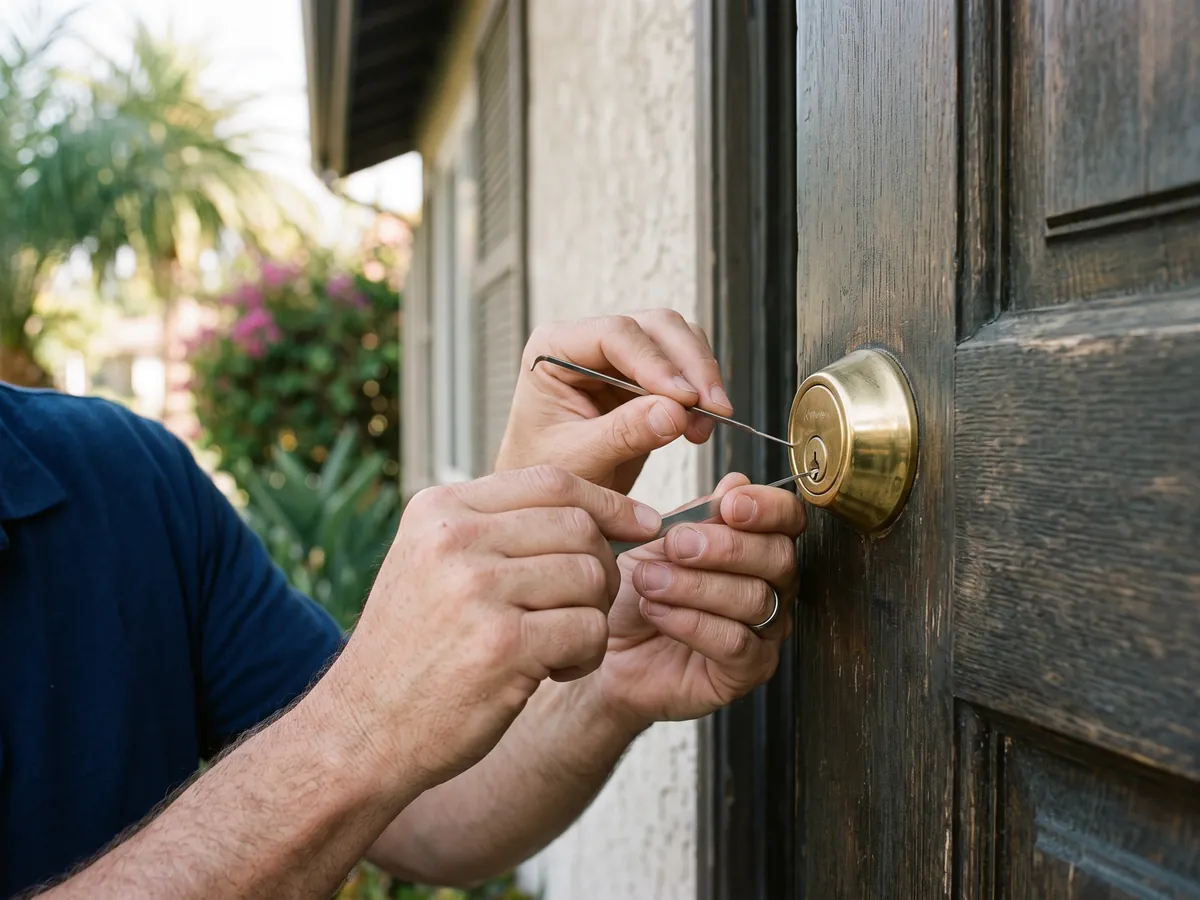
- Non-destructive entry. Most house lockouts in Brea end at this step with a pick and tension wrench or a latch tool. The door opens, the lock still works and you're inside. If a keypad needs power, we use its backup terminals or override cylinder, then swap the batteries right away.
- Test, explain and prevent. The last step is preventing the next call. We can cut a spare, adjust a self-closing garage entry door, reset a keypad master code, or rekey so one key fits every door of your home in Brea. Nothing extra happens without a quote and your yes.
What affects the cost
- Keypad or smart lock condition. A smart lock with dead batteries is usually a small job: emergency power, entry, fresh batteries. A motor jammed against the strike or a lock with a failed circuit board takes longer and may lead to repair or replacement. We diagnose before quoting anything beyond the opening itself.
- Drilling and replacement hardware. Most house lockouts end without new parts. When drilling is necessary, the cost includes the replacement cylinder or deadbolt, which ranges from basic residential grade to high-security. We quote the hardware options before drilling, and you can choose to match your other locks or upgrade.
- Extras after entry. The opening itself is one charge. Spare keys, rekeying, keypad battery replacement, strike adjustment or a new lock are separate and optional. Doing them while we're already at the house usually costs less than a second visit, but you decide what's worth doing.
Every job gets a clear quote before any work starts. Call (951) 903-3193 with the details and we'll tell you what to expect for your situation in Brea.
Mistakes to avoid
- Hiring the first ad that promises a very low price on the phone. Some unlicensed operators quote a small price, drill immediately and then charge far more. Ask for the California locksmith license number, check it at search.dca.ca.gov, and get a full quote before work starts.
- Kicking or shouldering the door. Done hard enough to work, it splinters the frame, tears the strike out and can crack the door slab. Done badly, it hurts you and leaves a damaged door that still won't open. A properly installed deadbolt is designed to resist exactly that.
- Breaking a window to get in. Replacement glass, especially dual-pane or tempered, usually costs more than a lockout service, and broken glass causes real injuries when people reach through to a latch. The house is also left unsecured until a glass shop can get there.
Practical tips before you call
- Teach older children how to turn the deadbolt thumbturn and the knob button from inside, and practice once together. During a lockout, a calm eight-year-old can often open the door before help arrives. Never pressure a frightened or very young child, and call 911 if their safety is in question.
- Find out today how your keypad lock gets emergency power. Look under the keypad for 9-volt terminals or a USB port, or locate the override key and label it. Knowing this turns a dead-battery lockout into a short inconvenience instead of a service call.
- Interior privacy knobs on bathrooms and bedrooms have an emergency release, usually a small hole in the outside knob. Keep the little pin tool on top of the door trim. When a toddler locks themselves in a bathroom, that tool solves it in seconds without anyone calling for help.
- If you rely on the garage to get in, find out whether your opener has battery backup. California has required backup batteries on newly installed residential openers since 2019, but older units in Brea may have none. Plan a second way in for outage days.
Getting to Brea
Brea is about 51 miles from our San Bernardino base, roughly 55 minutes in light traffic via I-215 South briefly to SR-210 West. When you call, you get an arrival estimate based on where the technician is and the traffic at that moment.
Traffic matters more than mileage. We check conditions on Lambert Road and its connecting routes before quoting you a time, and we don't pretend a long drive through heavy congestion is a short one.
About Brea: Downtown Brea was rebuilt on about 50 acres around Brea Boulevard and Birch Street in a redevelopment that opened in 2000.
| Neighborhoods | Blackstone, Carbon Canyon, Olinda Village, Downtown Brea, Arovista, Olinda Ranch |
|---|---|
| ZIP codes | 92821, 92823 |
| Main routes | SR-57, SR-90, SR-142, Brea Boulevard |
| From our San Bernardino base | about 51 miles via I-215 South briefly to SR-210 West (Foothill Freeway) through Rialto, Fontana, Rancho Cucamonga and La Verne, then SR-57 South (Orange Freeway) through Pomona and Diamond Bar and over the Puente Hills to the Lambert Road or Imperial Highway (SR-90) exits; alternate via I-15 South and SR-60 West to SR-57 South, or SR-60 West to SR-71 South and Carbon Canyon Road (SR-142) through Chino Hills for Olinda Village and Olinda Ranch |
Late calls are fine, up to a point. We run until 11:30 p.m. every night, but a call at 11:10 from a city far from our base may be booked for the next morning rather than rushed. We'll tell you which it is on the phone, plainly, so you can decide whether to wait for us or make other arrangements.
California's Locksmith Act requires a signed work order when a locksmith opens a residence or commercial property, recording the requester's name, address, phone number, date of birth and ID number. Business and Professions Code §6980.55 has us keep those records for two years, available to BSIS and peace officers on request.
Locked out in Brea?
Call (951) 903-3193 with the address and what's locked. You'll get an arrival estimate and a quote before anyone heads out, and when we arrive we'll ask for ID that ties you to the property. If a child or pet is shut inside a hot car or building, call 911 first.
Frequently asked questions
My keypad lock is dead. Can you open it without breaking it?
Usually. Many keypad deadbolts can be powered briefly from outside, through 9-volt terminals on some Yale and Lockly models or a USB port on others, so you can enter your code. If the lock has a key override, we can pick that cylinder. Afterward we replace the batteries and look at why they died early.
Is it faster to open the front door or the side door?
Often the side or garage door. Those frequently have only a knob or lever lock, which can be bypassed more quickly than a Grade 1 deadbolt on the front. During a house lockout in Brea, we check every door and choose the one that's quickest to open without damage, unless you'd prefer a particular entry.
My child is locked inside. Should I call you or 911?
Call 911 if a young child is alone inside, can't open the door, or could be in any kind of danger. Fire departments serving Brea can force entry and often arrive faster than any locksmith. If the child is safe and calm, say watching TV behind a door that simply locked, call us at (951) 903-3193 and we'll treat the call as a priority.
What if the key broke off in my lock?
Don't try to dig it out with tweezers or glue; that usually pushes the fragment deeper. We extract the broken piece with thin hooked tools, open the lock and cut a new key. Then we check why it broke, since stiff cylinders and misaligned strikes tend to break the next key the same way.
What ID do I need for a house lockout?
A photo ID showing the property address is easiest. If your ID has an old address or is sitting inside the house, we can open the door and verify with mail, a utility bill, a lease, a property tax bill or closing paperwork before we leave. If nothing connects you to the house, we won't complete the job.
Can a house sitter or family member call you?
They can, but we'll need the homeowner's authorization. Usually that means reaching the owner by phone, matching names, and having the person at the door show their own ID. If we can't reach anyone who owns or lives in the house, we won't open it. That rule protects your home too when you're the one traveling.
How far is Brea from your base?
Brea is about 51 miles from our San Bernardino base, roughly 55 minutes in light traffic. Arrival time depends on traffic and on the job the technician is finishing, so we give you an estimate on the phone before you commit.
Related services in Brea
House Lockout in nearby cities
- House Lockout in La HabraOrange County
- House Lockout in PlacentiaOrange County
- House Lockout in Rowland HeightsLos Angeles County
- House Lockout in FullertonOrange County
- House Lockout in La Habra HeightsLos Angeles County
- House Lockout in Yorba LindaOrange County
- House Lockout in AnaheimOrange County
- House Lockout in City of IndustryLos Angeles County