
Norwalk, Los Angeles County
Locked Out of Your House in Norwalk? Here's How We Get You In
Short answer: For a house lockout in Norwalk, Julian's Locksmith drives to your door, checks a photo ID or other proof that you live there, and opens the house without breaking anything in most cases. We usually pick the deadbolt or bypass a knob latch. Drilling is a last resort, and we quote any replacement hardware before touching it. Call (951) 903-3193 for an honest ETA.
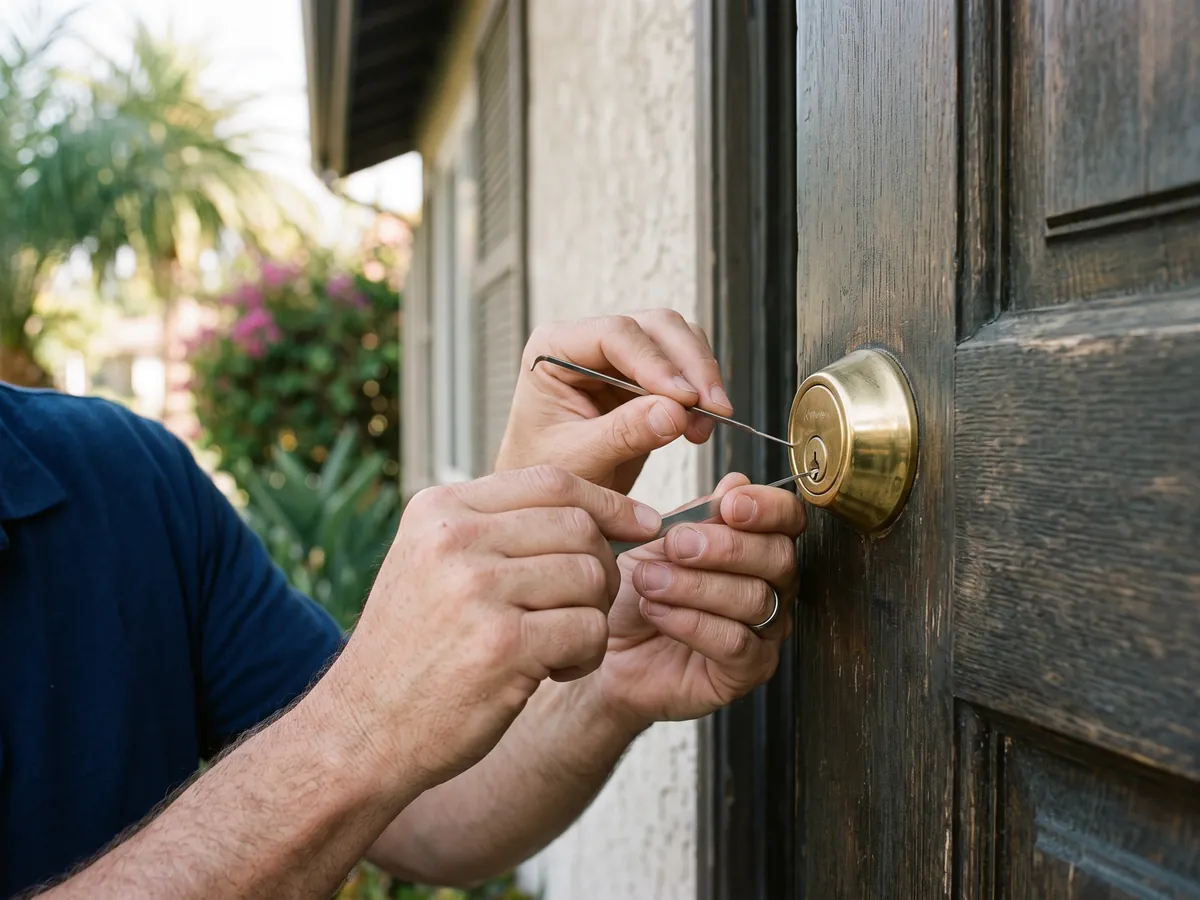
Most house lockouts in Norwalk start the same way: the door swings shut, and either the knob was set to lock or someone turned the deadbolt on the way out. Those are two very different problems. A spring latch in a knob or lever can often be slipped or bypassed with thin tools, as long as its anti-shim plunger isn't doing its job. A deadbolt throws a solid steel bolt about an inch into the frame, and the usual non-destructive answer is picking the cylinder pin by pin. Tell us which lock you think is engaged when you call (951) 903-3193. It helps us bring the right tools, choose the right door and give you a more accurate quote before we drive out.
Single-family houses in Norwalk give you more doors to be locked out of than you might think. There is the front door with its knob and deadbolt, the side door off the garage, the back door to the yard, and often a garage that opens through the house. A knob lock with a pushed-in button usually opens in moments. A deadbolt that was thrown takes longer, and a worn or sticky cylinder can take longer still. Keypad deadbolts fail in their own way. When the batteries die, the screen goes dark and the door will not take a code. Most keep a key cylinder under a cover, but not everyone knows where that key is. A fresh set of batteries every year or so, and a spare key in a lockbox, stop the problem from repeating. With kids or pets locked inside, tell us right away. A child alone in a closed house can be an emergency, so call 911 first if there is any danger. Otherwise we open the door, check your ID and proof of address, and leave the lock working.
How this works in Norwalk
Getting into a locked house without damage follows a sequence, and we start at the least invasive step. First come the free options: another door, a family member with a key, a garage keypad that still works. Next, if a keypad or smart deadbolt is the problem, we try emergency power or the key override before anything mechanical. For a door held only by a knob or lever, a latch bypass tool can retract the spring latch without leaving a mark, provided the deadlatch plunger isn't seated against the strike. Thrown deadbolts usually get picked. Builder-grade Kwikset and Schlage cylinders tend to cooperate; Grade 1 deadbolts with spool or serrated pins take more patience; patented high-security cylinders such as Medeco or Mul-T-Lock may not be practical to pick at all. Specialty tools that work through a gap or under the door come next. Drilling is the last step. When we drill, we aim at the shear line or the cam, the bolt retracts, and the damaged cylinder or deadbolt gets replaced on the spot with hardware you approve and price before we start. In Norwalk, most house lockouts never get past the picking stage.
What we can do on-site
- Deadbolt lockouts opened by picking. Picking a deadbolt leaves no marks, no new holes and no parts to buy. We check the brand and keyway first, since Schlage, Kwikset, Yale and Baldwin cylinders each behave a little differently. If the lock is worn or packed with grit from windy weather, we can clean and lubricate it after opening so your own key turns smoothly again.
- Knob and lever latch bypass. If only the knob or lever is locked, the door is held by a spring latch, and that can often be retracted without picking anything. We work thin bypass tools between door and frame, protecting paint and weatherstrip, as long as the anti-shim deadlatch isn't engaged. On many houses it's the quickest lockout fix there is.
- Keypad and smart lock lockouts. Smart deadbolts such as Schlage Encode, Kwikset Halo and Yale Assure fail in a few predictable ways: depleted batteries, a motor that stalls against a tight strike, or an app and Wi-Fi link that drops out. We figure out which one it is at your door in Norwalk, open the door, then fix the cause rather than just the symptom.
- Back, side, patio and French doors. Sliding patio doors are usually a poor entry point. With a dowel or security bar in the track, they can't be opened from outside without damage, and lifting a panel risks the glass and the rollers. French doors with flush bolts behave much the same. We'll normally open a swinging door instead and leave the slider alone.
- Keys cut on site after entry. If your keys are gone rather than locked inside, we can cut new ones once the door is open. Many residential locks have a code stamped on the cylinder or listed in paperwork, and others can be decoded by reading the pins. Our van carries key machines, so you aren't waiting on a hardware store to open.
What's different about Norwalk
Student rental houses in Norwalk usually have several roommates and a scattering of keys, so someone is always locked out. We'll need a lease showing the tenant's name or the landlord's authorization. If former roommates moved out with keys, talk to your landlord about rekeying; California landlords must provide working deadbolts on the main entry doors of rental units, and fresh keys are part of good practice.
Older houses in Norwalk often carry a patchwork of locks: an original knob on the side door, a deadbolt added decades later, maybe a mortise lock on a front door that predates both. During a house lockout that variety helps, because one of those doors is usually easy to open without damage. We also run into warped wood doors and painted-over strikes that bind, so we check alignment once you're back inside.
In family neighborhoods, house lockouts often involve kids: a toddler who pressed a knob button, a teenager home from school without a key, or a parent locked out in the middle of a bedtime routine. We treat a child inside as a priority and ask questions to confirm they're safe. Afterward, a keypad lock with a separate code for each kid can break the cycle of lost keys in Norwalk.
Example situations
A typical afternoon: a teenager gets home from school to a rental house in the Studebaker area and the keypad on the front door stays dark. The batteries are dead, and the backup key is in a parent's pocket across town. The parent calls us from work. We would keep the teenager somewhere safe and visible, arrive, check the parent's ID and the lease, and open the door by picking the backup cylinder or powering the keypad through its battery terminals. Then we would change the batteries, test the codes and show everyone where the spare key belongs.
- A typical call: you step out to grab the mail, and your two-year-old, fiddling with the front knob, presses the lock button. The door clicks shut behind you. The child is fine and watching cartoons, but can't reach the deadbolt or understand the button. If you're at all worried, call 911. If the child is calm and safe, we'd treat it as a priority, bypass the knob latch and get you through the door.
- Take a summer afternoon in Norwalk: the front deadbolt has felt gritty for months, and today the key twists and snaps at the shoulder. Half the key sits in the plug, the knob is locked as well, and groceries are warming on the porch. We'd extract the fragment with hooked extractors, open the lock, cut a new key from the pieces, and clean the cylinder so it stops grabbing.
- Suppose a pot is simmering on a gas burner when the back door, its knob set to lock, swings shut behind someone stepping out to the yard. The front deadbolt is already thrown. That's a call to 911 first, because a fire crew can force entry right away. Once the stove is off and the house is safe, we'd come out to repair or replace whatever lock and strike had to be broken.
Step by step with Julian's Locksmith
- Call and safety check. Tell us how you got locked out, because it changes the plan. Keys locked inside, keys lost, a dead keypad and a broken key are four different jobs. A minute of detail on the phone means the right tools, batteries and parts are already in the van when we pull up.
- Quote and honest ETA. Before dispatching, we give you a price based on what you've described and a realistic arrival estimate from where our van actually is. If something at the door turns out to be different, such as a high-security cylinder, we stop and requote before doing anything.
- Arrival and verification. Verification is quick but never optional. We match a name and address, ask a few questions if your ID is out of date, and note the details. House sitters and family members need the owner on the phone, and sometimes written permission by text as well.
- Survey every door. A quick look around the house in Norwalk can save you time and money. A knob-only side door or a keypad that only needs power beats picking a Grade 1 deadbolt. We'll explain which door we're choosing and why, so nothing about the job surprises you.
- Non-destructive entry. Most house lockouts in Norwalk end at this step with a pick and tension wrench or a latch tool. The door opens, the lock still works and you're inside. If a keypad needs power, we use its backup terminals or override cylinder, then swap the batteries right away.
- Test, explain and prevent. The last step is preventing the next call. We can cut a spare, adjust a self-closing garage entry door, reset a keypad master code, or rekey so one key fits every door of your home in Norwalk. Nothing extra happens without a quote and your yes.
How we quote the job
- Drilling and replacement hardware. If a cylinder is seized, broken internally or too secure to bypass, replacement hardware becomes part of the cost. Matching the finish and keyway of your other doors may affect which lock we recommend. We always tell you before the drill comes out, never after the fact.
- Distance and timing. Travel time is a real cost for a mobile locksmith. A house close to our base costs less to reach than one at the far edge of our service area. If you call near the end of our day, we'll tell you whether we can still make it and what that changes.
- Extras after entry. If your keys were lost or stolen, rekeying adds to the bill but protects you from whoever holds them now. Cutting keys from a code or decoding a cylinder costs more than copying a key, but it's the only option when no working key exists anywhere.
Every job gets a clear quote before any work starts. Call (951) 903-3193 with the details and we'll tell you what to expect for your situation in Norwalk.
What to do before we arrive
- Find out today how your keypad lock gets emergency power. Look under the keypad for 9-volt terminals or a USB port, or locate the override key and label it. Knowing this turns a dead-battery lockout into a short inconvenience instead of a service call.
- Keep a photo of your ID and a recent utility bill in a secure album on your phone. If your wallet is locked inside, a digital copy helps a locksmith verify residence sooner, although we may still ask to see the originals once the door is open.
- Before calling a locksmith, walk every door and gate around the house. Try the garage keypad, the side door, the back door and any door a family member might have left open. Call household members too; someone may be a short drive away with a key in their pocket.
- Interior privacy knobs on bathrooms and bedrooms have an emergency release, usually a small hole in the outside knob. Keep the little pin tool on top of the door trim. When a toddler locks themselves in a bathroom, that tool solves it in seconds without anyone calling for help.
What not to do
- Lifting a sliding patio door off its track. Panels are heavy, glass can shatter, and rollers and anti-lift blocks get damaged. Even when it works, the door may never slide or latch correctly again. A swinging door with a pickable lock is nearly always the better way in.
- Kicking or shouldering the door. Done hard enough to work, it splinters the frame, tears the strike out and can crack the door slab. Done badly, it hurts you and leaves a damaged door that still won't open. A properly installed deadbolt is designed to resist exactly that.
- Prying at the strike with a screwdriver or pry bar. Exterior doors in Norwalk homes usually hang in softwood jambs that split easily, and a split jamb means the deadbolt can no longer hold. You end up paying for frame repair, a strike and maybe a door, plus the lockout.
Getting to Norwalk
Norwalk is about 58 miles from our San Bernardino base, roughly 62 minutes in light traffic via SR-210 West from San Bernardino to I-605 South into Norwalk. When you call, you get an arrival estimate based on where the technician is and the traffic at that moment.
If you're close to Firestone Boulevard, tell us which exit or cross street you're nearest. It trims the last mile and keeps the van from circling a block that looks right on the map but isn't.
About Norwalk: Gilbert Sproul's Victorian farmhouse of 1870 and the Eastlake-style Hargitt House of 1891, on Mapledale Street, both survive as museums.
| Neighborhoods | Hoxie Avenue area near the Metro C Line station, Norwalk Hills, Cerritos College area along Alondra Boulevard, Excelsior area near Pioneer Boulevard and Alondra Boulevard, Norwalk Manor, Civic Center |
|---|---|
| ZIP codes | 90650 |
| Main routes | I-5, I-605, I-105, Imperial Highway |
| From our San Bernardino base | about 58 miles via SR-210 West from San Bernardino to I-605 South into Norwalk, then Firestone Boulevard, Imperial Highway or Alondra Boulevard to your address; alternate: I-10 West to I-605 South |
Plain version of the schedule: every day, 6:30 a.m.-11:30 p.m. Outside those hours nobody is out on the road, and we'd rather you know that now than discover it in the middle of a lockout. For an overnight safety problem, such as a door that won't latch after a break-in, call the police first.
Safes get the same scrutiny. Before drilling or manipulating one, we need reason to believe it's yours: a purchase record, the fact that it sits in your home or business, or estate paperwork if you inherited it. A safe exists to keep people out, so proof of ownership isn't optional.
Locked out in Norwalk?
Call (951) 903-3193 with the address and what's locked. You'll get an arrival estimate and a quote before anyone heads out, and when we arrive we'll ask for ID that ties you to the property. If a child or pet is shut inside a hot car or building, call 911 first.
Frequently asked questions
Can you get in through a sliding glass door?
Usually we don't try. A slider with a security bar or dowel in the track can't be opened from outside without damage, and lifting a panel risks broken glass and bent rollers. A swinging door with a pickable lock is the better entry point in nearly every house lockout, so we leave the slider alone unless there's truly no other option.
What if my keys were stolen along with my ID?
Then the thief may have both your house keys and your address. After we open the house, we strongly suggest rekeying the exterior locks the same day, changing your garage keypad code and deleting or changing smart lock codes. Rekeying in Norwalk keeps your existing hardware but makes the stolen keys useless.
Is it faster to open the front door or the side door?
Often the side or garage door. Those frequently have only a knob or lever lock, which can be bypassed more quickly than a Grade 1 deadbolt on the front. During a house lockout in Norwalk, we check every door and choose the one that's quickest to open without damage, unless you'd prefer a particular entry.
Will you damage my door or lock?
In most house lockouts, no. We pick the cylinder, bypass a latch or power a dead keypad, and the lock keeps working afterward. Drilling is reserved for seized, broken or high-security locks with no practical alternative, and we explain why and quote replacement hardware before we start. Damage usually comes from kicking, prying or breaking a window.
How much does a house lockout cost in Norwalk?
It depends on which lock is engaged, the lock's security level, whether drilling is needed and how far we drive. A knob latch is usually the simplest job; a high-security deadbolt or a failed smart lock takes longer. We don't list prices online, but you get a quote on the phone before we come out, and we requote before doing anything different.
My keypad lock is dead. Can you open it without breaking it?
Usually. Many keypad deadbolts can be powered briefly from outside, through 9-volt terminals on some Yale and Lockly models or a USB port on others, so you can enter your code. If the lock has a key override, we can pick that cylinder. Afterward we replace the batteries and look at why they died early.
How far is Norwalk from your base?
Norwalk is about 58 miles from our San Bernardino base, roughly 62 minutes in light traffic. Arrival time depends on traffic and on the job the technician is finishing, so we give you an estimate on the phone before you commit.
Related services in Norwalk
- Home Lockout in Norwalk
- Locked Out of House in Norwalk
- Mobile Locksmith for House Lockout in Norwalk
- Emergency Locksmith in Norwalk
- Rekey Locks after Losing Keys in Norwalk
- Smart Lock Troubleshooting in Norwalk
- Broken Key Stuck in Door in Norwalk
- Spare House Key in Norwalk
- Deadbolt Replacement in Norwalk
- House Rekey in Norwalk
House Lockout in nearby cities
- House Lockout in Santa Fe SpringsLos Angeles County
- House Lockout in ArtesiaLos Angeles County
- House Lockout in CerritosLos Angeles County
- House Lockout in BellflowerLos Angeles County
- House Lockout in DowneyLos Angeles County
- House Lockout in La MiradaLos Angeles County
- House Lockout in La PalmaOrange County
- House Lockout in LakewoodLos Angeles County