
Grand Terrace, San Bernardino County
Locked Out of Your Grand Terrace Home? Here's How We Get You In
Short answer: Getting past a home lockout in Grand Terrace is often about picking the right door. A garage entry secured only by a knob latch, a back door whose deadbolt was never thrown, or a keypad that just needs emergency power can open far faster than a locked front deadbolt. Julian's Locksmith asks which locks are engaged on each door, then chooses the least invasive way in.
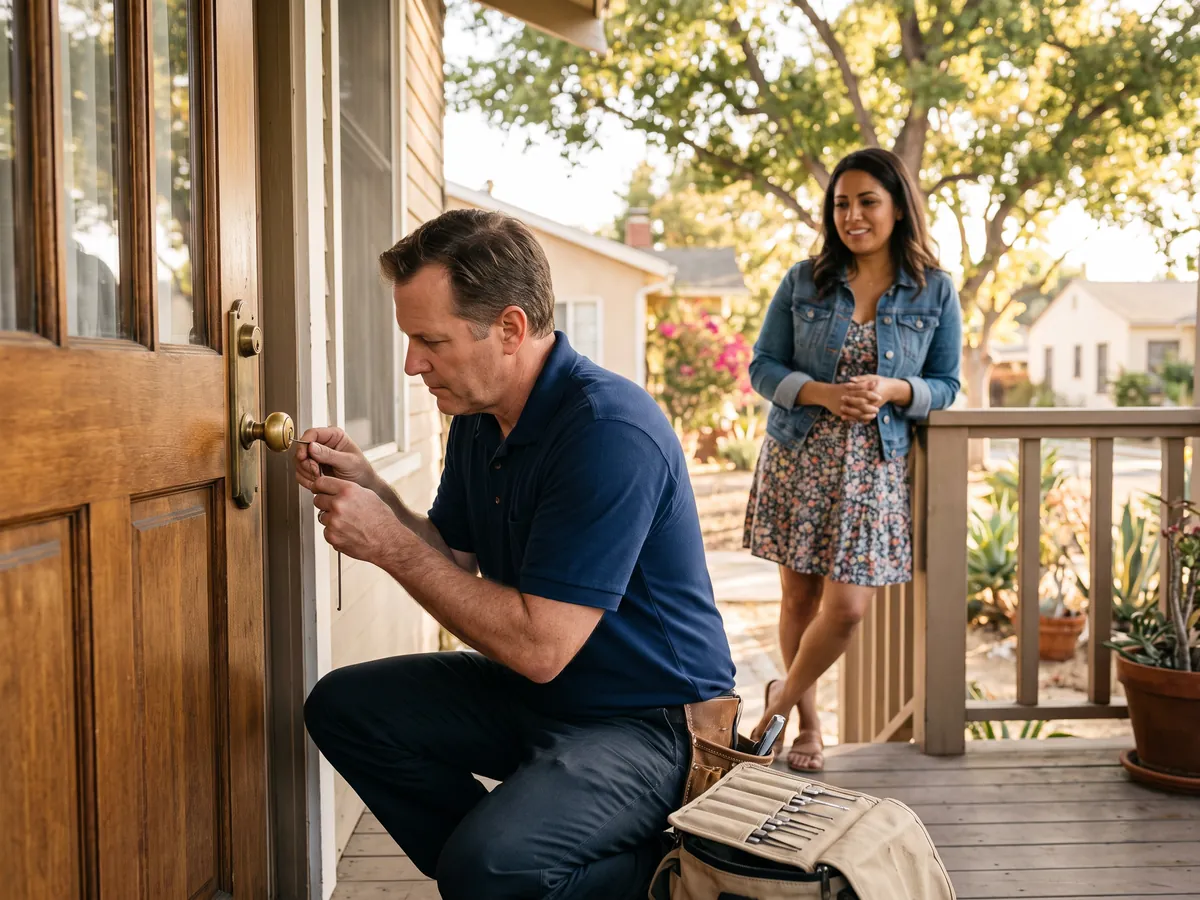
The door clicks shut, your keys are on the counter, and suddenly the place you live is a wall. A home lockout in Grand Terrace is rarely dangerous, but it's stressful, and stress leads people to pry at frames or climb through windows. Please don't. Julian's Locksmith is a licensed mobile locksmith that drives to you, confirms you live at the address, and opens the door with picks and bypass tools built for exactly this job. Houses, apartments, condos, townhomes and casitas all qualify, and so do garage entries and sliding doors. Call (951) 903-3193, tell us what kind of lock is holding you out, and you'll get a straight quote and an honest arrival estimate before we roll.
A home lockout in Grand Terrace is usually a story about an older house. Single-story tract homes from the 1970s and 1980s fill the streets between Michigan Street and Mount Vernon Avenue, and many still wear the original knobset with a deadbolt added later. Most of those doors open with a bypass tool or a few minutes of picking, which spares the door and its finish, so drilling is rare here. The front door is only one way in, and we treat the others as options. Original aluminum sliding doors often have latches that can be lifted or manipulated from outside. A side door into the garage frequently has nothing but a knob. Apartments and the senior units along Grand Terrace Road count as home lockouts too, usually with a deadbolt that needs a proper pick or a bypass. Before any door opens, we check your photo ID and something connecting you to the address, such as a bill, a lease or a piece of mail. If you can't produce either, we'll tell you what else works. We will not open a door for anyone who cannot show that they belong there, and that protects you as much as it protects the neighbors.
How this works in Grand Terrace
Who you are in relation to the property decides what we need before opening it. Owners and the people who live with them show a photo ID with the address, or a deed, mortgage statement, property tax bill or utility bill when the ID is out of date. Renters can use the lease or a call to the property manager. Guests, house sitters and caregivers need the owner or tenant on the phone giving consent we can verify, plus their own ID. Some situations call for more. A relative settling an estate needs paperwork showing authority over the home. A buyer locked out on closing day can show closing documents. If two people dispute who has the right to be in a home, a locksmith isn't the one to decide that, and we'll point you toward the police or the courts rather than open the door. None of this is meant to slow down a home lockout in Grand Terrace. It's how California's Locksmith Act and common sense protect everyone, including you, from someone else talking their way into your house.
Work included on a typical visit
- Front door deadbolt and knob opening. We read the hardware before choosing a tool. A Kwikset SmartKey deadbolt, a Schlage B60 and a decades-old builder-grade lock each respond to different techniques, so we look at the keyway, brand and condition first. That decision keeps the job short and avoids forcing anything that could bend a tailpiece or chew up a cylinder.
- Smart lock and keypad lockouts. Keyless models with no override cylinder are the hardest home lockout to solve without damage. We try the manufacturer's emergency power and recovery options first and explain honestly if removal is the only path. After entry, we can reset admin codes, add a backup user and show you how to keep the next battery from dying unnoticed.
- Broken key and failed lock lockouts. Sometimes the key is in your hand and you're still locked out: it turns freely, but the bolt doesn't move. That usually means a broken cam, tailpiece or spindle inside the lock. Picking won't help, so we use bypass techniques or a small, controlled access hole to reach the mechanism, then replace the failed part.
- Interior door lockouts. Shared rentals often put keyed locks on bedroom doors, and those keys go missing. We open the room for the person who rents it, with proof such as a room lease or the landlord's confirmation, and can rekey the lock so a former roommate's copy stops working.
- Rekeying and new keys after a lockout. After a lockout caused by a lost or stolen bag, we look at every cylinder those keys could open: front, back, garage, security screen and any private mailbox. Rekeying keeps your existing hardware and changes only the internals, which usually costs less than new locks. High-security cylinders may need restricted blanks we order.
How Grand Terrace shapes the job
In 55+ communities around Grand Terrace, lockouts often involve stiff keys and arthritic hands, out-swinging manufactured home doors, and family members calling on someone's behalf. We talk with the resident directly whenever possible and verify identity patiently, without rushing anyone. After entry, a lever-style keypad lock or a key with a larger grip can make the next trip out the door easier and safer.
Inland summers around Grand Terrace are hard on door hardware. Dark steel and fiberglass doors facing afternoon sun can bow enough to pull the deadbolt out of line with its strike, metal security screens bind, and keypad batteries drain faster than their rating. Summer lockouts often involve a lock that technically works but won't turn under load. We open it, then adjust the strike so the next heat wave doesn't repeat it.
Older homes in Grand Terrace often keep their original hardware: mortise locks on Craftsman and Spanish Revival doors, mid-century Weiser and Schlage knobs, and keyways worn smooth by decades of use. Those locks can be easy to open, or stubborn if paint and grit have frozen them. We judge their condition before picking, sometimes impression a working key for an old mortise lock, and avoid forcing brittle parts that are hard to replace.
Common situations
A typical call: someone walks the dog down to Gwen Karger Park, pulls the front door shut behind them and realizes the keys are on the kitchen counter. The house is a single-story off De Berry Street. After we check ID and a utility bill, the deadbolt is picked open in a few minutes. We then talk through a keypad deadbolt for next time. Nobody had to break a window or drive across town for a spare.
- Imagine a guest at a short-term rental whose door code expired at checkout time, a day earlier than planned. The guest has a reservation and an ID, but no ownership or lease. In that case we need the host or property manager to authorize entry in a way we can verify. Often the host can simply send a new code, which beats any locksmith visit.
- Picture a July afternoon in Grand Terrace: you punch your code into a keypad deadbolt and get nothing, not even a beep. The batteries gave out in the heat. If the model has emergency power contacts, a 9-volt jump lets you enter your code; if it has a key cylinder and the key is inside, we pick it. Afterward the batteries get replaced and you set a reminder.
- Closing day, as an illustration: escrow has recorded, the sellers left keys in a lock box, and none of them fit the back door or the deadbolt. The new owners have closing papers and IDs in hand. We open the stubborn locks, then rekey every cylinder on the property so nobody from the previous chapter of the house still holds a working key.
How the visit works
- Tell us about the lockout. We'll ask a handful of questions: what kind of home it is, whether you own or rent, which doors are locked, and whether the keys are inside or lost. Photos of the lock texted from your phone help too. Clear details turn into an accurate quote and a shorter visit.
- Get a quote and an honest ETA. You get two answers before we commit: the cost of entry and a realistic arrival window based on traffic and distance from San Bernardino. If either doesn't suit you, that's fine. Many people use that window to try reaching a spare-key holder one more time.
- Verify identity and residence. Guests, caregivers and house sitters need the owner or leaseholder reachable by phone so we can confirm consent, plus their own photo ID. For estates and newly purchased homes, the relevant legal or closing papers serve as proof. Licensing under California's Locksmith Act makes this check part of doing the job right.
- Survey every entry point. Before tools come out, we walk the doors with you. The best way in is the door with the fewest engaged locks and the least finish at risk, often a garage service door or a back door. Sliding doors and windows get discussed but are rarely chosen.
- Open the door without damage. Technique matters more than force. A deadbolt picked correctly shows nothing a homeowner would notice; one pried open leaves a split jamb and a bent bolt. That's why we carry several tools for each lock type and spend the extra minute choosing between them.
- Test, secure and wrap up. The final step is heading off the next lockout. Depending on what happened, that could mean cutting a spare, adding a backup code to your keypad, rekeying to one key, or adjusting a door that slams itself shut. Every suggestion is optional and priced before you decide.
What affects the cost
- Type and security level of the lock. Smart locks sit at both ends of the scale. Some open almost immediately once they get emergency power, while keyless models with dead electronics can be the most involved home lockout there is. We price based on the specific model, so share the brand and style if you can see them.
- How many locks are engaged. The number of barriers between you and your living room matters. A double lockout with a security screen in front of the entry door takes longer than either lock alone, and multipoint hardware on French doors counts differently than a single bolt. Expect your quote to reflect each one honestly.
- Distance and access. Travel time depends on freeway traffic as much as miles, and a crawl on the 10 or the 60 at rush hour is real. We base the quote and ETA on where our technician actually is. If someone with a spare key is closer, we'll tell you that's your quicker option.
Every job gets a clear quote before any work starts. Call (951) 903-3193 with the details and we'll tell you what to expect for your situation in Grand Terrace.
What to do before we arrive
- Give a spare to one trusted neighbor or nearby relative rather than hiding one outside. Tag it with a first name only, never your address. That single key probably prevents more home lockouts in Grand Terrace than any gadget, and it costs almost nothing if the right person lives close by.
- When a lockout happens because keys were lost or stolen, especially along with anything showing your address, plan to rekey that same day. Opening the door solves tonight; rekeying makes sure whoever holds your old ring can't use it tomorrow or next month.
- If your front door has a push-button or turn-button knob, consider switching to a passage knob paired with a keyed deadbolt. A passage set never locks, so the door can't lock behind you; you lock up deliberately with the deadbolt key. It's one of the simplest anti-lockout changes there is.
- Keep a spare key in a code-protected lock box mounted somewhere that isn't visible from the street, such as inside a side-yard gate or behind a hedge. Change the code after contractors or guests use it. A lock box beats a fake rock, which anyone who has ever burgled a house recognizes on sight.
What not to do
- Using superglue, a drill or a screwdriver on a broken key. Glue on an improvised extractor bonds to the cylinder as easily as to the key, and prying pushes the fragment deeper. Leave the piece alone and let a locksmith extract it with proper hooks and extractors.
- Skipping the rekey after losing keys with an ID or mail attached. Opening the door feels like the end of the problem, but your address may be in a stranger's pocket. Rekeying the exterior cylinders costs far less than dealing with someone who walks right in later.
- Forcing a sliding door off its track. Lifting a locked panel past its anti-lift blocks can chip rollers, bend the frame and crack tempered glass, which shatters completely when it fails. If a bar or dowel is in the track, treat that door as closed and choose another.
Service in Grand Terrace
Grand Terrace is about 13 miles from our San Bernardino base, roughly 18 minutes in light traffic via University Parkway to I-215 South through San Bernardino and Colton, past the I-10 interchange, to Exit 38. When you call, you get an arrival estimate based on where the technician is and the traffic at that moment.
We plan the drive the way a delivery route gets planned: freeway first, De Berry Street where it makes sense, then the side streets you describe. A landmark or the color of your building helps the technician spot you.
About Grand Terrace: Gwen Karger Park, at De Berry Street and Mount Vernon Avenue, displays community tile murals honoring the city's citrus and honey heritage and holds a time capsule due to be opened in 2028.
| Neighborhoods | Michigan Street west-side tracts, La Cadena Drive and Litton Avenue west of I-215, Main Street along the Highgrove edge, Barton Road corridor, Commerce Way industrial area, Blue Mountain hillside |
|---|---|
| ZIP codes | 92313 |
| Main routes | I-215, Barton Road, Mount Vernon Avenue, Michigan Street |
| From our San Bernardino base | about 13 miles via University Parkway to I-215 South through San Bernardino and Colton, past the I-10 interchange, to Exit 38 (Barton Road), then east on Barton Road to Michigan Street and Mount Vernon Avenue |
Here are our real hours: 6:30 a.m. to 11:30 p.m., every day of the week, weekends included. We aren't a 24/7 locksmith and won't pretend to be. If you're locked out while we're closed, your auto club or your property manager's emergency line may get you in sooner, and we're glad to book you for the moment we reopen.
California's Locksmith Act requires a signed work order when a locksmith opens a residence or commercial property, recording the requester's name, address, phone number, date of birth and ID number. Business and Professions Code §6980.55 has us keep those records for two years, available to BSIS and peace officers on request.
Locked out in Grand Terrace?
Call (951) 903-3193 with the address and what's locked. You'll get an arrival estimate and a quote before anyone heads out, and when we arrive we'll ask for ID that ties you to the property. If a child or pet is shut inside a hot car or building, call 911 first.
Frequently asked questions
Can you cut a new house key on the spot?
Yes. Our van carries key blanks and a cutting machine, so once you're inside we can cut a spare from your existing key or, if every key is gone, decode the lock and cut a new one. Restricted and high-security keys may need an authorization card or a factory order, and we'll tell you if yours falls into that group.
Can you get me into my garage in Grand Terrace?
Often, yes. A garage service door may have only a knob latch, and the door from the garage into the house is frequently left unbolted. When the overhead door is closed and the opener has lost power, we can sometimes trip the emergency release from outside with a specialized tool, then re-secure it before we leave. We verify ownership first.
Do I need to rekey after a home lockout?
Only if keys are missing. If they were sitting on the counter, nothing about your security has changed. If they were lost or stolen, especially with anything showing your address, rekeying makes the old keys useless while keeping your existing locks on the door. We can rekey on the same visit, and that price is quoted separately from the entry.
I rent. Do I need my landlord's permission for a lockout?
You don't need permission to be let into your own rental, but we do need proof you're the tenant: your lease, a rent receipt or a quick call from management. Check your lease too; some ask you to call the office first, and many bar tenants from changing locks. We open without altering the landlord's keying unless they approve a change.
Should I call the leasing office or HOA before a locksmith?
If they're open and hold a key, yes. A property manager or on-site maintenance tech can often let you in at little or no cost, and some leases require you to try them first. HOAs rarely hold keys to individual units, though, and most offices close in the evening. When they can't help, call (951) 903-3193 and we'll take it from there.
When should I call 911 instead of a locksmith?
Call 911 when someone inside could be in danger: a young child alone, a person having a medical emergency, a pet in a hot room, a stove left on or water flooding the floor. Emergency responders can force entry when it's warranted and don't need to wait for anyone. A locksmith is the right call when the only problem is that you're outside.
How far is Grand Terrace from your base?
Grand Terrace is about 13 miles from our San Bernardino base, roughly 18 minutes in light traffic. Arrival time depends on traffic and on the job the technician is finishing, so we give you an estimate on the phone before you commit.
Related services in Grand Terrace
- House Lockout in Grand Terrace
- Apartment Lockout in Grand Terrace
- Locked Out of House in Grand Terrace
- Locked Out of Apartment in Grand Terrace
- Condo Lockout in Grand Terrace
- Mobile Locksmith for House Lockout in Grand Terrace
- Emergency Door Unlocking in Grand Terrace
- Rekey Locks after Losing Keys in Grand Terrace
- Smart Lock Troubleshooting in Grand Terrace
- Key Broken Inside Lock in Grand Terrace
Home Lockout in nearby cities
- Home Lockout in ColtonSan Bernardino County
- Home Lockout in Loma LindaSan Bernardino County
- Home Lockout in San BernardinoSan Bernardino County
- Home Lockout in BloomingtonSan Bernardino County
- Home Lockout in RubidouxRiverside County
- Home Lockout in RialtoSan Bernardino County
- Home Lockout in RiversideRiverside County
- Home Lockout in RedlandsSan Bernardino County