
Charter Oak, Los Angeles County
Home Lockout Service in Charter Oak
Short answer: For a home lockout in Charter Oak, start by walking the whole house: every door, the garage keypad, any window you can reach safely from the ground. Ask whoever holds a spare, and call management if you rent. Still stuck? Call Julian's Locksmith at (951) 903-3193. We confirm you live there, then pick or bypass the lock so the door, frame and hardware come through intact.
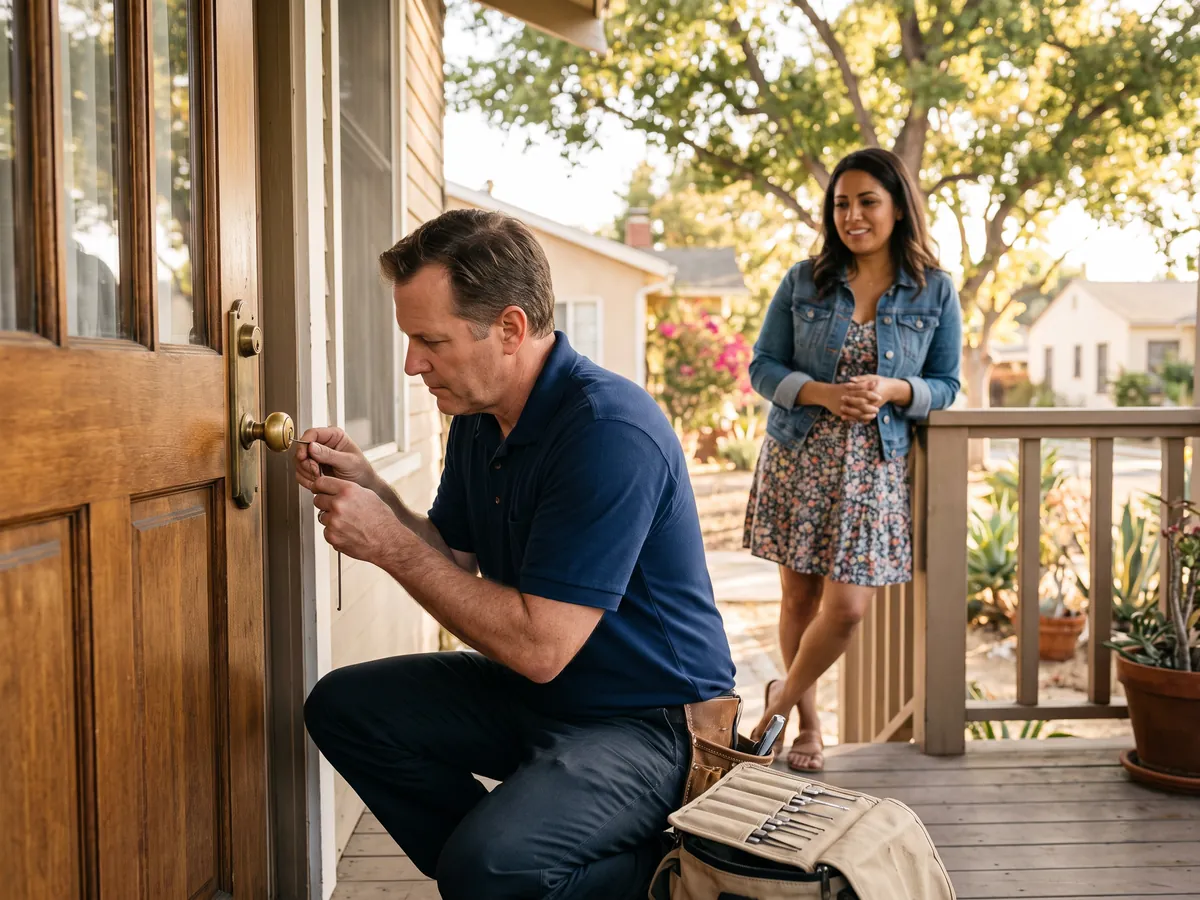
Not every home lockout in Charter Oak looks the same. A homeowner standing on a porch in Charter Oak only has to prove the place is theirs. A renter may have a leasing office that can open the unit during business hours, and a condo owner might need a guard to wave us through the front gate. A house sitter needs the owner on the phone. Julian's Locksmith handles each of those situations, and we know which documents and calls make the visit short. Tell us how you're connected to the property when you call (951) 903-3193, and we'll explain exactly what to have ready before we arrive.
Home lockouts in Charter Oak come in more varieties than you'd expect from a community under a square mile. Postwar ranch houses on Banna, Kinsella and Mangrove Avenues usually have a knob and a deadbolt up front, a keyed door from the garage and a back slider. Apartment buildings along Grand Avenue have a deadbolt and a shared walkway. The manufactured homes in the parks off Glendora Avenue and Valley Center Avenue have outswinging doors with their own latch hardware. Each opens differently. The aim in every case is to get you in without harming the door, the frame or the lock. A spring-latched knob is quick work. A deadbolt that was fully thrown takes more care, and a slider needs a different approach altogether. So before we leave, we ask which door, which lock, and whether a person or animal is inside. We also verify that you live there. Expect to show photo ID plus something tying you to the address, such as a lease, a utility bill or mail. If the names don't match, an owner or landlord who can authorize the entry by phone solves it.
How this works in Charter Oak
Who you are in relation to the property decides what we need before opening it. Owners and the people who live with them show a photo ID with the address, or a deed, mortgage statement, property tax bill or utility bill when the ID is out of date. Renters can use the lease or a call to the property manager. Guests, house sitters and caregivers need the owner or tenant on the phone giving consent we can verify, plus their own ID. Some situations call for more. A relative settling an estate needs paperwork showing authority over the home. A buyer locked out on closing day can show closing documents. If two people dispute who has the right to be in a home, a locksmith isn't the one to decide that, and we'll point you toward the police or the courts rather than open the door. None of this is meant to slow down a home lockout in Charter Oak. It's how California's Locksmith Act and common sense protect everyone, including you, from someone else talking their way into your house.
How we can help in Charter Oak
- Apartment and condo unit lockouts. If your leasing office is open, ask them first; they may hold a key and charge nothing. When the office has closed for the night or the HOA has no after-hours contact, we can open the unit once you show ID and something tying you to that unit number, such as a lease page, rent receipt or utility bill.
- Garage entry and overhead door lockouts. Standing outside with the opener remote clipped to a visor inside the garage? A wireless keypad that lost its code, a dead keypad battery or a neighborhood power outage are common causes. We check whether the keypad can be revived, whether a side door offers easier access, and whether the overhead door's release can be reached without bending a panel.
- Security screen door lockouts. A locked security screen door blocks every tool we'd use on the entry door behind it, so it always comes first. Most use standard pin tumbler cylinders that pick cleanly, though sun-faded, dust-packed locks may need cleaning and lubrication before they cooperate. If you'd like one key for both doors, we can rekey them to match.
- Broken key and failed lock lockouts. Sometimes the key is in your hand and you're still locked out: it turns freely, but the bolt doesn't move. That usually means a broken cam, tailpiece or spindle inside the lock. Picking won't help, so we use bypass techniques or a small, controlled access hole to reach the mechanism, then replace the failed part.
- Rekeying and new keys after a lockout. After a lockout caused by a lost or stolen bag, we look at every cylinder those keys could open: front, back, garage, security screen and any private mailbox. Rekeying keeps your existing hardware and changes only the internals, which usually costs less than new locks. High-security cylinders may need restricted blanks we order.
What's different about Charter Oak
Apartment lockouts in Charter Oak come with a leasing office, a lease and sometimes a property-specific cylinder. During office hours, management may open your unit for little or nothing, so ask them first. After hours, we can open the unit once you show ID and proof you rent it, without changing keying the landlord controls. If the building uses restricted keys, management may need to cut your replacement.
Older homes in Charter Oak often keep their original hardware: mortise locks on Craftsman and Spanish Revival doors, mid-century Weiser and Schlage knobs, and keyways worn smooth by decades of use. Those locks can be easy to open, or stubborn if paint and grit have frozen them. We judge their condition before picking, sometimes impression a working key for an old mortise lock, and avoid forcing brittle parts that are hard to replace.
Early commutes from Charter Oak mean early lockouts: out the door before dawn, coffee in hand, keys on the counter. We start at 6:30 a.m. every day, which helps if you can wait a little. If you can't, a neighbor's spare or a keypad deadbolt with a code you share with family can keep a home lockout from costing you a day of work.
Example situations
Say it's a windy October evening and you step out of your manufactured home in the park off Glendora Avenue to take out the trash. A gust pulls the outswing door shut behind you and the latch locks, with your keys on the table inside. We'd check your ID and confirm the unit is yours, or that you rent it with the park office's okay. Then we'd open the door without bending its thin skin or the frame, and adjust the latch and deadbolt to the strike so the next gust doesn't repeat it.
- Closing day, as an illustration: escrow has recorded, the sellers left keys in a lock box, and none of them fit the back door or the deadbolt. The new owners have closing papers and IDs in hand. We open the stubborn locks, then rekey every cylinder on the property so nobody from the previous chapter of the house still holds a working key.
- Suppose a power outage hits while you're out running errands. The overhead garage door won't respond to your remote, the house keys hang on a hook inside the garage, and the front deadbolt is locked. We'd verify ownership, then choose between picking the front deadbolt and reaching the overhead door's emergency release from outside, whichever carries less risk to your property.
- For example, a grandson calls because his grandmother, who lives alone in a 55+ manufactured home community, is locked out of her out-swinging front door. We'd talk with her directly, confirm her ID and space number, and open the combination knob and deadbolt unit without pulling hinge pins. If she struggles with small keys, a lever-style keypad lock might be worth discussing afterward.
Step by step with Julian's Locksmith
- Tell us about the lockout. We'll ask a handful of questions: what kind of home it is, whether you own or rent, which doors are locked, and whether the keys are inside or lost. Photos of the lock texted from your phone help too. Clear details turn into an accurate quote and a shorter visit.
- Get a quote and an honest ETA. Before anyone drives out, you hear the price for opening your door based on what you described, plus what could change it, such as a high-security cylinder or a failed lock. We also give an honest ETA from where our technician is, not a promise we can't keep.
- Verify identity and residence. Proof locked inside? We can open the door, then ask you to show the documents before we leave, with us present the whole time. If nothing ties you to the home, or the story keeps changing, we decline the job. That rule protects every homeowner, including you.
- Survey every entry point. We look at each lock's brand, keyway, grade and condition, check for security bars in sliders and note whether a deadbolt is actually thrown. A door that looks locked sometimes has only a spring latch engaged, which changes the method entirely and usually shortens the job.
- Open the door without damage. Technique matters more than force. A deadbolt picked correctly shows nothing a homeowner would notice; one pried open leaves a split jamb and a bent bolt. That's why we carry several tools for each lock type and spend the extra minute choosing between them.
- Test, secure and wrap up. Once you're inside, we confirm your documents if needed, then test the opened lock with your key from both sides. If we found a sticky cylinder, a binding bolt or a loose strike, we'll point it out, and we can fix it on the spot if you'd like.
What affects the cost
- Type and security level of the lock. A builder-grade knob latch is quicker to open than a Grade 1 deadbolt, and both are far quicker than a patented high-security cylinder like Medeco or Mul-T-Lock. The more pick-resistant the lock, the more time and skill entry takes, and that shows up in the price we quote for your Charter Oak home.
- How many locks are engaged. One locked knob latch is a single task. A thrown deadbolt, a locked security screen door and a keyed interior door mean three separate openings. We price each lock that actually has to be opened, which is why we ask you to check every door before we quote.
- Distance and access. We're a mobile service dispatched from San Bernardino, so the drive to your home factors in. A short hop within the Inland Empire differs from a run into the San Gabriel Valley or north Orange County. The quote for Charter Oak accounts for that, and we explain it plainly when you ask.
Every job gets a clear quote before any work starts. Call (951) 903-3193 with the details and we'll tell you what to expect for your situation in Charter Oak.
Mistakes to avoid
- Hiding a key under the mat, a planter or a fake rock near the door. Those spots are the first places anyone checks, and a key found there gives entry without any sign of forced entry, which can complicate a police report or an insurance claim afterward.
- Forcing a sliding door off its track. Lifting a locked panel past its anti-lift blocks can chip rollers, bend the frame and crack tempered glass, which shatters completely when it fails. If a bar or dowel is in the track, treat that door as closed and choose another.
- Pulling hinge pins on an out-swinging door. The door can come off, but heavy slabs fall, hinges bend and the door often won't rehang square. It also shows how easily your door can be removed, which deserves a security fix with set screws or non-removable pins.
Practical tips before you call
- If your garage is the only realistic way into your house, ask about an outside quick-release lock for the overhead door. It's a keyed cylinder that releases the opener from outside, so a power outage doesn't leave you stranded. Keep its key on a different ring from the house key.
- Keep a spare key in a code-protected lock box mounted somewhere that isn't visible from the street, such as inside a side-yard gate or behind a hedge. Change the code after contractors or guests use it. A lock box beats a fake rock, which anyone who has ever burgled a house recognizes on sight.
- Renters, ask your property manager now what happens if you're locked out after hours. Some offices keep an on-call contact; others tell you to call a locksmith and may charge for a replacement key. Knowing the policy before the door shuts saves you a panicked search through old emails.
- Build a keys-in-hand habit at the door. Some people mount a hook right beside the knob; others put the house key on the same ring as the car fob they never forget. The goal is simple: the door never closes unless a key is outside with you.
Getting to Charter Oak
Charter Oak is about 38 miles from our San Bernardino base, roughly 43 minutes in light traffic via Palm Avenue to I-215 North, I-15 South. When you call, you get an arrival estimate based on where the technician is and the traffic at that moment.
Homes and businesses just off Bonnie Cove Avenue are routine stops for us. Give the suite or unit number and any gate instructions, and say whether the van can park out front or should pull into a side lot.
About Charter Oak: Charter Oak's school district dates to 1894, when Charter Oak School opened in a tent with 24 students before moving into a one-room schoolhouse that November.
| Neighborhoods | Bonnie Cove Avenue corridor, Valley Center Avenue edge and Rancho San Jose mobile home park, Lyman Avenue and Sunflower Avenue area, Arrow Highway frontage along the Glendora line, Charter Oak Park blocks, Tudor Street and Greenhaven Street |
|---|---|
| ZIP codes | 91724 |
| Main routes | I-210, SR-57, Arrow Highway, Covina Boulevard |
| From our San Bernardino base | about 38 miles via Palm Avenue to I-215 North, I-15 South, then the Foothill Freeway (SR-210) West, which becomes I-210 at the SR-57 junction, to the Sunflower Avenue exit in Glendora and south on Sunflower Avenue to Arrow Highway; the Grand Avenue exit suits the west side |
Friday is a full day for us. We begin at 6:30 a.m. and close at 11:30 p.m., the same as every other day, Saturday included. If a lock fails after 11:30 p.m., call us when we reopen at 6:30 a.m., and in the meantime fall back on a neighbor's spare key, a night with family, or a door you can secure from inside.
ID locked inside with your keys? That's a common situation, and it isn't a dead end. We can open the door, and you show us your license or a piece of addressed mail from inside before we pack up. If nothing inside proves residence, your landlord or property manager can usually confirm it by phone.
Locked out in Charter Oak?
Call (951) 903-3193 with the address and what's locked. You'll get an arrival estimate and a quote before anyone heads out, and when we arrive we'll ask for ID that ties you to the property. If a child or pet is shut inside a hot car or building, call 911 first.
Frequently asked questions
Will opening my door damage the lock or frame?
Not usually. Picking, latch bypass and under-door tools work through the lock's normal mechanism or around it, so the cylinder, finish and jamb stay as they were. Damage becomes possible with high-security cylinders, locks that have failed internally, or doors someone already tried to pry. In those cases we explain the situation and the cost first, and you decide how to proceed.
Do I need to rekey after a home lockout?
Only if keys are missing. If they were sitting on the counter, nothing about your security has changed. If they were lost or stolen, especially with anything showing your address, rekeying makes the old keys useless while keeping your existing locks on the door. We can rekey on the same visit, and that price is quoted separately from the entry.
Can you open a high-security lock like Medeco or Mul-T-Lock?
We can try, but expectations should be realistic. High-security cylinders use sidebars, angled cuts or telescoping pins specifically to resist picking, so non-destructive entry may take a long time or fail. Often another door with standard hardware is the smarter route. If drilling is the only option, we discuss cost first and replace the cylinder, which may mean ordering keys under your key control card.
What ID do I need to show a locksmith?
A government photo ID with the home's address is ideal. If it shows a different address, add a lease, deed, mortgage statement, property tax bill, vehicle registration or utility bill with your name and that address, on paper or on your phone. Renters can also have management confirm by phone. We record the details on a signed work order for every opening.
What if my key turns but the door still won't open?
That usually points to a broken part inside the lock: a cam, tailpiece or spindle that no longer connects the cylinder to the bolt or latch. Sometimes it's a deadbolt binding in the strike, so try pushing or pulling the door while turning the key. If nothing works, we can bypass or drill strategically and replace the failed part the same visit.
I rent. Do I need my landlord's permission for a lockout?
You don't need permission to be let into your own rental, but we do need proof you're the tenant: your lease, a rent receipt or a quick call from management. Check your lease too; some ask you to call the office first, and many bar tenants from changing locks. We open without altering the landlord's keying unless they approve a change.
How far is Charter Oak from your base?
Charter Oak is about 38 miles from our San Bernardino base, roughly 43 minutes in light traffic. Arrival time depends on traffic and on the job the technician is finishing, so we give you an estimate on the phone before you commit.
Related services in Charter Oak
- House Lockout in Charter Oak
- Apartment Lockout in Charter Oak
- Locked Out of House in Charter Oak
- Locked Out of Apartment in Charter Oak
- Condo Lockout in Charter Oak
- Mobile Locksmith for House Lockout in Charter Oak
- Emergency Door Unlocking in Charter Oak
- Rekey Locks after Losing Keys in Charter Oak
- Smart Lock Troubleshooting in Charter Oak
- Key Broken Inside Lock in Charter Oak
Home Lockout in nearby cities
- Home Lockout in CovinaLos Angeles County
- Home Lockout in CitrusLos Angeles County
- Home Lockout in San DimasLos Angeles County
- Home Lockout in GlendoraLos Angeles County
- Home Lockout in AzusaLos Angeles County
- Home Lockout in IrwindaleLos Angeles County
- Home Lockout in West CovinaLos Angeles County
- Home Lockout in WalnutLos Angeles County