
Ontario, San Bernardino County
Home Lockout in Ontario: Houses, Apartments, Condos and More
Short answer: Julian's Locksmith handles home lockouts in Ontario every day, 6:30 a.m. to 11:30 p.m. Weekends are included. Your price depends on the lock, how many locks are engaged and when you call, and you hear it before any work starts. Call (951) 903-3193 for a quote and an honest ETA.
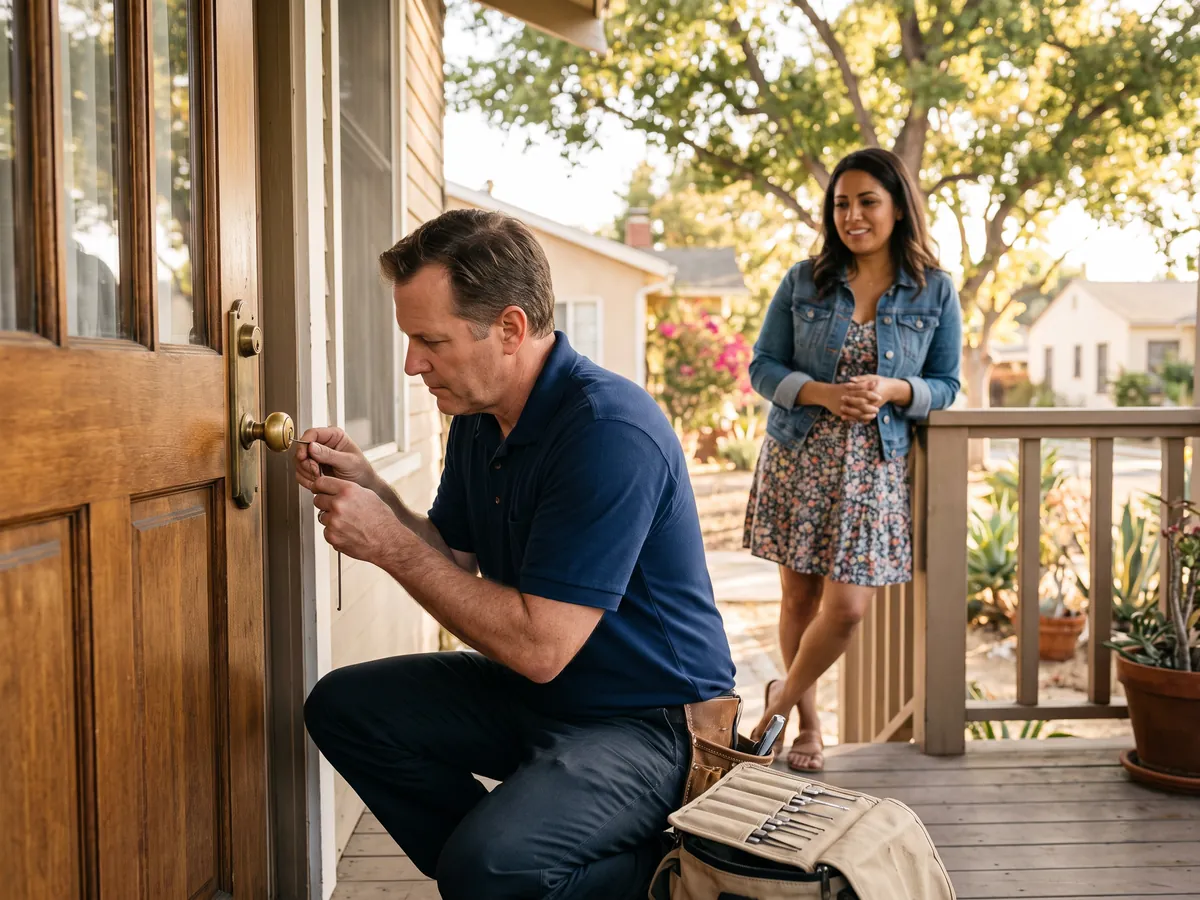
Plenty of home lockouts in Ontario no longer involve a lost key at all. The keypad deadbolt goes dark because its batteries quit, the smart lock app logs you out, or the garage opener loses power while you're standing in the driveway with the house key hanging inside. Each of those has its own fix, from emergency power contacts on the keypad to a keyed override cylinder hidden under a cover. Julian's Locksmith carries tools for both the electronic and mechanical sides of the problem, verifies that the home is yours, and gets you inside without tearing hardware off the door. Call (951) 903-3193 and tell us the brand of lock if you know it.
A home lockout in Ontario takes several forms, and the right approach depends on which door is shut. Around Euclid Avenue and downtown, the culprit is often an aging knob lock or an original mortise body that has finally stuck. On the 1950s and 1960s ranch tracts toward Mountain Avenue, it is usually a spring-latch knob plus a deadbolt that nobody carried a key for. In Edenglen townhomes, the shared garage court and a unit door with a higher-grade cylinder change the picture. And in Ontario Ranch, smart-lock failures are common: dead batteries, a bolt that rubs the strike, a keypad that no longer wakes up. Whatever the door, the sequence is the same. We confirm who you are with photo ID and some proof that you live there, such as a utility bill, lease or mail. Then we pick the least destructive way in, from a latch tool on a spring bolt to picking or decoding a deadbolt, with drilling kept for locks that give no other choice. Sliders, side doors and garage entry doors each get their own approach. Once you're inside, we look at whether the lock needs repair, a rekey or replacement, so the same thing doesn't happen next week.
Home Lockout in Ontario: what to expect
A home lockout service is more than opening a door. When you call Julian's Locksmith from Ontario, we start by asking what the property is (house, apartment, condo, townhome or guest unit), which doors exist, what locks are on each and whether anyone or anything inside changes the urgency. That conversation shapes the quote you hear before we leave, and it tells us which tools to pull from the van first. On site, the order stays consistent. We check identity and residence, walk the entry points with you to find the easiest one, and open it using picking or bypass methods that leave the hardware working. Once you're in, we confirm any documents that were locked inside, test the lock you'll rely on tonight, and complete a signed work order. If your keys are missing rather than sitting on the counter, we talk through rekeying so a lost ring can't open your door later. If the lockout happened because hardware failed, we can repair or replace it on the same visit when we carry the right parts. The job ends when your door locks properly behind you, not just when it swings open.
How we can help in Ontario
- Apartment and condo unit lockouts. Apartments and condos add a layer of permission. We'll ask for your lease or a quick call to management, and if the complex is gated we need a way past the entry gate. Many units use standard deadbolts we can pick, though some properties install restricted or high-security cylinders that management may prefer to open themselves.
- Garage entry and overhead door lockouts. Standing outside with the opener remote clipped to a visor inside the garage? A wireless keypad that lost its code, a dead keypad battery or a neighborhood power outage are common causes. We check whether the keypad can be revived, whether a side door offers easier access, and whether the overhead door's release can be reached without bending a panel.
- Broken key and failed lock lockouts. Locks wear out, especially the inexpensive ones builders install by the hundred. Worn pins, a cracked cylinder housing or a deadbolt binding in a misaligned strike can all leave a key that won't turn. We figure out which it is, get the door open, and tell you whether a repair or a new lockset makes more sense.
- Interior door lockouts. Bedroom and bathroom privacy locks open with a small pin or flat tool through the hole in the outside knob, and many people can do it themselves with the right tool. When a keyed interior lock, a home office deadbolt or a jammed privacy set won't cooperate, we open it without marring the door.
- Back, side and French door entry. Back and side doors are often the quickest fix because nobody threw the deadbolt on the way out. A spring latch with a misaligned strike or a deadlatch plunger that isn't engaging can sometimes be slipped. We check those doors before touching your front door, since the best entry is the one with the fewest locks engaged.
What's different about Ontario
Warehouse and distribution workers around Ontario often start shifts before we open, so a 4 a.m. lockout may mean waiting until 6:30 or finding a spare. Logistics hubs also bring many renters and roommates sharing single-family houses. We verify residence carefully when several adults list one address, and we can rekey a shared home when a roommate moves out with a key.
Older homes in Ontario often keep their original hardware: mortise locks on Craftsman and Spanish Revival doors, mid-century Weiser and Schlage knobs, and keyways worn smooth by decades of use. Those locks can be easy to open, or stubborn if paint and grit have frozen them. We judge their condition before picking, sometimes impression a working key for an old mortise lock, and avoid forcing brittle parts that are hard to replace.
Newer tracts in Ontario usually ship with builder-grade Kwikset or Schlage hardware, keypad garage openers and, increasingly, smart deadbolts. Lockouts here often involve electronics: a keypad that lost its code after a power blip, or a smart lock still tied to the builder's setup. Builder locks are sometimes construction-keyed, meaning other keys may have worked them during the build, so rekeying after a home lockout is a sensible step.
Situations this covers
A typical call comes from a family returning from an afternoon at Ontario Mills. The two-story house in New Haven has its front deadbolt thrown and the garage door shut, the kids' backpacks are inside, and the only house key hangs on a hook by the kitchen. We would verify ID and proof of address, check the side gate and slider for a legitimate no-damage route, and then pick the deadbolt without scarring the finish. Before leaving, we'd cut a spare and suggest a better place for it than under the mat.
- A house sitter in Ontario steps out to grab the mail and the smart deadbolt's auto-lock engages, with the phone holding the guest code still on the couch. The owners are traveling. We'd need to reach an owner on a call we can verify, plus the sitter's photo ID, before opening anything. Once inside, the owner can usually push a fresh guest code from the app.
- For example, a grandson calls because his grandmother, who lives alone in a 55+ manufactured home community, is locked out of her out-swinging front door. We'd talk with her directly, confirm her ID and space number, and open the combination knob and deadbolt unit without pulling hinge pins. If she struggles with small keys, a lever-style keypad lock might be worth discussing afterward.
- Say you're coming home after a long day near Ontario Mills, and the house key snaps off in the deadbolt as you turn it. Half the key is in your hand, half in the lock. We'd extract the broken piece with thin extractor tools, open the lock, and cut a new key in the van. Then we'd check why it snapped; a bolt binding in its strike is the usual suspect.
Step by step with Julian's Locksmith
- Tell us about the lockout. The first call is triage. If a child, vulnerable adult or pet is in danger inside, we'll tell you to dial 911 right away. Otherwise we gather the address, the hardware on each door and who has authority over the property, then explain what we expect to do.
- Get a quote and an honest ETA. Before anyone drives out, you hear the price for opening your door based on what you described, plus what could change it, such as a high-security cylinder or a failed lock. We also give an honest ETA from where our technician is, not a promise we can't keep.
- Verify identity and residence. Proof locked inside? We can open the door, then ask you to show the documents before we leave, with us present the whole time. If nothing ties you to the home, or the story keeps changing, we decline the job. That rule protects every homeowner, including you.
- Survey every entry point. Before tools come out, we walk the doors with you. The best way in is the door with the fewest engaged locks and the least finish at risk, often a garage service door or a back door. Sliding doors and windows get discussed but are rarely chosen.
- Open the door without damage. We start with the least invasive method the hardware allows and escalate only with your agreement. If a high-security cylinder or a broken internal cam makes damage-free entry impractical, we lay out the options and costs, and you choose before we drill or remove anything.
- Test, secure and wrap up. The final step is heading off the next lockout. Depending on what happened, that could mean cutting a spare, adding a backup code to your keypad, rekeying to one key, or adjusting a door that slams itself shut. Every suggestion is optional and priced before you decide.
What affects the cost
- How many locks are engaged. One locked knob latch is a single task. A thrown deadbolt, a locked security screen door and a keyed interior door mean three separate openings. We price each lock that actually has to be opened, which is why we ask you to check every door before we quote.
- Time of the call. Our hours run from 6:30 a.m. to 11:30 p.m. every day of the week. Calls near the edges of that window, early mornings and late evenings, can carry a different rate than midday visits. We tell you which applies before we dispatch.
- Distance and access. Travel time depends on freeway traffic as much as miles, and a crawl on the 10 or the 60 at rush hour is real. We base the quote and ETA on where our technician actually is. If someone with a spare key is closer, we'll tell you that's your quicker option.
Every job gets a clear quote before any work starts. Call (951) 903-3193 with the details and we'll tell you what to expect for your situation in Ontario.
What not to do
- Prying at the strike with a screwdriver or pry bar. A thrown deadbolt won't budge, so the jamb splits first, the weatherstripping tears and the door may never latch properly again. Repairing a split jamb and reinforcing the strike usually costs more than having the door opened cleanly in the first place.
- Using superglue, a drill or a screwdriver on a broken key. Glue on an improvised extractor bonds to the cylinder as easily as to the key, and prying pushes the fragment deeper. Leave the piece alone and let a locksmith extract it with proper hooks and extractors.
- Pulling hinge pins on an out-swinging door. The door can come off, but heavy slabs fall, hinges bend and the door often won't rehang square. It also shows how easily your door can be removed, which deserves a security fix with set screws or non-removable pins.
Practical tips before you call
- If your front door has a push-button or turn-button knob, consider switching to a passage knob paired with a keyed deadbolt. A passage set never locks, so the door can't lock behind you; you lock up deliberately with the deadbolt key. It's one of the simplest anti-lockout changes there is.
- Replace keypad and smart lock batteries on a schedule instead of waiting for the low-battery warning. Inland heat shortens battery life, so twice a year is reasonable for many locks. Use the battery type the manufacturer specifies; some locks don't read rechargeable cells accurately and die without much warning.
- If a door suddenly takes force to lock or unlock, fix it before it strands you. A sagging door or shifted strike makes the deadbolt bind, and binding bolts snap keys and break cams. Replacing a short hinge screw with a 3-inch screw driven into the stud often solves it.
- Resist climbing through a second-story window or onto a patio roof to get in. Ladder falls send homeowners to urgent care every year, and a torn screen or broken latch can turn a lockout into a security problem. A locksmith visit costs less than either outcome.
Getting to Ontario
Ontario is about 25 miles from our San Bernardino base, roughly 33 minutes in light traffic via I-215 North to the I-15 junction at Devore. When you call, you get an arrival estimate based on where the technician is and the traffic at that moment.
Rush hour on Fourth Street can stretch a drive considerably. We'd rather give you a realistic arrival window than an optimistic one, and we'll call you if a closure or a crash changes the plan.
About Ontario: The city opened Ontario Municipal Airport in 1929, and local control returned in November 2016 when the Ontario International Airport Authority took over from Los Angeles World Airports.
| Neighborhoods | Park Place, Grand Park, Euclid Avenue historic corridor, Guasti, Downtown Ontario, North Ontario near Chaffey High School |
|---|---|
| ZIP codes | 91761, 91762, 91764 |
| Main routes | I-10, SR-60, I-15, Euclid Avenue |
| From our San Bernardino base | about 25 miles via I-215 North to the I-15 junction at Devore, then I-15 (Ontario Freeway) South to I-10 West and Holt Boulevard for downtown and the airport; stay on I-15 South to Ontario Ranch Road or SR-60 for Ontario Ranch. SR-210 West to I-15 South is the usual alternate. |
Plain version of the schedule: every day, 6:30 a.m.-11:30 p.m. Outside those hours nobody is out on the road, and we'd rather you know that now than discover it in the middle of a lockout. For an overnight safety problem, such as a door that won't latch after a break-in, call the police first.
We won't open a door for someone who can't show they live or work there, however convincing the story. That includes a person who has moved out, a former partner, or anyone caught up in an eviction dispute. The rule protects you the same way it protects every other household we serve: no proof, no entry.
Locked out in Ontario?
Call (951) 903-3193 with the address and what's locked. You'll get an arrival estimate and a quote before anyone heads out, and when we arrive we'll ask for ID that ties you to the property. If a child or pet is shut inside a hot car or building, call 911 first.
Frequently asked questions
Can I book a home lockout with you on Saturday?
Yes, Julian's Locksmith is open on Saturday, and Friday hours are the same as every other day. We work from 6:30 a.m. until 11:30 p.m. every day of the week. If you're locked out while we're closed, try anyone holding a spare, your property manager or your HOA's after-hours line, and call 911 if someone inside is in danger. We'd rather be honest than leave you waiting.
My keypad deadbolt is dead. What can I do?
Look underneath the keypad for two metal contacts or a small port; several models accept a 9-volt battery or a USB-C power bank just long enough to enter your code. If the lock has a key cylinder, a spare key solves it. Otherwise, call us. We can pick the backup cylinder or work through the model's override, then replace the batteries once you're in.
Do I need to rekey after a home lockout?
Only if keys are missing. If they were sitting on the counter, nothing about your security has changed. If they were lost or stolen, especially with anything showing your address, rekeying makes the old keys useless while keeping your existing locks on the door. We can rekey on the same visit, and that price is quoted separately from the entry.
What if my key turns but the door still won't open?
That usually points to a broken part inside the lock: a cam, tailpiece or spindle that no longer connects the cylinder to the bolt or latch. Sometimes it's a deadbolt binding in the strike, so try pushing or pulling the door while turning the key. If nothing works, we can bypass or drill strategically and replace the failed part the same visit.
Can you cut a new house key on the spot?
Yes. Our van carries key blanks and a cutting machine, so once you're inside we can cut a spare from your existing key or, if every key is gone, decode the lock and cut a new one. Restricted and high-security keys may need an authorization card or a factory order, and we'll tell you if yours falls into that group.
Can you open a locked sliding glass door?
Sometimes. A slider's hook latch can occasionally be manipulated from outside, and keyed sliders can be picked. But if a security bar, dowel or foot lock was set from inside, there's no clean way through that door, and lifting the panel risks cracking tempered glass. In most cases another door is the better target, and we'll tell you so honestly.
How far is Ontario from your base?
Ontario is about 25 miles from our San Bernardino base, roughly 33 minutes in light traffic. Arrival time depends on traffic and on the job the technician is finishing, so we give you an estimate on the phone before you commit.
Related services in Ontario
- House Lockout in Ontario
- Apartment Lockout in Ontario
- Locked Out of House in Ontario
- Locked Out of Apartment in Ontario
- Condo Lockout in Ontario
- Mobile Locksmith for House Lockout in Ontario
- Emergency Door Unlocking in Ontario
- Rekey Locks after Losing Keys in Ontario
- Smart Lock Troubleshooting in Ontario
- Key Broken Inside Lock in Ontario
Home Lockout in nearby cities
- Home Lockout in MontclairSan Bernardino County
- Home Lockout in ChinoSan Bernardino County
- Home Lockout in UplandSan Bernardino County
- Home Lockout in Rancho CucamongaSan Bernardino County
- Home Lockout in ClaremontLos Angeles County
- Home Lockout in EastvaleRiverside County
- Home Lockout in PomonaLos Angeles County
- Home Lockout in EtiwandaSan Bernardino County
