
San Bernardino, San Bernardino County
Locked Out of House in San Bernardino? Start Here
Short answer: Locked out of house in San Bernardino? Walk the whole perimeter first: back door, side door, garage keypad, and anyone holding a spare. Skip the rock-through-the-window plan, because replacing dual-pane glass often costs more than a lockout call. Still stuck? Call Julian's Locksmith at (951) 903-3193. We confirm you live there and open the door without damage in most cases.
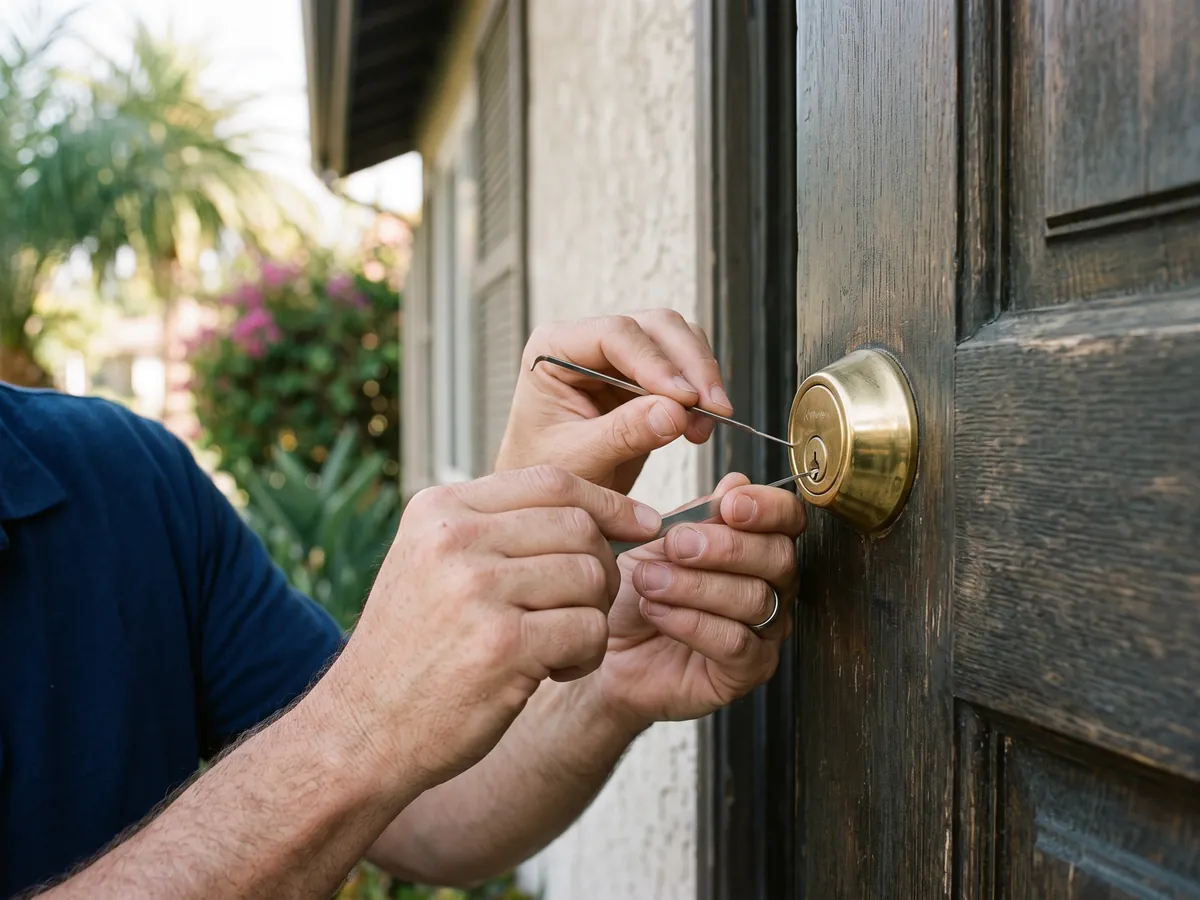
We'll be straight with you: Julian's Locksmith isn't open every hour. We work every day from 6:30 a.m. to 11:30 p.m., weekends included, and we're closed overnight. Inside those windows, if you're locked out of your house in San Bernardino, call (951) 903-3193 and we'll quote the opening and give an honest arrival estimate. Outside them, this page still helps. It covers the free things to try first, who else may hold a key, when to call 911 instead of anyone else, and the shortcuts that tend to cost more than they save.
What to know first in San Bernardino
Here's why a locksmith asks you to prove you live in the house, and what counts. California licenses locksmiths through the Bureau of Security and Investigative Services under the Locksmith Act (Business and Professions Code §6980 and following), and opening a door for the wrong person is the fastest way to hurt a family and lose a license. So before or right after we open a house in San Bernardino, we look for a match between you and the address. A driver's license showing that address is simplest. When the license lists an old address, other evidence helps: a utility bill, a property tax statement, a lease, a vehicle registration in your glove box, or a utility account open in an app on your phone. If your ID is inside, we open the door and check it with you at the kitchen table. When nothing matches, we may ask a landlord, HOA or neighbor to confirm. It takes a couple of minutes, and it's the same check that protects you if a stranger ever claims to live at your place.
What we can do on-site
- Choosing the easiest door, not the front one. Front deadbolt thrown? Check whether the kitchen, garage or back door has only its knob locked. We compare the options with you on site, explain which one we'd open and why, and leave the front lock alone when another route gets you into the house cleanly and for less money.
- Smart locks that locked themselves. Fully keyless locks are the hardest case. When a touchscreen deadbolt has no key cylinder and its batteries are dead, the options narrow to emergency power terminals, another door, or entering elsewhere and servicing the lock from inside. We tell you honestly which of those applies to your model before any work starts.
- Lockouts with a hazard inside. Shut off what you safely can while you wait. If water is running, the main valve is often near the street or where the line enters the house. An exterior electrical panel lets you kill a stove or heater circuit. If you smell gas, leave the area and call 911 from a distance. Then call us for a priority opening.
- New house, keys that don't fit. Closing day sometimes hands you a ring of keys that fits half the locks. If you're standing outside your new house in San Bernardino with keys that won't turn, we open the door, sort out which seller keys work where, and can rekey every cylinder to one new key so the old sets in circulation stop working.
- Slider, French door and back-door lockouts. Back doors cause plenty of lockouts: a patio slider's lever bumped to locked, a French door knob set to lock, a kitchen door that latched while you were in the yard. A locksmith can open many slider latches from outside, but a security bar or dowel in the track usually can't be reached, so we may steer you to another door.
Local factors in San Bernardino
Commuters tend to get locked out at the edges of the day: leaving before sunrise with keys on the counter, or coming home late to a lock that won't turn. We start at 6:30 a.m. every day and work until 11:30 p.m. That covers many of those moments. The hours between 11:30 p.m. and 6:30 a.m. are the gap to plan around with a spare.
Students sharing a rented house run into a specific lockout: five roommates, one front door, and keys copied and lost so often that nobody knows who holds one. We open for the tenant who's locked out after checking a lease or other proof of residence, and we'll suggest asking the landlord to rekey if keys are unaccounted for, since the locks belong to the owner.
Older houses around Westside often still carry original hardware: a mortise lock with a separate thumb-turn, a 1960s knob set with no deadbolt at all, or a storm door with its own latch. A lockout in a house like that is usually a gentle opening, since worn pins tend to pick easily. The catch is that worn locks also fail more often, so after entry we may suggest a properly installed deadbolt with a reinforced strike.
Common situations
- A typical early call: a nurse coming off a night shift reaches her front door just before seven and realizes her keys are in a locker at the hospital. The drive back is long, and she wants to sleep. Since we start at 6:30 a.m., we'd take the call, check the ID she has with her, pick the deadbolt, and cut a spare on site so the locker key ring isn't her only copy.
- A typical call: you carry groceries in from the car in two trips, and between them the smart deadbolt's auto-lock fires. Your phone is in one of the bags on the kitchen floor, and the keypad code you set up last spring has slipped your mind. We'd try the key override, pick it if the backup key is inside too, then sit down with you and set an auto-lock delay that matches how you actually unload a car.
- For example, a babysitter steps onto the patio with two kids, and the slider's latch catches as the door bumps shut. Everyone is outside and safe, but the house isn't hers. We'd reach the parents by phone, confirm the address and their permission, and open the most practical door. The parents would show ID when they got home or confirm by video call while we were still there.
- Say you step out to move the car for the street sweeper, and the door locks behind you with a pot of beans simmering on the stove. No smoke yet, but scorching won't be far off. A call like that goes to the top of our list, and we'd tell you honestly how far away we are. If smoke appears before anyone arrives, call 911; firefighters can force entry when a fire is starting.
How the visit works
- Get safe, then check for urgency. Before anything else, make sure you're safe: out of the heat, off a dark street, away from anyone who makes you uneasy. Then ask whether anything inside is urgent. A child, a person who needs care, or a fire or gas risk means 911. Everything else can follow the normal steps.
- Walk the perimeter. Circle the house once: back door, side door, garage service door, slider. A keypad on the garage or a remote clipped to a visor may get you in. While you walk, note whether each door's deadbolt is thrown or just the knob. That detail shapes the method and our quote.
- Call for a key, then call us. Run through your list of people who have keys. If the closest spare is an hour away, a locksmith may make more sense. On the phone we ask about the lock brand, any keypad, and what ID you have, and you hear the price and an arrival estimate before agreeing to anything.
- Wait somewhere sensible. While you wait, get out of direct sun, or sit in a neighbor's house or your car. Save your phone battery if you can; we'll call when we're close. Gather any proof of residence you can reach, like mail or a registration in your car, so verification goes quickly.
- Entry and verification. We start with a look at the lock and a quick ID check. Entry comes next, nearly always by picking or bypass rather than drilling. If drilling becomes necessary because a lock failed or is high-security, we stop and quote replacement hardware before going further. You decide.
- Test, then close the loop. We finish by testing the opened lock with your key, inside and out, and writing up what we did and what it cost. If the keys were stolen along with your wallet or bag, we recommend rekeying that day, because your address may be printed on the license that went with them.
How we quote the job
- Which lock is holding the door. We quote the opening on what's engaged, so a quick check before you call helps. Push gently on the door near the deadbolt; if it gives a little, only the latch may be holding. If it feels solid, the bolt is probably thrown. A photo of the lock's outside face tells us the brand and style.
- Whether something has failed. When your key turns and nothing happens, or the key snaps off, the visit has two parts: getting in and fixing what broke. Extraction tools, a new cylinder or a whole deadbolt may be needed. We price each piece, then let you choose between repairing the old lock and replacing it.
- Damage from earlier attempts. Bent latches, gouged cylinders and broken pick tips from online kits all add work, because we have to clear the damage before the normal opening method can succeed. If you or a helpful neighbor already tried something, mention it on the call so the quote you hear is realistic.
Every job gets a clear quote before any work starts. Call (951) 903-3193 with the details and we'll tell you what to expect for your situation in San Bernardino.
What to do before we arrive
- If a kitchen or garage door knob is a storeroom style that stays locked from outside every time it closes, consider swapping it for a standard entry lever with a push button. Let the deadbolt carry the security, and that door stops ambushing you on trash day.
- Use a key ring that splits: house keys on one loop, car keys on the other. When you hand your car to a valet or a mechanic, the house keys stay with you, and losing one set doesn't mean losing access to everything you own at once.
- Set up one spare key that doesn't live under a mat or a fake rock. A combination lockbox mounted out of sight, a trusted neighbor two doors down, or a relative who lives nearby beats the hiding spots every burglar checks first. Write down who has a copy so you remember when it counts.
- Write our number, (951) 903-3193, somewhere besides your phone, such as a card in the car's console. If your phone ends up locked inside with your keys, you'll be borrowing a neighbor's, and almost nobody remembers a locksmith's number from memory.
What not to do
- Pulling the hinge pins on a door that swings out. It sometimes works on back doors, but security hinges and non-removable pins stop it, a thrown deadbolt can still hold the door, and rehanging a heavy slab alone can strip screws from the frame.
- Sending a child through the pet door. Kids get stuck halfway, scraped by the flap frame or frightened alone inside an empty house. And if a child fits through, so might someone you don't want inside, which is worth addressing once you're back in.
- Breaking a window to get in. Dual-pane glass, the screen and any frame repair often cost more than a lockout call, and broken glass inside a house means finding slivers in the carpet for weeks. A cut hand can turn a simple lockout into a trip to urgent care.
Service in San Bernardino
San Bernardino is our home base, so most addresses in town are a short drive. When you call, you get an arrival estimate based on where the technician is and the traffic at that moment.
If you're close to I-10, tell us which exit or cross street you're nearest. It trims the last mile and keeps the van from circling a block that looks right on the map but isn't.
About San Bernardino: San Bernardino is the seat of San Bernardino County, the largest county by area in the contiguous United States.
| Neighborhoods | Arrowhead Springs, Shandin Hills, University District, Del Rosa, Westside, Hospitality Lane |
|---|---|
| ZIP codes | 92401, 92404, 92405, 92407, 92408, 92410, 92411 |
| Main routes | I-10, I-215, SR-210, SR-259 |
| From our San Bernardino base | Home base |
Planning a non-urgent job like a rekey, a smart lock install or a safe combination change? Every day of the week, appointments are available from first thing in the morning into the late evening, with 11:30 p.m. as closing time. Fridays and Saturdays follow the same schedule.
We won't open a door for someone who can't show they live or work there, however convincing the story. That includes a person who has moved out, a former partner, or anyone caught up in an eviction dispute. The rule protects you the same way it protects every other household we serve: no proof, no entry.
Locked out in San Bernardino?
Call (951) 903-3193 with the address and what's locked. You'll get an arrival estimate and a quote before anyone heads out, and when we arrive we'll ask for ID that ties you to the property. If a child or pet is shut inside a hot car or building, call 911 first.
Frequently asked questions
Will the police or fire department open my house?
Police generally don't unlock homes for routine lockouts. Fire departments will force entry in a real emergency, such as a child alone inside, a medical crisis or a fire risk, and in that situation you should call 911 without hesitating. Forced entry may damage the door, but that's the right tradeoff when safety is at stake. For ordinary lockouts, a licensed locksmith is the usual answer.
How do I keep this from happening again?
Choose one backup that doesn't depend on keys in your pocket: a keypad deadbolt, a hidden combination lockbox, or a spare with a trusted neighbor. Fix hardware that causes lockouts, such as knobs that lock themselves or deadbolts that stick. And keep a photo of a bill showing your address on your phone so verification goes quickly if it ever happens again.
I just moved in and none of the keys work. Can you help?
Yes. New owners and tenants often receive keys that fit some locks and not others. Show us closing papers, a lease, or an email from escrow or your landlord, and we'll open the door. Then we can sort out which keys fit, cut what's missing, or rekey every lock to one key. If you rent, rekeying should go through your landlord first.
Do I need to rekey my locks after a lockout?
Not if the keys were simply locked inside; nothing about who has access has changed. If they were lost somewhere public, think about what was attached. A lone key with no address is low risk. A ring with a garage remote, a tagged key, or a wallet with your license is different, and rekeying the same day is the safer move.
My smart lock locked me out and my phone is dead. Now what?
Try the keypad code if your lock has one, and check whether the model has emergency power terminals on the outside for a 9-volt battery. If neither helps, look for the hidden key override. If the backup key is inside, we can usually pick that cylinder. Locks with no mechanical override need a different plan, which we'll explain when you call.
What if I'm locked out of my house when you're closed?
Our hours are every day, 6:30 a.m. to 11:30 p.m. That includes weekends. If you're locked out outside those hours, try spare-key holders and your landlord first. If you can't wait, call another licensed locksmith and check their license at search.dca.ca.gov. In a true emergency, call 911.
How quickly can you get to an address in San Bernardino?
We're based in San Bernardino, so most addresses in town are a short drive. Arrival time still depends on traffic and on the job the technician is finishing, so we give you an estimate on the phone before you commit.
Related services in San Bernardino
- House Lockout in San Bernardino
- Home Lockout in San Bernardino
- Mobile Locksmith for House Lockout in San Bernardino
- Emergency Lockout Service in San Bernardino
- Locked Out of Apartment in San Bernardino
- Rekey Locks after Losing Keys in San Bernardino
- Spare House Key in San Bernardino
- Smart Lock Troubleshooting in San Bernardino
- Key Broken Inside Lock in San Bernardino
- Keypad Lock Installation in San Bernardino
Locked Out of House in nearby cities
- Locked Out of House in ColtonSan Bernardino County
- Locked Out of House in Loma LindaSan Bernardino County
- Locked Out of House in MuscoySan Bernardino County
- Locked Out of House in Grand TerraceSan Bernardino County
- Locked Out of House in HighlandSan Bernardino County
- Locked Out of House in RialtoSan Bernardino County
- Locked Out of House in BloomingtonSan Bernardino County
- Locked Out of House in RedlandsSan Bernardino County
