
Glendora, Los Angeles County
Locked Out of Your Glendora Home? Here's How We Get You In
Short answer: For a home lockout in Glendora, start by walking the whole house: every door, the garage keypad, any window you can reach safely from the ground. Ask whoever holds a spare, and call management if you rent. Still stuck? Call Julian's Locksmith at (951) 903-3193. We confirm you live there, then pick or bypass the lock so the door, frame and hardware come through intact.
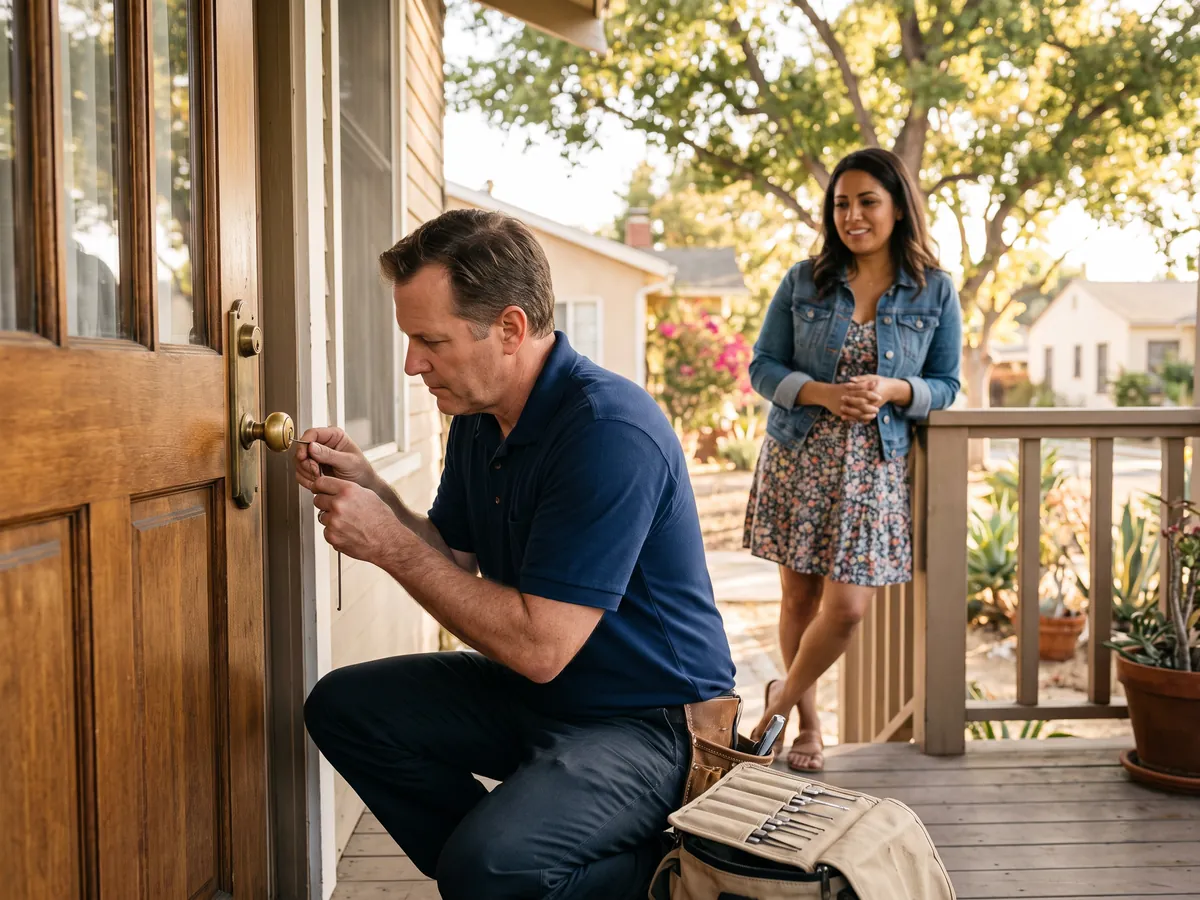
The door clicks shut, your keys are on the counter, and suddenly the place you live is a wall. A home lockout in Glendora is rarely dangerous, but it's stressful, and stress leads people to pry at frames or climb through windows. Please don't. Julian's Locksmith is a licensed mobile locksmith that drives to you, confirms you live at the address, and opens the door with picks and bypass tools built for exactly this job. Houses, apartments, condos, townhomes and casitas all qualify, and so do garage entries and sliding doors. Call (951) 903-3193, tell us what kind of lock is holding you out, and you'll get a straight quote and an honest arrival estimate before we roll.
Home lockouts in Glendora come in more shapes than you might expect, because the houses vary so much. A 1920s bungalow near the Village may have a mortise lock and a glass-paneled door. A 1960s ranch in the Alosta area often has a knob lock that clicked shut behind you on the way to the trash cans, plus a sliding patio door whose latch has been tired for years. Up in the foothills, the front door may be a heavy wood slab with a deadbolt that was clearly meant to keep people out. Each calls for a different method. Most knob locks and standard deadbolts can be picked or bypassed without a mark, and latch tools work on doors that allow them. Drilling is a last resort for failed or high-security cylinders, and we'll explain why before a drill comes out of the case. Before any door opens, we confirm you live there. A driver's license with the address works, and so do a lease, a utility bill or mail in your name, even if it's only on your phone. Afterward, ask why it happened. Self-locking knobs on back doors and keypad deadbolts that quit during a summer heat wave are common culprits, and a spare key with a trusted neighbor prevents the next call.
Home Lockout in Glendora: what to expect
Who you are in relation to the property decides what we need before opening it. Owners and the people who live with them show a photo ID with the address, or a deed, mortgage statement, property tax bill or utility bill when the ID is out of date. Renters can use the lease or a call to the property manager. Guests, house sitters and caregivers need the owner or tenant on the phone giving consent we can verify, plus their own ID. Some situations call for more. A relative settling an estate needs paperwork showing authority over the home. A buyer locked out on closing day can show closing documents. If two people dispute who has the right to be in a home, a locksmith isn't the one to decide that, and we'll point you toward the police or the courts rather than open the door. None of this is meant to slow down a home lockout in Glendora. It's how California's Locksmith Act and common sense protect everyone, including you, from someone else talking their way into your house.
What we can do on-site
- Garage entry and overhead door lockouts. Standing outside with the opener remote clipped to a visor inside the garage? A wireless keypad that lost its code, a dead keypad battery or a neighborhood power outage are common causes. We check whether the keypad can be revived, whether a side door offers easier access, and whether the overhead door's release can be reached without bending a panel.
- Sliding patio door lockouts. Sliders with a keyed exterior handle use small cylinders we can pick like any other lock. Older doors with worn rollers and sloppy latches are actually easier to open than they should be, which is worth knowing. After we're in, we can suggest a secondary lock that would stop someone else from doing the same thing.
- Smart lock and keypad lockouts. Smart locks fail in ways keys never did: forgotten codes, an app account that logged you out, an update that dropped user codes, or a motor stalled against a misaligned strike. We work on Schlage, Kwikset, Yale, August, Level, Lockly and Ultraloq hardware and choose between emergency power, picking the backup cylinder or a mechanical bypass.
- Interior door lockouts. Shared rentals often put keyed locks on bedroom doors, and those keys go missing. We open the room for the person who rents it, with proof such as a room lease or the landlord's confirmation, and can rekey the lock so a former roommate's copy stops working.
- Back, side and French door entry. Back and side doors are often the quickest fix because nobody threw the deadbolt on the way out. A spring latch with a misaligned strike or a deadlatch plunger that isn't engaging can sometimes be slipped. We check those doors before touching your front door, since the best entry is the one with the fewest locks engaged.
How Glendora shapes the job
Older homes in Glendora often keep their original hardware: mortise locks on Craftsman and Spanish Revival doors, mid-century Weiser and Schlage knobs, and keyways worn smooth by decades of use. Those locks can be easy to open, or stubborn if paint and grit have frozen them. We judge their condition before picking, sometimes impression a working key for an old mortise lock, and avoid forcing brittle parts that are hard to replace.
Larger homes around Glendora often carry high-security deadbolts, multipoint locks on tall pivot or double entry doors, smart locks tied to whole-house systems and gated driveways. That hardware is chosen to resist entry, which makes non-destructive opening slower and sometimes points us to a different door. We work carefully around custom finishes, coordinate with estate managers or security providers when needed, and verify ownership before anything else.
Inland summers around Glendora are hard on door hardware. Dark steel and fiberglass doors facing afternoon sun can bow enough to pull the deadbolt out of line with its strike, metal security screens bind, and keypad batteries drain faster than their rating. Summer lockouts often involve a lock that technically works but won't turn under load. We open it, then adjust the strike so the next heat wave doesn't repeat it.
Situations this covers
Imagine you step into the backyard of a 1960s ranch house near Sierra Madre Avenue to water the lawn, and the kitchen door swings shut behind you. The knob was set to lock, your phone is inside, and a neighbor lends you hers. We'd arrive, check your ID against the address, and open the knob with a latch tool without leaving a mark. Before leaving, we can show you how to disable the push-button lock on that knob so the door stops locking itself every time someone steps out.
- Imagine a guest at a short-term rental whose door code expired at checkout time, a day earlier than planned. The guest has a reservation and an ID, but no ownership or lease. In that case we need the host or property manager to authorize entry in a way we can verify. Often the host can simply send a new code, which beats any locksmith visit.
- Here's a frightening moment with a simple ending: a three-year-old locks the bathroom door and can't work the button again. Most privacy knobs open with a narrow pin pushed through the hole in the outside knob, and we'd walk you through it on the phone before sending anyone. If water is running or the child might be hurt, call 911 rather than waiting for us.
- A house sitter in Glendora steps out to grab the mail and the smart deadbolt's auto-lock engages, with the phone holding the guest code still on the couch. The owners are traveling. We'd need to reach an owner on a call we can verify, plus the sitter's photo ID, before opening anything. Once inside, the owner can usually push a fresh guest code from the app.
Step by step with Julian's Locksmith
- Tell us about the lockout. The first call is triage. If a child, vulnerable adult or pet is in danger inside, we'll tell you to dial 911 right away. Otherwise we gather the address, the hardware on each door and who has authority over the property, then explain what we expect to do.
- Get a quote and an honest ETA. You get two answers before we commit: the cost of entry and a realistic arrival window based on traffic and distance from San Bernardino. If either doesn't suit you, that's fine. Many people use that window to try reaching a spare-key holder one more time.
- Verify identity and residence. Proof locked inside? We can open the door, then ask you to show the documents before we leave, with us present the whole time. If nothing ties you to the home, or the story keeps changing, we decline the job. That rule protects every homeowner, including you.
- Survey every entry point. The survey also catches complications: a security screen door that has to open first, a door sagging so badly the bolt binds, or a smart lock whose app might be the quicker fix. Knowing all that up front keeps the entry gentle and avoids surprises halfway through.
- Open the door without damage. Picking with a tension wrench and hook, latch bypass, under-door tools for lever handles and emergency power for keypads cover most residential doors in Glendora. We work patiently so the pins, finish and weatherstripping come through untouched, and your existing keys still work afterward.
- Test, secure and wrap up. The final step is heading off the next lockout. Depending on what happened, that could mean cutting a spare, adding a backup code to your keypad, rekeying to one key, or adjusting a door that slams itself shut. Every suggestion is optional and priced before you decide.
What affects the cost
- Time of the call. Our hours run from 6:30 a.m. to 11:30 p.m. every day of the week. Calls near the edges of that window, early mornings and late evenings, can carry a different rate than midday visits. We tell you which applies before we dispatch.
- Distance and access. Access counts too. A guard-gated community that needs a callback, a rural property with a long dirt drive or an apartment building with no visitor parking can each add time. Mention gates, codes and parking when you call so the estimate is accurate from the start.
- Failed or damaged hardware. When the lockout is caused by a broken lock rather than a forgotten key, opening the door is only half the job. A snapped tailpiece, stripped spindle or seized cylinder needs parts. We quote the entry and the repair separately, so you can pick a replacement grade that fits your budget.
Every job gets a clear quote before any work starts. Call (951) 903-3193 with the details and we'll tell you what to expect for your situation in Glendora.
Common errors that cost time and money
- Skipping the rekey after losing keys with an ID or mail attached. Opening the door feels like the end of the problem, but your address may be in a stranger's pocket. Rekeying the exterior cylinders costs far less than dealing with someone who walks right in later.
- Breaking a window to reach the lock. Beyond the risk of a badly cut hand, you'll be paying for glass, possibly a custom-sized dual-pane unit, and the home stays exposed until it's replaced. A pane broken late on a Friday can mean a vulnerable house for days.
- Hiding a key under the mat, a planter or a fake rock near the door. Those spots are the first places anyone checks, and a key found there gives entry without any sign of forced entry, which can complicate a police report or an insurance claim afterward.
Advice before you book
- Renters, ask your property manager now what happens if you're locked out after hours. Some offices keep an on-call contact; others tell you to call a locksmith and may charge for a replacement key. Knowing the policy before the door shuts saves you a panicked search through old emails.
- If your front door has a push-button or turn-button knob, consider switching to a passage knob paired with a keyed deadbolt. A passage set never locks, so the door can't lock behind you; you lock up deliberately with the deadbolt key. It's one of the simplest anti-lockout changes there is.
- Keep a spare key in a code-protected lock box mounted somewhere that isn't visible from the street, such as inside a side-yard gate or behind a hedge. Change the code after contractors or guests use it. A lock box beats a fake rock, which anyone who has ever burgled a house recognizes on sight.
- When a lockout happens because keys were lost or stolen, especially along with anything showing your address, plan to rekey that same day. Opening the door solves tonight; rekeying makes sure whoever holds your old ring can't use it tomorrow or next month.
Getting to Glendora
Glendora is about 35 miles from our San Bernardino base, roughly 41 minutes in light traffic via University Parkway to SR-210 West. When you call, you get an arrival estimate based on where the technician is and the traffic at that moment.
Rush hour on Gladstone Street can stretch a drive considerably. We'd rather give you a realistic arrival window than an optimistic one, and we'll call you if a closure or a crash changes the plan.
About Glendora: The 2014 Colby Fire began with an illegal campfire in the mountains above Glendora, burned nearly 2,000 acres, destroyed five homes and forced about 3,600 people to evacuate.
| Neighborhoods | Grand Avenue and Foothill Boulevard area, Glendora Historic District, North Glendora Private, Glendora Country Club area, Lone Hill Avenue and Gladstone Street area, Charter Oak side |
|---|---|
| ZIP codes | 91740, 91741 |
| Main routes | I-210, SR-210, SR-57, Route 66 |
| From our San Bernardino base | about 35 miles via University Parkway to SR-210 West (Foothill Freeway), which becomes I-210 at the Lone Hill Avenue exit; Lone Hill Avenue for Glendora Marketplace and the south side, Grand Avenue for Route 66, the hospital and Glendora Village, or Citrus Avenue for Citrus College and the west side |
Not open around the clock, and we say so plainly. What we do offer is a long day: from 6:30 in the morning until 11:30 at night on Sundays, Mondays, Tuesdays, Wednesdays and Thursdays. Fridays and Saturdays get the same long day. That schedule covers the hours when people are usually heading out to work or getting back home.
California's Locksmith Act requires a signed work order when a locksmith opens a residence or commercial property, recording the requester's name, address, phone number, date of birth and ID number. Business and Professions Code §6980.55 has us keep those records for two years, available to BSIS and peace officers on request.
Locked out in Glendora?
Call (951) 903-3193 with the address and what's locked. You'll get an arrival estimate and a quote before anyone heads out, and when we arrive we'll ask for ID that ties you to the property. If a child or pet is shut inside a hot car or building, call 911 first.
Frequently asked questions
Should I call the leasing office or HOA before a locksmith?
If they're open and hold a key, yes. A property manager or on-site maintenance tech can often let you in at little or no cost, and some leases require you to try them first. HOAs rarely hold keys to individual units, though, and most offices close in the evening. When they can't help, call (951) 903-3193 and we'll take it from there.
Do I need to rekey after a home lockout?
Only if keys are missing. If they were sitting on the counter, nothing about your security has changed. If they were lost or stolen, especially with anything showing your address, rekeying makes the old keys useless while keeping your existing locks on the door. We can rekey on the same visit, and that price is quoted separately from the entry.
My keypad deadbolt is dead. What can I do?
Look underneath the keypad for two metal contacts or a small port; several models accept a 9-volt battery or a USB-C power bank just long enough to enter your code. If the lock has a key cylinder, a spare key solves it. Otherwise, call us. We can pick the backup cylinder or work through the model's override, then replace the batteries once you're in.
Can you open a high-security lock like Medeco or Mul-T-Lock?
We can try, but expectations should be realistic. High-security cylinders use sidebars, angled cuts or telescoping pins specifically to resist picking, so non-destructive entry may take a long time or fail. Often another door with standard hardware is the smarter route. If drilling is the only option, we discuss cost first and replace the cylinder, which may mean ordering keys under your key control card.
How do I know a locksmith is licensed in California?
Ask for the company's locksmith license number and look it up at search.dca.ca.gov, the Department of Consumer Affairs license search covering the Bureau of Security and Investigative Services. Julian's Locksmith holds California locksmith company license LCO7891. Be wary of anyone who won't give a business name, a real address or a license number over the phone before sending someone.
Can you get me into my garage in Glendora?
Often, yes. A garage service door may have only a knob latch, and the door from the garage into the house is frequently left unbolted. When the overhead door is closed and the opener has lost power, we can sometimes trip the emergency release from outside with a specialized tool, then re-secure it before we leave. We verify ownership first.
How far is Glendora from your base?
Glendora is about 35 miles from our San Bernardino base, roughly 41 minutes in light traffic. Arrival time depends on traffic and on the job the technician is finishing, so we give you an estimate on the phone before you commit.
Related services in Glendora
- House Lockout in Glendora
- Apartment Lockout in Glendora
- Locked Out of House in Glendora
- Locked Out of Apartment in Glendora
- Condo Lockout in Glendora
- Mobile Locksmith for House Lockout in Glendora
- Emergency Door Unlocking in Glendora
- Rekey Locks after Losing Keys in Glendora
- Smart Lock Troubleshooting in Glendora
- Key Broken Inside Lock in Glendora
Home Lockout in nearby cities
- Home Lockout in CitrusLos Angeles County
- Home Lockout in AzusaLos Angeles County
- Home Lockout in Charter OakLos Angeles County
- Home Lockout in CovinaLos Angeles County
- Home Lockout in San DimasLos Angeles County
- Home Lockout in IrwindaleLos Angeles County
- Home Lockout in DuarteLos Angeles County
- Home Lockout in La VerneLos Angeles County