
Montclair, San Bernardino County
Montclair Lock Replacement Matched to Your Existing Door
Short answer: If a key turns but the bolt stays put, a lever hangs limp, or a door was forced, the lock usually needs replacing rather than rekeying. We come to your Montclair home or business, confirm whether the fault is the lock or the door alignment, then fit a matching or stronger lock and test it with the door fully closed.
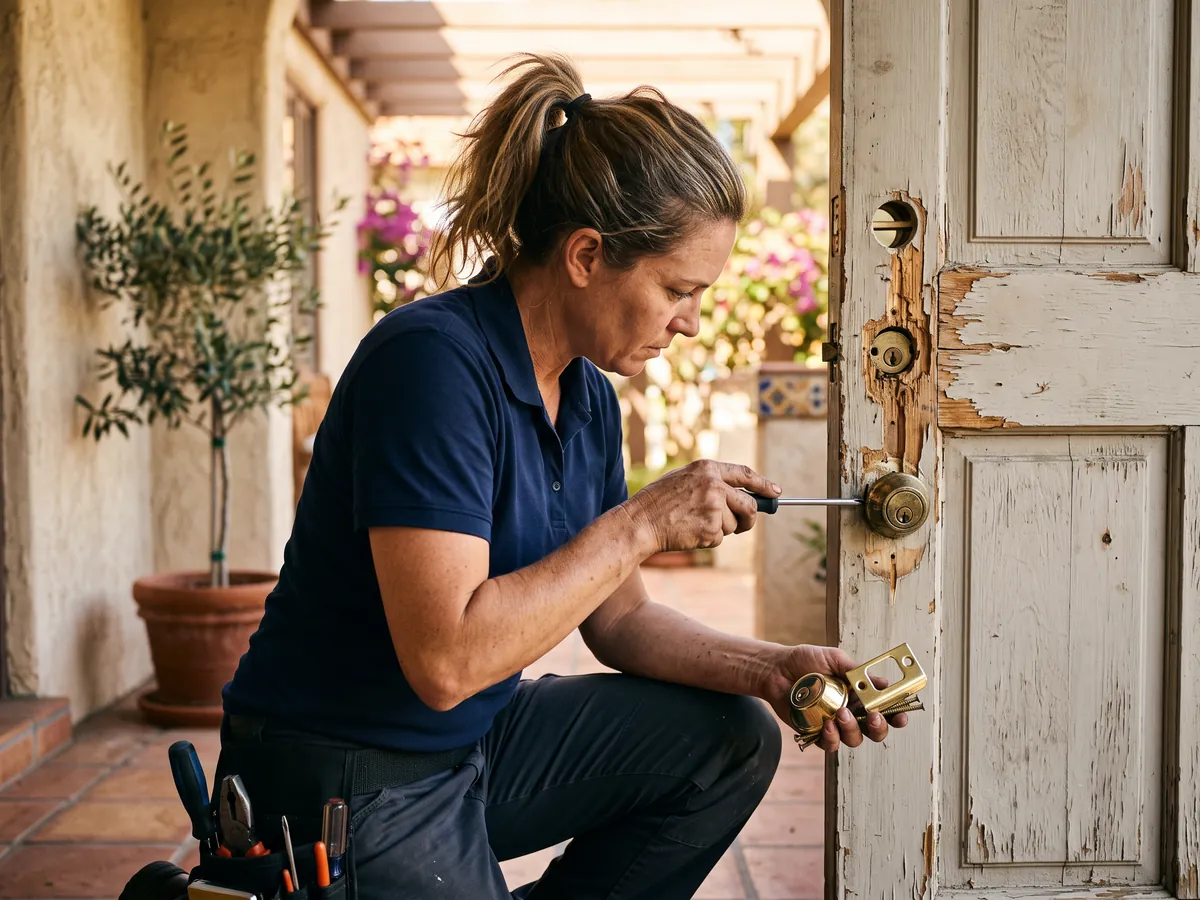
Not every sticky lock needs replacing, and a good locksmith should say so. Before recommending lock replacement at a Montclair home, we check whether the real culprit is a sagging door, a strike plate that shifted, or a cylinder that just needs cleaning. When the lock itself is finished, we replace it properly: correct backset, the right latch for the door edge, a strike aligned to the bolt, screws biting into solid wood, and keys that match the rest of the house if you want. One visit in most cases, one quote up front, and a lock you can stop thinking about.
Replacing a lock is different from changing one out of preference. This is about hardware that has failed, been damaged or simply aged out. In Montclair the causes are practical. A pry attempt leaves a bent latch and torn wood. Decades of use wear out the springs and cams inside a knob. Sun on west-facing front doors fades finishes and bakes plastic parts, and grit carried by Santa Ana winds works its way into latches and keyways. The aim is to match the new lock to the existing door prep so the job is clean. Most residential doors take a standard 2-1/8-inch bore with a 2-3/8 or 2-3/4 backset, but older doors and commercial ones vary, and we carry adapters and trim plates to cover old holes. When a break-in has damaged the door, we repair or reinforce the jamb before installing, since a new lock in a split frame is still vulnerable. We replace knobs, levers, deadbolts and handlesets, and on commercial doors, cylinders, mortise locks and exit devices. If a lock is only worn, a rekey or a repair may be enough, and we say so before selling you a new one.
How this works in Montclair
Most of the skill in lock replacement is invisible: making new hardware fit holes that were drilled for something else. Residential doors in Montclair are usually prepared with a 2-1/8 inch cross bore and a 1 inch edge bore, set at a backset of either 2-3/8 or 2-3/4 inches, which is the distance from the door edge to the center of the big hole. Most current latches adjust between those two backsets, but older doors throw curveballs: smaller bores from earlier tubular locks, square-corner latch recesses where the new faceplate has rounded corners, a handleset whose lower mounting hole sits at a different spacing than the replacement brand, or a door that's 2-1/4 inches thick instead of the usual 1-3/4. We measure all of it before choosing hardware. When the fit isn't exact, we use the cleanest available fix: a brand that shares the old spacing, a retrofit or filler plate, an extended tailpiece, or careful chisel work on the faceplate recess. The goal is a lock that looks like it was always there and a door that isn't left weaker than before.
How we can help in Montclair
- Break-in repair and strike reinforcement. Pried doors, drilled cylinders and pulled deadbolts each leave different damage, so the repair plan changes. Sometimes only the cylinder needs replacing; sometimes the lockset and strike do too. We explain what failed and why, then rebuild the opening with hardware chosen to resist that specific attack before we leave your Montclair property.
- Mortise lock replacement and conversion. When an antique mortise lock has no replacement body available, there are two good paths. A new mortise lock with a similar case size can often fit the existing pocket with minor work, or a retrofit kit can convert the opening to a standard cylindrical lock and deadbolt with plates that cover the old holes.
- Commercial lever lock replacement. Office, clinic and retail doors take a beating, and Grade 2 levers often sag long before the building is due for remodeling. We replace failed cylindrical locks with Grade 1 equivalents in the same function, whether that's storeroom, classroom, office or passage, keyed into your existing system.
- Smart lock and keypad lock replacement. If your electronic lock is still covered by the manufacturer, we'll tell you to call them first. When it isn't, we install a replacement with a footprint that covers the old holes, verify the bolt throws without the motor straining, and program user codes so you leave with a lock that's fully set up.
- Matching keys and finishes on replacement hardware. A new lock shouldn't mean a new key on your ring. We pin replacement hardware to your existing key whenever the keyway allows, or convert it so every exterior door in your Montclair home runs on one key. If the keyways can't be made compatible, we explain the options instead of quietly handing you a second key.
What's different about Montclair
Apartment entry locks take heavy use and frequent turnover, and owners need replacements that match the rest of the building. We replace failed deadbolts and levers with durable hardware keyed into your existing system, confirm each main entry deadbolt meets California's bolt-length requirement, and coordinate with management so tenants aren't stranded with a lock they can't use. Repeated failures on one model usually justify upgrading the whole property in phases.
Family homes wear locks out through sheer repetition: kids slamming doors, a garage-entry door used constantly, and side doors hit by the sprinklers. Lock replacement in Montclair neighborhoods usually covers a front entry set, the garage-entry knob and a deadbolt or two. We key everything alike, pick hardware that survives daily abuse, and can add a keypad deadbolt so the kids don't need to carry keys at all.
Storefronts lose locks to pry attempts, worn narrow-stile deadlocks and cylinders worn smooth by years of daily opening and closing. Replacing them means matching aluminum stile prep exactly. For shops along Mission Boulevard and nearby centers, we replace deadlocks, cylinders and cam assemblies, add guard plates where pry damage keeps happening, and key the replacement to the rest of the store so closing staff carry one key.
Common situations
A typical call: a homeowner with a west-facing porch near Moreno Street has a front deadbolt whose finish has flaked away, and the key turns only with a shove. The knob below it rattles. We would remove both, confirm the door prep, fit a matching Grade 2 deadbolt and knob in a finish rated for sun and weather, cut a few keys alike and check the strike so the bolt throws without effort.
- Here's a summer example: a keypad smart lock on a west-facing front door stops responding. Fresh batteries don't help, the motor grinds, and the keypad has yellowed and cracked. It's out of manufacturer coverage, so the owner opts for a newer model. We'd confirm the existing bore and backset suit it, install and pair it, and set the strike so the motor isn't straining against the bolt.
- A typical call: a homeowner in Montclair comes back from a weekend away to find the front door kicked in. The deadbolt is bent, the strike hangs by one screw and the jamb has split along the grain. We'd document it, replace the deadbolt and entry knob in the existing bore, install a box strike with long screws, wrap the cracked door edge, and leave the door locking solidly again.
- In a medical office suite, the exam room levers are sagging and one latch sticks whenever the HVAC kicks on and pressure shifts. The building runs a master key system with interchangeable cores. We'd replace the worn Grade 2 levers with Grade 1 cylindrical locks in the same functions, move the existing cores into the new hardware, and the staff keys would work exactly as before.
From your call to the finished job
- Tell us what failed. Call and describe the problem: what the key, knob or bolt is doing, the brand if you can see it, and whether there was forced entry. A photo of both sides of the door helps us load the right hardware for Montclair on the first trip.
- Verify authorization and diagnose. On arrival we check photo ID and proof that you own, live at or manage the property. Then we diagnose. A bolt that drags may be a misaligned strike rather than a bad lock, and we'll tell you so before recommending anything new.
- Measure the existing door prep. We measure backset, cross bore, edge bore, door thickness and faceplate shape, plus handleset spacing on entry doors. Those numbers decide which replacements drop in without new drilling and which would need a retrofit plate or extra work.
- Choose hardware and approve the quote. You decide between matching what was there and stepping up in strength or features. We explain the trade-offs in plain terms, including finish durability and keying, then give you a written quote covering parts, labor and any strike or door-edge work.
- Install, align and reinforce. New hardware goes on square and tight. We adjust the strike to where the door really closes, reinforce it on exterior doors, and handle any retrofit plates, chisel work or extended tailpieces the existing door prep requires.
- Key, test and hand over. Before we leave Montclair, you operate the lock yourself, inside and out. We confirm the keying plan, hand over spare keys, leave the manufacturer paperwork, and bag the damaged parts if a claim or police report is still open.
Pricing factors
- How well the existing prep fits. When the new lock fits the existing bore, backset and latch recess, installation is straightforward. Costs rise when we need retrofit plates, chisel work on the faceplate recess, re-boring an undersized hole, or an extension kit for a thick door.
- Keying requirements. Restricted and high-security keyways cost more because the cylinders and blanks are controlled. If your building uses a patented system, replacement cylinders may need to come through the authorized channel, and we factor that into both the price and the timeline.
- Number of locks and doors. Multi-unit and commercial jobs often include several identical locks, which speeds installation. We count doors, functions and cylinders during the quote so you see exactly what each one adds, instead of a vague lump sum that's hard to compare against other bids.
Every job gets a clear quote before any work starts. Call (951) 903-3193 with the details and we'll tell you what to expect for your situation in Montclair.
Practical tips before you call
- Measure your backset before shopping for a replacement: the distance from the door's edge to the center of the round hole. On residential doors it's almost always 2-3/8 or 2-3/4 inches. Most new latches adjust to both, but knowing the number saves a return trip to the store.
- Lubricate a new lock sparingly with a product made for lock cylinders or with dry graphite, not household oil. In dusty, windy weather, oily sprays attract grit that gums up pins and shortens the life of the replacement. A small puff once or twice a year is plenty.
- Business owners: check for a fire label on the hinge edge of the door or on the frame before choosing replacement hardware. Rated doors need listed locks and latches, and adding unapproved holes can void the label. A locksmith should look before ordering, not after drilling.
- Smart lock acting up? Install a fresh set of the battery type the manufacturer specifies before assuming the lock is dead. Low voltage causes motor stalls, missed codes and odd beeping. If new batteries don't help, ask the manufacturer about a replacement before buying another lock.
What not to do
- Installing a double-cylinder deadbolt on a door that is someone's only way out. If the key isn't in the lock during a fire, a key-operated inside cylinder slows escape, and building codes expect egress doors to open without a key. Use a single-cylinder deadbolt there and secure nearby glass another way.
- Overtightening the through-bolts on a new knob or lever. Cranking them down squeezes the chassis and binds the latch, which is why some freshly installed locks feel stiff or don't spring back. Snug is enough, and the latch should move freely before the trim goes on.
- Throwing out the broken lock before police or the insurance adjuster has seen it. Damaged hardware is evidence of forced entry and can support a claim. Bag it, label it, and keep it until the claim closes, along with your photos and the locksmith's itemized invoice.
Service in Montclair
Montclair is about 29 miles from our San Bernardino base, roughly 36 minutes in light traffic via Belmont Ave and Palm Ave to I-215 North, I-15 South past Fontana and Rancho Cucamonga. When you call, you get an arrival estimate based on where the technician is and the traffic at that moment.
Once the evening commute thins out on Holt Boulevard, drive times usually shrink. That makes an evening call before closing a practical option for non-urgent jobs that you couldn't fit into the workday.
About Montclair: A planned extension of Metro's A Line light rail to the Montclair Transit Center was put on indefinite hold in 2025 after San Bernardino County transportation officials redirected its funding.
| Neighborhoods | Kingsley Street area, Monte Vista Avenue corridor, Civic Center, Central Avenue corridor, Holt Boulevard corridor, Montclair Place District |
|---|---|
| ZIP codes | 91763 |
| Main routes | I-10, Central Avenue, Monte Vista Avenue, Mills Avenue |
| From our San Bernardino base | about 29 miles via Belmont Ave and Palm Ave to I-215 North, I-15 South past Fontana and Rancho Cucamonga, then I-10 West to the Monte Vista Avenue or Central Avenue exit; SR-210 West to Monte Vista Avenue, then south, for North Montclair |
New or replacement locks in Montclair?
Call (951) 903-3193 and tell us which doors and what kind of hardware you have in mind. If you already bought the lock, keep the box handy so we can check it fits the door, and we'll quote the install before any work starts.
Frequently asked questions
Is it worth repairing an old mortise lock instead of replacing it?
Sometimes. Many older mortise locks can be cleaned, given new springs and kept going, especially quality vintage pieces. When internal parts are broken and unavailable, or the lock has no deadbolt function, replacement or conversion makes more sense. We open it up, assess it honestly, and recommend the option that fits your door and your budget.
Will you verify ownership before replacing my lock?
Yes. Before changing any lock on a home, rental or business, we check photo ID and something linking you to the property, such as a deed, lease, utility bill or management authorization. It protects you and your neighbors. Julian's Locksmith is licensed by California's Bureau of Security and Investigative Services under license LCO7891.
Can you match my existing hardware finish?
Usually. Most manufacturers offer standard finishes like satin nickel, oil-rubbed bronze, satin chrome, polished brass and matte black, and we match finish codes so the new lock blends in. Some older or discontinued finishes have no exact equivalent. In those cases we'll show you the closest options or suggest replacing neighboring hardware together.
My smart lock stopped working. Do I need a new one?
Not always. Fresh batteries fix many problems, and a misaligned strike can make the motor stall. If the lock still fails, check whether the manufacturer will replace it. When it's out of coverage or obsolete, we install a replacement that fits your existing deadbolt prep and set up the codes and app with you before we leave.
When should I replace a lock instead of rekeying it in Montclair?
Replace it when the lock is physically failing: the key turns but nothing moves, the latch won't retract, the lever droops, or the bolt is bent. Rekey it when the lock works fine but you need old keys to stop working. If a lock is merely stiff, we check for misalignment or dirt first, since those can be fixed without buying new hardware.
Can you key my new lock to my old key?
In most cases. If the new lock uses the same keyway as your current key, we simply pin it to match. If it's a different brand, we can often install a compatible cylinder or convert the keyway. When that's not possible, as with some high-security systems, we explain the options before installation so there are no surprises on your key ring.
How far is Montclair from your base?
Montclair is about 29 miles from our San Bernardino base, roughly 36 minutes in light traffic. Arrival time depends on traffic and on the job the technician is finishing, so we give you an estimate on the phone before you commit.
Related services in Montclair
- Lock Installation in Montclair
- Change Locks in Montclair
- Deadbolt Installation in Montclair
- Lock Rekey in Montclair
- Door Hardware Repair in Montclair
- Replace Damaged Lock in Montclair
- High Security Locks in Montclair
- Smart Lock Installation in Montclair
- Storefront Lock Repair in Montclair
- Rekey or Replace Locks in Montclair
Lock Replacement in nearby cities
- Lock Replacement in ClaremontLos Angeles County
- Lock Replacement in PomonaLos Angeles County
- Lock Replacement in ChinoSan Bernardino County
- Lock Replacement in UplandSan Bernardino County
- Lock Replacement in OntarioSan Bernardino County
- Lock Replacement in La VerneLos Angeles County
- Lock Replacement in Chino HillsSan Bernardino County
- Lock Replacement in San DimasLos Angeles County