
Riverside, Riverside County
Riverside Door Hardware Repair, From Hinges to Exit Devices
Short answer: When a door won't latch, drags, slams or needs a shoulder shove, the lock is rarely the root cause. Usually a hinge has sagged, a strike has shifted or a closer has lost control. Julian's Locksmith traces the symptom back to its source on doors throughout Riverside, repairs that part, then cycles the door until it latches every single time.
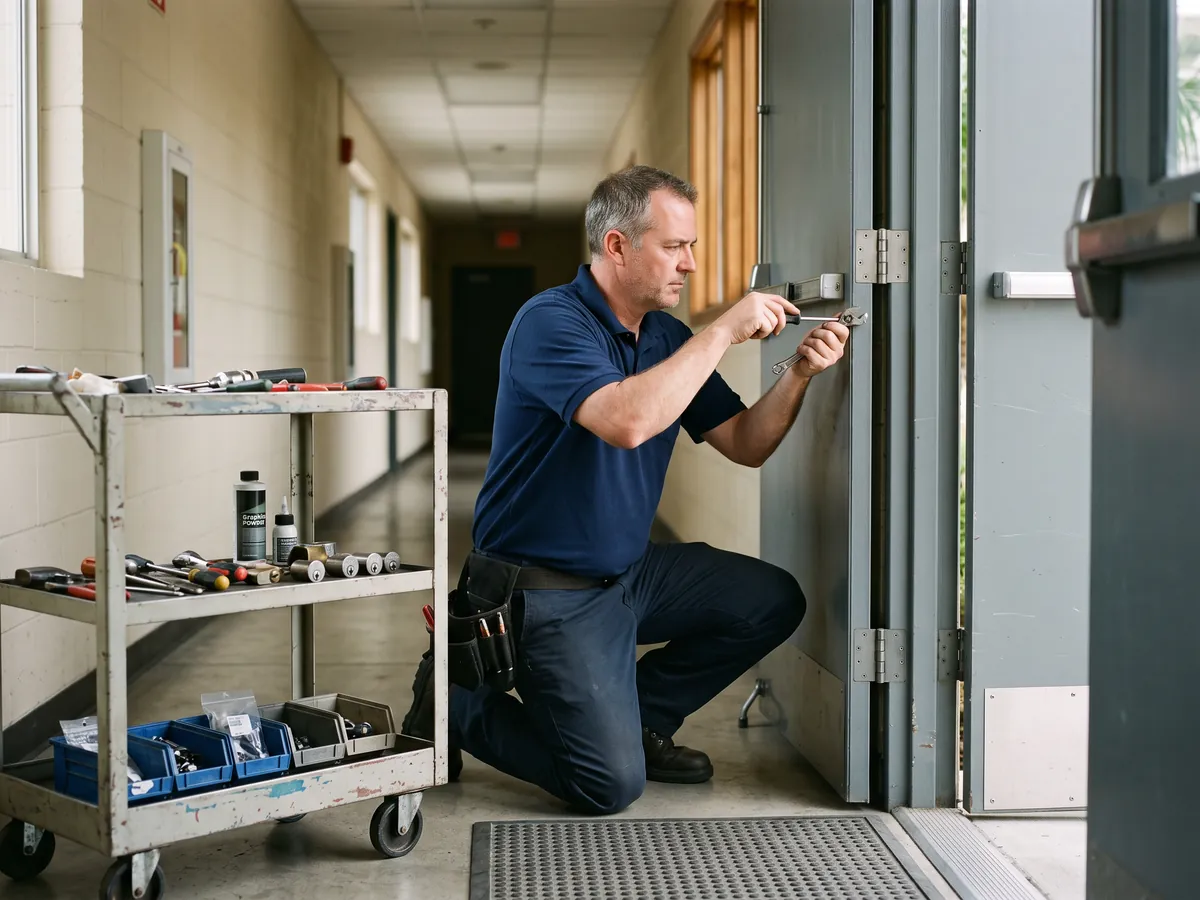
A door that doesn't latch is an unlocked door, even if the deadbolt works perfectly when you test it with the door standing open. That gap between how hardware behaves in your hand and how it behaves on a hung door is where most opportunistic break-ins and most code violations live. Julian's Locksmith treats door hardware repair in Riverside as a security and life-safety job: making sure the latch engages its strike every time, that exit doors open with one motion from inside, and that fire doors close and latch by themselves. Then we show you how to check it yourself between visits.
Door hardware repair in Riverside covers everything that makes a door open, close and latch: hinges, strikes, latches, closers, exit devices and the storefront pieces in between. Most failures here have local causes. Heat is the big one. Steel doors in full sun bow outward on hot afternoons, an effect called thermal bow, so a commercial door that latches fine in the morning may stop catching by mid-afternoon. Wood doors on older homes swell and shrink through the year. Fine dust from fall winds settles into hinges and latch bolts, turning a smooth door gritty. On busy retail entries in strip centers along Magnolia Avenue or at the Galleria at Tyler, heavy daily traffic wears hinge knuckles and pivots until the door sags onto the threshold. The fix depends on the failure. A door that won't latch may need its strike moved, its hinges shimmed or heavier ball-bearing hinges. A door that slams needs closer adjustment or a new closer. A panic bar that doesn't catch may need a new latch or rod adjustment. Worn knob springs, loose levers and dragging deadbolts on homes can usually be repaired without replacing the whole set. The van carries hinges, strikes, closer arms and common latch parts, so many repairs wrap up in one visit. When hardware is too far gone, we quote replacement with matching dimensions. On fire-rated door assemblies, rated hardware stays rated, which keeps your next inspection uneventful.
What to know first in Riverside
Door hardware repair covers everything mounted on or in a door that makes it swing, close, latch and lock. Hinges and pivots carry the weight, and when their screws loosen or their knuckles wear, the door drops toward the latch side. Strikes receive the latch and deadbolt, and they shift as frames settle. Latches and locksets contain springs, cams and retractors that wear out with use. Closers meter the swing with hydraulic fluid and valves, and they leak or lose adjustment. Exit devices add a push bar, rods and latches that bend when carts and pallets hit them. Storefront doors bring their own family of parts: narrow-stile deadbolts, hookbolts, offset pivots and concealed closers. Julian's Locksmith repairs all of these at homes and businesses in Riverside, and because they interact, we look at them together. A closer set too strong can wreck a latch; a sagging hinge can make a perfectly good lock look broken. Fixing the right part first saves money and repeat visits.
How we can help in Riverside
- Strike plate and latch alignment. New weatherstripping, a fresh coat of paint or seasonal swelling can push a door off its strike almost overnight. Rather than forcing it, we re-center the strike, shim it, or switch to one with a longer lip, and make sure its screws reach solid framing. Commercial frames get ANSI strikes matched to the lock's latch.
- Deadbolt binding and short throw. Keys that need a two-handed wiggle to lock a deadbolt wear down fast, and the cylinder follows. We fix the binding that causes the strain, then inspect the cylinder and key for wear. When the key itself is the issue, we cut a fresh one to the factory code where possible instead of copying a worn copy.
- Storefront door hardware repair. Aluminum narrow-stile storefront doors use slim deadbolts and hookbolts housed in a stile barely wider than the lock. We repair and replace these deadlocks, swap worn cylinder cams, tighten loose mortise cylinders, and realign hookbolts that no longer grab their strike after a door drops on its pivots.
- Double doors, flush bolts and coordinators. Fire-rated pairs often need a coordinator so the inactive leaf closes first and the active leaf latches over it. If the coordinator sticks or has been removed, the active door hangs open. We repair coordinators, closers and automatic flush bolts so the pair closes and latches in the correct order every time.
- Broken keys and jammed cylinders. Cylinders that turn hard often have nothing wrong inside them; the door is loading the bolt. Others really are worn, packed with grit or gummed up by the wrong lubricant. We test the cylinder off the door, clean or re-pin it, or replace it keyed to your existing key if you'd like to keep the same keys.
What's different about Riverside
Older homes in Riverside often still carry original hardware worth saving: mortise locks with brass faceplates, steel butt hinges with decorative tips, rim locks on back doors. Those parts are repairable in a way many modern builder sets are not. Decades of paint, settling and house movement are the usual enemies. We free painted-over latches, replace broken mortise springs, rehang doors that have dropped on worn hinges, and add a modern deadbolt where the original lock offers little real security.
Inland heat changes how doors behave. Closer fluid thins and doors swing faster, aluminum expands and storefronts bind, wood doors dry and shrink until latches fall short of the strike. In Riverside, a repair done in March may need tuning by August. We adjust hardware with the season in mind, recommend closers with all-weather fluid where it matters, and show you which adjustment to watch as temperatures climb.
Warehouses and distribution buildings are hard on man doors. Forklifts, pallet jacks and carts bend panic bar rods and kick plates, wind slams doors across open yards, and security depends on rear exits latching after every shift change. Near Van Buren Boulevard, we repair exit devices, closers and strikes on steel doors and frames, and recommend protective guards and stops where equipment keeps hitting the same piece of hardware.
Example situations
Picture a small office building on Market Street downtown. Its rear steel door faces west into the afternoon sun, latches every morning and swings free by mid-afternoon in summer. Staff have been propping a chair against it. On a typical visit, we'd look at the door at its worst, measure how far the latch misses, install an adjustable strike with a longer lip and speed up the closer's latch cycle so it pulls the door home. If the bow is severe, a lock or exit device with a longer latch throw may be the better long-term answer.
- Picture a pair of doors at a community hall where the deadbolt locks the active leaf to the inactive leaf, but a firm push opens both. The inactive leaf's top flush bolt has slipped out of its strike in the head, and the bottom bolt's floor cup is packed with dirt. Cleaning, a new strike and an adjusted bolt keep the inactive leaf fixed in place, which keeps the whole pair locked.
- In an older Riverside bungalow, the original mortise lock still locks with its old bit key, but the knob no longer pulls the latch back. Inside the case, a flat hub spring has snapped after the better part of a century. Replacing that spring, cleaning out the old grease and fitting a modern deadbolt above it keeps the original hardware on the door while adding real security.
- For example, a restaurant's kitchen exit off Victoria Avenue has a closer leaving a trail of oil down the door face, and the door now slams hard enough to rattle the hood vents. Adjusting won't help once the seals let go. We replace the closer with one sized for the heavy steel door, set backcheck so it doesn't fly open on windy afternoons, and tune latch speed so it closes firmly without banging.
Step by step with Julian's Locksmith
- Tell us what the door is doing. On the phone we ask a few quick questions: when did it start, does it change with the weather, has anything been replaced or painted lately, is the door fire-rated or an exit? Those answers narrow down the cause at Riverside homes and businesses before we ever arrive.
- Confirm authorization and walk the opening. Before diagnosing anything, we cycle the door several times and watch: where it rubs, how the latch meets the strike, how fast the closer swings it, whether the reveal stays even. Hardware problems in Riverside rarely live where the symptom shows up, so this walk-around matters.
- Find the root cause. Some causes need a closer look: a closer's arm disconnected to feel its spring power, a lockset pulled to inspect the chassis, an exit device cover removed to check springs and rods. We explain what we find as we go, with the worn part in your hand when that helps.
- Quote the options. Before any work starts, you get a clear quote with the options laid out: adjustment only, repair with parts, or full replacement. We point out which choice we'd make on our own door and why, and the decision stays yours.
- Make the repair. Repairs are made to last: screws that reach framing, hinges matched in size and finish, closers sized for the door, strikes set so the latch engages fully. If we install a new part, you can keep the old one so you can see exactly what failed.
- Test and hand off. Final checks include pulling on the closed door to confirm it latched, testing keys and thumbturns, timing the closer's swing, and on exit devices confirming one-push egress from inside. You'll know which parts were adjusted and which were replaced.
How we quote the job
- What's actually wrong. One symptom can have one cause or three. A door that won't latch might need a single hinge screw, or a hinge, a strike and a latch together. We price what the door actually needs, and when it turns out to be a small fix, the quote reflects that honestly.
- Hardware grade and type. Commercial Grade 1 hardware costs more per part than residential locksets, but it's designed to be serviced, so repairs often replace a spring or arm instead of the whole unit. Builder-grade home hardware is the opposite: replacing it is usually cheaper than rebuilding it.
- Code and compliance requirements. Fire-rated doors need listed replacement parts, and exit doors must stay operable from inside. Those rules sometimes call for a specific closer, latch or exit device rather than the cheapest one that fits. We explain when a code requirement, not preference, is driving the part choice.
Every job gets a clear quote before any work starts. Call (951) 903-3193 with the details and we'll tell you what to expect for your situation in Riverside.
Advice before you book
- Test your deadbolt with the door open, then with it closed. If the key or thumbturn turns easily open but drags closed, the bolt is rubbing the strike or the hole in the jamb is too shallow. That drag wears out the cylinder and tailpiece, so correcting alignment early keeps the lock smooth for years.
- Keep storefront thresholds clean. Gravel, sand and debris jam under aluminum doors, push against the pivots and wear the bottom rail. A quick sweep at closing helps, and if the door starts scraping, call before the pivot bearing fails and the door drops low enough to block the deadbolt.
- Make a pull test part of closing up a business. After the door shuts, pull it firmly from outside. If it opens, the latch didn't engage, no matter what the key or panic bar seemed to do. That one habit catches failing closers, worn latches and misadjusted rods before an intruder finds them.
- If someone in the home has arthritis, a weak grip or uses a mobility aid, swap round knobs for levers when a door is being repaired anyway. Levers work with an elbow or closed fist, and on heavier doors, pairing them with a properly set closer makes the opening usable without strain.
Common errors that cost time and money
- Driving short drywall screws into stripped hinge holes. They snap, they don't reach the framing, and the door sags again within weeks. Use proper wood or machine screws of the right gauge, and at the top hinge, a long screw that anchors into the stud behind the jamb.
- Forcing a key that won't turn, or grabbing it with pliers. That's how keys snap off inside the cylinder, turning a binding problem into an extraction. If a key fights you, stop, take pressure off the bolt by pushing or pulling the door, and try again gently before calling for help.
- Chaining, padlocking or bolting an exit door shut because its panic bar stopped latching. It's dangerous and conflicts with fire and building codes that require exit doors to open from inside with one motion. Have the device repaired, and if that can't happen right away, ask about a compliant temporary fix.
Reaching Riverside
Riverside is about 22 miles from our San Bernardino base, roughly 28 minutes in light traffic via I-215 South through Colton and Grand Terrace to SR-91 South. When you call, you get an arrival estimate based on where the technician is and the traffic at that moment.
If you're close to Magnolia Avenue, tell us which exit or cross street you're nearest. It trims the last mile and keeps the van from circling a block that looks right on the map but isn't.
About Riverside: Orangecrest was planted in citrus until the early 1980s and was annexed into the city in 1986 as a master-planned community bordering March Joint Powers Authority land.
| Neighborhoods | Magnolia Center, Arlanza, Wood Streets, La Sierra, Downtown, Arlington |
|---|---|
| ZIP codes | 92501, 92503, 92504, 92505, 92506, 92507, 92508 |
| Main routes | SR-91, SR-60, I-215, Magnolia Avenue |
| From our San Bernardino base | about 22 miles via I-215 South through Colton and Grand Terrace to SR-91 South (Riverside Freeway) into downtown and Magnolia Center; I-215 South to Alessandro Boulevard or Van Buren Boulevard for Mission Grove and Orangecrest |
Lock or door hardware trouble in Riverside?
Call (951) 903-3193 with the address and what the door or lock is doing. We'll quote the repair before any work starts.
Frequently asked questions
Do you repair aluminum storefront doors?
Yes. We repair narrow-stile deadlocks and hookbolts, replace worn cylinder cams, fix paddle handles and push bars, replace offset pivots so the door stops dragging, and service the closers that control storefront doors. Broken glass needs a glazier and torn aluminum frames may need welding, and we'll tell you if your door is in that category.
Can a sagging door be fixed without replacing it?
Almost always. Most sag comes from stripped screws at the top hinge or worn hinge knuckles. Replacing short screws with 3-inch screws that reach the framing pulls the door back up, and swapping worn hinges for new ones, ball-bearing on heavy doors, keeps it there. A door only needs replacing if the slab itself is warped, split or rotted beyond repair.
When can you come out?
Our hours are 6:30 a.m. to 11:30 p.m., seven days a week. Call (951) 903-3193 and we'll give you an honest ETA to your Riverside address based on our schedule and drive time. Doors that won't lock get priority over slow closers and squeaky hinges.
Why won't my door latch unless I slam it?
Usually the door has moved, not the lock. Loose hinge screws let the door sag, seasonal swelling or new weatherstripping pushes it off the stop, or the strike has shifted as the frame settled. Slamming forces the latch past the strike lip. The fix is to tighten or replace hinge screws, then realign the strike, so the latch drops in with a normal close.
What does door hardware repair include?
Door hardware repair covers every part that helps a door swing, close, latch and lock: hinges and pivots, strike plates, latches and locksets, deadbolts, door closers, panic bars and exit devices, flush bolts on double doors, and storefront deadlocks and handles. In Riverside, Julian's Locksmith repairs these on homes and businesses, adjusting what's adjustable and replacing only the parts that have actually failed.
Should I repair or replace my door closer?
If the closer just slams or closes too slowly, it can usually be adjusted using its sweep, latch and backcheck valves. If it's leaking oil, the internal seals have failed and it should be replaced; adding fluid isn't a lasting fix. Broken arms and mounting shoes can be replaced separately. We also check that the closer is sized correctly for the door's width and weight.
How far is Riverside from your base?
Riverside is about 22 miles from our San Bernardino base, roughly 28 minutes in light traffic. Arrival time depends on traffic and on the job the technician is finishing, so we give you an estimate on the phone before you commit.
Related services in Riverside
- Door Closer Repair in Riverside
- Panic Bar Installation in Riverside
- Storefront Lock Repair in Riverside
- Commercial Door Hardware in Riverside
- Broken Key Extraction in Riverside
- Lock Repair in Riverside
- Door Lock Repair in Riverside
- Latch Repair in Riverside
- Deadbolt Repair in Riverside
- Commercial Door Won't Latch in Riverside
Door Hardware Repair in nearby cities
- Door Hardware Repair in RubidouxRiverside County
- Door Hardware Repair in PedleyRiverside County
- Door Hardware Repair in Jurupa ValleyRiverside County
- Door Hardware Repair in Glen AvonRiverside County
- Door Hardware Repair in Mira LomaRiverside County
- Door Hardware Repair in Grand TerraceSan Bernardino County
- Door Hardware Repair in Home GardensRiverside County
- Door Hardware Repair in BloomingtonSan Bernardino County

