
Brea, Orange County
Brea Door Hardware Repair, From Hinges to Exit Devices
Short answer: Businesses in Brea call us for door hardware repair on surface and concealed closers, rim and vertical rod exit devices, mortise locks, and aluminum storefront deadbolts and pivots. Julian's Locksmith confirms the caller is authorized, quotes first, and works every day, 6:30 a.m. to 11:30 p.m., so many repairs happen before opening or after close.
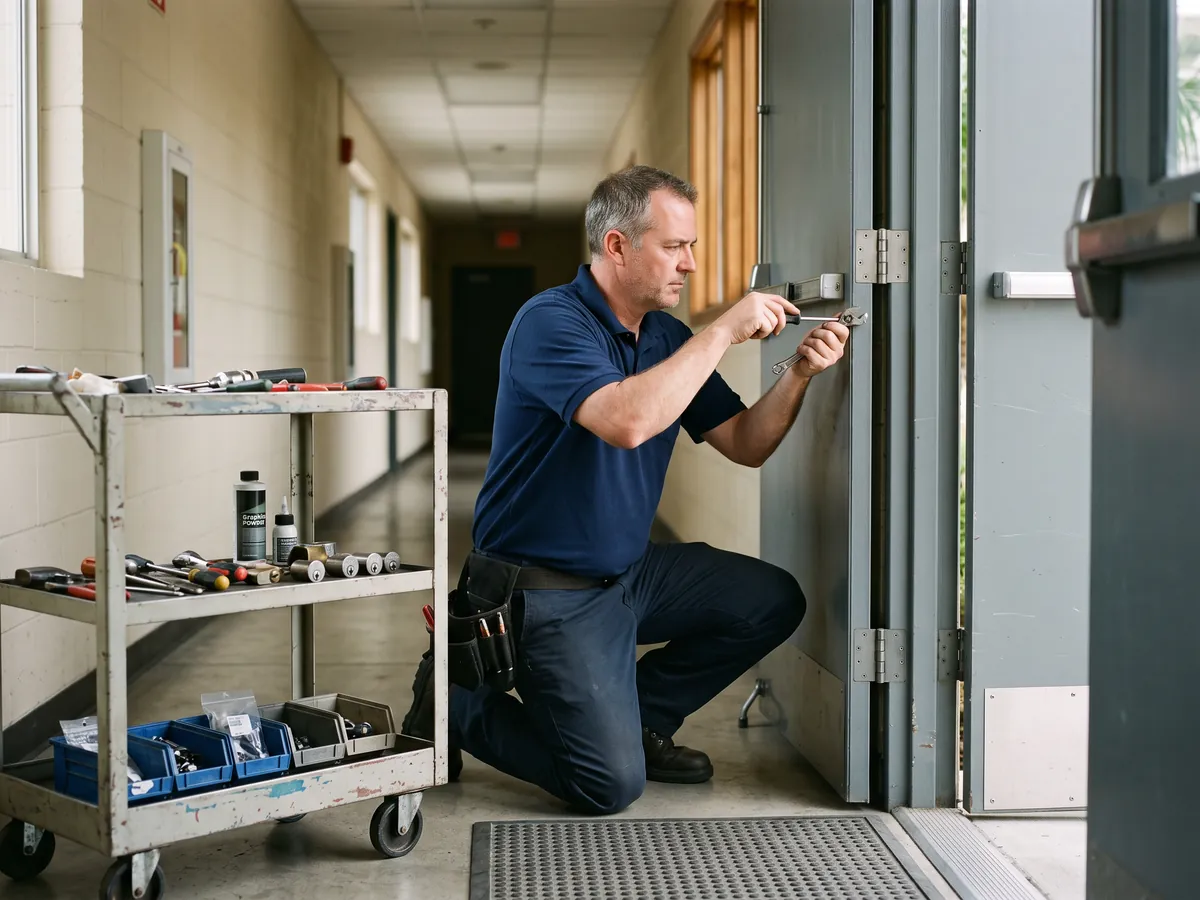
Not every door problem needs new hardware, and not every door problem is a locksmith job. That's the honest starting point for door hardware repair in Brea. Many calls end with an adjustment, a longer screw, a new spring or a relocated strike. Some need a replacement closer or exit device. A few need someone else entirely: a glazier for broken storefront glass, a welder for a torn hollow metal frame, an automatic door technician for a power operator. Julian's Locksmith will tell you which group your door falls into, fix what we can fix well, and give you a quote before starting.
Door hardware wears out where doors get used the most. Closers lose oil, hinges loosen, strikes shift, latches stick, exit devices stop catching and storefront handles come loose. In Brea, foot traffic at Brea Mall, the shops of Downtown Brea and the offices along Imperial Highway puts constant stress on all of it. Repair is usually the better choice when the door and frame are sound. A closer that slams can be adjusted. A latch that misses the strike can be realigned by moving the strike or shimming a hinge. A panic bar that sticks can be cleaned and its latch retracted. We replace parts when they are worn out and keep the door's existing hardware when a matching part is available. Some issues are safety issues. A door that does not latch properly may be a fire-door problem, and an exit device that does not release is an egress problem. We flag those so you can act. At home, the same logic applies to sagging patio doors, sticking deadbolts, loose handles and interior doors that rub their frames.
Door Hardware Repair in Brea: what to expect
The first question on most door hardware repair calls in Brea is whether to fix what's there or replace it. A few details decide it. Is the part made to be serviced? Many commercial closers, exit devices and mortise locks have replaceable springs, arms, rods and trim, while most builder-grade residential locksets don't. Is a replacement available in the same size and preparation? A lockset with a different backset, a closer with a different mounting pattern or an exit device with a different rail length means drilling new holes, and on a fire-rated door that may not be allowed. Does the finish matter? Satin chrome (US26D), satin stainless (US32D), oil-rubbed bronze (US10B) and bright brass (US3) don't mix gracefully on a front entry. Finally, how worn and abused is it? A closer that has leaked once will leak again, and a lock body with a cracked case isn't worth new springs. We lay out both paths, with honest costs, before doing any work.
How we can help in Brea
- Lockset and latch mechanism repair. Mortise locks, found in older Brea homes and most commercial buildings, are built to be repaired. We pull the case, clean out decades of dust and hardened grease, replace broken hub or latch springs, and tighten the cylinder set screw that stops the cylinder from unthreading and spinning in the lock body.
- Deadbolt binding and short throw. A deadbolt that turns smoothly with the door open but fights you with it closed isn't a bad lock. The bolt is rubbing the strike or bottoming out in a shallow hole in the jamb. We deepen the bolt hole, relocate or replace the strike, and confirm the bolt extends all the way so it actually locks.
- Door closer adjustment and replacement. When a door slams in July and crawls in January, the closer's fluid is reacting to temperature, and in Brea that seasonal swing is real. We set closers for the conditions the door actually sees, and when one is undersized or worn out, we replace it with a closer sized to the door's width, weight and exposure.
- Double doors, flush bolts and coordinators. French doors on homes share the weak spot of commercial pairs: short flush bolts that barely reach their holes. We extend bolt engagement, install proper strike cups in the floor or sill, and realign both leaves so the active door's deadbolt seats fully into the edge of the inactive door.
- Broken keys and jammed cylinders. Locks jammed after an attempted break-in may have a twisted cam, a broken tailpiece or a cylinder that was punched or pried. We open the door if needed after verifying you're authorized, salvage what's undamaged, and replace only the broken parts, keeping your current keys working wherever the hardware allows.
What's different about Brea
Newer tract homes around Brea come with builder-grade hardware and doors hung on a tight schedule. Typical first-year problems include short hinge screws that let doors sag as the house settles, strikes set slightly off so deadbolts drag, and latches that stick once fresh paint cures. These are inexpensive fixes when caught early. We add long hinge screws, reset strikes and, when a builder lockset gives out, suggest a sturdier replacement that fits the existing holes.
Older homes in Brea often still carry original hardware worth saving: mortise locks with brass faceplates, steel butt hinges with decorative tips, rim locks on back doors. Those parts are repairable in a way many modern builder sets are not. Decades of paint, settling and house movement are the usual enemies. We free painted-over latches, replace broken mortise springs, rehang doors that have dropped on worn hinges, and add a modern deadbolt where the original lock offers little real security.
Storefronts on busy retail strips depend on aluminum doors that open hundreds of times a day. Pivots wear, hookbolts stop catching, paddle handles crack and closers leak. A door that won't lock at closing is a serious problem when the store holds inventory overnight. We repair narrow-stile locks, pivots and closers for Brea retailers, with early-morning and evening appointments that keep the sales floor open.
Situations this covers
Imagine a stockroom door at a shop in the Brea Mall corridor that no longer latches. The strike is bent, the closer is slow and the hinges have shifted. We would tighten the hinges, reset the strike, adjust the closer's latch speed and test the door until it latches every time without a slam. The staff then stop propping it open with a box.
- A boutique in a strip center near Birch Hills Golf Course calls because the front door scrapes the threshold and the owner has to lift it to lock up. The bottom offset pivot has worn through its bearing, the door has settled, and the hookbolt now hits below its strike. New pivots raise the door back to its original height, the hookbolt finds its strike again, and the scraping stops.
- Picture a pair of doors at a community hall where the deadbolt locks the active leaf to the inactive leaf, but a firm push opens both. The inactive leaf's top flush bolt has slipped out of its strike in the head, and the bottom bolt's floor cup is packed with dirt. Cleaning, a new strike and an adjusted bolt keep the inactive leaf fixed in place, which keeps the whole pair locked.
- Consider a sliding patio door in a 1990s house where the latch hook no longer grabs the keeper. Nothing is wrong with the lock itself. The bottom rollers have worn flat, the panel has dropped, and the hook now swings beneath the keeper. Turning the roller adjustment screws raises the panel so the hook catches again, and if the rollers are too far gone, we talk about replacing them.
How the visit works
- Tell us what the door is doing. Photos help more than descriptions. Snap the whole door from a few feet back, then the hinges, the strike, the lock face and any label on a closer or panic bar. Send them to info@julians-locksmith.com when you call, and we'll often know which parts to bring before we leave.
- Confirm authorization and walk the opening. On arrival we confirm that you're the owner, a tenant with permission, or a manager who can approve work, and we check ID and proof of residence or ownership if the door is locked and has to be opened first. Then we look at the entire opening, not only the part you called about.
- Find the root cause. We work from the hinges toward the latch, checking screws, knuckle wear, frame bow and strike position before blaming the lock. If the door is sagging, moving the strike alone just relocates the problem. Finding the true cause is what keeps a repair from coming undone a month later.
- Quote the options. When parts have to be ordered, such as a specific closer, a discontinued finish or an exit device in a particular rail length, we say so up front, quote the full job, and can make a temporary fix so the door closes and locks in the meantime.
- Make the repair. On commercial doors in Brea, we work around your schedule, early before opening or later in the evening, so customers and staff aren't blocked. Fire-rated doors get listed parts only, and exit doors stay usable from inside for as much of the job as the work allows.
- Test and hand off. We cycle the door repeatedly, from wide open and from just a few inches, checking that it closes and latches every time and locks from both sides as designed. Then we walk you through what was done and what to keep an eye on.
What affects the cost
- Hardware grade and type. Brand matters mostly for parts. Established commercial lines such as LCN, Von Duprin, Sargent, Corbin Russwin and Adams Rite keep repair parts available for many years. Off-brand imports may have no parts at all, which pushes the decision toward replacement whether you like it or not.
- Parts availability, size and finish. Matching the existing preparation saves money. A replacement that fits the same holes, backset and mounting pattern installs quickly. A different size can mean filler plates, new holes or reprepping the door, which adds labor and, on a rated door, can raise questions about the fire label.
- Timing, access and number of doors. Repairs during our regular hours are simplest to schedule. Late-evening work is possible, and parts ordered for a specific job add a second visit. We close at 11:30 p.m., so plan late-evening calls early.
Every job gets a clear quote before any work starts. Call (951) 903-3193 with the details and we'll tell you what to expect for your situation in Brea.
Common errors that cost time and money
- Cranking up a closer's spring power to make a door latch. A stronger closer slams the latch into a misaligned strike and makes the door too heavy to open comfortably, which can put a commercial door outside California's accessibility limits. Correct the alignment and adjust latch speed first.
- Chaining, padlocking or bolting an exit door shut because its panic bar stopped latching. It's dangerous and conflicts with fire and building codes that require exit doors to open from inside with one motion. Have the device repaired, and if that can't happen right away, ask about a compliant temporary fix.
- Removing a broken closer and leaving the door without one. Fire-rated doors and the door between an attached garage and the house are meant to close by themselves, wind can fling an uncontrolled door into a wall, and a business exit without a closer may stay unlatched after hours.
Advice before you book
- Keep storefront thresholds clean. Gravel, sand and debris jam under aluminum doors, push against the pivots and wear the bottom rail. A quick sweep at closing helps, and if the door starts scraping, call before the pivot bearing fails and the door drops low enough to block the deadbolt.
- If your exit devices use hex-key dogging, keep the dogging key in a known spot and undog the bars at closing. A device left dogged leaves the door unlatched until someone notices. Fire-rated exit devices aren't permitted mechanical dogging, so if yours has none, that's probably the reason.
- Twice a year, tighten every hinge screw with a hand screwdriver, not a drill that can strip them. If a screw just spins, swap it for a 3-inch screw of the same gauge and head so it reaches the wall framing. At the top hinge, one long screw does more than tightening all the short ones.
- Don't prop a door that has a closer open with a wedge under the bottom. The closer keeps trying to shut it, straining the arm, the hinges and the closer's internals. If you need the door to stay open, ask about a hold-open arm or a wall magnet, and never hold open a fire door without a code-approved release.
Reaching Brea
Brea is about 51 miles from our San Bernardino base, roughly 55 minutes in light traffic via I-215 South briefly to SR-210 West. When you call, you get an arrival estimate based on where the technician is and the traffic at that moment.
Most trips into Brea use SR-90 for at least part of the drive, and the technician keeps an eye on live traffic along the way so the arrival estimate you heard on the phone stays honest.
About Brea: Baseball Hall of Fame pitcher Walter Johnson spent his boyhood in the oil camp of Olinda before his career with the Washington Senators.
| Neighborhoods | Olinda Ranch, La Floresta, Carbon Canyon, City Hall Park area, Olinda Village, Country Hills |
|---|---|
| ZIP codes | 92821, 92823 |
| Main routes | SR-57, SR-90, SR-142, Brea Boulevard |
| From our San Bernardino base | about 51 miles via I-215 South briefly to SR-210 West (Foothill Freeway) through Rialto, Fontana, Rancho Cucamonga and La Verne, then SR-57 South (Orange Freeway) through Pomona and Diamond Bar and over the Puente Hills to the Lambert Road or Imperial Highway (SR-90) exits; alternate via I-15 South and SR-60 West to SR-57 South, or SR-60 West to SR-71 South and Carbon Canyon Road (SR-142) through Chino Hills for Olinda Village and Olinda Ranch |
Lock or door hardware trouble in Brea?
Call (951) 903-3193 with the address and what the door or lock is doing. We'll quote the repair before any work starts.
Frequently asked questions
How much does door hardware repair cost in Brea?
It depends on the cause and the hardware. Hinge and strike adjustments with a few screws cost far less than replacing a closer or exit device, and concealed hardware takes more labor than surface-mounted. Matching finishes, discontinued parts and fire-rated requirements also play a role. We diagnose the door and give you a quote before starting work.
Do you repair electric strikes and access control door hardware?
We handle the mechanical side at the door: electric strikes that bind under pressure, misaligned keepers, mechanical overrides, and the locks and closers paired with access control. When the fault is in the controller, reader, power supply or wiring beyond the door, a low-voltage contractor or your access control provider may need to handle it, and we'll say so.
What does door hardware repair include?
Door hardware repair covers every part that helps a door swing, close, latch and lock: hinges and pivots, strike plates, latches and locksets, deadbolts, door closers, panic bars and exit devices, flush bolts on double doors, and storefront deadlocks and handles. In Brea, Julian's Locksmith repairs these on homes and businesses, adjusting what's adjustable and replacing only the parts that have actually failed.
Can you repair fire-rated doors?
We repair hardware on fire-rated doors using listed replacement parts, and we keep the door self-closing and positively latching as required. We avoid field modifications that could compromise the label. If a rated door needs work beyond hardware, such as a damaged slab or frame, or a formal annual inspection report, we'll tell you who handles that part.
My deadbolt is hard to lock when the door is closed. Is the lock broken?
Probably not. If the deadbolt turns easily with the door open, the lock is fine and the bolt is rubbing the strike or hitting the bottom of a shallow hole in the jamb. Forcing it wears the cylinder and can snap keys. We realign or relocate the strike and deepen the bolt hole so the bolt slides in smoothly to its full throw.
My lever handle droops. Can it be repaired?
Often. A drooping lever usually means a fatigued or broken return spring inside the lockset. On commercial and better residential locks, the spring or spring cage can be replaced. On many builder-grade levers, internal parts aren't sold separately and replacement costs less. We'll check whether your lock is serviceable before quoting either path.
How far is Brea from your base?
Brea is about 51 miles from our San Bernardino base, roughly 55 minutes in light traffic. Arrival time depends on traffic and on the job the technician is finishing, so we give you an estimate on the phone before you commit.
Related services in Brea
Door Hardware Repair in nearby cities
- Door Hardware Repair in La HabraOrange County
- Door Hardware Repair in PlacentiaOrange County
- Door Hardware Repair in Rowland HeightsLos Angeles County
- Door Hardware Repair in FullertonOrange County
- Door Hardware Repair in La Habra HeightsLos Angeles County
- Door Hardware Repair in Yorba LindaOrange County
- Door Hardware Repair in AnaheimOrange County
- Door Hardware Repair in City of IndustryLos Angeles County
