
Perris, Riverside County
Door Hardware Repair in Perris
Short answer: Door hardware repair in Perris means fixing the parts that make a door work: hinges, strikes, latches, closers, panic bars and storefront locks. Julian's Locksmith comes to your home or business, finds out why the door is failing, and quotes before any work starts. Most problems are solved on the spot with an adjustment or a replacement part. Call (951) 903-3193.
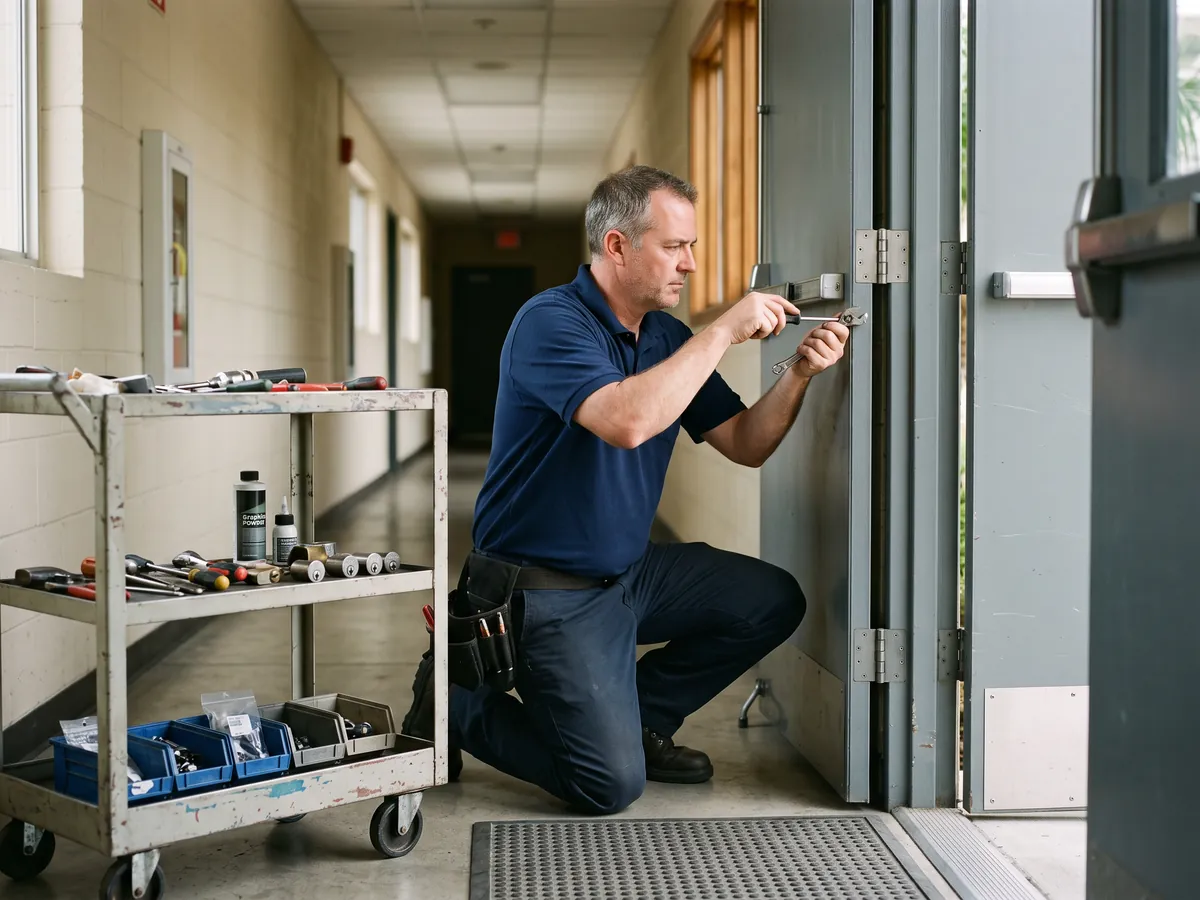
Doors in this part of Southern California live a hard life. Summer afternoons bake south- and west-facing entries, aluminum frames grow, closer fluid thins, and a door that latched fine at breakfast starts to slam or bind by late afternoon. Then a winter storm swells a wood door, or a Santa Ana gust catches one mid-swing and wrenches the closer arm. Door hardware repair in Perris has to account for all of it. Julian's Locksmith adjusts hinges, strikes, latches and closers with the season in mind, uses ball-bearing hinges and longer screws where the load demands them, and explains what to watch as temperatures change.
Door hardware repair covers the parts around the lock that make a door work: hinges, closers, latches, strikes, exit devices, thresholds and weatherstripping. Doors usually fail in the parts nobody looks at, and the symptoms mislead. A door that will not latch is rarely a bad lock. More often a hinge has sagged, a strike has shifted or a closer is pulling the door off its seat. In Perris, heat does half the damage. Steel and fiberglass doors swell in summer and bind against their strikes, hinge screws loosen where they bite into soft jamb wood, and weatherstripping dries and cracks. Dust from graded lots and open fields works into latches and mortise pockets. Old buildings on D Street and 4th Street add their own history: doors painted shut, replacement hardware that does not match the original mortise and wooden frames that settled decades ago. A typical repair visit checks the door in order: hinges first, with long screws if they have pulled loose; then strike alignment, latch action by hand, closer adjustment, exit device function and, last, the lock. The first three often cure the sticking without any new parts. On commercial doors, closers and exit devices need attention more than locks do. Fire-rated doors have their own rules: never prop them open, and never change latches without checking the rating.
Door Hardware Repair in Perris: what to expect
Residential and commercial door hardware fail in different ways, so they get repaired differently. Home doors usually carry ANSI Grade 2 or 3 cylindrical locks, 3.5-inch hinges and no closer, and their problems tend to be alignment, loose trim and worn latch springs. Commercial doors in Perris are heavier, often steel or aluminum, swing hundreds of times a day, and carry Grade 1 mortise or cylindrical locks, 4.5-inch ball-bearing hinges, surface closers and often exit devices. Their failures come from wear and abuse: elongated pivot holes, leaking closers, vertical rods bent by hand trucks, levers that droop because return springs fatigued. Commercial openings also carry rules a house rarely does. Fire-rated doors must self-close and positively latch, exit doors must open with one motion from the inside, and accessible doors have opening-force and closing-speed limits. Our door hardware repair work keeps those requirements intact, which is why we repair with listed, matching hardware instead of whatever happens to fit the hole.
Work included on a typical visit
- Strike plate and latch alignment. A well-set strike lets the latch drop in with a gentle close while the deadlatch plunger rests against the strike face. We check that relationship with the door shut, adjust the strike lip so it doesn't catch the door edge, and confirm the deadbolt's full throw clears the jamb hole without rubbing or bottoming out.
- Lockset and latch mechanism repair. Mortise locks, found in older Perris homes and most commercial buildings, are built to be repaired. We pull the case, clean out decades of dust and hardened grease, replace broken hub or latch springs, and tighten the cylinder set screw that stops the cylinder from unthreading and spinning in the lock body.
- Double doors, flush bolts and coordinators. French doors on homes share the weak spot of commercial pairs: short flush bolts that barely reach their holes. We extend bolt engagement, install proper strike cups in the floor or sill, and realign both leaves so the active door's deadbolt seats fully into the edge of the inactive door.
- Broken keys and jammed cylinders. A key snapped in a lock usually leaves part of the blade inside the plug. We remove it with thin extractor hooks and picks, without drilling, then figure out why it broke: a worn key, a binding cylinder or a door pulling on the bolt. We cut a replacement key and correct the cause.
- Forced-entry damage and reinforcement. After a pry attempt on a commercial door, we look for a spread frame, a bent latch and a damaged cylinder. Latch guards, longer strikes and hardened parts can follow. If the hollow metal frame is torn or the door itself is bent, we'll say so and point you toward a door and frame contractor.
How Perris shapes the job
Family homes wear doors out in predictable ways: kids swinging on levers, bedroom doors that get slammed, back doors left to bang against the frame. We repair loose and drooping levers, re-anchor strikes, restore self-closing on the garage-to-house door, and check that sliding patio doors latch the way they should. For Perris families, the goal is doors that lock reliably and close safely around small fingers.
Older homes in Perris often still carry original hardware worth saving: mortise locks with brass faceplates, steel butt hinges with decorative tips, rim locks on back doors. Those parts are repairable in a way many modern builder sets are not. Decades of paint, settling and house movement are the usual enemies. We free painted-over latches, replace broken mortise springs, rehang doors that have dropped on worn hinges, and add a modern deadbolt where the original lock offers little real security.
Newer tract homes around Perris come with builder-grade hardware and doors hung on a tight schedule. Typical first-year problems include short hinge screws that let doors sag as the house settles, strikes set slightly off so deadbolts drag, and latches that stick once fresh paint cures. These are inexpensive fixes when caught early. We add long hinge screws, reset strikes and, when a builder lockset gives out, suggest a sturdier replacement that fits the existing holes.
Situations this covers
A church hall on a downtown street has a pair of wooden doors, and the deadbolt on one will not throw. The hinges have pulled out of the soft frame, and the door drags on the floor. We remove the door, fill the screw holes with glue and hardwood dowels, rehang it on 3-inch hinge screws, trim the bottom edge, align the strike and adjust the closer. The lock was never the problem.
- Picture a warehouse rear exit where the panic bar works, yet the door can be pulled open from outside after it closes. The bottom rod of the vertical rod device was bent by a pallet jack and no longer drops its latch into the floor strike. We straighten or replace the rod, reset top and bottom latch timing, and add a kick plate and rod guard so the next bump doesn't repeat the problem.
- Consider a sliding patio door in a 1990s house where the latch hook no longer grabs the keeper. Nothing is wrong with the lock itself. The bottom rollers have worn flat, the panel has dropped, and the hook now swings beneath the keeper. Turning the roller adjustment screws raises the panel so the hook catches again, and if the rollers are too far gone, we talk about replacing them.
- A typical call: a stucco tract home near Perris Auto Speedway at the Lake Perris Fairgrounds where the front door only latches when someone slams it. The top hinge screws have pulled loose from a jamb softened by years of slamming, so the door has dropped about an eighth of an inch on the latch side. Two 3-inch screws through the hinge into the framing lift it back, the latch drops in with a light push, and the strike stays exactly where it was.
Step by step with Julian's Locksmith
- Tell us what the door is doing. On the phone we ask a few quick questions: when did it start, does it change with the weather, has anything been replaced or painted lately, is the door fire-rated or an exit? Those answers narrow down the cause at Perris homes and businesses before we ever arrive.
- Confirm authorization and walk the opening. For businesses, we ask who can approve repairs and whether a property manager or landlord needs to sign off, since many leases assign door hardware to one party or the other. Settling that before work begins avoids billing confusion and makes sure the right person knows what changed.
- Find the root cause. Weather and building movement belong in the diagnosis. A door that binds only on hot afternoons, a strike that drifted after foundation work, a frame that bowed when the stucco was redone: each points to a different fix, and we tell you which one we think fits your door.
- Quote the options. Quotes cover parts, labor and the trip, with no surprise add-ons afterward. If we uncover something mid-repair that changes the picture, such as a cracked lock case hiding behind the trim, we stop and talk with you before going any further.
- Make the repair. Repairs are made to last: screws that reach framing, hinges matched in size and finish, closers sized for the door, strikes set so the latch engages fully. If we install a new part, you can keep the old one so you can see exactly what failed.
- Test and hand off. We cycle the door repeatedly, from wide open and from just a few inches, checking that it closes and latches every time and locks from both sides as designed. Then we walk you through what was done and what to keep an eye on.
How we quote the job
- What's actually wrong. Simple adjustments cost far less than parts, so it pays to call before a problem cascades. A loose hinge left alone wears the latch, then the strike, and eventually the frame, turning what could have been a minor visit into a much bigger repair.
- Door and frame condition. On aluminum storefronts, the condition of the stile and frame sets the job's scope. Worn pivot pockets, cracked rail welds or a bent stile limit what new hardware can accomplish. We check those first, so the price you approve is the price that actually fixes the door.
- Timing, access and number of doors. Repairs during our regular hours are simplest to schedule. Late-evening work is possible, and parts ordered for a specific job add a second visit. We close at 11:30 p.m., so plan late-evening calls early.
Every job gets a clear quote before any work starts. Call (951) 903-3193 with the details and we'll tell you what to expect for your situation in Perris.
Mistakes to avoid
- Filing the strike opening wider every time the door stops latching. It works for a while, but the latch and deadlatch plunger lose the edges that hold them, and a door that once resisted a credit card can be slipped open. Fix the sag or shift that moved the door instead.
- Removing a broken closer and leaving the door without one. Fire-rated doors and the door between an attached garage and the house are meant to close by themselves, wind can fling an uncontrolled door into a wall, and a business exit without a closer may stay unlatched after hours.
- Chaining, padlocking or bolting an exit door shut because its panic bar stopped latching. It's dangerous and conflicts with fire and building codes that require exit doors to open from inside with one motion. Have the device repaired, and if that can't happen right away, ask about a compliant temporary fix.
Advice before you book
- Don't prop a door that has a closer open with a wedge under the bottom. The closer keeps trying to shut it, straining the arm, the hinges and the closer's internals. If you need the door to stay open, ask about a hold-open arm or a wall magnet, and never hold open a fire door without a code-approved release.
- Twice a year, tighten every hinge screw with a hand screwdriver, not a drill that can strip them. If a screw just spins, swap it for a 3-inch screw of the same gauge and head so it reaches the wall framing. At the top hinge, one long screw does more than tightening all the short ones.
- After adding new weatherstripping or a door sweep, test the latch right away. Fresh foam or a thicker seal pushes the door away from the stop, and the latch may no longer reach its strike. Sometimes the strike just needs a small move; sometimes a thinner seal is the better answer.
- If you own rentals in Perris, check door hardware at every turnover and write down what you find: hinge tightness, latch engagement, deadbolt throw, closer function on shared doors. Fixing small problems between tenants costs less than a mid-lease call and keeps entry doors meeting California's deadbolt rule for rentals.
Reaching Perris
Perris is about 32 miles from our San Bernardino base, roughly 37 minutes in light traffic via University Parkway to I-215 South through San Bernardino, Colton and Grand Terrace, along the SR-60 overlap in Riverside and past March Air Reserve Base. When you call, you get an arrival estimate based on where the technician is and the traffic at that moment.
Most trips into Perris use Perris Boulevard for at least part of the drive, and the technician keeps an eye on live traffic along the way so the arrival estimate you heard on the phone stays honest.
About Perris: Metrolink's 91/Perris Valley Line reached Perris in June 2016, adding the Perris-Downtown station at the Perris Transit Center and the Perris-South station on Case Road.
| Neighborhoods | Goetz Road and Perris Valley Airport area, Monument Ranch, Pinacate area along South A Street, South Perris near Case Road and Ethanac Road, May Ranch, West Perris toward Mead Valley and Good Hope |
|---|---|
| ZIP codes | 92570, 92571 |
| Main routes | I-215, SR-74, Ramona Expressway, Perris Boulevard |
| From our San Bernardino base | about 32 miles via University Parkway to I-215 South through San Bernardino, Colton and Grand Terrace, along the SR-60 overlap in Riverside and past March Air Reserve Base; exit Harley Knox Boulevard or Ramona Expressway for north Perris, Nuevo Road or D Street for downtown, Ethanac Road for the south side |
Lock or door hardware trouble in Perris?
Call (951) 903-3193 with the address and what the door or lock is doing. We'll quote the repair before any work starts.
Frequently asked questions
What if my door won't lock and I can't wait for parts?
We secure the door first. That might mean a temporary adjustment so the existing lock throws, a surface-mounted lock, or a spare part from the van that isn't the final match. Then we order the correct part and come back for the permanent repair. You'll know exactly which pieces are temporary before we leave your Perris property.
Is it okay to file my strike plate so the latch catches?
Only as a last, small adjustment. Filing the opening bigger can let the deadlatch plunger drop into the strike, which defeats the feature that stops someone from slipping the latch with a card. It also hides a sagging door that will keep getting worse. It's better to fix the hinge or move the strike so the latch lines up properly.
Why does my door work in the morning but stick in the afternoon?
Heat. Sun on a door expands aluminum frames, dries or swells wood, and thins the fluid inside a closer so it swings faster. A door that's borderline in the cool morning can bind or slam by late afternoon. We diagnose these doors with the timing in mind and adjust hinges, strikes and closers so they work across the whole daily range.
When can you come out?
Our hours are 6:30 a.m. to 11:30 p.m., seven days a week. Call (951) 903-3193 and we'll give you an honest ETA to your Perris address based on our schedule and drive time. Doors that won't lock get priority over slow closers and squeaky hinges.
Should I repair or replace my door closer?
If the closer just slams or closes too slowly, it can usually be adjusted using its sweep, latch and backcheck valves. If it's leaking oil, the internal seals have failed and it should be replaced; adding fluid isn't a lasting fix. Broken arms and mounting shoes can be replaced separately. We also check that the closer is sized correctly for the door's width and weight.
My lever handle droops. Can it be repaired?
Often. A drooping lever usually means a fatigued or broken return spring inside the lockset. On commercial and better residential locks, the spring or spring cage can be replaced. On many builder-grade levers, internal parts aren't sold separately and replacement costs less. We'll check whether your lock is serviceable before quoting either path.
How far is Perris from your base?
Perris is about 32 miles from our San Bernardino base, roughly 37 minutes in light traffic. Arrival time depends on traffic and on the job the technician is finishing, so we give you an estimate on the phone before you commit.
Related services in Perris
Door Hardware Repair in nearby cities
- Door Hardware Repair in Good HopeRiverside County
- Door Hardware Repair in Mead ValleyRiverside County
- Door Hardware Repair in RomolandRiverside County
- Door Hardware Repair in NuevoRiverside County
- Door Hardware Repair in Quail ValleyRiverside County
- Door Hardware Repair in March Air Reserve BaseRiverside County
- Door Hardware Repair in HomelandRiverside County
- Door Hardware Repair in MenifeeRiverside County
