
Mechanical Safe Lock Repair in Costa Mesa: Full Guide
By Julian's Locksmith, , 9 min read
A step-by-step troubleshooting guide for mechanical safe lock problems in Costa Mesa, from simple dial resets to when drilling or a service call makes sense.
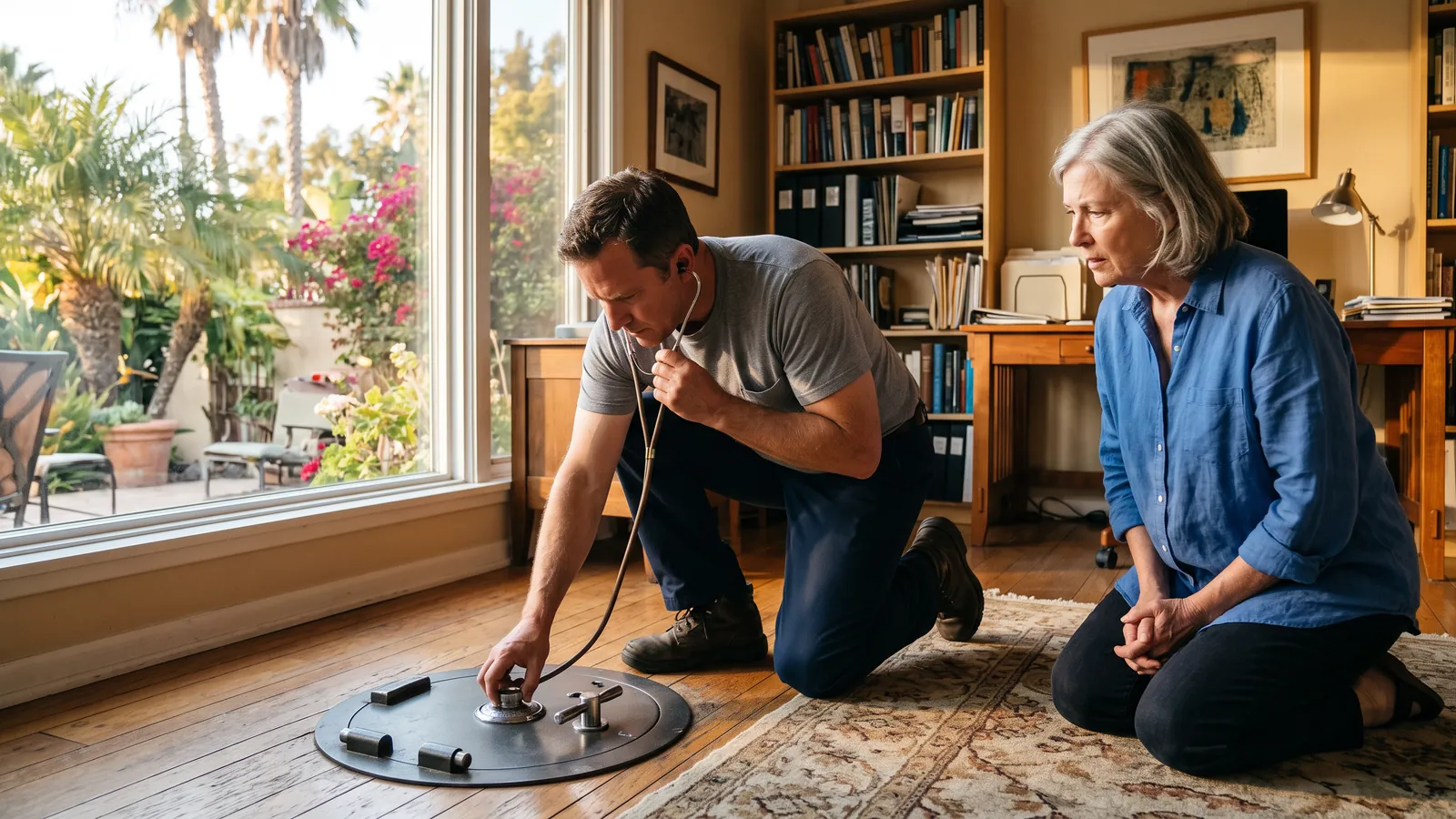
If your floor safe or gun safe has a mechanical dial or key lock that's turning stiff, skipping numbers, or not releasing the bolt, start with the simplest checks before assuming the lock has failed. Most problems trace back to dial-in technique, a loose handle, or a bolt that's binding against the door frame rather than a dead lock mechanism. This guide walks through what to check first, what usually means real wear inside the lock, and when it's time to call a safe locksmith in Costa Mesa instead of forcing it.
Mechanical locks are mechanical for a reason: they're built from wheels, levers, cams, and springs that wear slowly over years, not electronics that fail all at once. That means most issues develop gradually and give warning signs before a full lockout happens. Catching those signs early, especially heading into the busier fall season when safes get opened more often for back-to-school paperwork, holiday valuables, and document storage, can save you from a middle-of-the-night emergency.
Start With the Dial, Not the Lock
Before suspecting the lock itself, rule out user error. Dial-type combination locks are unforgiving about rotation count and direction, and a single missed turn throws off the whole sequence.
- Confirm you're using the current combination, not a factory default or an old one from a previous owner.
- Count full rotations carefully. Most group 2 mechanical locks require three full turns left, stop on the first number, two full turns right, stop on the second, one full turn left, stop on the third, then turn right to the final stop.
- Reset to zero and redial slowly, pausing on each number rather than rushing through the sequence.
- Watch for a dial that spins freely without resistance at any point, which can indicate the spindle has disconnected internally rather than a dialing mistake.
If you consistently land on the right numbers and the bolt still won't retract, move to the handle and bolt work before assuming the internal lock has failed.
Check the Handle and Bolt Mechanism
A mechanical lock can be functioning perfectly while the handle or bolt linkage is what's actually stuck. This is especially common on safes that don't get opened often, since linkages can stiffen from disuse.
- Try the handle with firm, even pressure rather than jerking or forcing it, which can bend the linkage further.
- Look at the bolt itself through the gap in the door. If it's only partially retracted, the lock may have released but something is blocking full bolt travel.
- Check for visible rust or discoloration around the handle collar, a sign of moisture intrusion that can swell the linkage.
- If the safe sits in a garage or storage room, verify nothing has shifted against the door that's putting pressure on the bolt from outside.
A stiff handle that eventually gives way is a different problem than a handle that's completely frozen. The second usually means internal parts have corroded or seized, which calls for professional disassembly rather than continued force.
Listen and Feel for Wheel Pack Problems
If dialing technique and the handle both check out, the issue is likely inside the lock's wheel pack, the stack of rotating discs that align to release the fence and allow the bolt to move.
Signs of wheel pack wear include:
- The combination working intermittently rather than consistently.
- A gritty or inconsistent feel when turning the dial, compared to a smooth, even resistance.
- The lock requiring you to dial slightly off the original numbers to get it to release, which suggests the wheels have shifted on their spindle.
- A faint clicking or scraping sound as you turn, audible if you hold your ear near the dial in a quiet room.
Wheel pack issues don't always mean full lock replacement. A locksmith can often open the lock case, clean out old graphite or oil buildup, and re-align or lubricate the wheels. This is detailed work that requires the lock to come off the door, which is a service best left to someone trained specifically in safe locksmith work rather than general door lock repair.
Rule Out Environmental Causes Before Fall and Winter
Southern California's dry fall months bring Santa Ana wind events that kick dust and fine debris into mechanisms that aren't fully sealed. If your safe lives in a garage, workshop, or near a vent, dust intrusion is a realistic cause of a stiff dial or a bolt that drags.
- Wipe down the dial and handle area with a dry cloth to remove visible dust before testing the lock again.
- Avoid spraying household lubricants like WD-40 directly into the dial or keyhole, since they can gum up with dust over time and make the problem worse rather than better.
- If the safe sits near a window or door that gets propped open during Santa Ana conditions, consider relocating it or sealing gaps around its storage area.
Daylight saving time ending in November also means more safes get opened in darker, less-lit conditions during early evening hours. A lock that felt fine in daylight can feel stiffer or harder to read by dial feel alone when you're working with a flashlight. If you're regularly struggling to see the dial clearly, that's worth fixing with better lighting before you misdiagnose a lighting problem as a mechanical one.
Try a Controlled Reset Before Assuming Failure
Many mechanical locks, particularly on older safes, benefit from a full reset rather than repeated attempts at the same combination.
- Close the safe door without locking the bolt, if possible, and dial the combination from a completely neutral starting position.
- Turn the dial several full rotations in each direction before starting the sequence, to clear any residual tension in the wheel pack.
- Dial the combination at a slow, even pace, stopping cleanly on each number rather than overshooting and correcting.
- Test the handle gently after each attempt rather than forcing it repeatedly, which can wear the bolt mechanism further.
- If it still won't open after three careful attempts, stop trying and treat it as a mechanical issue rather than a dialing issue.
Repeated forceful attempts on a lock that's already struggling can turn a repairable problem into one that requires drilling. If you've reached this point, it's worth reading through our page on a safe won't open scenario, which covers what typically happens next.
When the Combination Itself Is the Problem
Sometimes the lock works fine, but the combination is lost, forgotten, or was never passed down from a previous owner, which is common with safes bought secondhand or inherited from a family member.
If you've lost the combination entirely:
- Check any paperwork that came with the safe, including a manufacturer's envelope or sticker often placed inside the door or on the back panel.
- Contact the manufacturer directly if the safe has a visible model and serial number, since some keep combination records on file for registered owners.
- Avoid repeatedly guessing numbers, since this can trigger relockers on safes equipped with them, a safety feature that locks the bolt permanently in place after detecting a possible break-in attempt.
A locksmith can often determine the combination through manipulation on older mechanical locks, without drilling, depending on the lock's design and condition.
Key Lock Variants and Worn Keys
Not every mechanical safe uses a dial. Many smaller safes use a key-operated lock instead, and these have their own wear patterns.
- A key that turns partway and stops usually means worn key teeth rather than a damaged lock.
- A key that spins freely without engaging the bolt suggests the lock's internal cam has sheared, which is a lock problem rather than a key problem.
- A key that's difficult to insert or remove may indicate a bent key or debris inside the keyway rather than lock failure.
If you've lost your only key or it's broken off inside the lock, don't attempt to extract it with pliers or wire, which risks pushing fragments deeper into the mechanism. Our page on safe key replacement in Costa Mesa covers how replacement keys are cut and fitted once ownership is verified.
When to Stop Troubleshooting and Call a Locksmith
Some signs mean it's time to stop working on the lock yourself and bring in a professional:
- The dial spins without any resistance at all, suggesting a disconnected spindle.
- The handle is completely frozen and won't move even with light, steady pressure.
- You've confirmed the correct combination multiple times with careful dialing, and the bolt still won't retract.
- The safe has a visible relocker trigger warning in its manual, and you're unsure whether a failed attempt may have activated it.
- The lock feels fine, but you've lost the combination entirely with no paperwork or manufacturer record.
At this point, continued attempts risk permanent damage to the lock or forcing a drilling job that could have been avoided with proper manipulation. A technician experienced in mechanical safe lock repair in Costa Mesa can assess whether the issue is a simple adjustment, a wheel pack service, or a lock that needs replacing entirely, and provide a quote before any work begins.
What a Professional Repair Actually Involves
Understanding what a locksmith does once called out can set realistic expectations:
- Diagnosis first. A technician will test the dial, handle, and bolt travel independently to isolate where the failure actually is, rather than assuming the worst-case scenario.
- Manipulation when possible. For many older mechanical locks, skilled manipulation can open the safe without drilling, preserving the original lock.
- Targeted drilling when necessary. When drilling is required, it's typically a small, precise hole at a calculated point on the door, not a large opening, and many safes can be repaired afterward with a patch plug and a new lock installed.
- Lock replacement. If the original lock has failed internally beyond repair, a comparable mechanical or electronic replacement can usually be fitted to the existing door.
- ID and ownership verification. Before opening any locked safe, a licensed locksmith will ask for identification and proof of ownership or residence, consistent with the standards set under the state's Locksmith Act (Business and Professions Code 6980 et seq.).
You can verify any locksmith's license status directly through the Bureau of Security and Investigative Services at search.dca.ca.gov before letting anyone work on a safe in your home or business.
Preventing Repeat Problems
Once your safe is working again, a few habits reduce the odds of running into the same issue:
- Open and close the safe periodically even if you don't need access, to keep the mechanism from stiffening through disuse.
- Keep the area around the safe free of dust, especially during dry fall months when Santa Ana winds are more likely to kick particulates into garages and storage rooms.
- Store a written note of the combination somewhere secure but separate from the safe itself, not taped to the safe or stored only in one person's memory.
- Avoid lubricating the dial or lock yourself with generic household oils; ask a locksmith what's appropriate for your specific lock model.
If you're dealing with a broader lock or security question beyond the safe itself, our general locksmith page for Costa Mesa covers other common residential and commercial issues in the area.
Getting Help in Costa Mesa
If you've worked through dial technique, handle checks, and a careful reset and the safe still won't open, or you suspect internal wear in the wheel pack, it's a reasonable point to call for help rather than keep forcing the mechanism. Julian's Locksmith is a licensed, insured, and bonded mobile locksmith (California locksmith company license LCO7891) available 24 hours a day, seven days a week, serving Costa Mesa and surrounding communities across Orange, Los Angeles, Riverside, and San Bernardino counties.
Before any work begins on your safe, a technician will verify your identification and ownership or residency, then provide a quote so you know what the repair involves. You can learn more on our safe locksmith page for Costa Mesa or reach out directly through our contact page.
Call (951) 903-3193 any time, day or night, to describe what's happening with your safe lock and arrange a visit.
Frequently asked questions
Why won't my mechanical safe open even though I'm using the right combination?
The most common causes are dial-in error from counting rotations incorrectly, a worn or slipping wheel pack inside the lock, or a bent handle that won't retract the bolt even when the combination is correctly dialed. Temperature shifts and humidity can also cause metal parts to swell slightly, which changes how the lock feels compared to when you first set it.
Can a mechanical safe lock be repaired without drilling the safe?
Often, yes. Many mechanical lock problems come from handle linkage, bolt alignment, or a sticking fence rather than the lock body itself. A locksmith with the right diagnostic tools can sometimes manipulate or service the lock without drilling. Drilling becomes necessary mainly when the lock has failed internally or the combination is permanently lost.
How much does mechanical safe lock repair usually involve?
Cost depends on the lock type, how the safe was manufactured, and whether drilling and a replacement lock are required. A locksmith should inspect the safe and provide a quote before starting any work, so you know what the repair involves before committing to it.
Is it legal for anyone to open my locked safe in California?
California's Locksmith Act (Business and Professions Code 6980 et seq.) requires locksmiths to be licensed through the Bureau of Security and Investigative Services. A legitimate locksmith will ask for identification and proof of ownership or residence before opening a safe, which protects you from unauthorized access to your property.
Does Santa Ana wind season or dry fall weather affect safe locks?
Dust and dry air during Santa Ana wind events can work into dial mechanisms and handle linkages, especially on older safes or those stored in garages. If your safe sits near a window, vent, or garage door, a light service check before winter can catch grit buildup before it causes a harder failure.
More locksmith advice
- Emergency Door Unlocking in Wildomar: 24/7 Local Home Lockout Guide
- Key Fob Access Control in Chino: How It Works
- Door Closes Too Slowly? Fullerton Fix Guide
- Commercial Latch Repair in Anaheim: Mistakes to Avoid
- Rekey Locks After Tenant Moves Out: North Fontana Guide
- App-Controlled Lock Installation in Nuevo: Fix Guide