
Devore, San Bernardino County
Devore Car Lockout Help: Cabin, Trunk and Smart-Key Lockouts
Short answer: Keys in a closed trunk and smart fobs locked inside push-start cars are the two lockouts people assume are hopeless, and both are routine for us in Devore. We open a door first, then reach the trunk through its release, the fold-down seats or the interior emergency handle. With a fob left inside, we open the car and then find out why it went undetected.
We'll be straight with you about timing, because a car lockout is all about timing. Julian's Locksmith runs from 6:30 a.m. to 11:30 p.m. every day of the week, weekends included. Inside those hours we take lockout calls across Devore as they come in and give you a realistic arrival window on the phone, based on where our van is and the traffic between us. Outside them, we'll point you toward the options that genuinely help, like a roadside plan, a household spare or the automaker's app. Either way, call (951) 903-3193 first and we'll give you a straight answer.
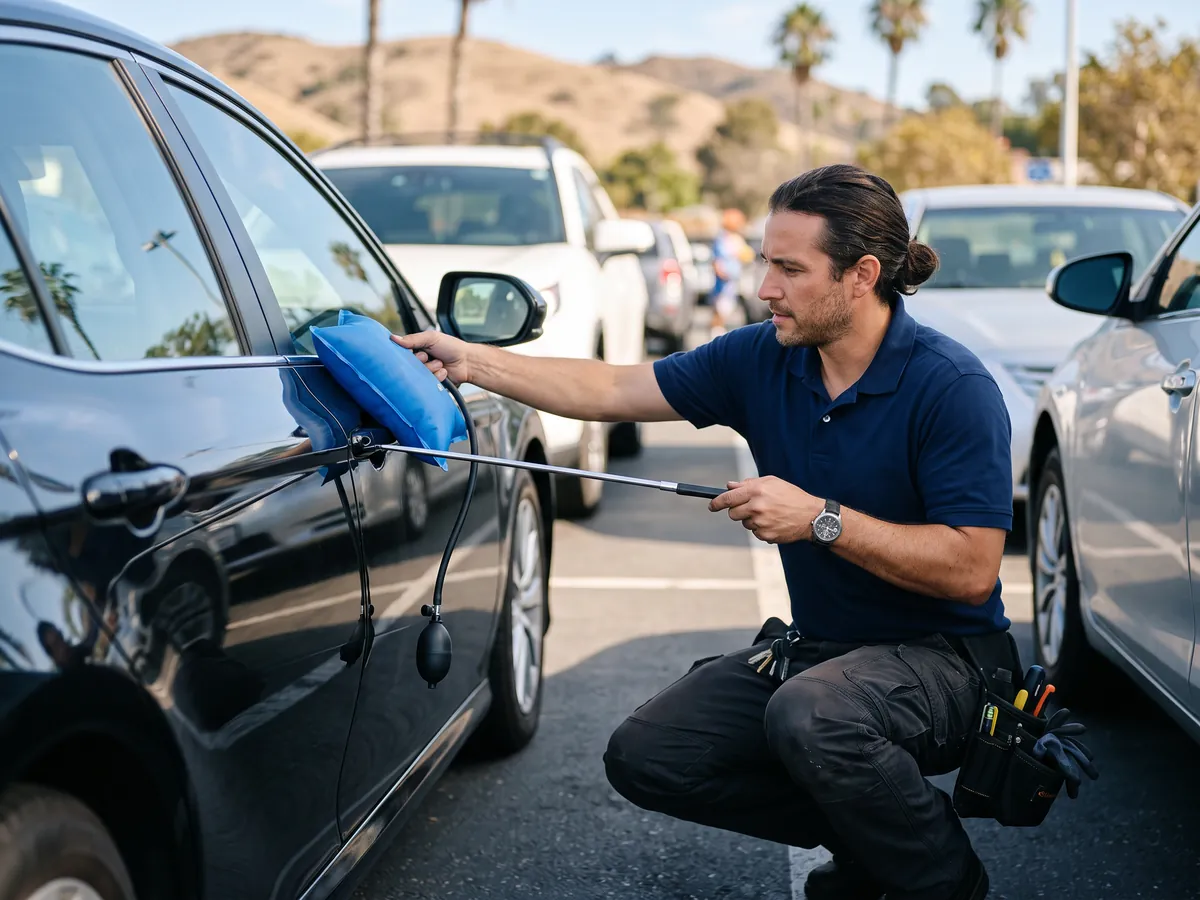
Car lockouts around Devore tend to happen while people are busy with something else. You hook up a trailer, step out to check the lights, and your thumb catches the lock button as the door swings shut with the keys still in the cab. Or you pull into the Devore Animal Shelter lot on Shelter Way to meet a dog and come back to find the fob on the seat. Our approach is the same for a ranch pickup or a family sedan. An inflatable air wedge opens a thin gap at the top of the door, and a long-reach tool presses the unlock button or pulls the inside handle. No coat hangers, no bent door skin, and no risk to the wiring and side airbag components that run through the door. When we need to read the lock itself, a Lishi decoder lets us pick it and see the key cuts at the same time, which helps if the key is gone for good. Trunk lockouts and push-start cars have quirks of their own. A sedan trunk with the keys inside often opens from the cabin once we are in, through a release or a folding seat. Push-button cars normally refuse to lock with a fob in the cabin, but a weak fob battery or a second key in a pocket can fool them. We check ID and registration before opening any vehicle.
What to know first in Devore
Most vehicle entry starts at the top rear corner of the driver's or front passenger door, where the frame has a little natural flex. We slide in a thin protective sleeve, then a flat inflatable air wedge, and pump it with a hand bulb until there's a gap of a few millimeters, just enough for a tool. A plastic wedge often goes in beside it to hold the opening steady. The long-reach rod is a stiff, coated steel shaft with a soft tip, and its target depends on the vehicle: the power unlock button on the armrest, the interior door handle, a lock knob or post on older models, or occasionally the unlock key on the center console. Many cars also unlock and open in one motion if the interior handle is pulled. When the door swings open, the factory alarm may sound; it quiets once the key or fob is recognized. The real skill is restraint. An over-inflated wedge can spring a door frame so it whistles and leaks at freeway speed, so we inflate slowly, watch the glass and the seal, and stop at the smallest gap that works.
How we can help in Devore
- Air wedge and long-reach entry. Think of it as working inside the car without climbing in. We protect the door edge, inflate a wedge by hand a few millimeters at a time, then guide a long-reach tool by sight to the lock button on the armrest. Slow inflation is the whole trick, because it keeps the frame from springing and the glass from flexing.
- Push-start cars locked with the fob inside. If your keyless car locked itself with the fob in a bag, a cupholder or the cargo area, the car simply failed to detect it. We open the door, recover the fob, then test its battery and signal right there in Devore. A fading coin cell is the usual culprit, and we can swap it before you drive away.
- Truck, van and work-vehicle lockouts. Cargo vans like the Ford Transit, Ram ProMaster and Mercedes Sprinter can lock the cargo area separately from the cab. Keys dropped in the back may mean opening the cab and using the dash release, or working a rear or sliding door lock directly. Commercial upfits sometimes add aftermarket locks we'll need to look at first.
- Urgent lockouts: running engines, kids and pets. A car left idling with the doors locked is common at gas stations and in driveways on chilly mornings. Fuel burns while you wait, and an unattended running car invites theft. During our hours we treat these as priority calls in Devore and open the car the same non-destructive way, with the engine still running.
- Rental, fleet and borrowed vehicles. Locked out of a rental? Read your rental agreement first, because many companies want you to use their own roadside line and some contracts restrict outside service. If they authorize it or can't reach you in time, we open the car without damage and record the agreement number alongside your ID.
How Devore shapes the job
Inland heat is hard on cars in Devore. Coin cells in smart fobs weaken faster when keys bake on a dashboard, which leads to undetected fobs and push-start cars locking with the key inside. Door cylinders that rarely turn dry out and stiffen. And a locked car in summer sun is dangerous for anyone inside, so if a child or pet is in the cabin, call 911 first and us second.
Foothill trailheads and canyon turnouts near Devore are lonely places for a lockout, with spotty cell coverage and narrow shoulders. If you can, call from a spot with signal and give us a precise location, like the trailhead name or nearest mile marker. Hot afternoons and Santa Ana winds make it worth finding shade while you wait, and we'll call back when we're close.
Long commutes out of Devore mean early starts, park-and-ride lots and cars left for ten hours at a stretch. Those are prime conditions for a lockout: keys set on the seat while grabbing a lunch bag in the dark, or a battery that gives up after a long day in a sun-baked lot. Our day starts at 6:30 a.m., which lines up with the predawn rush, and we bring wedges and picks to the lot instead of asking you to tow anywhere.
Situations this covers
Consider a cold morning near the Devore Road exit, with frost on the windshield and the truck idling to warm up while you check the hitch. Your thumb brushes the lock button as the driver's door closes, and the fob rides the seat with the engine still running. We'd confirm the registration, wedge the door open a finger-width, hook the fob with a reach tool, and have you hitched and pulling out without a scratch on the paint or a stretched weatherseal.
- For example, someone finishes a long walk around BNSF Cajon Subdivision rail line and realizes the only key to a late-2000s Honda with a laser-cut blade fell out of a pocket somewhere along the way. The car is locked and the key is gone. We'd pick and decode the door with a HON66 tool, check the registration from the glove box against the driver's ID, then cut and program a new key so the car leaves on its own power.
- For example, a driver parks a crossover at a shopping center near Cajon Wash, sets the smart key on the wireless charging pad with her phone stacked on top, and walks off with walk-away auto-lock switched on. The car couldn't hear the fob under the phone and locked itself. We'd open the driver's door with a wedge and reach tool, hand back the key, and suggest a better resting spot for it in that console.
- Picture a pickup with a boat trailer still hitched, parked near a lake launch ramp, with the truck keys locked in the cab while the boat keys sit in your pocket. The trailer doesn't change how the truck opens, but parking room for our van and any fee gate matter, so tell us where you are. A long reach rod to the door switch would have you loading the boat back up shortly after we arrive.
How the visit works
- Tell us where the keys are. When you call, the first question is where the keys are: visible in the cabin, in the trunk, inside a locked compartment, or missing. Then the year, make and model, and whether anyone or anything is inside. Those answers decide which reach tools, Lishi picks and key blanks we load before leaving.
- Get a quote and an arrival estimate. Before anyone drives over, you get a price for the entry based on your vehicle and situation, plus a realistic arrival estimate from where our van is right then. If something on site changes the job, such as a seized lock or a missing key, we explain it and re-quote before going further.
- Size up the vehicle and the scene. A quick inspection saves time and paint. We check for frameless glass, aftermarket tint, existing door damage and which interior control is easiest to reach. If the car already has a scratch or dent near the work area, we point it out before we start so there's no confusion later.
- Open the vehicle. If the keys are in the trunk, the door is only step one. Once inside, we try the trunk release, the floor lever and the seatback pass-through in that order, turning on any disabled valet switch. Picking the trunk cylinder is the fallback when the cabin route won't work.
- Confirm ownership. Before you take the car back, we match your photo ID to the registration or proof of insurance, often pulled from the glove box once the door is open. For rentals we check the rental agreement; for company vehicles, we get authorization from the owner or fleet manager.
- Test everything and prevent a repeat. Before we leave, we test the locks with your key or fob, make sure the door closes cleanly and the weatherstrip sits right, and check the fob battery on a push-start car. If the cell is weak, we can replace it on the spot so the same lockout doesn't happen again.
How we quote the job
- Where the keys ended up. Keys visible on a seat are the simplest case: one door and you're done. Keys in a closed trunk can mean opening a door and then working the trunk release or seats, which adds steps. Keys that are lost altogether turn the job into cutting and programming, a different and larger service.
- Distance and site access. Tell us if the car sits behind a gate, in a garage with a height limit, or in a lot that requires a permit. Our van may need to park outside while we carry tools in, or you may need to arrange guest access. Small details like that keep the quote accurate and the visit short.
- Extra work after the door opens. A spare key made during a lockout visit usually costs less than a separate trip later, because we're already at the car with the cutting and programming equipment. It's worth considering if you've only got one key, but the decision is yours, and we won't push it on you.
Every job gets a clear quote before any work starts. Call (951) 903-3193 with the details and we'll tell you what to expect for your situation in Devore.
Practical tips before you call
- Never assume a few minutes is fine for a child or pet in a locked car. Closed cabins heat up fast, even on a mild day. If anyone vulnerable is inside and the interior is warming, call 911 before calling a locksmith. Emergency crews can break glass, and no mobile service can promise to arrive as quickly.
- Keep a spare key somewhere useful: with a household member, at work, or with a neighbor you trust. A magnetic box under the bumper is the first place a thief looks and often shakes loose on the freeway. For push-start cars, even a spare mechanical blade cut to your fob's code will open the driver's door.
- If you're locked out somewhere that feels unsafe, like a dark lot or a freeway exit, move to a lit, populated spot while you wait and tell us exactly where you'll be standing. We'll call when we're close. The car can sit safely for a while; you're the one who matters.
- Turn the mechanical key in your driver's door lock every few months, even if you always use the fob. Cylinders that never move collect dust and dried lubricant on cars parked outdoors around Devore, and they tend to seize right when the battery dies. A quick turn and a little lock-safe lubricant keep the wafers free.
Common errors that cost time and money
- Trusting a push-start car never to lock with the key inside and leaving the fob in the cabin while you run back for something. The detection system isn't foolproof, particularly with a weak battery or the fob near electronics. Keep the key on you whenever you step away, even briefly.
- Breaking a window as a first resort when nobody inside is in danger. Tempered side glass shatters into fragments that hide in seat tracks and door cavities for months, laminated glass won't break cleanly at all, and the replacement plus cleanup usually costs more than having the door opened.
- Agreeing to a suspiciously low phone price, then hearing a much higher total once the door is open. Ask for the full price of the entry before anyone drives over, and check that the company holds a California locksmith license, which anyone can verify at search.dca.ca.gov.
Getting to Devore
Devore is about 8 miles from our San Bernardino base, roughly 14 minutes in light traffic via Kendall Drive or Palm Avenue to I-215 North, through the Devore junction onto I-15 North, exit Kenwood Avenue for Devore Heights. When you call, you get an arrival estimate based on where the technician is and the traffic at that moment.
If you're close to I-15, tell us which exit or cross street you're nearest. It trims the last mile and keeps the van from circling a block that looks right on the map but isn't.
About Devore: The San Andreas Fault runs through the hills at the upper end of Devore, while the Glen Helen and San Jacinto faults cross the Cajon Wash below it.
| Neighborhoods | Keenbrook, Cable Canyon, Kimbark Canyons, Kenwood Avenue corridor, Kimbark Avenue area, Cajon Boulevard corridor |
|---|---|
| ZIP codes | 92407 |
| Main routes | I-15, I-215, Cajon Boulevard, Kenwood Avenue |
| From our San Bernardino base | about 8 miles via Kendall Drive or Palm Avenue to I-215 North, through the Devore junction onto I-15 North, exit Kenwood Avenue for Devore Heights; Devore Road exit for Glen Helen and lower Cajon Boulevard |
Mornings start early here: phones are answered from 6:30 a.m. seven days a week, which suits commuters who discover a missing key in the driveway and shop owners who can't open the front door. Saturday and Sunday are no different. Every day runs to 11:30 p.m.
Expect a few questions and a signature. A licensed California locksmith has to document who asked for a lock to be opened or a key to be made, and we follow that rule on every job in Devore. If a locksmith skips the ID check entirely, ask yourself whose door they'd open next.
Locked out of your car in Devore?
Call (951) 903-3193 with the year, make and model and where the car is parked. You'll get an arrival estimate and a quote before anyone heads out. If a child or pet is shut inside a hot car or building, call 911 first.
Frequently asked questions
My keys are locked in the trunk and the car has no trunk keyhole. Now what?
That's normal on many newer sedans, and it rarely matters. We open a door, then use the trunk button on the dash or door panel, the release lever beside the driver's seat, or the fold-down rear seats. If the glove-box valet switch has shut off the release, we turn it back on. As a last resort, a reach tool through the pass-through can sometimes get to the trunk's interior emergency handle.
Can my keyless car really lock itself with the fob inside?
Yes, though it's designed not to. Most smart-key systems refuse to lock from the door-handle button when they detect a fob inside, but that check can fail. A dying coin cell, a fob inside a metal case or under a phone, and locking the car with a second fob from outside are the common causes. On many models, a lock command from another remote is treated as deliberate and simply obeyed.
Can you open a European car that's been double-locked?
Usually, by picking. When some European models are locked twice in a row with the remote, they deadlock: the interior handles and lock buttons stop responding, so pressing the switch with a reach rod accomplishes nothing. Turning the driver's door cylinder with the correct Lishi tool cancels the deadlock the same way your key would. The alarm may sound until the car recognizes its key.
What if my keys aren't in the car at all?
Then opening the door is only the first step. The Lishi readings taken while picking the driver's lock become the cuts for a new blade, and once ownership checks out, the chip or smart fob gets programmed to your immobilizer at the car. That's a larger job priced separately, and you'll hear the quote before we start. A few models still require dealer programming, and we'll tell you if yours is one.
Will my alarm go off when you open the door?
It often will, and that's expected. Opening a locked door without the remote looks like a break-in to the factory alarm. On most cars the horn stops once the fob's unlock button is pressed, the key is turned in the ignition, or the start button is pushed with the fob nearby. We recover your keys right after entry so the noise doesn't last long or draw much of a crowd.
Could opening the door set off my airbags or damage wiring?
Not with the methods we use. The air wedge sits at the top corner of the door frame and the reach rod works on the cabin side, well away from side-impact sensors, curtain airbags and the wiring that runs through the door. The real risk comes from slim jims and coat hangers pushed down inside the door shell, where harnesses, latch cables and sensors live. We don't put tools there.
How far is Devore from your base?
Devore is about 8 miles from our San Bernardino base, roughly 14 minutes in light traffic. Arrival time depends on traffic and on the job the technician is finishing, so we give you an estimate on the phone before you commit.
Related services in Devore
Car Lockout in nearby cities
- Car Lockout in Glen HelenSan Bernardino County
- Car Lockout in MuscoySan Bernardino County
- Car Lockout in North FontanaSan Bernardino County
- Car Lockout in RialtoSan Bernardino County
- Car Lockout in FontanaSan Bernardino County
- Car Lockout in EtiwandaSan Bernardino County
- Car Lockout in San BernardinoSan Bernardino County
- Car Lockout in BloomingtonSan Bernardino County