
Diamond Bar, Los Angeles County
Diamond Bar Apartment Lockout: Gates, Proof of Tenancy and Entry
Short answer: Have three things ready before we reach your Diamond Bar complex: a photo ID, something tying you to the unit such as your lease, a resident-portal screen or a utility bill, and a way through the gate. If your ID shows an old address, documents inside the apartment can confirm it once the door is open. Call (951) 903-3193 with your building and unit number.
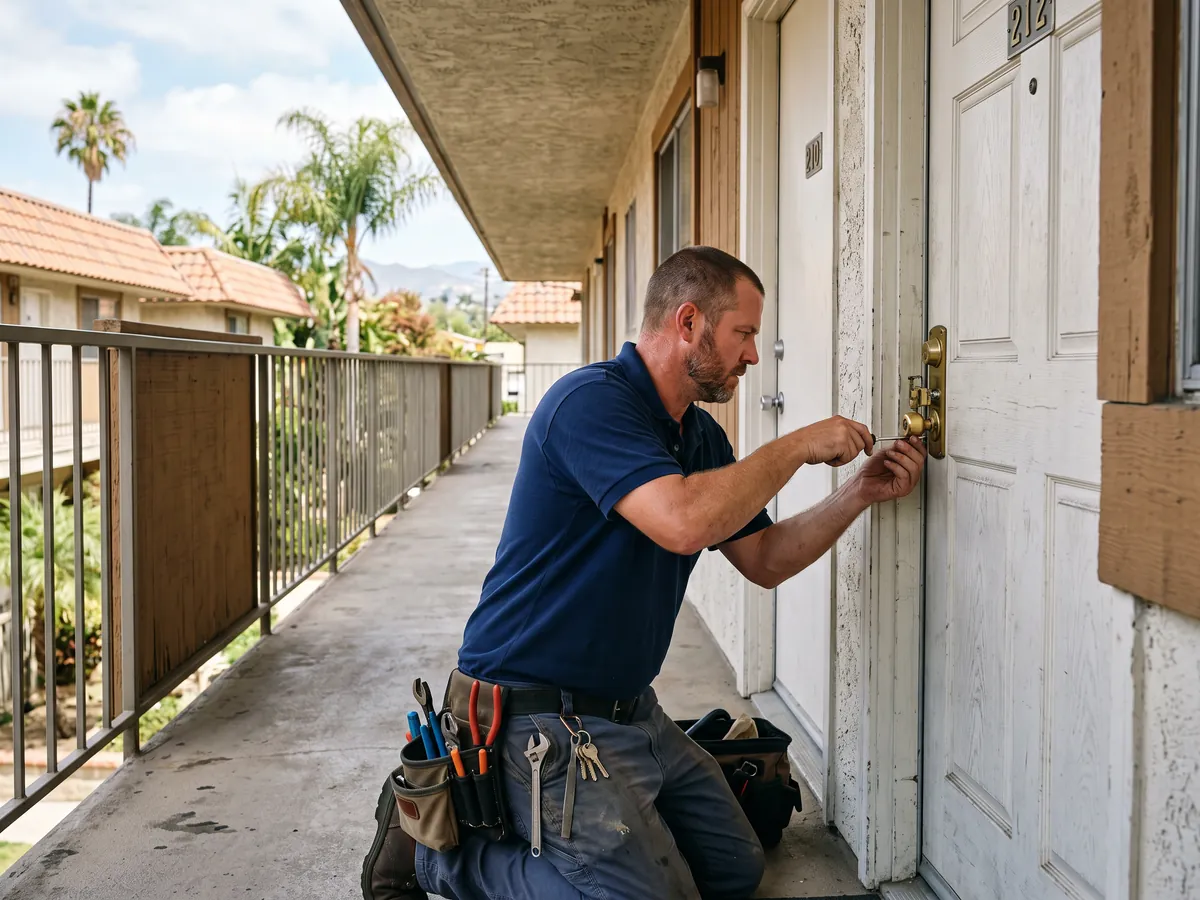
Leasing offices tend to close in the early evening, and after-hours maintenance lines are often reserved for leaks and fires rather than misplaced keys. That leaves a gap, and it's the gap we fill. Julian's Locksmith takes apartment lockout calls in Diamond Bar from 6:30 a.m. until 11:30 p.m. every day. We're closed overnight, and we would rather say so plainly than let you wait on a callback that won't come. Inside our hours, call (951) 903-3193, tell us your complex and unit, and we'll give you an honest arrival estimate and a quote before we head out.
Apartment and condo lockouts have a different rhythm from house calls. Diamond Bar's multifamily buildings cluster on Brea Canyon Road, Golden Springs Drive and Diamond Bar Boulevard, and many have pedestrian gates and carport or underground parking. Your first call should go to the property manager or leasing office, which may hold a master key or a lockbox. Offices keep limited hours, though, and when they're closed we step in. We'll ask for ID plus something that ties you to the unit: a lease, a utility bill, or a note from the leasing office. A landlord can also authorize us by phone. A landlord's duty to supply a working deadbolt on the main entry door is spelled out in Civil Code §1941.3, so if yours is worn out, a lockout is a fine moment to raise it in writing. Most apartment locks are standard deadbolts and knobs that open cleanly with picks or bypass tools. A high-security cylinder takes longer, and a door damaged by an earlier break-in attempt may need repair first. If your keys vanished along with your wallet, tell us, because rekeying the unit afterward is the safer ending. And let the gate attendant or call box know we're expected.
Apartment Lockout in Diamond Bar: what to expect
The hardware on apartment doors in Diamond Bar spans several generations. Older garden-style complexes often still have a builder-grade knob with a push-button lock and a single-cylinder deadbolt above it, both on a common keyway such as Kwikset KW1 or Schlage SC1. Many managers have switched to Kwikset SmartKey cylinders, which maintenance staff can rekey between residents with a small tool and a new key. Larger portfolios may use interchangeable cores from Best or Schlage, swapped with a control key, or patented systems such as Medeco and Mul-T-Lock that block unauthorized copies. Newer mid-rise buildings add electronic locks tied to a management platform, fire-rated corridor doors with closers, and lever handles. Each of these opens differently. A spring latch can sometimes be handled without touching the cylinder, a standard deadbolt is a picking job, a sidebar or patented cylinder takes more time and skill, and a smart lock may be solved by a management-issued code rather than any tool at all. If you can read the brand stamped on the face of your lock, tell us when you call; it helps us plan.
Work included on a typical visit
- Unit entry door openings. Before choosing a method, we study the door from the walkway: is the bolt thrown, does the latch have a deadlatch plunger, is there a lever inside, and how much gap does the frame leave? Those few observations decide whether we work the latch, pick the cylinder or use a tool that reaches the inside handle.
- Smart lock and keypad lockouts. On property-managed smart locks in Diamond Bar, the fastest fix is often a fresh access code from the management dashboard. If no one at the office can issue one, we open the door through the lock's keyed override or another non-destructive route, then make sure the keypad accepts codes again before we leave.
- Gate and building access coordination. Call boxes dial a resident's phone to buzz visitors through, which doesn't help when your phone is on the kitchen counter. A neighbor, the courtesy officer, the leasing office during its hours or a gate code you remember can all get us in. We never use a fire department key box or slip a gate that isn't ours to open.
- Condo and townhome lockouts. Townhome lockouts often give us more than one way in: the front door, an attached garage with an interior entry door, or a patio slider. We choose the route that's fastest and least likely to damage anything, which sometimes turns out to be the garage side door rather than the front deadbolt.
- Openings for property managers and owners. Turnover days are a common source of manager lockouts: a vendor left the key inside, a lockbox code changed, or the cleaning crew pulled shut a knob set to lock. We open the vacant unit, check that the hardware works and can rekey it before the next resident gets keys. Occupied units follow the property's own notice rules.
Local factors in Diamond Bar
Families renting apartments or townhomes juggle kids, strollers and grocery bags, so a door that latches behind someone is common. If a young child is alone inside, call 911 first; firefighters respond to that. Otherwise, tell us who is inside and whether they can safely speak through the door. An older child can sometimes turn a thumbturn while you coach them from the walkway.
Inland summers are rough on apartment hardware. Doors on west-facing walkways expand in the afternoon and bind deadbolts, keypad batteries drain faster, and metal handles get too hot to hold. A summer lockout turns urgent when a pet or a vulnerable person is inside a unit without cooling. Tell us right away so we can prioritize, and ask the office whether maintenance can reach you sooner.
High-end condos and luxury rentals often carry patented cylinders such as Medeco, Mul-T-Lock or ASSA, plus concierge desks and controlled elevators. Expect more time for a non-destructive opening and a careful verification with the front desk. If the building keeps a spare in a managed key cabinet, staff may resolve it faster, and we'll tell you so honestly before we drive out to Diamond Bar.
Situations this covers
It's 9 p.m. on a Tuesday, and a tenant in a second-floor condo off Golden Springs Drive realizes her keys are in a gym locker across town. The leasing office closed at five. We'd confirm her ID and lease or a recent utility bill, get the owner's or manager's okay by phone, and open the deadbolt without drilling. Because the keys are out of her hands overnight, we'd mention rekeying the lock the next day.
- Say it's a Wednesday at 9:40 p.m. and you're a student coming back from the library to a shared off-campus apartment. Three roommates, three key rings, and nobody home. Call while there's still time before our 11:30 p.m. cutoff, have your student ID plus the lease or a roommate's confirmation ready, and we'd open the door so you aren't sleeping on a friend's floor.
- Say a daughter calls from out of state because her father, who lives in a 55-plus apartment community, left his keys in a jacket at church and can't reach the office. We'd talk with both of them, ask him to have his ID ready, and meet him at the building entrance instead of making him walk to the main gate. Afterward we'd check whether his round knob is hard to grip and mention a lever option.
- Picture your third night in a new apartment off Pathfinder Road. The lease, the welcome packet and your keys are all on the counter, and your driver's license still lists the address you just left. That isn't a dead end. We'd try to reach management to confirm your name, and if nobody answers, we'd open the door and go over the signed lease with you before leaving, so the check happens with the paperwork in hand.
Step by step with Julian's Locksmith
- Call with your complex, building and unit. If you can, read us the brand on the lock face and describe your key: an ordinary house key, one with angled cuts or dimples, or one stamped Do Not Duplicate. Those clues tell us whether to expect an everyday cylinder in Diamond Bar or something restricted that needs specialty tools.
- Plan the route through the gate. Before we drive out, we settle where to meet. Tell us whether there's a vehicle gate, a pedestrian gate or a call box, where guests can park and which entrance sits closest to your building. If your fob is inside, we'll meet outside the gate and find a legitimate way in together.
- Confirm you live there. At the door we check a photo ID and something that ties you to the unit: a lease, a resident-portal screen, mail or a utility bill. A manager's confirmation by phone also works. We record the details on the work order before starting, which protects you and everyone else in the building.
- Read the door and choose the method. Our order of preference is simple: the gentlest method that will work. Picking leaves no trace on a standard cylinder. Patented or sidebar cylinders get specialty tools and more patience. Drilling is the last resort, and we stop to talk with you before it ever happens.
- Open the door, then test every lock. Smart lock lockouts get an extra step: batteries checked or replaced, every user code tested and the mechanical override shown to you. If the lock belongs to management, we don't reprogram it; we write down what we found so the office can follow up.
- Sort out keys, rekeys and reporting. Keys locked inside? You're done. Keys lost? We talk through the risk: was your unit number on the tag, and who might have found the ring? In a rental, rekeying is management's decision, so we can do it with their approval or give you a written summary to send the office.
What affects the cost
- Cylinder security level. Knowing your lock brand in advance helps. A glance at the face of the cylinder or the bow of a spare key usually shows the name. If your building uses interchangeable cores, management may simply swap the core with a control key, which can be the cheapest route of all.
- Entry only, or keys and a rekey too. If your keys are inside, the job ends when the door opens. Lost keys can add a duplicate cut on site, a rekey with management's approval, or both. We quote the opening separately from any key work, so you can decide what you actually need and skip what you don't.
- Smart locks and electronic access. Consumer smart locks such as Schlage Encode, Yale Assure and Kwikset Halo usually keep a key cylinder for exactly this reason. Opening through it is generally priced like a standard deadbolt. Keyless models or a damaged keypad need more work, and we say so before starting.
Every job gets a clear quote before any work starts. Call (951) 903-3193 with the details and we'll tell you what to expect for your situation in Diamond Bar.
Common errors that cost time and money
- Assuming the after-hours maintenance line will send someone for a lockout. Many properties use it only for floods, fire alarms and gas smells, so you may wait on a callback that never covers your situation. Ask once, and if the answer is no, move on to your next option.
- Sliding a credit card or a butter knife into the latch gap. That trick rarely works on a latch with a functioning deadlatch plunger and never on a thrown deadbolt, and it chews up weatherstripping and paint that management will notice at inspection.
- Changing or rekeying your apartment locks on your own after a lockout. Most leases prohibit it without approval, it blocks maintenance during emergencies, and it can break a master key system. California's protective-order rules are a separate case with their own steps.
Practical tips before you call
- Ask your manager whether the building uses a master key system or interchangeable cores. If it does, the office can usually let you in during business hours and handle any rekey in-house, and you'll know a locksmith's role is limited to opening your door.
- When it's hot out and a pet stays home alone, close the blinds on sun-facing windows and leave the air conditioning on a sensible setting. If you do get locked out on a scorching afternoon in Diamond Bar, the apartment stays survivable while help is on the way.
- On a ground-floor patio, carry your keys or leave the slider fully open. Slider latches can drop on their own when a panel bumps shut, and if a security bar sits in the track, nobody outside can open that door without damaging it.
- Update the address on your driver's license after a move. California asks drivers to report a new address to the DMV within 10 days, and an ID that matches your apartment makes every identity check, including ours at a lockout, faster and simpler.
Getting to Diamond Bar
Diamond Bar is about 43 miles from our San Bernardino base, roughly 46 minutes in light traffic via I-215 South briefly to SR-210 West. When you call, you get an arrival estimate based on where the technician is and the traffic at that moment.
Homes and businesses just off SR-60 are routine stops for us. Give the suite or unit number and any gate instructions, and say whether the van can park out front or should pull into a side lot.
About Diamond Bar: In March 2026 the City Council adopted the Town Center Specific Plan for about 45 acres along Diamond Bar Boulevard between Golden Springs Drive and SR-60.
| Neighborhoods | Brea Canyon Road corridor, Willow Heights, South Pointe, Chino Hills Parkway area, Golden Springs Drive corridor, North Diamond Bar |
|---|---|
| ZIP codes | 91765, 91789 |
| Main routes | SR-57, SR-60, Diamond Bar Boulevard, Grand Avenue |
| From our San Bernardino base | about 43 miles via I-215 South briefly to SR-210 West (Foothill Freeway) through Rancho Cucamonga, Upland and La Verne, then SR-57 South (Orange Freeway) through Pomona to the Grand Avenue, Diamond Bar Boulevard or Pathfinder Road exits; alternate via I-10 West to SR-57 South at the Kellogg interchange, continuing on SR-60 West to Brea Canyon Road or Lemon Avenue for the west side |
We start at half past six every morning, seven days a week. Every day the phones stay on until 11:30 at night, so an after-dinner lockout is usually still within reach. Saturday is no exception, with service ending at 11:30 at night. Call early that day if the problem can't wait until Sunday morning.
We won't open a door for someone who can't show they live or work there, however convincing the story. That includes a person who has moved out, a former partner, or anyone caught up in an eviction dispute. The rule protects you the same way it protects every other household we serve: no proof, no entry.
Locked out in Diamond Bar?
Call (951) 903-3193 with the address and what's locked. You'll get an arrival estimate and a quote before anyone heads out, and when we arrive we'll ask for ID that ties you to the property. If a child or pet is shut inside a hot car or building, call 911 first.
Frequently asked questions
What proof do I need to show a locksmith for an apartment lockout?
A photo ID plus something tying you to the unit: a lease, a resident-portal page, mail, a utility bill or a renters insurance declaration with the address. A manager's phone confirmation works too. If your documents are all inside, tell us when you call. We can often verify with management, or open the door and review the paperwork with you immediately afterward.
Do I need my landlord's permission to call a locksmith?
Not to have your own door opened. You're the lawful occupant, and opening the door without altering it leaves the landlord's hardware as it was. Changing or rekeying the lock is different: most leases require approval, and the property usually must keep a working key. We'll open your door with proof of tenancy and leave any lock changes to a conversation with management.
My landlord changed the locks on me. Can you let me back in?
We won't step into that dispute. If a sheriff carried out an eviction after a court judgment, the landlord has possession and we can't reopen the unit. If your landlord changed the locks without any court process, California law generally prohibits that kind of self-help lockout, but the remedy runs through law enforcement, a tenant legal aid group or the court rather than a locksmith.
What if I'm locked out between 11:30 p.m. and 6:30 a.m., when you're not open?
We're closed between 11:30 p.m. and 6:30 a.m., so start with your property: the leasing office may keep an after-hours line, and a courtesy officer or on-call maintenance tech may handle lockouts. A spare with a friend or family member is the next option. If you can stay somewhere safe overnight, we open at 6:30 a.m. Sunday and can plan your visit for that morning.
Will an apartment lockout damage the lock or cost me my deposit?
Not when it's done right. We pick the cylinder or work the latch on most doors, and the lock keeps working with your existing key. Drilling is a last resort, mainly for certain patented or already damaged cylinders, and we talk it through with you first. Your work order shows how the door was opened, which helps if management asks about it at move-out.
How soon can you get to my apartment in Diamond Bar?
It depends on where our technician is, freeway traffic between San Bernardino and your complex, and how many calls are ahead of yours. We give you an honest estimate when you call rather than a promise we can't keep, and we'll update you if it changes. Lockouts involving a pet in the heat or something left running get moved up the list.
How far is Diamond Bar from your base?
Diamond Bar is about 43 miles from our San Bernardino base, roughly 46 minutes in light traffic. Arrival time depends on traffic and on the job the technician is finishing, so we give you an estimate on the phone before you commit.
Related services in Diamond Bar
- Locked Out of Apartment in Diamond Bar
- Condo Lockout in Diamond Bar
- Apartment Locksmith in Diamond Bar
- Home Lockout in Diamond Bar
- Apartment Lock Rekey in Diamond Bar
- Apartment Mailbox Lock Replacement in Diamond Bar
- Smart Lock Troubleshooting in Diamond Bar
- Broken Key Stuck in Door in Diamond Bar
- Locksmith for Property Manager in Diamond Bar
- Apartment Key Copy in Diamond Bar
Apartment Lockout in nearby cities
- Apartment Lockout in Chino HillsSan Bernardino County
- Apartment Lockout in WalnutLos Angeles County
- Apartment Lockout in Rowland HeightsLos Angeles County
- Apartment Lockout in PomonaLos Angeles County
- Apartment Lockout in BreaOrange County
- Apartment Lockout in ValindaLos Angeles County
- Apartment Lockout in West CovinaLos Angeles County
- Apartment Lockout in City of IndustryLos Angeles County