
Devore, San Bernardino County
Apartment Lockout Help in Devore
Short answer: Have three things ready before we reach your Devore complex: a photo ID, something tying you to the unit such as your lease, a resident-portal screen or a utility bill, and a way through the gate. If your ID shows an old address, documents inside the apartment can confirm it once the door is open. Call (951) 903-3193 with your building and unit number.
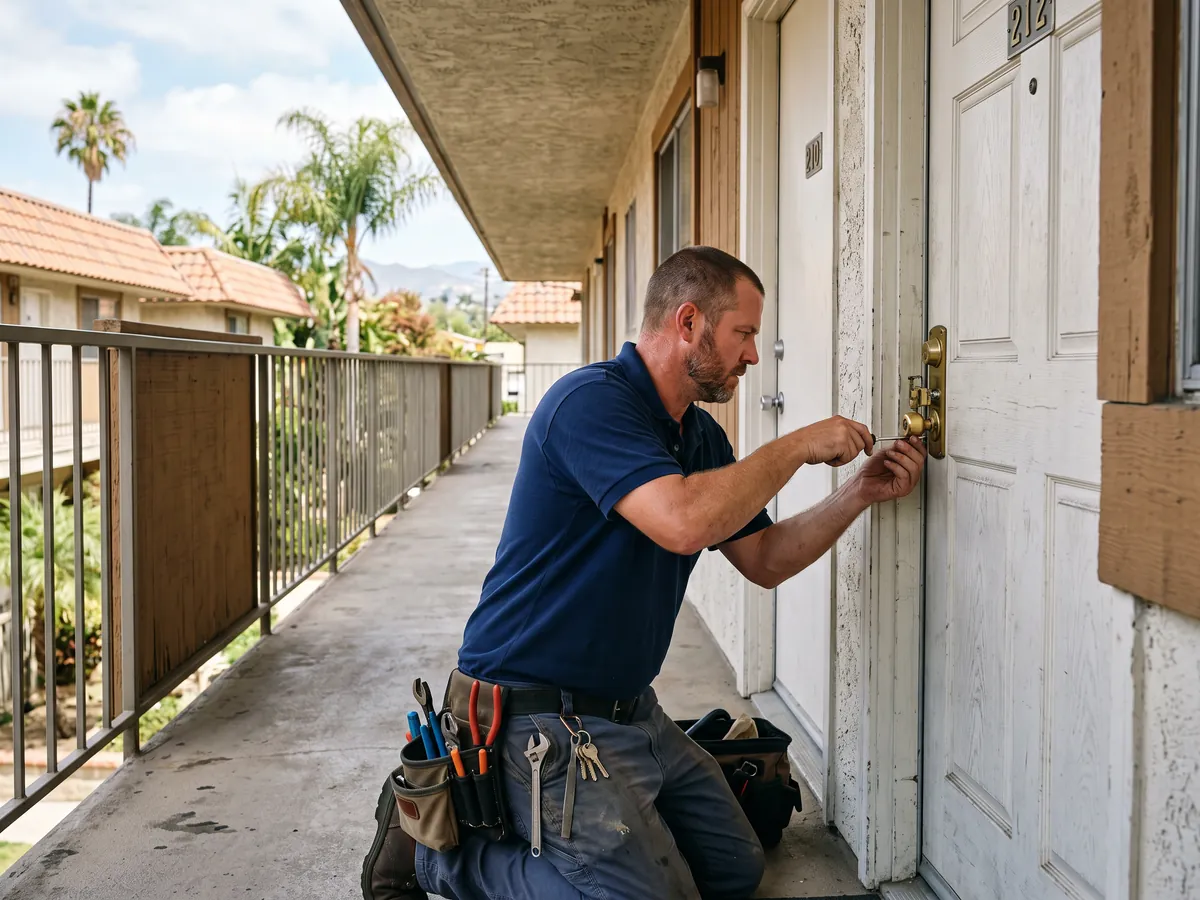
It usually happens on a small errand. You carry the recycling down to the bins, the door swings shut on its closer, and the keys are sitting on the kitchen counter next to your phone. An apartment lockout in Devore has a few wrinkles a house lockout doesn't: the lock belongs to your landlord, the leasing office keeps its own hours, and there may be a gate between the street and your door. Julian's Locksmith handles all of that. We ask a few questions on the phone, meet you where we can get onto the property, confirm the unit is yours and open it with methods that leave the hardware working. Borrow a neighbor's phone and call (951) 903-3193.
Devore is mostly single-family land, so apartment lockouts here are the exception. They tend to be rented guest houses, converted garages, casitas and manufactured homes on a landlord's lot, plus the apartment complexes a few miles south around University Parkway, Kendall Drive and Verdemont, which we reach quickly from our base in University Heights. The rules are the same wherever the door is. Your landlord or manager holds a key, but a leasing office closes in the evening and an on-site manager may live miles away on rural land. If you can reach them, ask first. If you can't, we can open the door once we have checked your ID against your lease, a rent receipt or a utility bill in your name. We never open a unit for someone we can't tie to it. Many rentals use restricted or high-security cylinders, and some complexes keep a master key system, so a lock may need decoding rather than a standard pick. We open without damage whenever possible, since a broken door is a repair someone has to pay for. In California, landlords must provide working deadbolts on main swinging entry doors (Civil Code §1941.3), so a deadbolt that fails on its own is worth reporting to your landlord.
What to know first in Devore
The hardware on apartment doors in Devore spans several generations. Older garden-style complexes often still have a builder-grade knob with a push-button lock and a single-cylinder deadbolt above it, both on a common keyway such as Kwikset KW1 or Schlage SC1. Many managers have switched to Kwikset SmartKey cylinders, which maintenance staff can rekey between residents with a small tool and a new key. Larger portfolios may use interchangeable cores from Best or Schlage, swapped with a control key, or patented systems such as Medeco and Mul-T-Lock that block unauthorized copies. Newer mid-rise buildings add electronic locks tied to a management platform, fire-rated corridor doors with closers, and lever handles. Each of these opens differently. A spring latch can sometimes be handled without touching the cylinder, a standard deadbolt is a picking job, a sidebar or patented cylinder takes more time and skill, and a smart lock may be solved by a management-issued code rather than any tool at all. If you can read the brand stamped on the face of your lock, tell us when you call; it helps us plan.
What we can do on-site
- Smart lock and keypad lockouts. Keypad deadbolts and app-controlled locks fail in predictable ways: dead batteries, a code wiped by management at lease renewal, a hub that dropped offline, or a phone that died with your digital key on it. We check whether your lock has an emergency power contact or a mechanical override before treating it like a full lockout.
- Condo and townhome lockouts. HOA rules can shape what happens after the lockout. Some associations dictate the finish or style of exterior hardware, and most control keyed common areas like the pool gate and trash enclosure. We open your unit, then note anything that would need HOA approval if you later decide to replace locks in Devore.
- Mailbox, storage and garage lockouts. Lost keys rarely go missing one at a time. When your unit key disappears, the mailbox key, storage-closet key and carport cabinet key often go with it. With management's authorization, we open and replace cam locks on apartment mailboxes and storage lockers so you have a complete set again.
- New keys and rekeys after entry. If your keys are locked inside, you just need the door open. If they're lost, the job may continue. We can cut a duplicate on site from your unit's cylinder when the keyway isn't restricted. For restricted or master-keyed systems, duplicates come through management or their authorized dealer, and we'll tell you which applies.
- Openings for property managers and owners. Managers get locked out too: of a vacant unit when the key tag is missing, of the maintenance shop, of the leasing office itself or of a storage room full of appliances. With written authorization from the owner or management company, we open the space and can rekey it on the same visit.
What's different about Devore
Inland summers are rough on apartment hardware. Doors on west-facing walkways expand in the afternoon and bind deadbolts, keypad batteries drain faster, and metal handles get too hot to hold. A summer lockout turns urgent when a pet or a vulnerable person is inside a unit without cooling. Tell us right away so we can prioritize, and ask the office whether maintenance can reach you sooner.
Commuters tend to lock themselves out at the edges of the day: walking out at 5:45 a.m. with the keys still on the counter, or returning after a long drive to find the office long closed. Our day starts at 6:30 a.m., so an early call can still save the workday. Keep a spare at work or with a trusted coworker to cover the hours we're not available.
Older garden-style complexes and converted fourplexes often keep original knob sets, painted-over strikes and doors that have swelled and shrunk for decades. Those quirks can help or hinder an opening. A sagging door may leave the latch half-engaged, while a deadbolt that never fully extends can jam. After we open the door, we point out worn hardware so your maintenance request can be specific.
Example situations
Imagine a renter living in a converted garage unit behind a main house off Kimbark Avenue. The landlord is out of town, the property manager isn't answering, and the door has shut behind her with the latch on after a trip to the curb with the trash. She has a lease and a power bill showing the address. We'd verify both along with her ID, open the door without damage, and mention the problem to the landlord so any repair is theirs to approve.
- A typical call: it's Sunday evening, you carry a laundry basket across the complex, and the knob you set to lock earlier in the day holds the door shut behind you. The leasing office closed at six and the after-hours line covers only floods and fire alarms. We'd meet you at the pedestrian gate, check your ID against the resident portal on a neighbor's tablet, and work the latch without touching the deadbolt you never threw.
- For example, a July afternoon in an inland complex: you stepped out to grab a delivery, the door latched, and your dog is inside with the air conditioning set to eco mode. Tell us about the animal the moment you call. We'd move the job up our list, give you a straight arrival estimate, and suggest asking the office whether maintenance can get there sooner. Whoever reaches the door first should open it.
- Say it's a Wednesday at 9:40 p.m. and you're a student coming back from the library to a shared off-campus apartment. Three roommates, three key rings, and nobody home. Call while there's still time before our 11:30 p.m. cutoff, have your student ID plus the lease or a roommate's confirmation ready, and we'd open the door so you aren't sleeping on a friend's floor.
Step by step with Julian's Locksmith
- Call with your complex, building and unit. Call (951) 903-3193 and tell us the community name, building and unit number, which locks are engaged and whether your keys are inside or lost. Mention gates, a lobby fob or a smart lock. That conversation lets us quote the job and plan the route before we leave.
- Plan the route through the gate. Large properties hide units well. Give us the building letter, the nearest amenity such as the pool or the mail kiosk, and which stairwell serves your door. In a mid-rise, tell us whether the elevator needs a fob, so we know to plan for the stairs.
- Confirm you live there. If your ID shows a different address, we look for another link: a manager who can vouch for you, a leaseholder on the phone, or documents inside that we review together right after the door opens. What we can't accept is a neighbor's word or a story by itself.
- Read the door and choose the method. Sometimes the best door isn't the one you're standing at. An attached garage entry, a second unit door or a management key that's on its way may beat a slow high-security cylinder. We tell you which route we recommend and why, and you make the call.
- Open the door, then test every lock. Once the door is open, you grab your keys and we work each lock with them to be sure the deadbolt throws fully, the latch catches and nothing was disturbed. If the bolt dragged or the strike sat out of line before we arrived, we point it out for maintenance.
- Sort out keys, rekeys and reporting. Keys locked inside? You're done. Keys lost? We talk through the risk: was your unit number on the tag, and who might have found the ring? In a rental, rekeying is management's decision, so we can do it with their approval or give you a written summary to send the office.
Pricing factors
- Cylinder security level. Knowing your lock brand in advance helps. A glance at the face of the cylinder or the bow of a spare key usually shows the name. If your building uses interchangeable cores, management may simply swap the core with a control key, which can be the cheapest route of all.
- Entry only, or keys and a rekey too. A rekey costs more than an opening because each cylinder is taken apart, repinned and tested, and a master-keyed building needs its keying records followed exactly. On a standalone unit key the rekey is straightforward; on a master system it may be better handled by the property's own locksmith.
- Extra openings and parts. If a cylinder must be drilled, the replacement adds to the bill, and matching a building's keyway or master system can limit which cylinders will work. Sometimes we fit a temporary cylinder and leave the permanent one to management's locksmith. We explain that tradeoff before the drill comes out.
Every job gets a clear quote before any work starts. Call (951) 903-3193 with the details and we'll tell you what to expect for your situation in Devore.
Practical tips before you call
- Keep a digital copy of your lease and a recent utility bill in your email or a cloud folder you can open from any device. If you're locked out with your own phone inside, a borrowed phone and your login give us the tenancy proof we need right there at the door.
- Don't tag your key ring with your unit number or building name. If the keys go missing, an anonymous ring is an inconvenience; a labeled one is a reason to rekey. A colored key cap tells your keys apart without telling a stranger where they fit.
- Memorize your community's gate code or guest procedure. A call box that dials your phone is useless when the phone is inside, and knowing how a visitor gets onto the property shaves time off any lockout, whether it's us arriving or a friend bringing your spare.
- Replace keypad batteries on a schedule instead of waiting for the low-battery beeps. Inland heat and heavy daily use drain alkaline cells sooner than the package suggests. Find out whether your model has emergency power terminals or a hidden key cylinder, and know where the backup key lives.
What not to do
- Sliding a credit card or a butter knife into the latch gap. That trick rarely works on a latch with a functioning deadlatch plunger and never on a thrown deadbolt, and it chews up weatherstripping and paint that management will notice at inspection.
- Changing or rekeying your apartment locks on your own after a lockout. Most leases prohibit it without approval, it blocks maintenance during emergencies, and it can break a master key system. California's protective-order rules are a separate case with their own steps.
- Breaking a window to reach the lock. Dual-pane apartment windows are usually a special-order replacement, broken glass is a hazard for kids and pets, and the unit sits exposed until the glazier comes. A careful opening of the door costs less and leaves nothing to repair.
Reaching Devore
Devore is about 8 miles from our San Bernardino base, roughly 14 minutes in light traffic via Kendall Drive or Palm Avenue to I-215 North, through the Devore junction onto I-15 North, exit Kenwood Avenue for Devore Heights. When you call, you get an arrival estimate based on where the technician is and the traffic at that moment.
We plan the drive the way a delivery route gets planned: freeway first, I-15 where it makes sense, then the side streets you describe. A landmark or the color of your building helps the technician spot you.
About Devore: Before taking the Devore name, the land in the northern corner of Rancho Muscupiabe was called the Martin District, the Guernsey Tract and the Glen Helen Tract.
| Neighborhoods | Verdemont, Kimbark Canyons, Kimbark Avenue area, Keenbrook, Kenwood Avenue corridor, Lytle Creek |
|---|---|
| ZIP codes | 92407 |
| Main routes | I-15, I-215, Cajon Boulevard, Kenwood Avenue |
| From our San Bernardino base | about 8 miles via Kendall Drive or Palm Avenue to I-215 North, through the Devore junction onto I-15 North, exit Kenwood Avenue for Devore Heights; Devore Road exit for Glen Helen and lower Cajon Boulevard |
Friday is a full day for us. We begin at 6:30 a.m. and close at 11:30 p.m., the same as every other day, Saturday included. If a lock fails after 11:30 p.m., call us when we reopen at 6:30 a.m., and in the meantime fall back on a neighbor's spare key, a night with family, or a door you can secure from inside.
Before we open a home or business, we ask for photo ID and something tying you to the address: a lease, a utility bill, mail with your name on it, or written authorization from the property manager. It adds a minute or two, and it's the same check you'd want if a stranger tried to get into your place.
Locked out in Devore?
Call (951) 903-3193 with the address and what's locked. You'll get an arrival estimate and a quote before anyone heads out, and when we arrive we'll ask for ID that ties you to the property. If a child or pet is shut inside a hot car or building, call 911 first.
Frequently asked questions
What if I'm locked out between 11:30 p.m. and 6:30 a.m., when you're not open?
We're closed between 11:30 p.m. and 6:30 a.m., so start with your property: the leasing office may keep an after-hours line, and a courtesy officer or on-call maintenance tech may handle lockouts. A spare with a friend or family member is the next option. If you can stay somewhere safe overnight, we open at 6:30 a.m. Sunday and can plan your visit for that morning.
Can you open my sliding patio door instead of the front door?
Sometimes. On a ground-floor slider with no bar or dowel in the track, the latch can occasionally be worked from outside without harm. If there's a security bar, or the door opens onto an upstairs balcony, it's off the table; we don't climb or lift panels off their tracks. In most Devore apartments the front deadbolt is the cleaner choice anyway.
Do I need my landlord's permission to call a locksmith?
Not to have your own door opened. You're the lawful occupant, and opening the door without altering it leaves the landlord's hardware as it was. Changing or rekeying the lock is different: most leases require approval, and the property usually must keep a working key. We'll open your door with proof of tenancy and leave any lock changes to a conversation with management.
Will an apartment lockout damage the lock or cost me my deposit?
Not when it's done right. We pick the cylinder or work the latch on most doors, and the lock keeps working with your existing key. Drilling is a last resort, mainly for certain patented or already damaged cylinders, and we talk it through with you first. Your work order shows how the door was opened, which helps if management asks about it at move-out.
What proof do I need to show a locksmith for an apartment lockout?
A photo ID plus something tying you to the unit: a lease, a resident-portal page, mail, a utility bill or a renters insurance declaration with the address. A manager's phone confirmation works too. If your documents are all inside, tell us when you call. We can often verify with management, or open the door and review the paperwork with you immediately afterward.
My child or pet is locked inside. What should I do first?
If a child is alone inside, or anyone inside is in danger, call 911 first; firefighters respond to those situations and can force entry. For a pet in a warm apartment, call us at (951) 903-3193 and say so immediately, then ask the office or maintenance whether someone on site can open sooner. Whoever can reach your door first should do it.
How far is Devore from your base?
Devore is about 8 miles from our San Bernardino base, roughly 14 minutes in light traffic. Arrival time depends on traffic and on the job the technician is finishing, so we give you an estimate on the phone before you commit.
Related services in Devore
- Locked Out of Apartment in Devore
- Condo Lockout in Devore
- Apartment Locksmith in Devore
- Home Lockout in Devore
- Apartment Lock Rekey in Devore
- Apartment Mailbox Lock Replacement in Devore
- Smart Lock Troubleshooting in Devore
- Broken Key Stuck in Door in Devore
- Locksmith for Property Manager in Devore
- Apartment Key Copy in Devore
Apartment Lockout in nearby cities
- Apartment Lockout in Glen HelenSan Bernardino County
- Apartment Lockout in MuscoySan Bernardino County
- Apartment Lockout in North FontanaSan Bernardino County
- Apartment Lockout in RialtoSan Bernardino County
- Apartment Lockout in FontanaSan Bernardino County
- Apartment Lockout in EtiwandaSan Bernardino County
- Apartment Lockout in San BernardinoSan Bernardino County
- Apartment Lockout in BloomingtonSan Bernardino County