
Ontario, San Bernardino County
Apartment Lockout Help in Ontario
Short answer: Management may let you in at no charge or for a fee set in your lease, but only while someone with the master key is on duty. A licensed locksmith fills the gap in the evening and on Sundays. Julian's Locksmith covers Ontario every day until 11:30 p.m., so the office or courtesy officer is your option after we close.
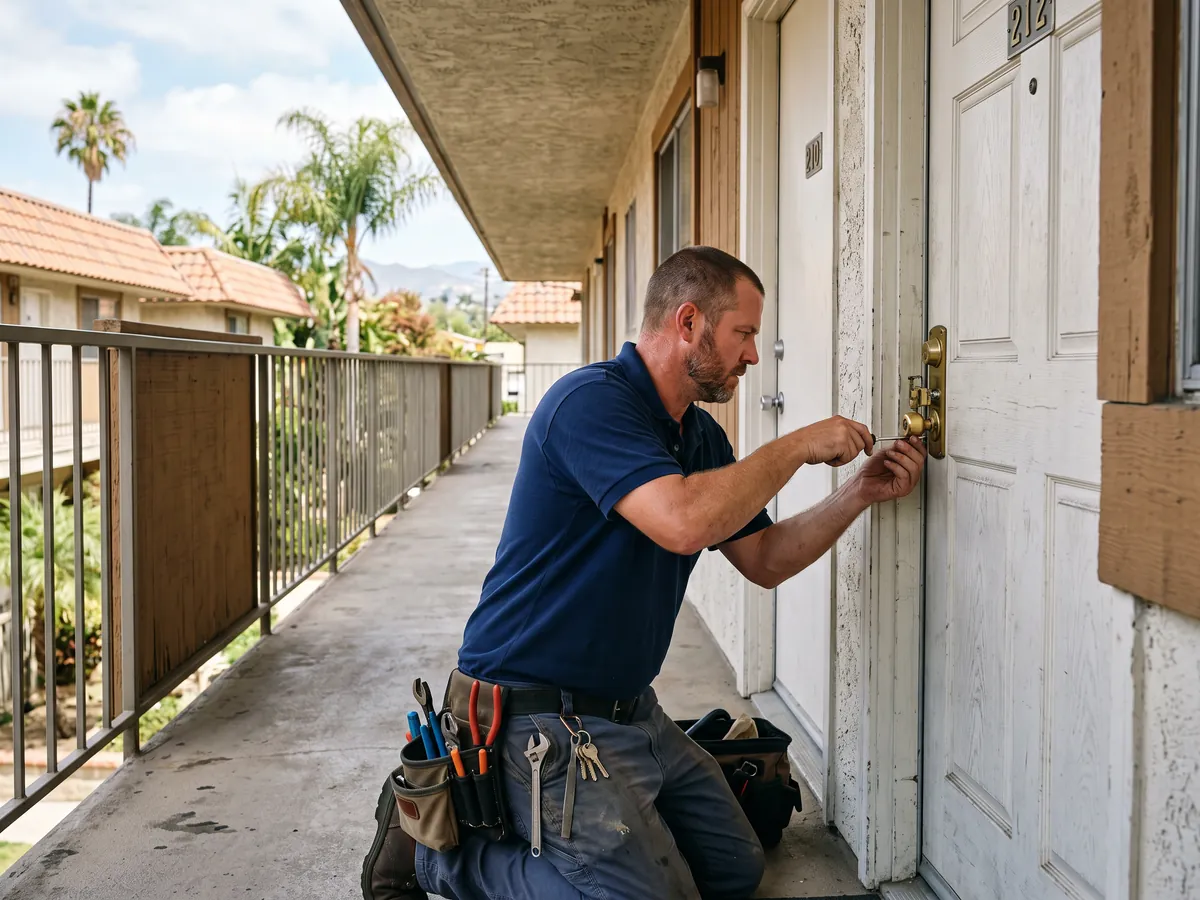
Here's what separates a legitimate apartment lockout service from a risky one: the locksmith asks you to prove you live there. Anyone can stand at a door and say it's theirs, and in a building full of neighbors, opening the wrong unit for the wrong person is a real danger. Julian's Locksmith checks a photo ID and a link to the unit, such as a lease, a resident-portal page or mail with your name and address, before we start on the lock. New to the complex and your license still shows your old address? Tell us when you call from Ontario. There are workable ways to confirm tenancy, including a quick look at documents once the door is open.
Many Ontario households rent, so apartment lockouts are a regular call, and they come with questions a house doesn't raise. First comes the leasing office. Most complexes keep office hours that end mid-afternoon or early evening, and an after-hours maintenance line may or may not have a master key. If management can open your door, that is often the easy route. If the office is closed, or won't, we can step in. We ask for photo ID plus something that ties you to the unit: a lease, a utility bill, or a mailbox key and a letter with the address. When a lockout involves a roommate dispute or a former partner, we may need to speak with the property manager first. We open only for someone who has a right to be there. Hardware varies. Older buildings along Holt Boulevard and Mission Boulevard often have a basic deadbolt, while newer complexes in the Ontario Center area and in Ontario Ranch use higher-security cylinders, tight pedestrian gates and fob-controlled entries. Some leases bar tenants from changing a lock or adding their own, so a rekey needs the landlord's okay. Leasing offices usually control the gate fob too, so ask them about a replacement.
How this works in Ontario
An apartment lockout in Ontario is not just a house lockout with a smaller floor plan. Three things change the job. The first is ownership: the locks usually belong to the property owner, so the way we open the door should leave the hardware and the building's key system intact. The second is verification. Apartment communities pack dozens or hundreds of doors close together, and a locksmith who opens one for the wrong person can put a neighbor in danger, so we confirm tenancy before we touch a lock. The third is access. Gates, call boxes, lobby doors, assigned parking and long walkways all sit between our van and your unit, and each one adds time if nobody planned for it. Julian's Locksmith builds the call around those three points. On the phone we ask about the complex layout, which locks are engaged and what proof you can show. At the door we pick the deadbolt or work the latch, the way a careful maintenance supervisor would want it done. After you're inside, we test every lock you rely on and tell you whether lost keys mean the cylinder should be rekeyed, which in a rental is a conversation to have with management.
How we can help in Ontario
- Unit entry door openings. Picking is our default for a Ontario apartment door because it leaves no marks, keeps the landlord's key system intact and doesn't put a replacement charge on your deposit. Builder-grade Kwikset and Schlage cylinders on common keyways respond well to careful picking, and a few minutes of patience at the door saves you the cost of a new cylinder.
- Condo and townhome lockouts. Condo owners can authorize their own lockout, because the unit door hardware usually belongs to them rather than the HOA. Bring ID and a deed, tax bill, HOA statement or utility bill showing the address. Renters in a condo need the owner's confirmation, since there's rarely a leasing office on site to vouch for them.
- Patio and balcony slider lockouts. Upstairs balcony doors are off the table for climbing. We don't scale balconies, and we'd ask you not to let a helpful neighbor try either. If the front door is the only realistic entry, we work it, even when the slider looks easier from the parking lot below.
- Jammed locks and broken keys. A key that snaps in the cylinder is a common apartment lockout, especially with worn copies made from other copies. We extract the broken piece with thin hooked extractors, never glue, and then cut a fresh key by decoding the cylinder or the fragment, provided the keyway isn't restricted.
- New keys and rekeys after entry. If your keys are locked inside, you just need the door open. If they're lost, the job may continue. We can cut a duplicate on site from your unit's cylinder when the keyway isn't restricted. For restricted or master-keyed systems, duplicates come through management or their authorized dealer, and we'll tell you which applies.
Local factors in Ontario
Dense rental communities in Ontario run on schedules: office hours, maintenance tickets and courtesy patrols. An apartment lockout tends to land in the gaps between them. We work as the after-office option, verifying tenancy the way a careful manager would and opening the door with methods that leave the landlord's hardware intact. Tell us the building and unit, how guests get past the gate, and whether your keys are inside or lost.
Commuters tend to lock themselves out at the edges of the day: walking out at 5:45 a.m. with the keys still on the counter, or returning after a long drive to find the office long closed. Our day starts at 6:30 a.m., so an early call can still save the workday. Keep a spare at work or with a trusted coworker to cover the hours we're not available.
Inland summers are rough on apartment hardware. Doors on west-facing walkways expand in the afternoon and bind deadbolts, keypad batteries drain faster, and metal handles get too hot to hold. A summer lockout turns urgent when a pet or a vulnerable person is inside a unit without cooling. Tell us right away so we can prioritize, and ask the office whether maintenance can reach you sooner.
Common situations
For example, a tenant on a second-floor walkway in a complex off Haven Avenue gets home from a long shift at an airport freight terminal. His keys are on the nightstand, the door has swung shut behind him, and the leasing office closed hours ago. We would check his lease and ID, then open the standard deadbolt by picking, with no marks on the door or frame. He'd get a short note for the manager about the call, and we'd suggest he leave a spare key with a coworker.
- A familiar one: a copy of a copy, cut years ago at a hardware kiosk, finally snaps in the deadbolt while you're turning it. You're standing outside holding half a key. We'd pull the broken piece with a thin extractor, open the lock, and cut a fresh key from the cylinder's bitting instead of the worn fragment, provided the keyway isn't restricted. Then we'd run the new key several times to confirm a smooth turn.
- Say a daughter calls from out of state because her father, who lives in a 55-plus apartment community, left his keys in a jacket at church and can't reach the office. We'd talk with both of them, ask him to have his ID ready, and meet him at the building entrance instead of making him walk to the main gate. Afterward we'd check whether his round knob is hard to grip and mention a lever option.
- For example, a July afternoon in an inland complex: you stepped out to grab a delivery, the door latched, and your dog is inside with the air conditioning set to eco mode. Tell us about the animal the moment you call. We'd move the job up our list, give you a straight arrival estimate, and suggest asking the office whether maintenance can get there sooner. Whoever reaches the door first should open it.
Step by step with Julian's Locksmith
- Call with your complex, building and unit. The first questions are practical: are you safe, is any person or animal inside, and is anything running, like a stove or a bath? Then we ask about the door. A knob latch, a thrown deadbolt and an unresponsive keypad are three different jobs, and knowing which one you have shapes the quote.
- Plan the route through the gate. Large properties hide units well. Give us the building letter, the nearest amenity such as the pool or the mail kiosk, and which stairwell serves your door. In a mid-rise, tell us whether the elevator needs a fob, so we know to plan for the stairs.
- Confirm you live there. At the door we check a photo ID and something that ties you to the unit: a lease, a resident-portal screen, mail or a utility bill. A manager's confirmation by phone also works. We record the details on the work order before starting, which protects you and everyone else in the building.
- Read the door and choose the method. Sometimes the best door isn't the one you're standing at. An attached garage entry, a second unit door or a management key that's on its way may beat a slow high-security cylinder. We tell you which route we recommend and why, and you make the call.
- Open the door, then test every lock. A lockout is a good moment to check hardware you take for granted. We lock and unlock from both sides, confirm the thumbturn moves freely and test the keypad if there is one. You should end the visit with locks that behave exactly as they did that morning.
- Sort out keys, rekeys and reporting. Before we leave, you get a work order showing what we did, which method we used and that no cylinder was replaced or altered without your approval. That paper is handy if management ever asks how the door was opened or a question comes up at move-out.
What affects the cost
- Which locks are engaged. Not sure whether you turned the deadbolt on your way out? Check the narrow gap between door and frame, where a thrown bolt is sometimes visible. Sharing that detail on the phone keeps the quote accurate and saves a second conversation once we're standing at your door.
- Cylinder security level. Knowing your lock brand in advance helps. A glance at the face of the cylinder or the bow of a spare key usually shows the name. If your building uses interchangeable cores, management may simply swap the core with a control key, which can be the cheapest route of all.
- Extra openings and parts. A lost key ring often covers more than one door. Mailbox, storage, garage and gate locks can be handled on the same visit, each priced as its own line item. Replacement cam locks and cylinders are parts costs, and we show you the choices before installing anything.
Every job gets a clear quote before any work starts. Call (951) 903-3193 with the details and we'll tell you what to expect for your situation in Ontario.
Common errors that cost time and money
- Climbing to a balcony or reaching through an upstairs window. Falls from second-floor railings cause serious injuries, and a neighbor who sees someone climbing may reasonably call the police. No lockout is worth that risk when a ground-level door can be opened without harm.
- Breaking a window to reach the lock. Dual-pane apartment windows are usually a special-order replacement, broken glass is a hazard for kids and pets, and the unit sits exposed until the glazier comes. A careful opening of the door costs less and leaves nothing to repair.
- Leaving out details on the phone, such as a gate, a lobby fob, a smart lock or a key stamped Do Not Duplicate. Those details change the tools and the time, and a quote built on missing information is one that has to change at your door.
What to do before we arrive
- Read the lockout and lock-change clauses in your lease now, before you need them. Some properties charge for a manager-assisted opening, and most forbid changing or rekeying locks without approval. Knowing the rules helps you choose between waiting for the office and calling us.
- Memorize your community's gate code or guest procedure. A call box that dials your phone is useless when the phone is inside, and knowing how a visitor gets onto the property shaves time off any lockout, whether it's us arriving or a friend bringing your spare.
- Don't tag your key ring with your unit number or building name. If the keys go missing, an anonymous ring is an inconvenience; a labeled one is a reason to rekey. A colored key cap tells your keys apart without telling a stranger where they fit.
- If your knob has a push-button lock, glance at it before stepping out for the mail or the trash. Plenty of apartment lockouts begin with a button pressed hours earlier and forgotten. Holding the key in your hand before the door swings shut is the simplest habit there is.
Getting to Ontario
Ontario is about 25 miles from our San Bernardino base, roughly 33 minutes in light traffic via I-215 North to the I-15 junction at Devore. When you call, you get an arrival estimate based on where the technician is and the traffic at that moment.
If you're close to Haven Avenue, tell us which exit or cross street you're nearest. It trims the last mile and keeps the van from circling a block that looks right on the map but isn't.
About Ontario: The city opened Ontario Municipal Airport in 1929, and local control returned in November 2016 when the Ontario International Airport Authority took over from Los Angeles World Airports.
| Neighborhoods | Guasti, Park Place, Euclid Avenue historic corridor, New Haven, Ontario Ranch, West Ontario along Mountain Avenue |
|---|---|
| ZIP codes | 91761, 91762, 91764 |
| Main routes | I-10, SR-60, I-15, Euclid Avenue |
| From our San Bernardino base | about 25 miles via I-215 North to the I-15 junction at Devore, then I-15 (Ontario Freeway) South to I-10 West and Holt Boulevard for downtown and the airport; stay on I-15 South to Ontario Ranch Road or SR-60 for Ontario Ranch. SR-210 West to I-15 South is the usual alternate. |
Late calls are fine, up to a point. We run until 11:30 p.m. every night, but a call at 11:10 from a city far from our base may be booked for the next morning rather than rushed. We'll tell you which it is on the phone, plainly, so you can decide whether to wait for us or make other arrangements.
Expect a few questions and a signature. A licensed California locksmith has to document who asked for a lock to be opened or a key to be made, and we follow that rule on every job in Ontario. If a locksmith skips the ID check entirely, ask yourself whose door they'd open next.
Locked out in Ontario?
Call (951) 903-3193 with the address and what's locked. You'll get an arrival estimate and a quote before anyone heads out, and when we arrive we'll ask for ID that ties you to the property. If a child or pet is shut inside a hot car or building, call 911 first.
Frequently asked questions
Can you open my sliding patio door instead of the front door?
Sometimes. On a ground-floor slider with no bar or dowel in the track, the latch can occasionally be worked from outside without harm. If there's a security bar, or the door opens onto an upstairs balcony, it's off the table; we don't climb or lift panels off their tracks. In most Ontario apartments the front deadbolt is the cleaner choice anyway.
What if I'm locked out between 11:30 p.m. and 6:30 a.m., when you're not open?
We're closed between 11:30 p.m. and 6:30 a.m., so start with your property: the leasing office may keep an after-hours line, and a courtesy officer or on-call maintenance tech may handle lockouts. A spare with a friend or family member is the next option. If you can stay somewhere safe overnight, we open at 6:30 a.m. Sunday and can plan your visit for that morning.
Can you open a smart lock or keypad deadbolt on my apartment?
Usually. Most keypad and app-controlled deadbolts keep a key cylinder we can open without harming the electronics, and some keyless models accept emergency power from a nine-volt battery held to contacts on the keypad. If management controls the lock through its own platform, a new code from the office may be the real fix, and we'll tell you when that's faster than us.
My child or pet is locked inside. What should I do first?
If a child is alone inside, or anyone inside is in danger, call 911 first; firefighters respond to those situations and can force entry. For a pet in a warm apartment, call us at (951) 903-3193 and say so immediately, then ask the office or maintenance whether someone on site can open sooner. Whoever can reach your door first should do it.
Will an apartment lockout damage the lock or cost me my deposit?
Not when it's done right. We pick the cylinder or work the latch on most doors, and the lock keeps working with your existing key. Drilling is a last resort, mainly for certain patented or already damaged cylinders, and we talk it through with you first. Your work order shows how the door was opened, which helps if management asks about it at move-out.
My landlord changed the locks on me. Can you let me back in?
We won't step into that dispute. If a sheriff carried out an eviction after a court judgment, the landlord has possession and we can't reopen the unit. If your landlord changed the locks without any court process, California law generally prohibits that kind of self-help lockout, but the remedy runs through law enforcement, a tenant legal aid group or the court rather than a locksmith.
How far is Ontario from your base?
Ontario is about 25 miles from our San Bernardino base, roughly 33 minutes in light traffic. Arrival time depends on traffic and on the job the technician is finishing, so we give you an estimate on the phone before you commit.
Related services in Ontario
- Locked Out of Apartment in Ontario
- Condo Lockout in Ontario
- Apartment Locksmith in Ontario
- Home Lockout in Ontario
- Apartment Lock Rekey in Ontario
- Apartment Mailbox Lock Replacement in Ontario
- Smart Lock Troubleshooting in Ontario
- Broken Key Stuck in Door in Ontario
- Locksmith for Property Manager in Ontario
- Apartment Key Copy in Ontario
Apartment Lockout in nearby cities
- Apartment Lockout in MontclairSan Bernardino County
- Apartment Lockout in ChinoSan Bernardino County
- Apartment Lockout in UplandSan Bernardino County
- Apartment Lockout in Rancho CucamongaSan Bernardino County
- Apartment Lockout in ClaremontLos Angeles County
- Apartment Lockout in EastvaleRiverside County
- Apartment Lockout in PomonaLos Angeles County
- Apartment Lockout in EtiwandaSan Bernardino County
